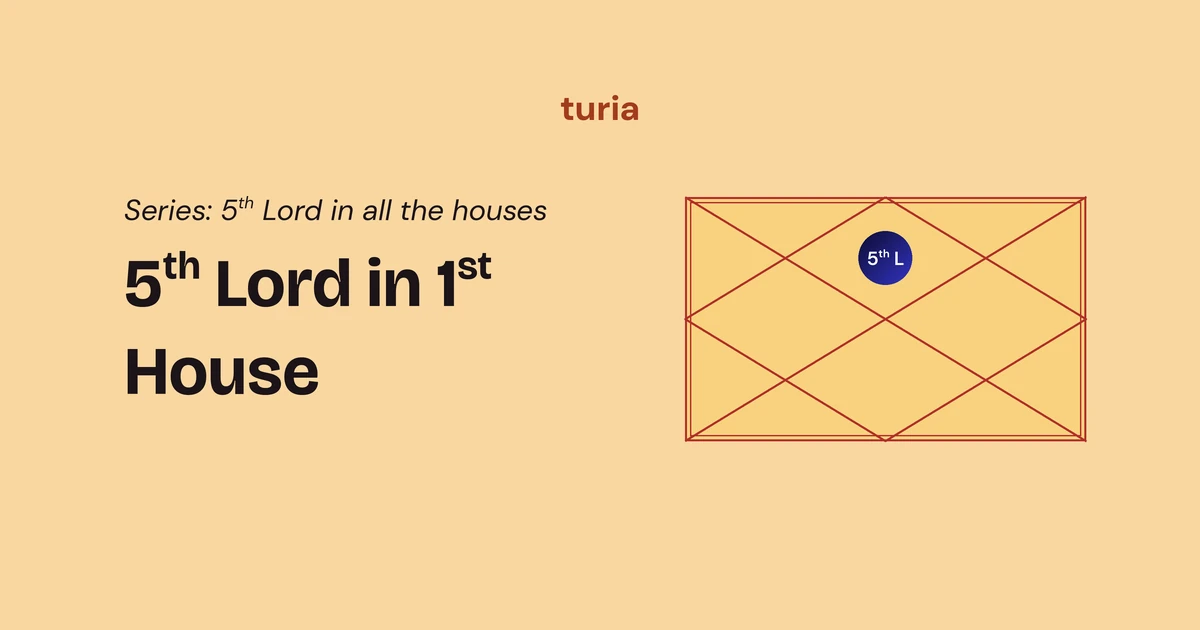
Introduction
You open your kundali and find the 5th lord sitting in the 1st house. The question that follows is rarely technical.
"Is this why people say I'm smart but a little too sure of myself? Why does everything I create feel like it's me?"
Fair question. This placement is one of the few where the 5th house stops being a department of life and becomes your whole face.
The 5th house is Putra Bhava — children, intelligence, creativity, romance, mantra and purva punya (the merit carried from earlier lives). The 1st house, Tanu Bhava, is body, temperament and how you walk into a room. When the 5th lord (Panchamesh) lands in the lagna, your talents, your love of learning and your instinct for romance stop being side projects. They become who you are.
In this guide we'll cover what BPHS actually says (including the harsh part most pages quietly skip), what it means for children, education and love, when it becomes a Maha Yoga, and how affliction changes the picture.
Quick answer
5th lord in the 1st house places your house of intelligence, creativity and children (Putra Bhava) inside your house of self (Tanu Bhava). BPHS says such a native "will be scholarly, be endowed with progenic happiness, be a miser, be crooked and will steal others' wealth" (Ch. 24, Sl. 49). Read honestly, that is a mixed result: real scholarship and happiness through children, with a sharp, self-protective streak in temperament. A Kona lord (trine) sitting in a Kendra (angle) is structurally strong, and if the lagna lord also sits in the 5th house, Phaladeepika calls it Maha Yoga #3.
What "5th Lord in the 1st House" Actually Means
Three terms first.
The 5th lord is the planet that rules the sign on your 5th house cusp. In a Taurus ascendant chart, for example, that planet is Mercury, since Virgo falls on the 5th.
The 1st house is the lagna, the anchor of the whole chart. Everything else is read relative to it.
And the 5th is a Kona, a trine, while the 1st is both a trine and an angle. BPHS Ch. 11 says it plainly:
"Putr and Dharm Bhava are known by the name Kon (or trine)." (BPHS, Ch. 11, Sl. 33-38)
Lagna is counted among both Kendras and Konas in classical practice, so a Kona lord sitting in the lagna is one of the cleaner structural placements available. Trine lords are the planets that carry fortune. When one of them sits on the ascendant, that fortune attaches to the native directly.
People mix this up constantly, so, to be clear: this is not the 1st lord in the 5th house. That is the reverse. There, your personality travels into creativity and children. Here, creativity and children travel into your personality. If both happen together (lagna lord in the 5th and 5th lord in the 1st), you have an exchange, covered below.
The Core Classical Result (BPHS Ch. 24, Sl. 49)
Here is the sloka in full:
"If Putr's Lord is in Lagn, the native will be scholarly, be endowed with progenic happiness, be a miser, be crooked and will steal others' wealth." (BPHS, Ch. 24, Sl. 49)
Two good things and three hard words. Let's not pretend the hard ones aren't there, and let's not read them like a courtroom verdict either.
The good: scholarly and progenic happiness. Intelligence is a headline trait. And the sloka promises happiness through children, which fits the general rule in Ch. 16 that children come easily when the Putra lord is well placed in a strong house.
The hard: miser, crooked, steals others' wealth. Classical language is blunt. The practical reading across charts tends to be much softer: a native who guards resources closely, who is strategic and sharply aware of advantage, and who can come across as calculating, particularly in money and credit. Think of the friend who always knows exactly who owes whom. Not a criminal. Just very, very observant about what is his.
That tension is the placement's signature: brilliant, a little guarded.
Intelligence, Education and Creativity
Because Putra Bhava governs buddhi (intellect), this placement tends to make the mind visible. The native is often the "smart one" in the family, quick at picking up theory and happy to show it.
In an Indian context, you see this in the student who is pushed toward a professional degree because "she is so sharp" and in the person who ends up as the family's default explainer for everything from tax forms to horoscopes. Creative work (writing, teaching, music, design, even strategy) tends to carry a personal stamp. People don't just consume the work. They recognise whose it is.
One honest caution. When intelligence sits in the lagna, it can slide into identity. If your self-worth rides on being the clever one, a failed exam or a rejected idea hits harder than it should. That is a chart pattern worth being aware of, not a flaw.
Children and Romance
The sloka promises progenic happiness, and Ch. 16 explains the conditions. BPHS says that if the lords of the lagna and the 5th are "in their own Rāśis, or in an angle, or in a trine, one will enjoy thorough happiness through his children" (Ch. 16, Sl. 1-3). Here the 5th lord is in an angle and a trine at the same time, which supports the result.
Two cautions from the same chapter keep it honest. The 5th lord combust, or sitting with malefics while weak, weakens the promise. And placement of the 5th lord in the 6th, 8th or 12th would raise concerns, but that is not the case here, because the 1st house is not a dusthana.
On romance: since Putra Bhava is also the house of love affairs, this placement often shows up as someone who falls in love openly and expects love to be a visible, central part of life. For the relationship-anxious reader, the useful insight is that you tend to bring your whole self into romance, which can feel like all-in or nothing.
If you want to see how this plays against your actual chart rather than a generic reading, you can run your AI Kundali and look at where your 5th lord sits and in what sign.
The Maha Yoga Question: When It's a Full Exchange
This is the point most placement pages skip.
When two house lords sit in each other's houses, it is a Parivartana Yoga. Phaladeepika sorts the 66 possible exchanges into three groups: 30 Dainya, 8 Kahala, and 28 Maha Yogas. The relevant line from the Maha Yoga list:
"(3) the Lord of the Lagna in the 5th and the lord of the 5th in Lagna." (Phaladeepika, Yoga Adhyaya, Maha Yoga list)
So if your 5th lord is in the 1st house and your lagna lord is in the 5th house, that is Maha Yoga #3. It is a fortunate combination, tying self and creativity together in both directions.
Most people reading this will not have the reciprocal placement. For them, the BPHS Ch. 24, Sl. 49 result stands on its own. It is still a structurally strong placement.
Strength: What Changes the Outcome
The house tells you where. The planet's condition tells you how well it works.
Exalted or own-sign 5th lord in the 1st is the strongest version. The scholarship and children's happiness come forward, and the miserly streak softens into plain carefulness.
Debilitated 5th lord in the 1st needs a check for Neecha Bhanga (cancellation of debilitation) first. Without it, expect self-doubt about talent or delays around children and education.
Combust 5th lord (too close to the Sun) dims the result until the planet's dasha activates it.
Aspected by Jupiter, the natural significator of children, supports the placement. Ch. 16 specifically says children come when the 5th lord is "yuti with, or drishtied by Guru" (Ch. 16, Sl. 16).
Conjunct Saturn, Mars or Rahu brings out the harder side of the sloka: secrecy, rigidity, an over-competitive mind. Not doom. Just the calculating streak getting louder.
Never judge from the house alone. Look at the sign, dignity, aspects and the dasha that activates it.
5th Lord in the 1st House vs Other Placements
| Placement | Core theme | How it differs from the 1st house |
|---|---|---|
| 5th lord in 1st house | Intelligence and creativity fused into personality | The comparison point here |
| 5th lord in 2nd house | Talent converted into wealth, family and fame (BPHS Sl. 50) | Intelligence expressed through money and speech, not the self |
| 5th lord in 4th house | Intelligence feeding home, mother and status (Sl. 52) | Inner life and roots rather than personality |
| 5th lord in 5th house | Own-house strength, results depend on association (Sl. 53) | Self-contained, not filtered through identity |
FAQ
What does 5th lord in 1st house mean?
Your house of intelligence, creativity and children sits inside your house of self. BPHS says the native is scholarly and has happiness through children, with a guarded, calculating streak in temperament.
Is 5th lord in 1st house good?
Mostly yes. It is a trine lord in an angle, which is structurally strong, and BPHS credits scholarship and progenic happiness. The harsher words in the sloka are best read as miserliness and sharpness, not criminality.
Will I have children with 5th lord in the 1st house?
The placement supports children. BPHS Ch. 16 says happiness through children comes when the lagna and 5th lords are in angles or trines. Combustion, weakness or malefic company can delay or dilute it, so check the full chart.
Is 5th lord in 1st house the same as 1st lord in 5th house?
No. They are reverse placements. Here, intelligence and creativity shape your personality. In the reverse, your personality is poured into creativity, romance and children.
Is 5th lord in 1st house a Maha Yoga?
Only as a full exchange: 5th lord in the 1st and lagna lord in the 5th together. Phaladeepika lists this as Maha Yoga #3. Without the reciprocal placement, you have the standalone BPHS result.
What if the 5th lord is afflicted in the 1st house?
Expect self-doubt tied to intelligence, a secretive or over-competitive temperament, and possible delays around children or education. Jupiter's aspect and a strong dasha lord help.
Closing
So, is 5th lord in the 1st house a good placement? Yes, with a footnote. You get scholarship, creativity and a real shot at happiness through children. The footnote is the guarded streak BPHS names so bluntly.
Know that streak, and you get to use it as discernment instead of suspicion.
Check your own kundali for this one. The guarded streak is easier to spot in yourself than in a sloka.