Most people who explore Jyotish for the first time focus on two things: their lagna and their Moon sign.
And that’s reasonable. Those two are the most important starting points.
But there’s a third planet that quietly shapes every conversation you have, every exam you sit, every business decision you make - and most people never look at it carefully.
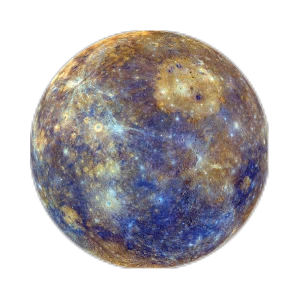
That’s Mercury. Budh Grah.
And this is where things get interesting: Budh is the only planet in classical Jyotish described as a pure chameleon. It has no fixed allegiance. Associate it with benefics - it becomes a benefic. Associate it with malefics - it turns malefic. The prince of the planetary cabinet, still learning, still adapting. Whoever it sits with in your kundali, that’s the flavour of your Mercury.
In this guide, we’ll cover what Budh actually signifies in classical Jyotish, how it behaves in all 12 houses, the three nakshatras it rules, what a Budh Mahadasha of 17 years actually delivers, and how to assess whether your Mercury is working for you or not.
In Vedic astrology, Mercury (Budh Grah) is the vaani karak - the significator of speech. It represents intellect, communication, logic, trade, and the ability to process and express thought. Budh rules Gemini (Mithuna) and Virgo (Kanya), is exalted at 15° Virgo, and is debilitated at 15° Pisces (Meena). Its Vimshottari Mahadasha lasts 17 years. Budh is naturally a benefic but turns malefic when associated with malefic planets - the most functionally context-dependent planet in the entire Navagraha.
What Is Budh? Core Significations in Jyotish
"Sūrya is the soul of all. Chandra is the mind. Mangal is one’s strength. Budh is speech-giver, while Guru confers Knowledge and happiness.
- BPHS · Ch. 3, Slokas 12–13
Sun is the soul. Moon is the mind. Mercury is the bridge between them - the translator that turns private thought into public expression.
In the planetary cabinet, Parashara gives Budh the rank of Prince. Not King. The curious, adaptable young heir - not yet fully formed, still picking up the traits of whoever he associates with. This is exactly why Mercury’s expression in a chart depends so heavily on the planets sitting next to it.
Parashara’s physical description of Budh is precise and revealing: “Budh is endowed with an attractive physique and the capacity to use words with many meanings. He is fond of jokes. He has a mix of all the three humours.” (BPHS, Ch. 3, Sloka 26)
“Words with many meanings” - that’s the essential Budh trait. Not just the ability to speak, but the ability to layer meaning, shift register, be precise when precision is needed and oblique when that serves better. The pundit, the trader, the lawyer, the stand-up comic - all Mercury types.
“Of royal status are Sūrya and Chandra, while Mangal is the Army chief. Prince-apparent is Budh. The ministerial Grahas are Guru and Śukr. Śani is a servant.
— BPHS · Ch. 3, Slokas 14–15
| Signification | Detail |
|---|---|
| Vāṇī (speech) | Communication, rhetoric, the capacity to use words with many meanings |
| Buddhi (intellect) | Discriminating intellect, analytical reasoning, mathematics |
| Trade & commerce | Business acumen, writing, accounting, negotiation |
| Skin (tvak) | Among the Sapta Dhatus, Budh rules skin (BPHS Ch. 3, Sloka 31) |
| Nervous system | Nerves, anxiety, mental processing speed |
| Day & nature | Wednesday (Budhavar); Rajasik; neutral gender; strong day and night |
| Gemstone | Emerald (panna) |
Budh’s Strength - Exaltation, Own Signs & Debilitation
The chameleon rule - the most important thing to know about Budh: “Budh, however, is a malefic, if he joins a malefic.” (BPHS, Ch. 3, Sloka 11). A Mercury conjunct Jupiter → sharp, ethical, eloquent. A Mercury conjunct Rahu → sharp, clever, sometimes deceptive. A Mercury conjunct Saturn → methodical, slow to speak, precise when it does. The planet itself has no fixed agenda - it amplifies the agenda of its associates.
Also worth noting: “Budh is strong during day and night” (BPHS, Ch. 3, Slokas 35–38). Unlike most planets that gain or lose strength by time of day, Mercury maintains power in both day and night charts.
Mercury at its most analytical and precise. Interesting that Mercury is exalted in the sign it also rules - Virgo is where Mercury’s earthy precision and analytical depth find their perfect expression.
In Virgo, Parashara breaks Mercury into three zones: exaltation (0°–15°), Mooltrikon (15°–20°), and own sign (20°–30°). Gemini is Mercury’s air sign - faster, more versatile, socially oriented.
In Pisces - the sign of dreams, spirituality, and diffuse emotion - Mercury’s precision dissolves. Not necessarily a disaster (many imaginative writers have Mercury in Pisces), but the channel of clear expression gets murky.
Mercury in the 12 Houses - Key Effects
Mercury brings analytical energy, communicative skill, and intellectual sharpness to whatever house it occupies.
Mercury in the 3rd house and 10th house are two of its most effective placements for career outcomes. The 3rd is the natural house of communication and skill - Mercury here flows freely. The 10th is the house of career - Mercury here turns intellectual work into public recognition.
Mercury’s Nakshatras - Ashlesha, Jyeshtha & Revati
Budh rules three of the 27 nakshatras (lunar mansions):
If your Moon or lagna falls in Ashlesha, Jyeshtha, or Revati, Budh is your nakshatra lord. Mercury’s themes - intellect, communication, trade, skin - colour your mental default directly.
The serpent nakshatra, presided by Sarpas (serpent deities). Mercury’s intelligence here becomes penetrating and observational - these people read rooms and read between lines. Not loud communicators, but precise ones.
Means “eldest” or “the senior.” Authority through communication. Jyeshtha-Mercury natives speak with command - natural spokespersons, decision-makers, or the one person in the room everyone defers to when a clear answer is needed.
The shepherd nakshatra, symbolizing safe passage and compassion. Revati is where Mercury lands in Pisces - its debilitation sign. The intellect here becomes empathetic and poetic rather than logical and precise. Beautiful communicators who may struggle with clear-cut analysis.
Strong Mercury vs. Weak Mercury - How to Read Yours
Honestly - a weak Mercury that associates with Saturn often produces slow, methodical, deeply careful communicators who get underestimated until they speak. The blockage is real, but so is the eventual precision.
Strong Mercury
- Ease with language and numbers
- Quick learning; clear communication under pressure
- Natural talent for trade or negotiation
- Can explain complex things simply - without notes
Weak Mercury
- Overthinking without resolution
- Hesitation in speech; difficulty retaining studied material
- Skin issues; anxiety that scatters across too many worries
- Not a lack of intelligence - a blocked channel for expressing it
Budh Mahādaśā - What 17 Years With Mercury Looks Like
In the Vimshottari system, Budh rules a 17-year Mahadasha - the longest of the personal planets. BPHS describes the arc: gains of wealth and educational betterment at the start, government recognition in the middle, and distress in the final years.
When Budh is exalted or in its own sign: gain of jewels, learning, success in the educational sphere, acquisition of name and fame. When afflicted: punishment by government, inimical relations with kinsmen, journey to a foreign country, and urinary troubles.
In practical Indian life, the fields that typically flourish during a strong Budh Mahadasha: IT, content, education, accounting, banking, media, writing, and any form of trade that requires mental agility. This period often marks when a person “finds their professional voice.”
The 17 years are enough to build something real. The danger is mental overload - Budh governs the nerves, and a well-placed Mercury that drives hard through all 17 years often ends with anxiety, burnout, or the need for significant rest before the next Dasha begins.
"Gain of jewels, like pearls etc., learning, increase in happiness and performance of pious deeds, success in the educational sphere, acquisition of name and fame."
- BPHS · Antardasha of Budh in Budh Mahadasha
Remedies for a Weak Budh (Budh Upay)
These come from classical tradition.
Budh’s day. The most accessible remedy for most people.
Om Bram Breem Broum Sah Budhaya Namah - 108 times on Wednesday mornings, ideally during Budh Hora.
BPHS specifically recommends this for Budh Mahadasha afflictions: “Remedial measure to obtain relief from the above evil effects, is recitation of Vishnu Sahasranam.”
Moong dal, green bangles, green cloth, green vegetables. Budh’s colour is green; the donation is directed toward Budh’s energy.
On the little finger of the right hand - but only after a full chart consultation. Emerald amplifies Mercurial energy; for some ascendants this can backfire.
Budh strengthens through the faculties it governs. A weak Mercury that commits to daily reading, careful writing, or mathematical practice often improves over time in ways that remedies alone don’t achieve.
When someone asks “Is my Mercury good?” - the honest answer is: check the sign, the house, the associations, and the running dasha. A Mercury in Pisces in the 10th with Jupiter’s aspect reads very differently from a Mercury in Pisces in the 12th conjunct Rahu and Saturn.
Budh is not your vocabulary score. It is the quality of your mental processing, the way your intelligence reaches the world - through your words, your decisions, your negotiations, and your capacity to learn and adapt. Understanding your Mercury placement is understanding one of the most practical levers in your entire kundali.