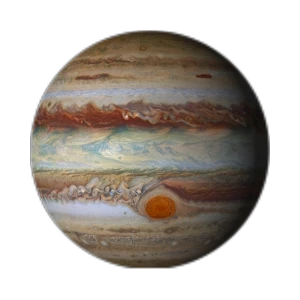
Most people discover that Jupiter is the “most benefic planet” and immediately want to know where their Jupiter sits. If it’s in Cancer, they relax. If it’s in Capricorn or the 8th house, the worry starts.
And then there’s the question every woman with a chart gets at some point: “Where is your Jupiter? That shows your husband.”
The popular version of Jupiter is simple - lucky planet, teacher energy, wisdom and abundance. The classical Jyotish version is considerably more layered. A well-placed Guru opens doors that look sealed. A poorly placed one doesn’t make you unlucky exactly, but it does make you work much harder for the things Jupiter is supposed to hand you.
In this guide, we’ll cover what Guru actually represents in Jyotish - its classical significations, how to read its strength, its effects in all 12 houses, its nakshatras, its Mahadasha, and remedies from the classical tradition.
In Vedic astrology, Jupiter (Guru or Brihaspati) is the natural significator of knowledge, children, and wealth - a natural benefic (Shubha Graha) classified as the “preceptor of the Gods” in classical texts. It rules Sagittarius (Dhanu) and Pisces (Meena), is exalted in Cancer (Karka) at 5°, and debilitated in Capricorn (Makara) at 5°. Its Vimshottari Mahadasha lasts 16 years. In a female chart, Jupiter is the primary significator of the husband.
What Is Guru? Core Significations in Jyotish
"Sūrya is the soul of all. Chandra is the mind. Mangal is one’s strength. Budh is speech-giver, while Guru confers Knowledge and happiness.
- BPHS · Ch. 3, Slokas 12–13
The Sun is the soul. The Moon is the mind. And Jupiter - specifically - is the planet of knowledge and happiness. Not fame, not authority, not money directly. Knowledge and happiness. The rest follows from that.
In the planetary cabinet, Guru holds the role of minister (Mantri). The Sun is the king. Mars is the army chief. Guru is the wise counselor - the one who advises, guides, and shapes dharma from the second row. It doesn’t assert itself the way Mars or the Sun does. It works through influence, guidance, and alignment with principle.
Phaladeepika gives Jupiter’s full karakatwas (significations): knowledge, noble qualities, sons, minister, good behavior, teaching, magnanimity, knowledge of the shrutis and shastras, progress in every direction. In a female chart, Jupiter becomes the Pati Karaka - the significator of the husband. In a male chart, it is the Santan Karaka - the significator of children.
Physically, BPHS describes Jupiter as: “having a big body, tawny hair and tawny eyes, phlegmatic, intelligent and learned in Shastras” (Ch. 3, Sloka 27). Jupiter rules Thursday (Guruvaar), the direction Northeast, Yellow Sapphire (Pukhraj) as its gemstone, gold as its metal, and peepal trees and temples as its places.
“The ministerial Grahas are Guru and Śukr.
— BPHS · Ch. 3, Slokas 14–15
| Signification | Detail |
|---|---|
| Knowledge (jnana) | Wisdom, higher learning, shastras, teaching, philosophical depth |
| Children (putra) | Sons and progeny in a male chart; quality of that relationship |
| Husband (pati) | In a female chart, Jupiter is the primary significator of the husband |
| Dharma & ethics | Moral alignment, righteousness, spiritual grace |
| Wealth (dhana) | Expansion of resources, generosity, abundance |
| Body (medas) | Fat tissue among the Sapta Dhatus; Kapha constitution |
| Day & gemstone | Thursday (Guruvaar); Yellow Sapphire (Pukhraj) in gold |
Jupiter’s Strength - Exaltation, Own Sign & Debilitation
"Mercury and Jupiter get directional strength when they are in the 1st house.
- Phaladeepika · Ch. 4, Verse 2
"The aspects of Jupiter on the 5th and 9th houses from him are treated as full aspects.
- Phaladeepika
Digbala (directional strength): Jupiter gains peak directional strength in the 1st house (Lagna). A Jupiter in Lagna, regardless of sign, has additional horsepower.
Special aspects: Jupiter casts full aspects (Drishti) on the 5th and 9th houses from its position, in addition to the standard 7th house aspect. A Jupiter in the 1st house is simultaneously blessing the 5th (children), 7th (spouse), and 9th (fortune). That’s why the placement of Guru is disproportionately significant in a kundali.
Hamsa Yoga - one of the five Pancha Mahapurusha Yogas: when Jupiter occupies its own sign or exaltation in a Kendra (1st, 4th, 7th, or 10th house). It gives clarity of dharma, natural authority, and a life shaped by principle.
Jupiter at its maximum expression. Cancer is ruled by the Moon - wisdom becomes nurturing, expansive, and emotionally grounded. Jupiter and the Moon are natural allies in Jyotish.
Sagittarius is the fire sign of dharma, philosophy, and higher truth. Pisces is the water sign of dissolution, compassion, and spirituality. Both are strong placements - Jupiter’s philosophical and devotional sides.
Saturn-ruled, practical, skeptical Capricorn compresses Jupiter’s expansion. Wisdom becomes calculating. Generosity becomes conditional. But house placement and aspects modify the debilitation substantially.
Jupiter in the 12 Houses - Key Effects
These are from Phaladeepika. Jupiter brings wisdom, expansion, and grace to whatever house it occupies - but its special 5th and 9th aspects mean it always influences three houses simultaneously.
Two placements deserve a longer note. The 5th house surprises people - Jupiter is the natural Santan Karaka yet Phaladeepika says its placement in the 5th brings “distress from children.” A planet in the house it signifies often scorches it. The 9th house is Jupiter’s most naturally harmonious placement - the planet of dharma in the house of dharma.
Jupiter’s Nakshatras - Punarvasu, Vishakha & Purva Bhadrapada
Jupiter rules three of the 27 nakshatras (lunar mansions):
If your Moon falls in any of these three nakshatras, Jupiter is your Janma Nakshatra Lord - its placement in your chart colours your emotional baseline and mental processing directly.
Ruled by Aditi, the goddess of infinite abundance. Literally means “return to goodness.” Themes of renewal, restoration, coming home after difficulty, and philosophical optimism. People with Moon in Punarvasu have a natural ability to bounce back.
Ruled by Indra and Agni together. A nakshatra of ambition and determination. The image is of a forked branch - two paths, one goal. Jupiter’s governance gives it moral drive and expansive ambition, while the Indra-Agni rulership makes it fiery and competitive.
Ruled by Aja Ekapada, the one-footed goat who stands firm. Intense, philosophical, sometimes visionary. Known for depth of transformation and spiritual seeking.
Strong Jupiter vs. Weak Jupiter - How to Read Yours
Honestly - Jupiter’s condition in a kundali is one of the best single indicators of how gracefully a person moves through life’s larger cycles. The Sun shows soul clarity. The Moon shows inner peace. Jupiter shows whether the world opens up for you or makes you work for every door.
Strong Jupiter
- Natural optimism grounded in principle
- Ease in education and advanced study
- Respected mentor figures in life
- In a woman’s chart - a supportive, ethical husband
Weak Jupiter
- Difficulty in formal education despite effort
- Children-related worry or delay
- Confusion around dharma or life purpose
- In a woman’s chart - delay in marriage or disappointing spouse
Guru Mahādaśā - What 16 Years With Jupiter Looks Like
In the Vimshottari system, Guru rules a 16-year Mahadasha - the second longest after Venus. When Jupiter is well-placed: career peak, marriage, children, recognition by authority, spiritual deepening, and material expansion - sometimes all within the same 16-year window.
When Jupiter is debilitated, combust, or in the 6th or 8th house: loss of residential premises, anxiety, distress to children. But BPHS notes something important - even an afflicted Jupiter Mahadasha tends to improve in its later years, because Jupiter’s natural trajectory is upward.
Best use of Guru Mahadasha: higher education, advanced study, building a teaching or advisory role, travel for learning, and - if there are unresolved tensions around one’s guru or teacher - addressing those directly. It rewards those who are humble enough to keep learning.
"Acquisition of kingdom, great felicity, recognition by Government, acquisition of conveyances and clothes, devotion to deities and Brahmins, happiness in respect of his wife and children."
- BPHS · Dasha chapter, Slokas 45–48
Remedies for a Weak Jupiter (Guru Upay)
These come from classical and traditional practice.
Abstain from food until evening, or eat only once in the afternoon. Thursday is Jupiter’s day. One of the most widely practised Jupiter remedies.
Om Graam Greem Groum Sah Guruve Namah - 108 times, ideally on Thursday mornings. Or the simpler Om Guruve Namah.
Chickpeas (chana dal), turmeric (haldi), yellow cloth, bananas, and sweets made with chickpea flour. Offered to a teacher or a temple.
The peepal tree (Ficus religiosa) is Jupiter’s tree. Water it with a copper vessel on Thursdays and light a ghee lamp beneath it.
Guru is the Devaguru, preceptor of the gods. Unresolved conflict with one’s teacher, guru, or father-figure directly weakens Jupiter. Making amends is the most overlooked classical remedy.
On the index finger of the right hand, ideally on a Thursday morning during Jupiter Hora. A natural, untreated stone of at least 3 carats - but only after chart-specific consultation.
When someone asks “is my Jupiter good or bad?” - the honest answer, as always, is: it depends on the sign, the house, the aspects, and the Mahadasha running at the time. A Jupiter in Cancer in the 1st house with Hamsa Yoga is very different from a Jupiter in Capricorn in the 6th, conjunct Ketu.
What’s consistent: Jupiter is the planet that carries dharma forward. It shows where in life grace is available - not as luck, but as alignment with what is genuinely right. Understanding your Guru clearly is how you start working with that grace rather than missing it.