Recently I came across a couple of reels. One claimed Claude can generate your Kundali. Another said ChatGPT can forecast your future.
I was genuinely confused. So I tried it - the viral prompt, exactly as the AI Instagram influencers shared it.
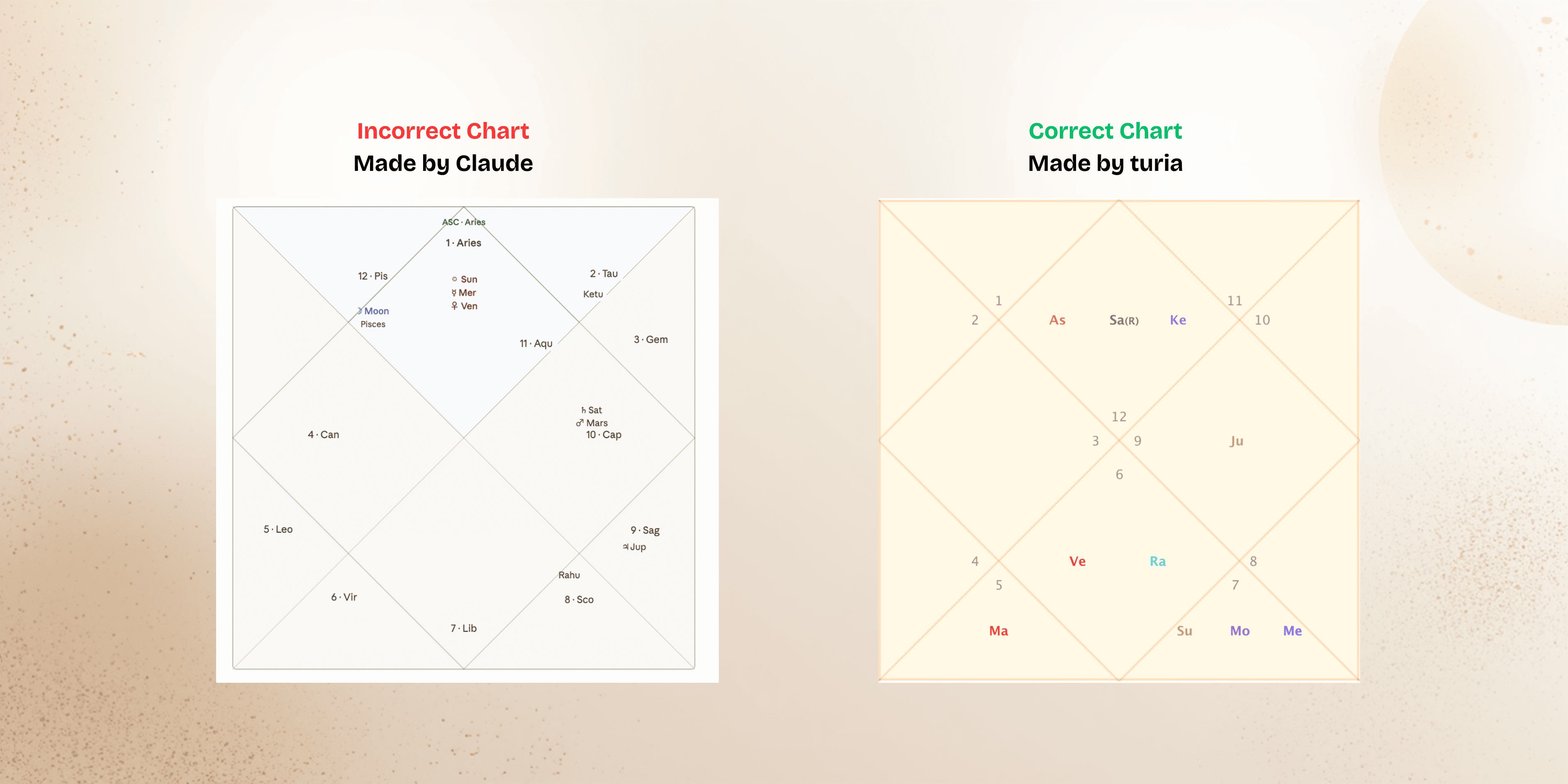
The chart came out wrong.
I could catch it because I know both astrology and AI. But ChatGPT astrology is everywhere now, and most people using it have neither background. They’d trust that chart. Make real decisions - about marriage, about career, about moving cities - based on a chart that was wrong from the start.
Over 1 in 3 people now use AI for mental health support, and this peaks at 64% for people aged 25–34. In India, astrology is mental health support for a lot of people. It’s how we process our patterns, understand our strengths and weaknesses, make sense of why certain things keep going wrong.
Which is exactly why careless ChatGPT astrology is a real problem. It makes mistakes confidently. And you’d never know unless you already understood what you were looking at.
I’m a certified Vedic astrologer. My team built an AI astrologer. Based on hundreds - probably thousands - of conversations testing ChatGPT for astrology, here’s an honest breakdown of what it gets right, where it breaks down, and what to use when you need real answers.
What ChatGPT Actually Gets Right
ChatGPT is a genuinely good storyteller.
Ask it what Moon in the 8th house means and it’ll give you a thoughtful, emotionally resonant answer. It knows your context - your chart details, your life situation, the threads of what you’ve shared before. It connects them in ways that feel personally accurate.
Pattern recognition is where ChatGPT, Claude, and Gemini all genuinely shine. Every persistent challenge traces back to something in the chart. Saturn and Ketu conjunct in the 1st house? You’re probably highly self-critical and deeply allergic to working for anyone else. Moon in the 8th? Your emotional life has likely been harder than most people around you would guess. Going through a Ketu dasha? Don’t expect your relationships to feel grounded right now. These models map life events to planetary positions with surprising depth - and they do it for free, at any hour.
They’re also emotionally empathetic in a way traditional astrologers rarely are. No judgment. No time pressure. No fear-based pronouncements. ChatGPT is always available, always patient, and free to start. For someone coming to astrology for the first time - or someone in the middle of a difficult period looking for perspective - that accessibility matters.
The problem starts the moment you move from understanding your patterns to asking for predictions about real events.
Where ChatGPT Breaks Down for Vedic Astrology
Your kundali is a fingerprint
Think of Jyotish like Google Maps. It’s only useful if your starting location is accurate. If the chart is wrong - wrong house degrees, wrong ayanamsha, a sign off by a few minutes of arc - every analysis built on it is built on a broken foundation.
A kundali isn’t just which planet is in which house. There are degrees. Each degree change shifts the actual nature and intensity of a placement. For any real Vedic reading, the chart has to be precise.
ChatGPT cannot generate your kundali. Neither can Claude. They are general large language models. Generating a kundali requires complex astronomical computation - exactly what LLMs were not designed to do.
You can push the high-reasoning models - ChatGPT 5.5 Reasoning, Claude Opus 4 - to write a program that calculates a chart and then run it. These models can produce working code. But LLMs are non-deterministic. The output may still carry errors. And unless you already understand astrology well enough to check it, you have no way to catch them.
Don’t use any LLM to generate your chart. Use a dedicated platform, take a screenshot of your dashboard, and share that with the AI instead.
LLMs hallucinate. Intelligently.
The more dangerous problem isn’t bad chart generation - it’s confident wrong answers midway through a long conversation.
LLMs are trained to produce fluent, coherent text. They’re trained to sound accurate. After enough exchange in a long thread, they start filling gaps with invented details. Planetary positions that don’t exist in your chart. Yoga combinations that were never there. An exaltation that isn’t.
Research on long-context AI performance consistently shows accuracy drops significantly as conversations lengthen - particularly when critical details are buried in the middle of a long prompt. A full kundali reading spanning birth chart, navamsa, and multiple dasha levels is exactly the kind of context-heavy task where this breaks down badly.
The model is too fluent for the errors to feel like errors. You’d never catch it unless you already understood what you were looking at.
Dasha and timing analysis falls apart
This is the most important thing astrology does - and the thing ChatGPT does worst.
For any timing-related prediction, an astrologer needs to evaluate whether a dasha will give good or difficult results, which area of life gets activated, and how Mahadasha, Antardasha, and Pratyantar dasha interact. That’s at minimum three layers of simultaneous analysis. Add transits and you’re at four or five.
LLMs routinely skip to just one layer. Developers and researchers call it the “lazy learner” phenomenon - models take shortcuts to conserve output tokens. What looks like a layered prediction is often a surface-level pass dressed in the language of depth.
Transit analysis is even worse on non-reasoning models. The model is likely guessing timing or hallucinating transit dates outright.
Asking ChatGPT when you’ll get married, whether a career shift is right for your chart, or whether you’ll settle abroad - it’s a bad idea. Not because it doesn’t try. Because you won’t know how much of what it tells you was invented.
Is ChatGPT Astrology Accurate?
For predictions about real life events - no.
The problems compound each other. The chart it works from may be wrong to begin with. It hallucinates once the conversation grows complex. And even when it doesn’t hallucinate, it performs only surface-level analysis - one layer where five or six are needed.
Take the most common question in astrology: when will I get married? A trained astrologer considers the 7th house, its lord, the lord’s nakshatra, Venus placement, the navamsa, karaka planets, the running dasha and sub-dasha, and transits over marital significators - all simultaneously. ChatGPT looks at one or two of those and frames it as a reading.
What you get looks like astrology. The terminology is right. The sentences sound confident. The reasoning isn’t there.
ChatGPT for Astrology: What It’s Actually Good For
Two things. Both genuinely valuable.
Learning astrology concepts
I posted a question about this in a Reddit astrology community recently. The top response from practicing astrologers: ChatGPT is excellent for learning. It explains planetary archetypes clearly, helps you question assumptions, and breaks down classical principles in plain language. If you want to understand what a karaka does, how a navamsa chart works conceptually, or what the difference between Parashari and Jaimini methodology is - it’s an outstanding teacher. It aids the learning process in a way most textbooks don’t.
Understanding your own patterns
If you have an accurate chart and share it with ChatGPT, it will map your life patterns to planetary positions with real depth. You start to understand why certain relationship dynamics repeat. Why certain work environments feel suffocating. Why you self-sabotage at specific moments. For that kind of self-understanding - without prediction - it’s worth using freely.
What it’s not for: timing. Predictions about events. Anything that requires multi-chart, multi-dasha, multi-transit analysis. For that, use something built specifically for the job.
ChatGPT Astrology vs a Purpose-Built AI Astrologer
ChatGPT is a general model doing astrology on the side. Turia was built specifically for this.
The foundation is accurate. Parashari system. Lahiri ayanamsha. Our charts are cross-checkable against any standard kundali tool - because we know that if the chart is wrong, everything downstream is wrong.
The methodology is classical, built under the guidance of practicing astrologers - including Shri Anil Kumar Jain, faculty at the All India Federation of Astrologers’ Societies and author of 8 books on Vedic astrology. Not crowd-sourced astrology knowledge scraped from the internet.
And we don’t do fear-based readings. No mangal dosha panic. No sade sati dread. You get honest guidance focused on what you can actually do - not a list of things to be afraid of.
If you want to understand exactly how a purpose-built AI astrologer works differently from a general LLM, I’ve written a full breakdown here.
ChatGPT astrology is a solid starting point. For real answers, use something built for the job.
FAQ
Q1: Is ChatGPT good for astrology?
Depends entirely on what you’re using it for. For learning concepts and understanding your own chart patterns - yes, genuinely useful. For a real personalised reading based on your birth chart - no. It has no chart calculation engine and no Vedic-specific methodology.
Q2: Can ChatGPT read my birth chart?
No. ChatGPT cannot calculate a birth chart. It works only from information you manually provide and has no way to verify accuracy. A real Vedic reading requires a precisely calculated chart as its foundation - without that, the reading is built on guesswork.
Q3: Does ChatGPT use Vedic astrology or Western astrology?
Western tropical by default. You can prompt it to use Vedic framing, but it still cannot calculate a sidereal chart. The zodiac difference - roughly 23 degrees - means your planetary positions may be significantly off, which changes most of the analysis.
Q4: What is the difference between ChatGPT astrology and an AI astrologer?
ChatGPT has no chart engine, no dasha calculator, no Vedic-specific methodology. A purpose-built AI astrologer starts with an accurate chart calculation and applies a specific classical system. Completely different foundation.
Q5: Is ChatGPT astrology accurate?
For general concepts - reasonably accurate. For specific chart predictions - no. It hallucinates planetary positions confidently, cannot calculate dashas, and uses the wrong zodiac by default.