Introduction
This article covers everything about the importance of malefic planets and how you can use their energies for your growth. Since the article is in details, you can also watch the video for a quick overview
Before starting, a short story 🙂
What Doesn’t Kill You Makes You Stronger
I joined my first company right after college.
Until then, life was simple - the world quietly revolved around me.
If I didn’t feel like going to class, I stayed home.
If I wanted a spontaneous trip, I went.
The world felt light, playful, mine.
Then I started working.
My boss was strict, the deadlines stricter.
Suddenly, I had to show up — every day, nine hours straight.
I had to meet expectations, prove value, deliver results.
And when I didn’t, I heard it. Loud and clear.
The world didn’t revolve around me anymore — it revolved around responsibility.
I hated that phase.
I’d leave home at 8 a.m., return at 9 p.m., and tell myself almost daily, “I want to quit.”
But I didn’t. I kept showing up.
A year later, when I switched companies, something shifted.
Without realizing it, I was taking on more, solving harder problems, moving faster than people around me.
Somewhere in the grind, something had changed — me.
Those tough early days had rewired me.
They had quietly built endurance, discipline, and self-respect.
What once felt punishing had turned into power.
That’s the thing about hard times — they rarely feel like growth while you’re in them.
But when you look back, you realize they were training you for everything that came next.
Realized later in life - my Shani Mahadasha had just started. :)
The Shiva Trimurti: Creation, Sustenance, and Destruction
If you’ve ever changed careers, ended a relationship, or simply outgrown a version of yourself, you already know the feeling.
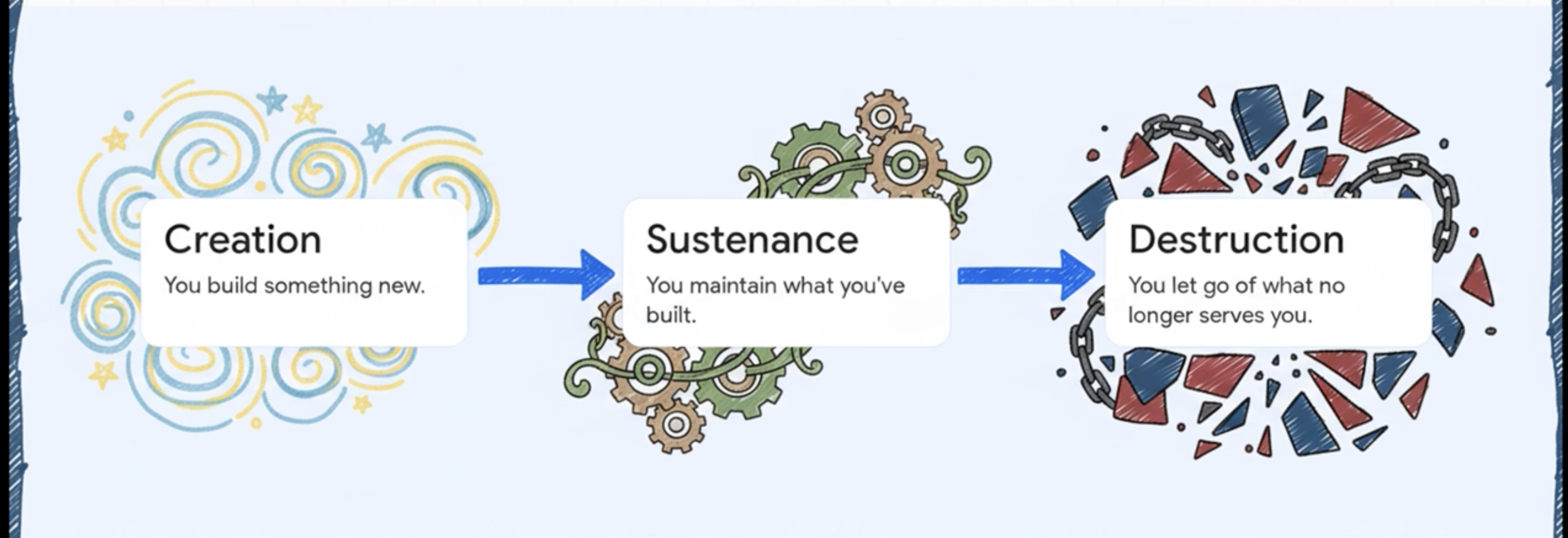
It’s the same rhythm that runs through the Shiva Trimurti — Creation. Sustenance. Destruction.
In simple terms: you build something, you maintain it, and when it stops serving you, you let it fall away so something better can take its place.
That last part — destruction — is what most of us resist. Because it’s painful. It’s inconvenient. It asks us to face endings when all we want is comfort.
Think about it:
- Staying in a job you’ve outgrown, just for stability.
- Holding onto a relationship that’s lost its spark, just to avoid being alone.
- Scrolling endlessly instead of sitting with what hurts.
We all delay endings, even when we know they’re overdue.
Astrology mirrors this exact cycle.
We need benefic forces to help us create and sustain — and we need malefic forces to help us prune, pressure, and purify what no longer fits. Without that pruning, there’s no space for the next version of you to emerge.
This article demystifies malefic planets in vedic astrology - what they truly are, why they’re feared, and how they actually fuel your evolution.
We’ll also explore the practical side: how to balance malefic energy, and how to find which of these teachers are most active in your chart right now.
Benefic vs. Malefic Planets in Astrology: The Real Difference
Before we go deeper, let’s get the basics straight.
Natural benefics are planets traditionally seen as supportive - Jupiter and Venus (and the waxing Moon and Mercury when well placed). They bring nourishment, opportunity, and a sense of ease. These are the planets that help you build, grow, and sustain what’s already working.
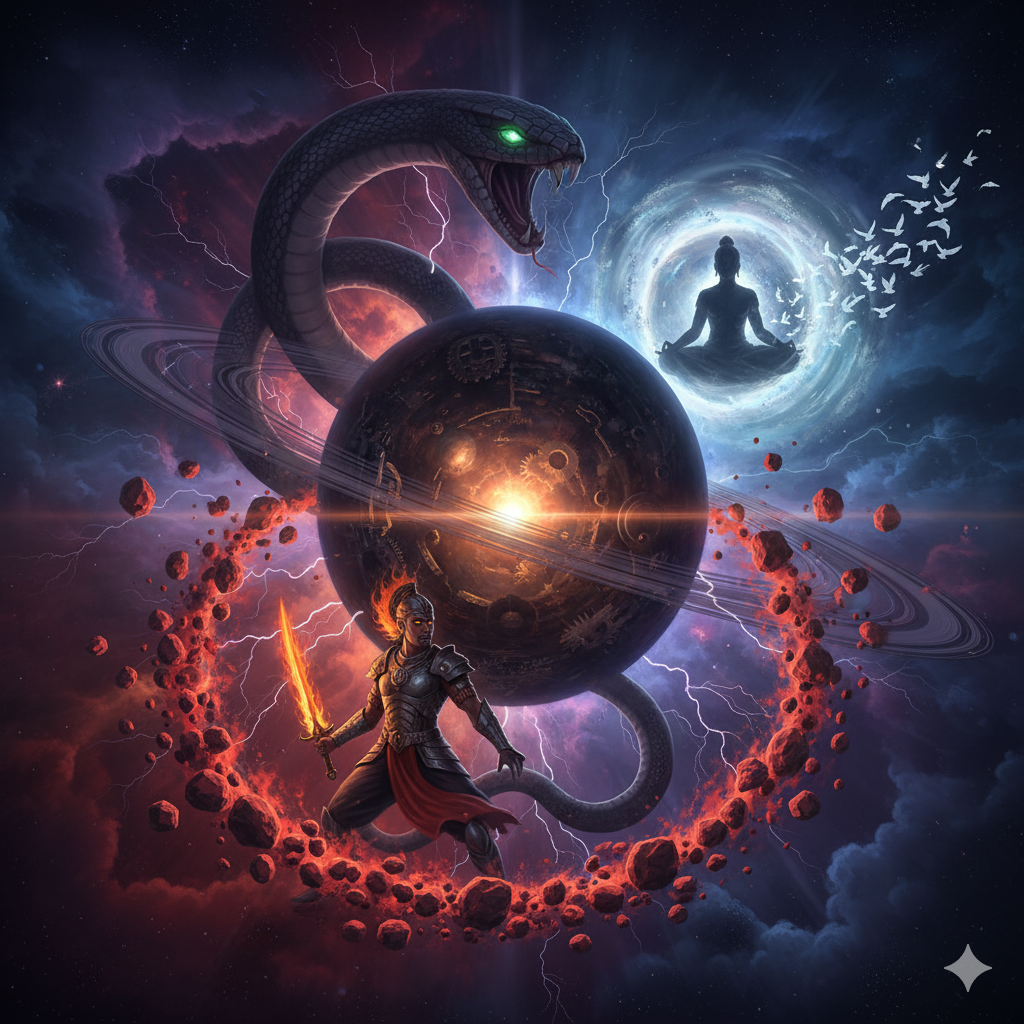
Natural malefics are the tougher ones - Saturn, Mars, Rahu, and Ketu (and the waning Moon and Mercury when afflicted). They bring pressure, friction, and tests that often lead to endings but also to evolution. They are the teachers who shape you through effort.
That’s the natural nature of planets. But astrology goes one layer deeper.
Depending on your ascendant (lagna), planets take on additional roles - becoming functional benefics or functional malefics based on the houses they rule. This means a planet that is a natural benefic (like Jupiter) could behave like a malefic in your chart, while a planet that’s naturally malefic (like Saturn) could end up being a benefic to you.
Context, always, is everything.
If you’re curious which ones are functionally malefic in your chart, you can sign up to your free astrology dashboard and check your functional benefic and functional malefic based on your birth details.
For this article, though, we’ll focus on the natural malefic planets - Saturn, Mars, Rahu, and Ketu because their very nature represents growth through challenge.
What Are Malefic Planets in Vedic Astrology? Malefic Planet Meaning
In Vedic astrology - malefic planets are those that create pressure, tests, and friction. Their aim isn’t to harm but to push growth through discomfort, discipline, and reality checks.
Malefic planet meaning: They prune what’s weak, amplify what’s unhealed, and force you out of comfort zones so you can develop strength, clarity, and agency. The natural malefics are:
- Saturn: limits, time, responsibility, maturity
- Mars: force, courage, boundaries, action
- Rahu: obsession, ambition, desire, disruption
- Ketu: detachment, insight, release
Remember: Whether a planet is “helpful” or “harsh” for you depends on placement, dignity, aspects, house rulership, and timing (dashas/transits). Check your’s here.
Why Malefics Are Feared and Why That’s Misleading
Let’s name the elephant in the room: Malefic planets are despised because they feel uncomfortable. They:
- Pull you out of your comfort zone
- Delay gratification and force effort
- Expose weaknesses and patterns you would rather avoid
- Break things that are poorly built or no longer aligned
Ancient texts framed malefics through this lens of pressure and pruning. But “pressure” is not the same as “punishment.”
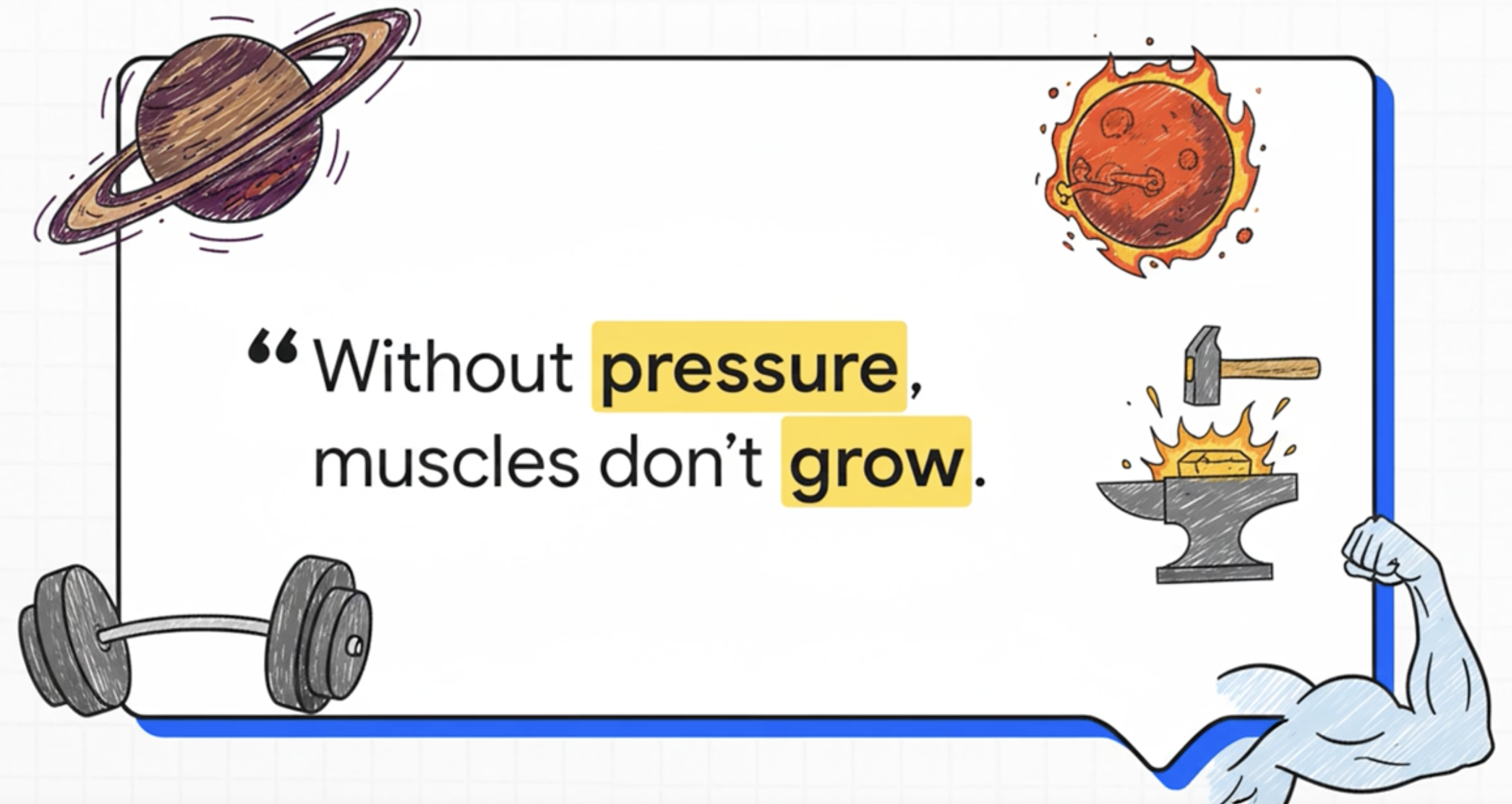
Without pressure, muscles don’t grow.
Without constraints, craft doesn’t sharpen.
Without friction, courage doesn’t mean much.
The modern perspective reframes malefics as long term growth agents. They are the teachers who are tough but fair if you do the work.
A reasonable caution: Too much strength in malefics without balance can also create imbalances. Example:
- Strong Mars can be impulsive, combative, or injurious.
- Strong Rahu can chase status and cheap dopamine.
- Strong Saturn can make native cold, rigid, or too self critical.
The goal isn’t to “avoid” malefics. It’s to balance them so they build rather than break.
The Growth Gifts of Key Malefics
Saturn: Consistency, Responsibility, Maturity
Role: Saturn is time, structure, and consequence. It tests what’s real. It asks you to show up, consistently, for a long time often with little or no applause.
Growth path:
- Builds endurance, patience, and skill depth.
- Cultivates humility and responsibility: you own your choices.
- Rewards the long game: things earned through Saturn tend to last.
When Saturn is strong but balanced:
- You keep commitments (to yourself and others).
- You develop mastery through repetition and feedback.
- You become trusted because your word means something.
When Saturn is unbalanced:
- Fear of failure or judgment stops action.
- Perfectionism delays progress; cynicism sets in.
- Life feels heavy, joyless, or overly constrained.
How to Support Saturn
- Build routines that make you reliable - not rigid.
- Set goals that stretch you, but don’t break you.
- Face your weak spots instead of hiding behind your strengths.
- Offer mentorship where you can, and accept guidance where you need it.
- Saturn rewards sincerity, patience, and the quiet commitment to keep showing up - even when no one’s watching.
Mars: Courage, Initiative, Boundaries
Role: Mars is energy, assertion, and the will to move forward. It’s the spark to start, the fuel to defend what matters, and the edge that carves a path when there isn’t one yet.
Growth path:
- Builds courage under pressure and the bias for action.
- Teaches you to set and enforce healthy boundaries.
- Helps you say “no,” cut losses, and move.
When Mars is strong but balanced:
- You take timely action with preparation and focus.
- You communicate directly and respectfully.
- You train your body and your will; you recover quickly.
When Mars is unbalanced:
- Impulse overrides judgment; fights burn bridges.
- Anger is unmanaged; energy is scattered.
- You take risks without adequate skill or ethics.
How to Support Mars
- Train your body to train your will - lift, move, or sweat a little every day. Mars needs a physical outlet to keep your mind clear.
- Finish what you start. Even small completions build self-trust — the muscle Mars thrives on.
- When anger rises, use it as data, not destruction. Speak clearly, not loudly.
- Say what you mean. Set boundaries early, calmly, and consistently.
- And whenever energy feels chaotic, channel it into building something that
- outlasts the moment - a project, a skill, a cause. That’s how raw fire becomes power.
Rahu: Obsession, Ambition, Desire
Role: Rahu is the part of us hungry for more new terrains, bigger visions, wider horizons. It’s disruptive, boundary-pushing, often unorthodox. It can be visionary or reckless, depending on your guardrails.
Growth path:
- Pioneers and innovates outside old constraints.
- Surfaces hidden desires and blind spots so you can integrate them.
- Pushes you to redefine success on your terms - then chase it.
When Rahu is strong but balanced:
- You take bold leaps with informed risk management.
- You build networks and learn fast, filtering hype from value.
- You play big without compromising core ethics.
When Rahu is unbalanced:
- Dopamine loops: click-chasing, status-chasing, shiny objects.
- Manipulation, shortcuts, or boundary violations.
- Burnout from constant stimulation.
How to Support Rahu
- Define what “enough” means for you — before Rahu convinces you it’s always more.
- Set goals rooted in your values, not your insecurities. Chase expansion, not validation.
- Create digital boundaries: one screen-free hour a day, no doom scrolls before bed.
- Find mentors who speak uncomfortable truths — not people who feed your ambition.
- And when success comes, pause. Ask: Is this growth or just a louder hunger?
- Rahu expands everything it touches — your vision or your void. Choose wisely.
Ketu: Detachment, Insight, Release
Role: Ketu is the scalpel. It strips the nonessential, cuts illusions, and points you toward clarity. It can feel like loss, but it frees your attention.
Growth path:
- Helps you let go of old attachments and identities.
- Sharpens intuition and discernment.
- Guides you toward simplicity and meaning.
When Ketu is strong but balanced:
- You release gracefully; you’re not easily baited.
- You see patterns clearly; you choose depth over noise.
- You experience calm focus and a lighter footprint.
When Ketu is unbalanced:
- Apathy, disengagement, escapism, or nihilism.
- Cutting off too quickly; avoiding human warmth.
- Over-spiritualizing to bypass necessary work.
How to support Ketu:
- Meditation, minimalism, reflective time, digital sabbaths.
- Practices that honor meaning over performance.
- Gentle reconnection to body, people, and simple joys if detachment goes too far.
Why You Need Malefics for Real Growth
Growth doesn’t come from comfort - it comes from discomfort.
The malefic planets create that discomfort. They pressure, delay, and expose. But in doing so, they build the inner infrastructure that benefic planets simply can’t.
They build agency.
Every time Saturn makes you show up despite resistance, or Mars demands that you act instead of overthink, you strengthen your “I can handle this” muscle. Agency isn’t inherited - it’s trained through repetition and friction.
They build emotional endurance.
Benefics make you feel good; malefics make you strong. They expand your capacity to hold discomfort without collapsing. When life throws uncertainty, conflict, or rejection, Mars teaches you to move through it, Saturn helps you sit with it, and Ketu helps you detach from the drama of it.
You stop breaking at every setback and start bending without losing form.
They teach patience and the power of process.
Malefics are not interested in quick results. Saturn tests your commitment to the long road. Ketu asks if you can keep doing the right thing even when no one’s watching.
They remind you that karma unfolds on its own schedule - your job is to sow, not to rush the harvest. You learn that mastery, like maturity, can’t be microwaved.
They reveal what’s real.
Rahu shows you what you crave so you can pursue it consciously.
Ketu shows you what you don’t need so you can release it.
Saturn shows you what endures.
Mars shows you what’s worth fighting for.
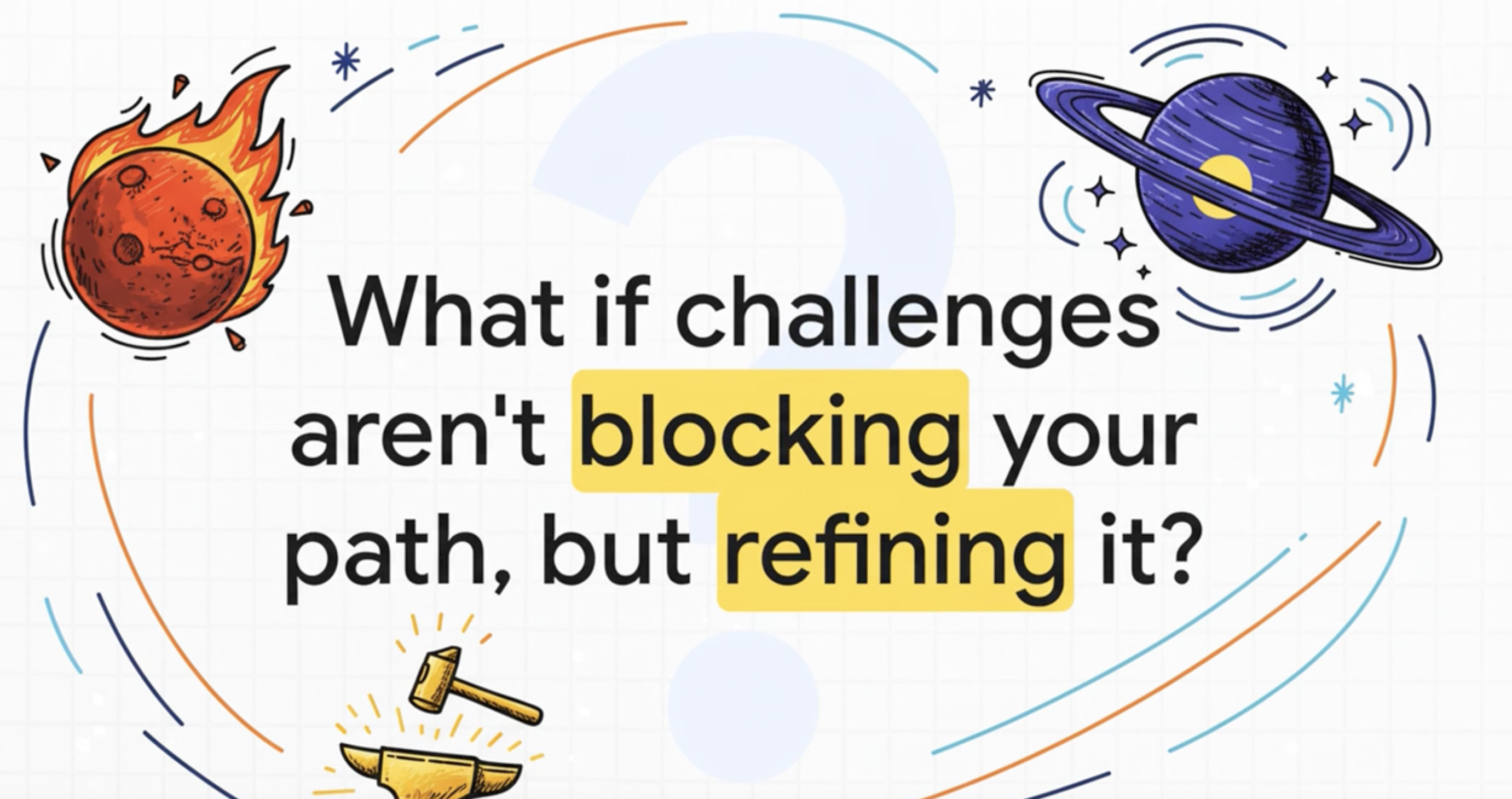
In the end, malefics don’t block your path - they refine it.
They strip what’s false, temper what’s fragile, and stretch what’s small.
Because the life you’re meant for can’t be built on shortcuts. It’s built through process, patience, and the kind of strength that only pressure creates.
The irony? The parts of life we try hardest to avoid often become the exact chapters that shape us. Malefic planets don’t just “happen” to you. They happen for you - when you work with them.
FAQs
How do I check my malefic planets?
- Start with your ascendant (lagna). Natural malefics are Saturn, Mars, Rahu, and Ketu. Functional malefics vary by ascendant based on which houses a planet rules in your chart. Dignity (sign strength), aspects, and periods (dashas/transits) refine the picture. We’ll provide a link to check your functional malefics by ascendant.
What are malefic planets as per my birth chart?
- Natural malefics: Saturn, Mars, Rahu, Ketu. Functionally, any planet can act as a malefic if it rules challenging houses for your ascendant. Consider the whole context: house rulership, placement, aspects, conjunctions, and timing.
What is the difference between malefic and benefic planets?
- Benefic planets tend to bring ease, support, and protection. Malefic planets tend to bring pressure, tests, and pruning. Both can help or hinder depending on context. Often, benefics help you enjoy and maintain, while malefics help you strengthen and evolve.
Are malefics always harmful in every house?
- No. Well-placed malefics can be highly productive—especially where grit, competition, or discipline help (think achievement, endurance, or overcoming obstacles). Conversely, benefics can enable comfort that stalls growth if overemphasized.
Can benefics behave poorly and malefics help, depending on ascendant?
- Yes. That’s the functional concept: depending on your lagna, a planet’s house rulership can make it behave more like a benefic or malefic in your life. This is why personalized chart reading matters.
Conclusion: Discomfort Is a Teacher - Use It
The Shiva Trimurti teaches that endings are part of the sacred cycle. Astrology agrees: creation and sustenance need a counterpart - pruning, pressure, and transformation. Malefic planets symbolize the uncomfortable parts of growth: the work, the courage, the honesty, the letting go.
Saturn asks you to keep your word. Mars dares you to act. Rahu pushes you to dream bigger - without losing yourself. Ketu frees you from what you don’t need. None of that is easy. All of it is worth it.
If you want to go further, start by checking your functional malefics by ascendant. Understand the currents in your chart. Then swim with them - on purpose. Your future self will thank you.