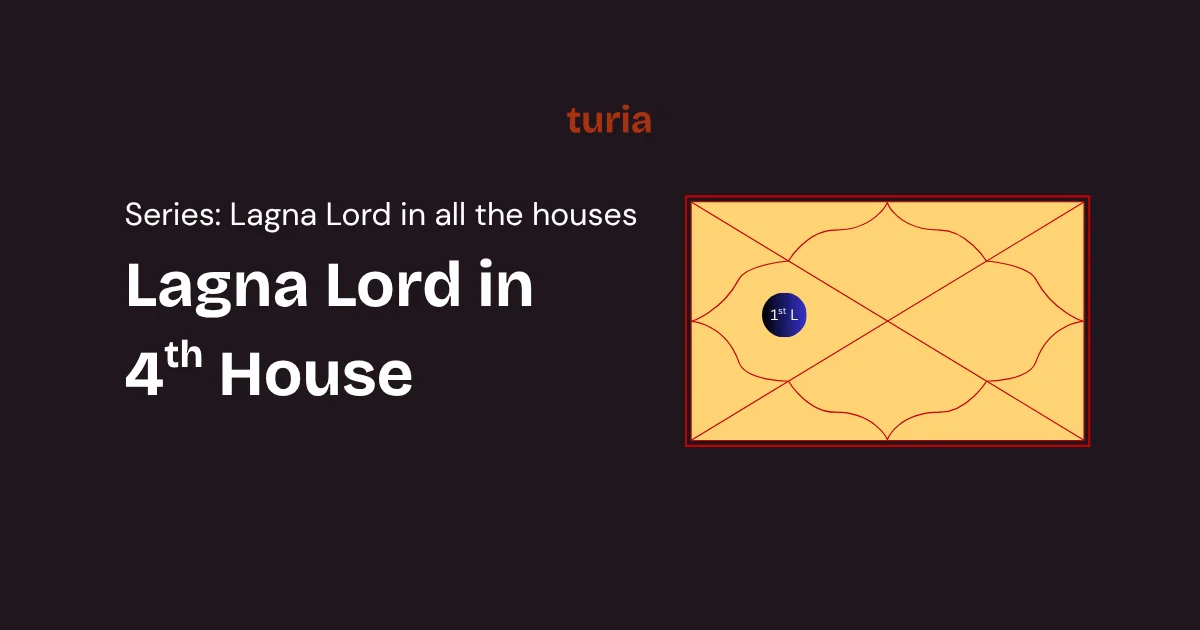
Every time someone finds out their lagna lord — the ruling planet of their ascendant — sits in the 4th house, the question is almost always the same: "Does this mean I'll be close to my mother?" Close behind it: "Is this a good placement or not?"
And honestly… most generic astrology pages answer both too quickly. They call it an automatic Raj Yoga, promise a beautiful house and a doting mother, and move on. That skips the actual mechanics — and what happens when the placement is under stress.
This is the fourth article in the "Lagna Lord in 12 Houses" series. Here's what the Brihat Parashara Hora Shastra (BPHS) and the Phaladeepika actually say about this placement — home, mother, property, identity, where the real Raj Yoga condition kicks in, and how it compares to the lagna lord elsewhere.
Quick answer
When the lagna lord (ascendant lord) sits in the 4th house, it's a Kendra-to-Kendra placement — one of the most stable results in the birth chart. BPHS (Ch. 24, Sl. 4) says the native will be "endowed with paternal and maternal happiness" and be "virtuous and charming." The placement strengthens home, property, and the mother-bond, and links the native's identity closely to their domestic foundation. It becomes a classical Maha Yoga specifically when there's a mutual exchange — the 4th lord also sitting in the lagna. Without affliction, this is a genuinely good placement; with heavy malefic influence, domestic instability and a restless mind are the risks.
What "Lagna Lord in the 4th House" Actually Means
Before the interpretation, the mechanics. Your lagna is your ascendant — the sign rising on the eastern horizon at the moment you were born. It represents your body, your personality, your sense of self. The planet that rules your ascendant sign is your lagnesh, or lagna lord.
When that planet sits in your 4th house (Sukha Bhava, house of happiness, or Bandhu Bhava, house of relatives), your very identity is placed inside the house that governs home, mother, comfort, and emotional roots.
Structurally, this matters because the 4th house is a Kendra (angular house), along with the 1st, 7th, and 10th. BPHS is explicit that planets in Kendras carry amplified strength:
"If he [the lagna lord] is in an angle, or trine there will be at all times comforts of the body." — BPHS, Ch. 12, Sl. 1-2
So before the specific 4th-house themes: a lagna lord placed in any Kendra tends to be structurally strong, unless badly afflicted, debilitated, or combust. This is one of the four "power positions" in the chart, not a random placement.
The Core Classical Result
The most direct classical statement on this exact placement comes straight from BPHS:
"If Lagn's Lord is in Bandhu Bhava, the native will be endowed with paternal and maternal happiness, will have many brothers, be lustful, virtuous and charming." — BPHS, Ch. 24, Sl. 4
Four distinct outcomes here: happiness from both parents (not just the mother), a larger family circle, strong personal charm, and — Parashara doesn't shy away from it — a tendency toward strong desire/attachment (lustful here reads closer to "strongly driven by attachment and pleasure" than a moral judgment).
Notice what's missing from most modern blog summaries: the "many brothers" detail and the charm/virtue combination. Most pages focus almost entirely on mother and property, but the classical text is broader — it describes someone whose whole social and emotional world becomes a source of strength.
Effects on Home and Domestic Happiness
This is where the placement earns its reputation. Because the lagna lord physically sits in the house of home and happiness, your personal identity and domestic life become deeply intertwined. Decisions about career, relationships, even where to live, tend to circle back to family and home base.
BPHS makes a direct, practical statement about housing:
"One will have residential comforts in full degree, if Bandhu is occupied by its Lord, or by Lagn's Lord and be drishtied by a benefic." — BPHS, Ch. 15, Sl. 2
The condition matters — "drishtied by a benefic" (aspected by Jupiter, Venus, or a well-placed Mercury). When met, the classical promise is full residential comfort: a settled, happy home life, often including a good house or eventual property ownership.
Think of the person whose career decisions are shaped by staying close to the family home — turning down a Bangalore posting to stay in Pune near their parents, or building their business out of the ground floor of the family house. That's lagna lord in the 4th, playing out in an ordinary, everyday Indian life.
Effects on Mother and the Mother-Bond
The 4th house is Matru Bhava — the house read for the mother's condition, longevity, and her bond with the native. With the lagna lord here, the native's core identity is unusually entwined with the mother.
Practically, this often shows up as:
- A close, emotionally significant relationship with the mother, often lasting into adulthood
- The native feeling shaped by the mother's values, habits, or worldview more than by the father's
- In some charts, professional or financial support connected to the mother's side of the family
Modern interpretive sources also point out that because the 4th house can be read as career-through-the-home-axis, a strong 4th sometimes reflects well on the mother's own standing — her career or reputation — which the native absorbs as part of their own identity.
The caveat: this is the default, unafflicted reading. If the lagna lord is heavily conjunct or aspected by malefics (Saturn, Mars, Rahu) in the 4th, the mother-bond theme can flip — distance from the mother, her health being a recurring concern, or a home life that feels unsettled rather than comforting. Classical texts describe both outcomes depending on affliction.
Property, Land, and Vehicles
Because the lagna lord sitting in the 4th links personal identity to Bandhu Bhava's core significations — conveyances, lands, and buildings — this placement is consistently associated with an aptitude for, or eventual acquisition of, property and vehicles.
BPHS reinforces this from another angle — the 10th lord's relationship to the 4th lord:
"If Karm's Lord joins Bandhu's Lord in an angle, or in a trine, the native will acquire beautiful mansions." — BPHS, Ch. 15, Sl. 4
This specific sloka is about the 10th lord and the 4th lord, but it shows the general classical pattern: strength connected to Bandhu Bhava — whether through its own lord or the lagna lord occupying it — tends to manifest as tangible real estate and material comfort, not just emotional contentment.
In an Indian context, this often plays out literally: the first flat a family buys, ancestral agricultural land, or a genuine interest in real estate, architecture, or interior design as a career path — which lines up with the classical emphasis on yānam (conveyances) and bhumi (land) as core Bandhu Bhava themes.
Identity, Personality, and the Career Angle
Because a planet in the 4th house casts a full aspect on the 10th house (the house directly opposite), the lagna lord here doesn't just influence home — it reaches into career and public standing too.
This creates an interesting dynamic: someone whose sense of self (lagna) is rooted in home and family, but whose ambitions (10th house) are also being quietly shaped by that same planet. In practice, this often produces natives drawn toward careers connected to their roots — family business, real estate, education, local politics, or professions that let them stay geographically or emotionally close to home rather than uprooting entirely.
It's a different flavor of ambition than, say, the lagna lord in the 10th house directly (pure career drive) or the 7th house (identity built through partnership). Here, the drive is filtered through the emotional need for a secure base.
The Maha Yoga Condition — When This Placement Becomes Truly Powerful
Here's the nuance most pages skip entirely: lagna lord in the 4th house on its own is a good, stable placement. But classical texts describe something stronger when there's a mutual exchange — the 4th lord also placed back in the lagna.
The Phaladeepika is specific about this:
"Maha Yogas: (1) The lord of the Lagna in the 2nd and the lord of the 2nd in Lagna, (2) the lord of the Lagna in the 4th and the lord of the 4th in Lagna..." — Phaladeepika, Parivartana Yoga section, Sl. 28-32
This mutual exchange — called Parivartana Yoga — is classified as one of the 28 Maha Yogas, the major fortune-conferring combinations in classical astrology. It's a meaningfully stronger result than the simple, one-directional placement of lagna lord in the 4th without the return exchange.
So if you've read that your lagna lord is in the 4th and assumed you automatically have a major Raj Yoga running — check whether your 4th lord is actually sitting back in your lagna. If yes, you have the full Maha Yoga. If not, you still have the solid, classical Bandhu Bhava benefit described earlier — just not the amplified exchange version.
Strength Considerations — What Makes or Breaks This Placement
A placement description is only half the story. Classical astrology is explicit that results depend on strength and affliction. Four factors decide how this placement actually plays out:
- Dignity of the lagna lord. Exalted or in its own sign in the 4th gives the fullest expression of the classical promise. Debilitated or in an enemy sign weakens it considerably, even in a Kendra.
- Benefic vs. malefic association. BPHS's condition — "drishtied by a benefic" — is not decorative. Jupiter, Venus, or a well-placed Mercury aspecting the 4th strengthens domestic happiness and the mother-bond. Saturn, Mars, or Rahu in close conjunction or aspect can create the opposite — instability, health concerns for the mother, or a restless, hard-to-settle quality at home.
- Whether the exchange (Parivartana) is present. As covered above, this is the difference between a good placement and a classical Maha Yoga.
- Dasha timing. The results of this placement activate most visibly during the Mahadasha or Antardasha of the lagna lord itself, or of the 4th lord — property purchases, home renovations, or a deepening of the mother relationship often cluster in these periods.
A Word on Kendradhipati Dosha
If you've been reading around this topic, you may have come across "Kendradhipati Dosha" — the idea that a planet ruling only Kendra houses (with no trine rulership) can become a mild functional malefic for certain ascendants.
Worth being precise here: this specific dosha concept does not appear by name in either BPHS or the Phaladeepika — it's a later commentarial framework used by modern astrologers, not a classical Parashari doctrine. And even within that modern framework, the lagna lord itself is generally treated as exempt or only mildly affected, because the 1st house carries an inherent auspiciousness (closer to a trikona in effect) regardless of which other house it also rules. So if your lagna lord sits in the 4th, Kendradhipati Dosha is rarely the concern to lose sleep over — dignity and affliction matter far more.
Lagna Lord in 4th vs. Other Kendra and Key Houses
Since this is part of a 12-house series, here's how the 4th compares to the other major lagna lord placements:
| Placement | Core Theme | Classical Flavor |
|---|---|---|
| Lagna lord in 1st (own house) | Physical vitality, strong personality | BPHS Ch. 12: "physical happiness and prowess," intelligence, but fickle-minded |
| Lagna lord in 4th | Home, mother, emotional foundation | BPHS Ch. 24 Sl. 4: paternal/maternal happiness, charm, larger family circle |
| Lagna lord in 7th | Identity through partnership/marriage | Native's sense of self becomes bound up with spouse and partnerships; can weaken personal independence if afflicted |
| Lagna lord in 10th | Career, public standing, achievement | BPHS Ch. 24 Sl. 10: "paternal happiness, royal honour, fame... self-earned wealth" |
All four are Kendras, so all four carry structural strength. What differs is where that strength gets expressed — the body and personality (1st), the home and mother (4th), the partner and public dealings (7th), or career and reputation (10th). If you're comparing your own placement against a sibling or partner whose lagna lord sits elsewhere, this table is the quick reference — but each deserves its own full read in this series.
FAQ
Is lagna lord in 4th house good or bad?
Generally good. It's a Kendra-to-Kendra placement, which classical texts treat as inherently strengthening. BPHS (Ch. 24, Sl. 4) describes paternal and maternal happiness, charm, and a larger family circle. The placement turns unfavorable mainly when the lagna lord is debilitated, combust, or heavily afflicted by malefics — then domestic instability or strain with the mother becomes more likely.
What does lagna lord in 4th house mean for the mother?
It typically indicates a close, emotionally significant bond with the mother, and the native's identity being shaped by her values and presence. BPHS also links a strong, benefic-aspected 4th lord/lagna lord combination to a long-living, happy mother (Ch. 15, Sl. 2, 6-7). If the placement is afflicted, the mother's health or the closeness of the bond can be affected instead.
Does lagna lord in 4th house always give Raj Yoga?
Not automatically. The placement on its own gives the solid classical benefit from BPHS Ch. 24, Sl. 4. It becomes a full Maha Yoga specifically when there's a mutual exchange — the 4th lord also placed in the lagna (Phaladeepika, Sl. 28-32). Check your own chart for that exchange before assuming the strongest version applies.
What happens if the lagna lord in the 4th house is afflicted or debilitated?
Affliction (conjunction with or aspect from Saturn, Mars, or Rahu, or debilitation) can flip the domestic themes — restlessness at home, frequent relocation, strain in the mother relationship, or delays in acquiring property. The house's themes don't disappear; they simply express with more friction and require more conscious effort to stabilize.
Does this placement help with property, land, or vehicles?
Yes, this is one of the more consistent themes. BPHS (Ch. 15, Sl. 2, 4) links a strong Bandhu Bhava — occupied by its own lord or the lagna lord, with benefic aspect — to full residential comfort and even "beautiful mansions" when combined with 10th lord strength. Many natives with this placement also show a natural interest in real estate, architecture, or property-related work.
Is Kendradhipati Dosha a concern with this placement?
Rarely. Kendradhipati Dosha is a later commentarial concept, not found by name in BPHS or the Phaladeepika. Even within modern frameworks, the lagna lord is usually treated as exempt or only mildly subject to it, since the 1st house carries its own auspiciousness regardless of dual rulership. Dignity and malefic affliction are far more important factors to check.
How does lagna lord in 4th house affect career?
Indirectly but meaningfully. A planet in the 4th house fully aspects the 10th house (career), so this placement often shapes career choices toward roots — family business, real estate, education, or work that keeps the native geographically or emotionally close to home — rather than careers built on distance from family and constant relocation.
Bringing It Together
So when someone asks, "Is lagna lord in the 4th house a good placement?" — the honest, classical answer is: yes, generally, and more so than most placements, because it's a Kendra sitting in a Kendra. But the strength of the result depends on the lagna lord's dignity, whether it's aspected by benefics or malefics, and whether the rarer mutual exchange with the 4th lord is actually present in the chart.
What this placement really describes is a person whose sense of self is inseparable from home — where they come from, who raised them, and the physical and emotional foundation they return to. Get that foundation right, and everything else in the chart tends to stand on steadier ground.