Introduction
This is the placement with the harshest line in the whole 6th lord set.
Sickly, inimical, desires others' wealth, interested in others' wives, impure.
And then, a few clicks away, a different website announces that the same placement is a Vipareeta Raja Yoga that makes you a king.
So which is it? Honestly, neither extreme survives a close reading.
The 8th house is Randhra Bhava: sudden events, hidden matters, inheritance, research, the things you do not say aloud. The 6th lord (Shashthesh) is the planet of rivals, debts and illness. When it lands in the 8th, struggle goes underground.
In this guide we will quote the sloka as it is, translate it into real habits, explain what the Vipareeta claim needs, cover the Dainya exchange, and show what strength and dasha change.
Quick answer
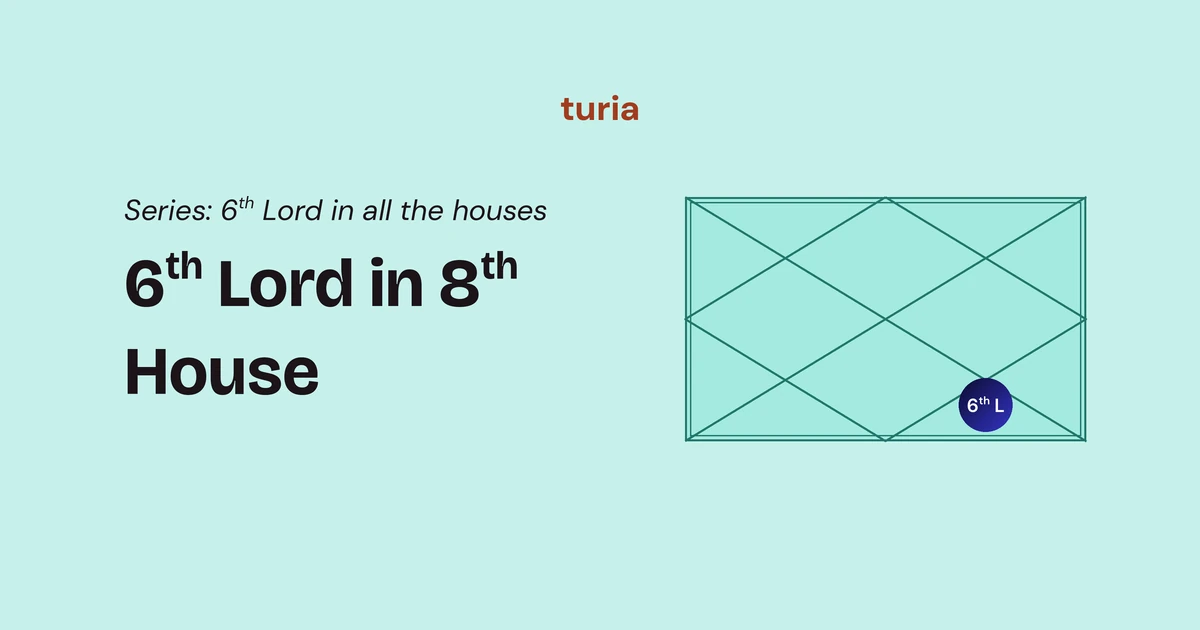
6th lord in the 8th house places the lord of rivals and illness (Ari Bhava) in the house of hidden matters and sudden change (Randhra Bhava), a dusthana in a dusthana. BPHS says the native "will be sickly, inimical, will desire others' wealth, be interested in others' wives and be impure" (Ch. 24, Sl. 68). Later tradition links this to Vipareeta Raja Yoga, but only under conditions. Read the sloka as tendencies around resentment, boundaries and hidden stress, which dignity, aspects and dasha can change a lot.
What "6th Lord in the 8th House" Actually Means
Find the sign on your 6th cusp and note its ruler. For a Libra lagna the 6th sign is Pisces, so Jupiter is the 6th lord. For a Capricorn lagna the 6th sign is Gemini, so Mercury is.
If that planet sits in the 8th house, you have this placement.
BPHS Ch. 11 classifies the house clearly:
"Evil Bhavas, or Dusthan Bhavas are Ari, Randhr and Vyaya Bhava." (BPHS, Ch. 11, Sl. 33-36)
So a dusthana lord has gone to another dusthana. The classical logic is that both houses carry hardship, and when one hardship-lord sits in another hardship-house, the first one's harshness gets absorbed. This is the root of the Vipareeta idea, and we will come back to it.
The Core Classical Result (BPHS Ch. 24, Sl. 68)
The sloka, in full:
"If Ari's Lord is in Randhr Bhava, the native will be sickly, inimical, will desire others' wealth, be interested in others' wives and be impure." (BPHS, Ch. 24, Sl. 68)
Five phrases, all difficult. There is no softening line like "famous" or "very rich" here, which is why this placement scares people.
How to read it in proportion: the sloka describes where the mind is likely to slip, not what a person must become. Inimical points to a long memory for grudges. Desires others' wealth is envy and the pull of shortcuts. Interested in others' wives is a boundary problem. Impure is a lapse in discipline. Sickly is the body paying for stress.
Every one of these is a habit that can be recognised and managed. Some people with this placement turn out to be the most careful in their circle precisely because they know the pull.
Health, Stress and Hidden Habits
BPHS Ch. 17 adds a line about the body:
"Should Ari's Lord be in Ari itself, or in Lagn, or Randhr, there will be ulcers, or bruises on the body." (BPHS, Ch. 17, Sl. 2)
Read it gently. It points to a body that carries stress quietly: acidity, skin flare-ups, slow-healing small injuries, a stomach that reacts before the mind admits worry.
Practical reading: do not postpone health check-ups, do not carry old resentments in your gut, and keep a regular sleep routine. This is habit guidance, not a diagnosis.
Money, Others' Resources and Inheritance
The 8th rules other people's money: inheritance, insurance, joint accounts, loans taken from or given to others. The 6th lord here connects debts and disputes to exactly those areas.
Think of a family property dispute that drags through three courts, a joint business loan that turns sour, or an insurance claim that takes two years.
Desires others' wealth is the shadow side. The healthy side is an eye for hidden value: auditing, investigation, insurance, research, forensic work, restructuring. Many people with this placement are the ones called in when a messy financial situation needs untangling.
A simple guard: keep every joint money arrangement written down, even with family.
Relationships and Boundaries
The sloka's line about others' wives sounds archaic, so translate it. The 8th house is secrecy, and the 6th lord adds temptation and conflict. In modern terms: a pull toward what is off limits, workplace entanglements, and secrets that give someone a hold over you.
The fix is dull and effective. Decide your lines in advance, when nothing is at stake. People who keep their boundaries clear when it is easy keep them when it is hard.
The Vipareeta Raja Yoga Question
Now the part every other page oversells.
Phaladeepika's commentary quotes an older rule from Uttarakalamrita: if the lord of the 6th is in the 8th or 12th, and the lords involved are not associated with or aspected by the lords of other houses, the person "will be very prosperous and a king of kings" (Phaladeepika commentary, Vipareeta Raja Yoga).
Look at the conditions. The planets must stay free of association with other house lords, and that is a strict requirement. Few charts meet it cleanly.
The same commentary adds that Parashara's BPHS has not accorded recognition to this yoga. For this placement, BPHS gives the plain Sl. 68 result.
Frankly, treat it as a possibility that a full chart reading may confirm, never as something promised by one placement.
The Dainya Question: When It's a Full Exchange
When two house lords sit in each other's houses it is called Parivartana. Phaladeepika calls the exchanges among the 6th, 8th and 12th lords Dainya Yogas, and number seven on its list is:
"(7) the lord of the 6th in the 8th and the lord of the 8th in the 6th" (Phaladeepika, Dainya Yogas)
Phaladeepika says such a person "will encounter obstacles in all his ventures" (Phaladeepika, Yoga Adhyaya, v. 33).
Notice the contrast. The Vipareeta rule rewards a lord that stands alone. The Dainya rule describes lords that exchange. Which reading applies depends on the exact chart, which is why checking the 8th lord's position matters.
Strength: What Changes the Outcome
Own sign or exalted 6th lord in the 8th is the strongest version. It sharpens research ability and softens the sloka's rougher lines.
Debilitated 6th lord in the 8th needs a check for cancellation of debilitation (Neecha Bhanga). Without it, the grudge and money-trouble themes grow.
Combust 6th lord, too close to the Sun, is muted until its dasha.
Aspected by Jupiter is a real relief. It steadies judgement and helps with health.
Conjunct Saturn, Mars or Rahu raises the stakes: longer disputes, more secrecy and a heavier body.
When the Results Actually Show Up
The 6th lord's Mahadasha and Antardasha are the main windows. A sudden health scare that turns into a lifestyle reset, an inheritance dispute, a loan problem, or a research project that finally pays off.
The 8th lord's dasha, and Saturn's transit over the 8th, can bring the buried themes up to the surface.
6th Lord in the 8th House vs Other Placements
| Placement | Core theme | How it differs from the 8th house |
|---|---|---|
| 6th lord in 8th house | Struggle goes hidden, envy and stress | The comparison point here |
| 6th lord in 6th house | Own house, kin friction (Sl. 66) | Open conflict, not hidden |
| 6th lord in 7th house | Marriage strain, public success (Sl. 67) | Visible partnership themes |
| 6th lord in 9th house | Trade in wood and stones, fluctuating fortunes (Sl. 69) | Work and belief, not secrecy |
FAQ
What does 6th lord in 8th house mean?
The lord of rivals, debts and illness sits in the house of hidden matters and sudden change. BPHS lists sickliness, enmity, envy of others' wealth and boundary problems as tendencies of the native.
Is 6th lord in 8th house good or bad?
The BPHS sloka is difficult, with no softening line. Later tradition adds a Vipareeta Raja Yoga possibility, but only under strict conditions. Planet strength and dasha decide the real outcome.
Is 6th lord in 8th house a Vipareeta Raja Yoga?
Uttarakalamrita treats it so when the lords involved are unconnected to other house lords. Phaladeepika's commentary notes that BPHS gives no such recognition. Check the full chart before assuming it.
Does 6th lord in 8th house cause health problems?
BPHS calls the native sickly and Ch. 17 mentions ulcers or bruises. Read it as a body that carries stress quietly. Regular check-ups, sleep and digestion habits matter more than fear.
How does 6th lord in 8th house affect money?
Debts and disputes tend to gather around inheritance, joint money and insurance. The same placement suits auditing, research and investigation. Written agreements prevent most of the trouble.
Is 6th lord in 8th house a Dainya Yoga?
Only as a full exchange: 6th lord in the 8th and 8th lord in the 6th together. Phaladeepika lists it as Dainya Yoga number seven. Without the reciprocal placement, the plain BPHS result applies.
Closing
So is 6th lord in the 8th house dangerous? It is demanding. It shows a mind that learns early where its weak points are, and a life that improves once those points are named.
Write the line down before the temptation arrives, and the sloka loses most of its grip.