Introduction
You find the 6th lord in your 4th house and the first thing you read is the first thing the sloka says: devoid of maternal happiness.
"Does this mean something is wrong with my mother? Or with me?"
Neither, necessarily. Let's slow down and read it properly.
The 4th house is Bandhu Bhava (or Sukha Bhava): mother, home, vehicles, property, education at the foundational level and the feeling of being at peace. The 6th lord (Shashthesh) is the planet of service, rivals, illness and obligation. When it sits in the 4th, duty and friction move into the room where you are supposed to rest.
In this guide we'll cover what BPHS says, how to read the mother line without panic, why the sloka also mentions intelligence and wealth, and how the Dainya Yoga exchange fits in.
Quick answer
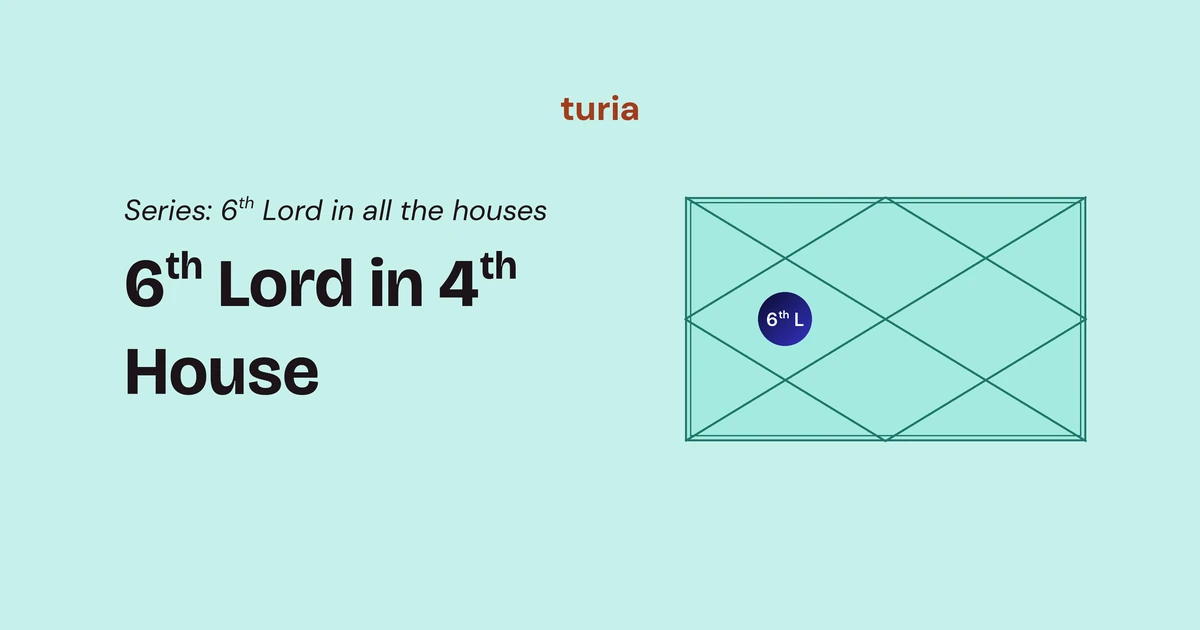
6th lord in the 4th house puts the house of work, rivals and ailments (Ari Bhava) inside the house of mother, home and inner peace (Bandhu Bhava). BPHS says the native "will be devoid maternal happiness, be intelligent, be a tale bearer, be jealous, evil-minded and very rich" (Ch. 24, Sl. 64). The result is a mix: emotional distance or strain around the mother and home, a sharp mind, a touch of suspicion, and real wealth potential. A full exchange with the 4th lord in the 6th is a Dainya Yoga.
What "6th Lord in the 4th House" Actually Means
Terms first.
The 6th lord is the planet ruling your 6th house sign. For a Sagittarius lagna it is Venus, since Taurus falls on the 6th. For a Capricorn lagna it is Mercury, because Gemini does.
The 4th house is your base: the house you grew up in, your mother, your sense of belonging.
BPHS Ch. 11 puts the 4th in the strongest company:
"The Kendras are specially known, as Lagn (the ascendant), Bandhu Bhava, Yuvati Bhava (the descendant) and Karm Bhava (mid-heaven)." (BPHS, Ch. 11, Sl. 33-38)
So the 6th lord is in a Kendra, an angle. A dusthana lord in an angle is visible and active. It cannot hide, and it gets worked on. That tends to make the results more dramatic, in both directions.
This is not the 4th lord in the 6th house, which is the reverse. There, home and comfort are pulled toward work and struggle. Here, work and struggle enter the home.
The Core Classical Result (BPHS Ch. 24, Sl. 64)
The sloka, in full:
"If Ari's Lord is in Bandhu Bhava, the native will be devoid maternal happiness, be intelligent, be a tale bearer, be jealous, evil-minded and very rich." (BPHS, Ch. 24, Sl. 64)
Six descriptors. Two are good (intelligent and very rich). Four are rough (devoid of maternal happiness, tale bearer, jealous, evil-minded).
Do not skip the "very rich". It is one of the strongest wealth promises in the 6th lord set.
As for the rough words, classical language compresses a lot. Evil-minded in practice tends to describe a suspicious or calculating habit of thought, especially under stress. Tale bearer is someone who knows everyone's business and finds it hard not to mention it. Jealous is a comparing mind. None of this is a character verdict. These are tendencies of a mind that has learned to watch for threats early.
Mother, Home and Emotional Comfort
Devoid of maternal happiness is the line that stops readers. Read it carefully.
It does not say the mother will suffer, or that the bond is broken. In real charts, this placement often shows up as distance of some kind. A child sent to a hostel at twelve. A mother who works long hours or is unwell for years. A move to another city for work, leaving the family home behind. Two people who love each other but never quite say it.
You can recognise this in the young professional who calls home every evening, hears "Have you eaten?", and still feels something unsaid between them.
If this is you, a few small things help. Ask your mother about her own childhood, not just your day. Visit without an agenda. Those conversations often cover more ground than years of daily phone calls.
And one firm point: do not take this sloka as a prediction about your mother's health or life. For that, you would need the full chart, including the 4th lord, the Moon and the dasha.
Property, Vehicles and Wealth
The sloka says very rich, and it is worth asking how.
The 6th is a house of service, competition and loans. A 6th lord in the 4th tends to build wealth through hard, steady work, and the 4th puts that wealth into property, land, vehicles and home. Think of the person who buys a first flat at thirty with a home loan, services it patiently and owns three properties by forty-five.
It also links to professions tied to home and land: real estate, construction, hospitality, healthcare facilities, education.
The catch is peace of mind. You can own the house and still not feel at home in it. That gap, between having and belonging, is what this placement asks you to close.
To see how your own sign and planet shape this, run the AI Kundali and note which planet is your 6th lord and what sign it holds.
Mind, Intelligence and Trust
Intelligent is the quiet good news here. The 4th house also governs the mind's resting state, and a 6th lord there often gives a sharp, analytical, problem-solving mind.
The downside is the suspicious streak. Natives can read hidden motives into harmless remarks and carry small hurts for a long time. That is the jealous and tale bearer part, seen from the inside.
A simple practice: before you repeat something about a person, ask whether you would say it to their face. It sounds basic, but it removes most of what this sloka warns about.
The Dainya Question: When It's a Full Exchange
The exchange needs two planets, so most readers will not have it.
When two house lords occupy each other's houses, it is a Parivartana Yoga. Phaladeepika says 30 of the 66 possible exchanges are caused by the lords of the 6th, 8th and 12th, and calls them Dainya Yogas. The fourth on its list is:
"(4) the lord of the 6th in the 4th and the lord of the 4th in the 6th" (Phaladeepika, Dainya Yogas)
If your 6th lord is in the 4th and your 4th lord is in the 6th, you have a Dainya Yoga. Phaladeepika says such a person "will encounter obstacles in all his ventures" (Phaladeepika, Yoga Adhyaya).
That reads grimly, so some context. The result depends on the strength of the two planets involved. A well-placed 4th lord in the 6th, with benefic aspects, can still deliver property and education through effort. The yoga shows where the struggle will be. It does not say the struggle fails.
Strength: What Changes the Outcome
Not every 6th lord in the 4th reads the same, because planets differ in condition.
Exalted or own-sign 6th lord in the 4th is the strongest version. The wealth and intelligence in the sloka lead, and the home strain softens.
Debilitated 6th lord in the 4th needs a check for Neecha Bhanga (cancellation of debilitation). Without it, expect more suspicion, more emotional distance, and shakier property matters.
Combust 6th lord (too close to the Sun) mutes the result until its dasha begins.
Aspected by Jupiter steadies the mind and improves the mother-home picture. The Moon, natural significator of mother, being strong also helps greatly.
Conjunct Saturn, Mars or Rahu deepens the distance and sharpens the suspicious streak.
Check sign, dignity, aspects and dasha before drawing a conclusion.
When the Results Actually Show Up
The 6th lord's Mahadasha and Antardasha are when these themes move forward: a house purchase with a loan, an illness in the family, a move away from home.
The 4th lord's dasha, and Saturn's transit over the 4th, can also bring the emotional side to the surface.
6th Lord in the 4th House vs Other Placements
| Placement | Core theme | How it differs from the 4th house |
|---|---|---|
| 6th lord in 4th house | Duty and friction enter home and mother | The comparison point here |
| 6th lord in 1st house | Rivals and health shape temperament (BPHS Sl. 61) | Shows in the self, not in the home |
| 6th lord in 2nd house | Service feeds money and speech (Sl. 62) | Mostly positive, earnings and family |
| 6th lord in 3rd house | Anger and sibling friction (Sl. 63) | Effort and courage, not roots |
FAQ
What does 6th lord in 4th house mean?
Your house of work, rivals and ailments sits inside your house of mother, home and peace. BPHS says the native is intelligent and very rich, but lacks maternal happiness and tends toward suspicion.
Is 6th lord in 4th house good or bad?
It is mixed. BPHS gives two strong positives, intelligence and wealth, against four rough traits. Because the 4th is a Kendra, the results are visible and workable, not hidden.
Does 6th lord in 4th house harm the mother?
The sloka speaks of missing maternal happiness, which in real charts often looks like distance, a busy or unwell mother, or relocation. It is not a prediction about her life. Check the Moon and 4th lord.
Will I be rich with 6th lord in the 4th house?
BPHS says "very rich". The route is usually steady work converted into property, land or vehicles. The planet's strength and the running dasha decide the timing and scale.
Is 6th lord in 4th house a Dainya Yoga?
Only as a full exchange: 6th lord in the 4th and 4th lord in the 6th together. Phaladeepika lists this as Dainya Yoga number four. Without the reciprocal placement, the plain BPHS result applies.
What if the 6th lord is afflicted in the 4th house?
Expect more emotional distance at home, a suspicious streak and complications in property matters. Jupiter's aspect, a strong Moon and a sound 4th lord ease the pattern.
Closing
So, is 6th lord in the 4th house a bad omen for home life? Not on its own. It describes a person who earns well and thinks sharply, and who has to work on feeling at home.
Call your mother more often than the chart suggests, and the sloka's hardest line loses most of its force.