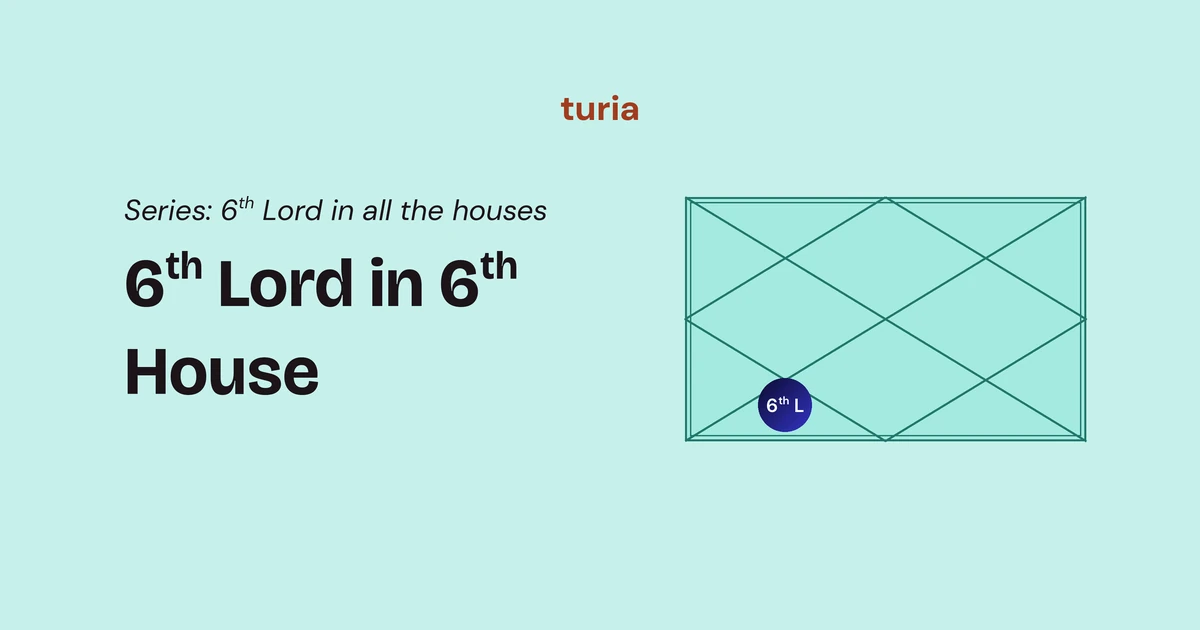
Introduction
Search this placement online and you get two very different answers.
One page says it is a Harsha Yoga, a Vipareeta Raja Yoga, a guaranteed win over enemies. Another says you will fight your own relatives forever.
Both cannot be right.
The 6th house is Ari Bhava: rivals, debts, illness, daily service, litigation. Its lord (Shashthesh) is the planet that decides how you handle all of it. When that lord sits in its own house, you get a person who is at home with conflict. Not fond of it. At home with it.
In this guide we will cover what BPHS says, what the Harsha Yoga claim actually requires, how the kin-versus-outsiders line shows up in family life, and how strength and dasha change the picture. No exchange yoga is possible here, because the lord is already in its own house.
Quick answer
6th lord in the 6th house means the ruler of rivals, debts and daily service sits in its own house. BPHS says the native "will have enmity with the group of his kinsmen, but be friendly to others and will enjoy mediocre happiness in matters, like wealth" (Ch. 24, Sl. 66). The 6th is also an Upachaya house, one that improves with time and effort. Expect friction within the family circle, easy dealings with outsiders, and results that grow slowly. Harsha Yoga needs more than this single placement.
What "6th Lord in the 6th House" Actually Means
The 6th lord is the planet that owns the sign on your 6th cusp. For an Aries lagna it is Mercury, because Virgo is the 6th sign. For a Scorpio lagna it is Mars, because Aries is.
If that planet sits in the 6th itself, it is in its own house. For Mercury that means it is in Virgo, so it is in own sign as well.
BPHS Ch. 11 gives two labels for this house that sit side by side:
"Evil Bhavas, or Dusthan Bhavas are Ari, Randhr and Vyaya Bhava." (BPHS, Ch. 11, Sl. 33-36)
"Sahaj, Ari, Karm and Labh Bhava are Upachaya Bhavas." (BPHS, Ch. 11, Sl. 33-36)
A dusthana, yes. Also an Upachaya, a house of growth with time. That second label is why this placement tends to improve in the thirties and forties, not because the house is soft, but because it rewards persistence.
The Core Classical Result (BPHS Ch. 24, Sl. 66)
The sloka, in full:
"If Ari's Lord is in Ari Bhava, the native will have enmity with the group of his kinsmen, but be friendly to others and will enjoy mediocre happiness in matters, like wealth." (BPHS, Ch. 24, Sl. 66)
Notice what is unusual. The friction is aimed at kinsmen, the group closest to you. Strangers and colleagues are treated well.
Think of the person who is the star of every office team but cannot sit through a family wedding without an argument about inheritance or who said what at the last function. That is the sloka in a sentence.
Mediocre happiness in wealth is also worth reading properly. It says the money is middling, not poor. Enough, with effort, without ease.
Enemies, Litigation and Competition
The 6th lord in its own house gives a talent for handling opposition. Rivals can be beaten, cases can be fought, and competitive exams can be cleared by someone with enough patience.
That is why this placement shows up in lawyers, civil servants, doctors, sports people, soldiers and anyone whose daily work is a contest of some kind.
The downside is the fight habit. A person comfortable with conflict can start one out of boredom. If every disagreement at home becomes a case to be won, the "enmity with kinsmen" line starts to describe you.
A rule that helps: before you argue with family, ask what you would actually do with the win.
Health Habits and Daily Rhythm
BPHS Ch. 17 has a short line about this placement:
"Should Ari's Lord be in Ari itself, or in Lagn, or Randhr, there will be ulcers, or bruises on the body." (BPHS, Ch. 17, Sl. 2)
Read it as a pointer to habits. The 6th rules digestion, stress responses and the body's wear and tear. A person with this placement tends to push through discomfort because there is always a case to handle or a deadline to meet.
So the practical reading: eat on time, take the check-up you keep postponing, and treat minor aches as information. This is advice about routine, not a medical forecast.
Harsha Yoga: What It Actually Requires
This is where most pages go wrong.
Phaladeepika describes Harsha Yoga this way:
"if the lords of the 6th, 8th and 12th occupy the 6th house, the native will be blessed with happiness and good fortune and a strong constitution. He will conquer his enemies" (Phaladeepika, Yoga Adhyaya, v. 63)
Look at the condition. It speaks of the lords of the 6th, 8th and 12th in the 6th house. One lord in its own house is only part of it.
The commentary on Phaladeepika adds that the related idea, Vipareeta Raja Yoga, comes from Uttarakalamrita, and that Parashara's BPHS gives no recognition to it. For this placement, BPHS gives the plain Sl. 66 result.
So if a website promises you a raja yoga because the 6th lord is in the 6th, check how many lords are actually there. Frankly, one is not enough.
Strength: What Changes the Outcome
Own sign and strong (for example Mercury in Virgo for an Aries lagna) gives the cleanest version: sharp handling of rivals and work, with the family friction minimal.
Weak or combust 6th lord (too close to the Sun) makes the fight habit louder and the stamina lower.
Aspected by Jupiter softens the tone at home and helps with money.
Conjunct Saturn, Mars or Rahu brings long legal matters, sharp rivalries and a stubborn body.
Other dusthana lords present (8th or 12th) move the chart toward the Harsha idea, and a full reading then looks at their own dignity.
When the Results Actually Show Up
The 6th lord's Mahadasha and Antardasha are the main windows. Competitive exams, a lawsuit, a loan, a health scare that ends in better habits, or a family dispute that finally gets settled.
Because the 6th is an Upachaya, the later years of the dasha usually go better than the first.
6th Lord in the 6th House vs Other Placements
| Placement | Core theme | How it differs from the 6th house |
|---|---|---|
| 6th lord in 6th house | Own house, fights with kin, easy with others | The comparison point here |
| 6th lord in 4th house | Home and mother strain, wealth (Sl. 64) | Pressure moves into the house of peace |
| 6th lord in 5th house | Children and friends bring friction (Sl. 65) | Pressure on creativity and love |
| 6th lord in 7th house | Marriage happiness reduced, fame, wealth (Sl. 67) | Pressure in partnership |
FAQ
What does 6th lord in 6th house mean?
The ruler of rivals, debts and daily service sits in its own house. BPHS says the native clashes with kinsmen, stays friendly with others, and enjoys mediocre happiness in wealth.
Is 6th lord in 6th house good or bad?
It is mixed. The 6th is an Upachaya house, so results improve with time and effort. The sloka gives family friction and modest happiness in money. A strong planet softens both.
Is 6th lord in 6th house a Harsha Yoga?
Not by itself. Phaladeepika describes Harsha Yoga when the lords of the 6th, 8th and 12th occupy the 6th house. One lord in its own house is only a part of that condition.
Will I win against enemies with 6th lord in the 6th house?
The placement gives patience and skill for handling opposition, so rivals and cases are often managed well. Victory still depends on the planet's strength and the running dasha.
Does 6th lord in 6th house affect health?
BPHS Ch. 17 mentions ulcers or bruises for this placement. Read it as a pointer to routine, stress and digestion habits, not a diagnosis. Regular check-ups and sleep matter more than any remedy.
What if the 6th lord is afflicted in the 6th house?
Expect longer disputes with relatives, heavier stress on the body and a stubborn fight habit. Jupiter's aspect, a strong Moon and a calm dasha ease the pattern.
Closing
So is 6th lord in the 6th house a curse or a raja yoga? It is neither. It is a person who has been handling conflict since childhood and who gets better with every decade.
Spend that skill on the real problem, and keep it out of the family group chat.