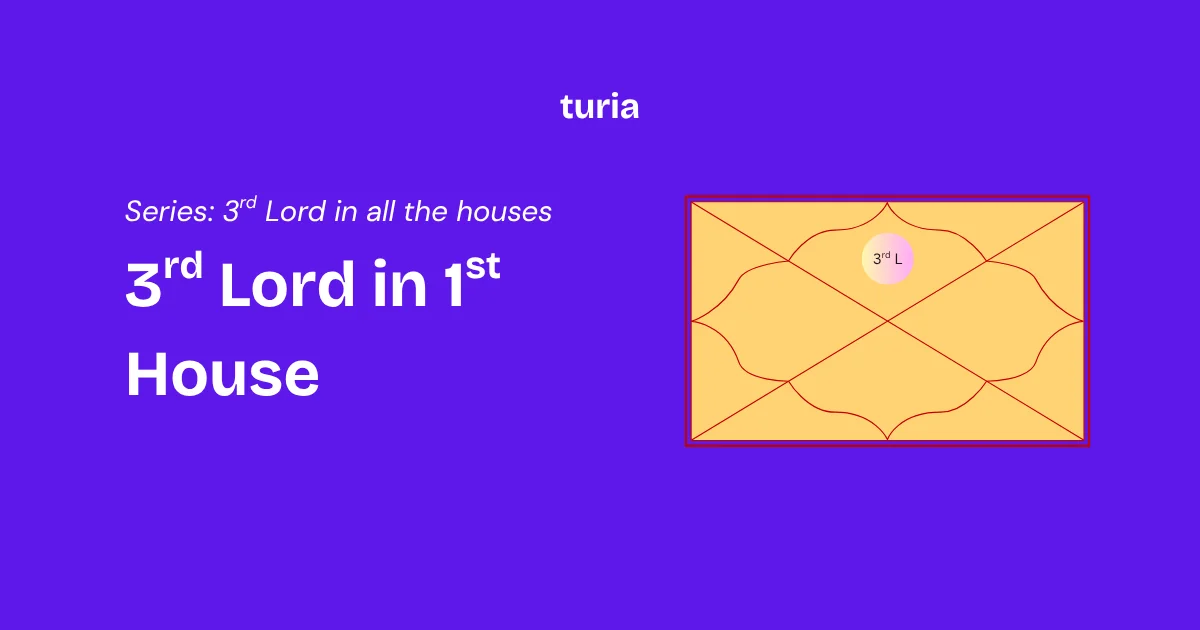
Someone finds out their 3rd lord sits in the 1st house of their kundali, and the first question is almost always the same: "Does this make me courageous, or does it make me difficult?"
Fair question. The 3rd house and the 1st house aren't an obvious pair. One is about effort, valour, siblings and short trips. The other is about the self — the body, the personality, the whole direction of a life.
And this is where it gets interesting.
When the 3rd lord moves into the 1st house, it doesn't sit there quietly. It fuses with the self. Effort stops being something the native does occasionally and starts being who they are. Courage becomes a personality trait, not a mood. Communication becomes a lens the whole identity gets viewed through.
In this guide, we'll cover what this placement actually means, what BPHS and Phaladeepika say about it, how it shows up in personality, siblings, health and career, and how it compares to the reverse placement — the lagna lord sitting in the 3rd house.
Quick answer
The 3rd lord in the 1st house blends Parakrama Bhava (courage, effort, siblings, communication) directly with Tanu Bhava (self, body, identity). In practice, this usually means self-made success — a personality built on hard work rather than inheritance or luck, strong communication skills that shape how the native comes across, and siblings who feel closely tied to the native's own story. Classical texts read it favourably overall: BPHS calls it a placement for self-made wealth, valour and intelligence, with one honest caveat — formal learning may take a back seat to practical effort.
What Tanu Bhava and Parakrama Bhava Actually Cover
Before blending the two, it helps to separate them cleanly.
| Bhava | Sanskrit name | What it governs |
|---|---|---|
| 1st house | Tanu Bhava (also Lagna) | Physique, appearance, intellect, complexion, vigour, innate nature, overall life direction |
| 3rd house | Parakrama Bhava (also Sahaj Bhava) | Courage, self-effort, valour, younger siblings, short journeys, communication, skill, hobbies |
The Brihat Parashara Hora Shastra states the karakatwas of both plainly: "Physique, appearance, intellect... complexion of the body, vigour, weakness, happiness, grief and innate nature are all to be guessed through the ascending Rāśi," and for Sahaj Bhava, "valour, servants, brothers, sisters etc., initiatory instructions, journey and parent's death" (BPHS, Ch. 11, v.2 & v.4).
Phaladeepika lists the same houses under different classical names — the 1st house is also called Lagna, Deha (body), Rupa (form), and Udaya (rising); the 3rd is called Duschikya, Uras (breast/valour) and simply "brother" (Phaladeepika, house-signification verses). "Duschikya" roughly points to a house of effortful, sometimes reluctant, striving — a fitting undertone for a house that is, classically, an Upachaya (growth) house rather than a weak one.
So when the lord ruling the 3rd house physically sits inside the 1st house of the kundali, you're watching the planet in charge of courage and effort settle directly into the seat of the self.
What 3rd Lord in 1st House Means, in Plain Terms
Think of it like this: the 3rd house is the hustle. The 1st house is the person doing the hustling.
Put the hustle inside the person, and the most common pattern across both classical and modern readings is this — effort becomes identity. Not a phase, not a job description. A defining trait. The native is often described as the "self-made" one in the family or friend group — someone whose achievements trace back to their own courage and initiative rather than inherited advantage.
This is why several modern astrology sites describe this exact placement as a "self-made sovereign" pattern — the person builds their own standing, their own business, their own name, brick by brick, and the effort itself becomes part of how people describe them.
Communication tends to be part of that identity too. Because the 3rd house rules speech, writing and skill, a 3rd lord sitting in the 1st house often shows up as someone whose way of talking, presenting, or expressing themselves is central to their personality — not incidental to it.
What the Classical Texts Say
This exact placement has a direct citation in the Brihat Parashara Hora Shastra. In the chapter on the effects of Sahaj Bhava, Parashara writes:
"If Sahaj's Lord is in Tanu Bhava, the native will have self-made wealth, be disposed to worship, be valorous and be intelligent, although devoid of learning." (BPHS, Ch. 14, v.25)
Read carefully, this is a mostly favourable verse with one honest catch. Self-made wealth, a devotional or worshipful streak, valour, and sharp practical intelligence — that's the strong side. "Devoid of learning" is the caveat: formal scholarship, bookish education, or academic credentials may not be where this native's strength lies. Their intelligence tends to be lived and applied rather than studied and certified.
That distinction matters. It doesn't mean the native is uneducated — it means their real intelligence shows up in action, not in a transcript. Many self-made businesspeople, performers, and communicators fit this exact profile: sharp, capable, persuasive, but not necessarily the top of their class in a classroom.
BPHS also lays out the general rule for any lord placed in Tanu Bhava: "If [the Lagna Lord] is in an angle, or trine there will be at all times comforts of the body. If Lagn Lord is in debilitation, combustion, or enemy's Rāśi, there will be diseases" (BPHS, Ch. 12, v.1-2). Since the 1st house is itself an angle, a 3rd lord arriving here — even though it isn't the Lagna lord itself — still benefits from the general logic that occupying an angle tends to be strengthening, provided the lord isn't badly afflicted.
Phaladeepika adds useful texture through Shaurya Yoga — formed when the 3rd house is aspected by benefics and its lord is strong, uncombust, and well-placed. That native's "younger brothers will attain glory and will be brave and valiant... he will be engrossed in state affairs, will be loved by everybody and will be very renowned" (Phaladeepika). A 3rd lord carrying that kind of strength into the 1st house tends to bring exactly this — valour, sibling glory, and public renown — straight into the native's own personality and public image.
Personality and Temperament
The clearest theme across classical logic and modern astrology writing is that courage and self-reliance become baked into the character.
- Self-driven, not entitled. The native tends to distrust shortcuts and prefers earning things through their own effort — a trait that often reads as admirable stubbornness.
- Physically resilient when the lord is strong. BPHS ties bodily comforts to a well-placed angle lord — a strong 3rd lord here often correlates with good physical constitution and stamina.
- Communicator by nature. Speech, writing, or performance often becomes part of how the person is known, not just something they're good at.
- A worshipful or devotional streak. BPHS's own wording — "disposed to worship" — suggests a quieter, more reflective side under the outward courage, often expressed through ritual, discipline, or a personal practice.
- Shadow side. Some modern commentary flags argumentativeness, restlessness, or a tendency to be blunt to the point of friction — worth watching, especially when the 3rd lord is afflicted, but not a fixed outcome.
Siblings and Family Ties
Because the 3rd house rules younger siblings, and its lord has now settled directly into the self, sibling relationships and personal identity tend to be closely intertwined.
BPHS ties the fortune of co-borns directly to the strength of Sahaj Bhava's lord throughout Chapter 14, and Shaurya Yoga specifically promises that "younger brothers will attain glory and will be brave and valiant" when the 3rd house is strong. In practical terms, Indian astrology writers reading this exact placement often describe the native as a standout among siblings — someone who either becomes the most well-known or successful of the group, or whose personal journey is closely bound up with a sibling's fortunes, sometimes with real closeness, occasionally with rivalry if the lord is weak or afflicted.
Health: A Word of Caution About Overreading
Some modern astrology blogs describe the 3rd house as a "Dusthana" (malefic house) and suggest this placement brings childhood health sensitivity that improves with age.
Worth pausing on this. Classically, the Dusthana houses are the 6th, 8th and 12th — houses of obstacles, chronic conditions, and endings. The 3rd house is actually an Upachaya (growth) house, along with the 6th, 10th and 11th — meaning its effects, unlike a true Dusthana, tend to improve with time and effort rather than simply cause harm. BPHS's own verse on this exact placement (Ch. 14, v.25) doesn't mention disease at all — it talks about self-made wealth, valour and intelligence.
So while it's fair to note that any angle lord (the 1st house is an angle) suffering real affliction — debilitation, combustion, a difficult conjunction — can affect vitality per the general principle in BPHS Ch. 12, there's no classical basis for treating this specific placement as inherently unhealthy. Read any health-related claims about this placement as one modern interpretive strand, not a classical certainty — consistent with treating astrology as a framework for reflection, not a source of fear.
Career and Communication
Given how strongly this placement links effort and speech to identity, certain career textures show up often in both classical and modern readings:
- Self-made entrepreneurship. Business built from the ground up rather than inherited — the native's own name becomes the brand.
- Speaking- and writing-led work. Journalism, teaching, public speaking, sales, broadcasting, or content creation — any field where communication is the product.
- Performance and the arts. Some traditions link a strong 3rd lord here to talent in singing, acting, or other performance-based skills, especially when Venus or the Moon plays the role of 3rd lord.
- Short-distance-heavy work. Because the 3rd house also governs short journeys, roles involving frequent local travel, courier-like logistics, or regional sales territories often suit this placement well.
When the 3rd Lord Is Strong vs Weak or Afflicted
Since dignity decides so much of the reading, it's worth laying the spectrum out plainly.
- Own sign or exalted, well-aspected: self-made success, physical vitality, confident communication, and — per Shaurya Yoga — genuine renown and sibling pride. Close to BPHS's favourable reading in full.
- Combust: self-esteem takes a hit. Sibling relationships may feel strained, and the native might find an unreliable advisor or "enemy in guise" close to them.
- Debilitated or in an enemy sign, malefic-aspected: courage can tip into recklessness or argumentativeness, and the "devoid of learning" caveat in BPHS's verse can lean harder toward scattered focus or unfinished education.
- Conjunct or aspected by Mangal (natural karaka for siblings and courage): sharpens the courage-and-identity theme further, sometimes adding a more assertive, even combative, edge to how the native presents themselves.
None of this is fixed fate — it's a starting map. The dasha the native is running, the navamsa (D9) placement of this same lord, and the overall shadbala (planetary strength) refine the picture considerably.
3rd Lord in 1st House vs 1st Lord in 3rd House
These two placements get confused constantly because they involve the same two houses, just with the roles reversed. Worth separating clearly.
| 3rd Lord in 1st House | 1st (Lagna) Lord in 3rd House | |
|---|---|---|
| Direction of energy | Effort and courage settle into the self — they become identity | The self actively goes out to apply effort and courage |
| Primary theme | Self-made success as a character trait; communication shapes personality | Proactive courage in action; BPHS calls it "equal to a lion in valour" |
| Siblings | Siblings closely tied to the native's own story and self-image | Native's assertiveness can create friction with siblings or colleagues |
| Classical tone (BPHS) | Favourable — self-made wealth, valour, intelligence (v.25), with a "devoid of learning" caveat | Strongly favourable — "equal to a lion in valour... wealth... intelligent and happy" (Ch. 15, v.3) |
| Everyday texture | Quietly self-assured; effort feels internalised | More visibly active; effort feels externalised, sometimes restless |
Neither placement is simply "better." They're the same two houses, working in opposite directions — one folds effort inward into identity, the other sends identity outward into effort.
FAQs
What does 3rd lord in 1st house mean in simple terms?
It means the planet ruling your 3rd house of courage, effort, siblings and communication is sitting in your 1st house of self and identity. In plain terms, effort and courage stop being occasional traits and become part of who you fundamentally are — most readings describe this as a self-made, communicative, valorous personality.
Is this a good placement overall?
Generally, yes. BPHS's direct verse on this placement (Ch. 14, v.25) describes self-made wealth, valour, worship-mindedness and intelligence — a largely favourable combination. The one caveat is "devoid of learning," meaning formal education may matter less to this native's success than practical, lived effort.
Does it make someone more courageous, or more aggressive/argumentative?
Usually more courageous and self-reliant, but the shadow side does exist — some modern commentary notes a tendency toward bluntness or argumentativeness, especially if the 3rd lord is afflicted or conjunct/aspected by Mangal. A strong, well-placed lord leans toward confident courage rather than conflict.
How does it affect relationships with siblings?
Sibling fortunes tend to feel closely linked to the native's own life story. Classical texts (and Shaurya Yoga specifically) suggest siblings can become notably successful or well-regarded alongside a strong 3rd lord, with real closeness between the native and their co-borns. A weak or afflicted lord can instead bring more rivalry or distance.
Does this placement really affect health, especially in childhood?
Not classically, despite some modern blogs suggesting it. The 3rd house is an Upachaya (growth) house, not a Dusthana — it's meant to improve with time and effort, unlike true Dusthana houses (6th, 8th, 12th). BPHS's own verse on this placement doesn't mention disease. Any health caution really depends on whether the 3rd lord itself is afflicted, per the general angle-lord principle, not on this placement specifically.
How is this different from the lagna lord placed in the 3rd house?
They're the same two houses in reverse. 3rd lord in 1st house means effort and courage get absorbed into the self as identity — self-made, communicative, often quietly confident. Lagna lord in 3rd house means the self actively goes out to apply courage and effort, which BPHS describes even more strongly ("equal to a lion in valour"), often with a more visibly active, sometimes restless texture.
Does the navamsa (D9) placement of the 3rd lord matter here?
Yes. The D1 (birth chart) placement establishes the broad theme, but the navamsa placement of the same lord helps confirm how reliably it holds up — particularly for questions around siblings, career direction, and long-term temperament. A 3rd lord well-placed in both D1 and navamsa makes the favourable, self-made-success reading more dependable.
The Honest Takeaway
So if someone asks whether the 3rd lord in the 1st house is good, the honest answer leans favourable — but it still depends on the lord's own dignity. Classical texts describe a native whose effort, courage and communication fuse directly into their identity, building a self-made life rather than an inherited one. The caveat worth remembering is BPHS's own: formal learning may not be where this native shines, but lived, practical intelligence usually is. What stays constant across every reading is the theme — this is a person whose character was built, not given.
Hope this gives you a clearer picture.