Introduction
The 6th lord in the 3rd house comes with a sloka that reads like a list of complaints. Anger. No courage. Enmity with brothers and sisters. Servants who do not listen.
"Is this why I never got along with my sibling? Is this why I freeze before I take a big step?"
Hold on before you accept that. The sloka is real, and we will quote it in full. But the word-for-word reading is the harshest version of the story, and charts rarely play out that way.
The 3rd house is Sahaja Bhava: effort, courage, skills, siblings, short travel and communication. The 6th lord (Shashthesh) is the planet of rivalry, service and friction. Put them together and you get a chart where effort and competition are tangled up.
In this guide we'll cover what BPHS says, why the placement is more workable than it sounds, what it does to sibling bonds and confidence, and what to make of the Dainya Yoga exchange.
Quick answer
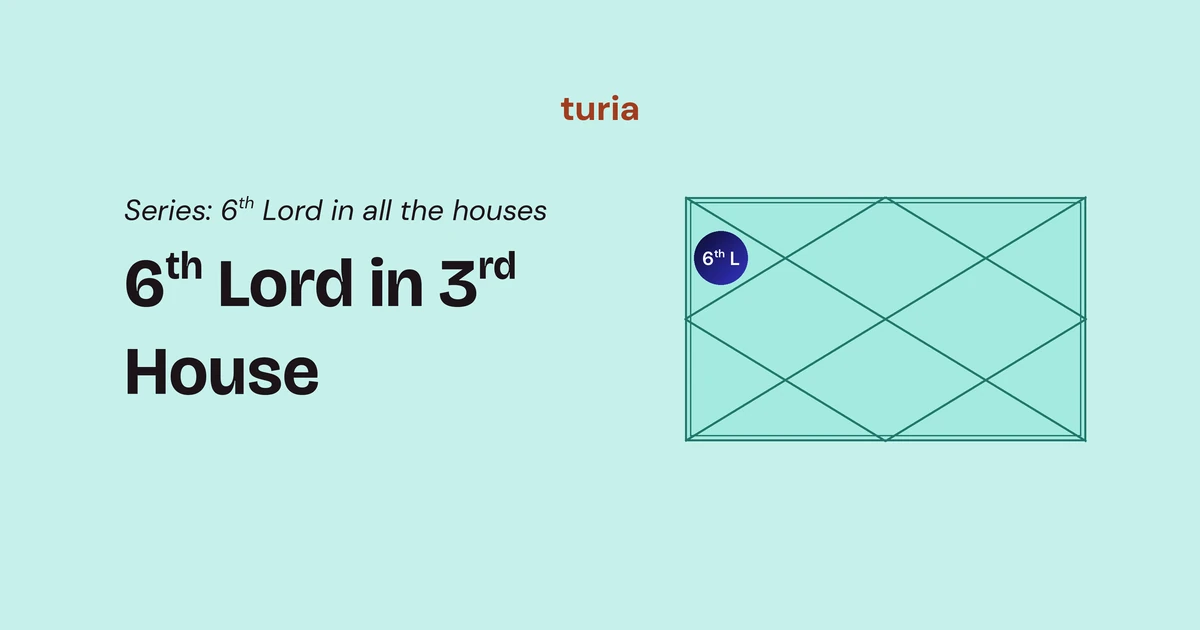
6th lord in the 3rd house places the house of rivals, work and conflict (Ari Bhava) inside the house of effort, courage and siblings (Sahaja Bhava). BPHS says the native "will be given to anger, be bereft of courage, inimical to all of his co-born and will have disobedient servants" (Ch. 24, Sl. 63). Read in proportion, it points to a short temper, sibling friction and doubts about taking initiative. Both houses are Upachayas (houses that improve with time), so the pattern usually eases with age and effort.
What "6th Lord in the 3rd House" Actually Means
Definitions first.
The 6th lord is the planet ruling the sign on your 6th house. For a Virgo lagna it is Saturn, since Aquarius falls on the 6th. For a Scorpio lagna it is Mars, because Aries does.
The 3rd house is about what you do with your own hands and voice: skills, writing, courage, younger siblings, the nerve to start something.
BPHS Ch. 11 sorts the 3rd into two groups at once:
"Sahaj, Ari, Karm and Labh Bhava are Upachaya Bhavas." (BPHS, Ch. 11, Sl. 33-38)
That line matters more than it looks. Upachaya means "growth". These are houses where bad results fade and good ones build over time. So the 6th lord is in one Upachaya (3rd) and rules another (6th). The classics are hard on the sloka, yet the structure is the kind that matures.
Also note that this is not the 3rd lord in the 6th house, the reverse. There, your effort goes to rivals and service. Here the rivalry shows up inside your effort and your family.
The Core Classical Result (BPHS Ch. 24, Sl. 63)
The full sloka:
"If Ari's Lord is in Sahaj Bhava, the native will be given to anger, be bereft of courage, inimical to all of his co-born and will have disobedient servants." (BPHS, Ch. 24, Sl. 63)
Four hard clauses, no good ones. This is one of the harsher lines in the 6th lord series, and it would be dishonest to dress it up.
But look at what each clause is really describing.
Given to anger is a temper. Bereft of courage is a lack of confidence, especially before the first step. Inimical to co-born is sibling friction. Disobedient servants means people working under you do not follow instructions, which in modern terms is a team that does not listen.
All four are about relationships with people around you, and all four are things a person can learn to manage. That is the practical difference between a tendency and a fate.
Siblings and Family Dynamics
The 3rd house rules younger siblings, and the 6th house rules rivalry. Put them together and you get the classic family story: the brother who borrowed money and never returned it, the sister who always got the better room, the cousin who was compared to you in every family function.
Sibling friction under this placement tends to be about competition and fairness, not hatred. Who got more attention. Who contributes to the parents' care. Who gets the ancestral flat.
A helpful reframe: the sloka says "inimical to all his co-born". In many real charts, this is one difficult sibling, not all of them. And often the friction ends once there is distance, separate homes or a clear division of responsibilities.
If you are working on a relationship with a sibling right now, try one rule. Never discuss money and old grievances in the same conversation.
Courage, Anger and Initiative
"Bereft of courage" is the line that hurts most, so let's be careful with it.
What it often looks like in practice: someone talented who delays applying for the better job, or who starts a business idea three times and shelves it twice. Not a coward. Someone whose first instinct is to expect a fight.
The anger works the same way. Quick flare-ups, regret afterward. Mostly directed at those closest to you, and mostly when you feel disrespected.
Here is where the Upachaya structure helps. Courage in this chart is built, not given. Small repeated acts (speaking up in one meeting a week, finishing one risky task a month) shift the pattern far faster than waiting to feel brave.
If you want to see how your own sign placement changes this, run your AI Kundali and look at the 6th lord's sign and the planets aspecting it.
Work, Teams and the "Disobedient Servants" Line
Disobedient servants sounds old-fashioned, but it maps neatly onto modern management. A team lead whose team misses deadlines. A shop owner whose staff keep quitting. A founder who cannot get an intern to follow a process.
The lesson in the sloka is to give clear instructions and build systems instead of relying on personality. People who get this right often become excellent managers, because they learned early that authority alone does not get things done.
The Dainya Question: When It's a Full Exchange
This is the section where a lot of pages get confused.
When two house lords sit in each other's houses, it is a Parivartana Yoga. Phaladeepika sorts the 66 possible exchanges into three groups: Dainya (caused by the 6th, 8th and 12th lords), Kahala (caused by the 3rd lord) and Maha. The 3rd and 6th lords exchanging places is listed under Dainya:
"(3) the lord of the 6th in the 3rd and lord of the 3rd in the 6th" (Phaladeepika, Dainya Yogas)
So even though the 3rd lord is involved, this exchange is a Dainya Yoga, not a Kahala Yoga. Also keep it separate from BPHS's "Kahal Yog" in Ch. 36, which is a completely different combination.
As for the result, Phaladeepika is blunt: a person with Dainya Yoga "will speak harshly and will not have a stable mind" (Phaladeepika, Yoga Adhyaya). Treat this as a warning about temper and restlessness, not a sentence. Most people with 6th lord in the 3rd do not have the exchange at all.
Strength: What Changes the Outcome
Where the planet sits is only half the reading. The other half is how healthy it is.
Exalted or own-sign 6th lord in the 3rd is the best version. Anger becomes drive, and the sibling friction tends to be mild.
Debilitated 6th lord in the 3rd needs a check for Neecha Bhanga (cancellation of debilitation). Without it, the courage issue and the temper are more pronounced.
Combust 6th lord (too close to the Sun) mutes the result until its dasha.
Aspected by Jupiter softens the harsh clauses noticeably. Jupiter's wisdom works well on temper.
Conjunct Mars, Saturn or Rahu sharpens anger and turns sibling disagreements into long-running cold wars.
Always read sign, dignity, aspects and dasha together.
When the Results Actually Show Up
Look to the 6th lord's Mahadasha and Antardasha. That is when sibling tension, a job conflict or a confidence crisis tends to surface.
The 3rd lord's dasha also triggers it. Saturn transiting the 3rd house can bring a long, slow test of courage.
6th Lord in the 3rd House vs Other Placements
| Placement | Core theme | How it differs from the 3rd house |
|---|---|---|
| 6th lord in 3rd house | Rivalry inside effort, courage and siblings | The comparison point here |
| 6th lord in 1st house | Rivals and health shape temperament (BPHS Sl. 61) | Visible in personality, not in effort |
| 6th lord in 2nd house | Service feeds money and speech (Sl. 62) | Mostly positive, shows in earnings |
| 6th lord in 4th house | Strain around mother and home comforts (Sl. 64) | Emotional base, not courage |
FAQ
What does 6th lord in 3rd house mean?
Your house of rivals, work and conflict sits inside your house of effort, courage and siblings. BPHS says the native is given to anger, lacks courage and is at odds with siblings.
Is 6th lord in 3rd house good or bad?
It is one of the harder lines in the BPHS 6th lord set. Both houses are Upachayas, though, so the pattern usually improves with age, effort and good dasha periods.
Will I fight with my siblings with 6th lord in 3rd house?
Sibling friction is the classical result. In real charts it is often one difficult relationship about money, fairness or care for parents. Distance and clear boundaries usually help.
Does 6th lord in the 3rd house mean low courage?
The sloka says so, but courage here is built through repeated small actions. Jupiter's aspect, a strong Mars and steady practice change the picture a lot.
Is 6th lord in 3rd house a Kahala Yoga or Dainya Yoga?
A full exchange between the 6th and 3rd lords is a Dainya Yoga in Phaladeepika, listed as number three. It is not a Kahala Yoga, and it is unrelated to BPHS's Kahal Yog in Chapter 36.
What if the 6th lord is afflicted in the 3rd house?
Expect a sharper temper, longer sibling disputes and more hesitation before big steps. Jupiter's aspect, a strong 3rd lord and steady routines help.
Closing
So, how worried should you be about 6th lord in the 3rd house? Less than the sloka suggests, as long as you work on the two things it names: temper and first steps.
Build courage in small doses, keep sibling money talks short, and the Upachaya in this placement does the rest.