Introduction
Gain wealth through his enemies.
Few lines in classical astrology are as quotable as this one. It sounds like a business-school case study from the 1500s.
And it is also one of the kindest results in the 6th lord set.
The 11th house is Labha Bhava: income, gains, networks, fulfilled wishes. The 6th lord (Shashthesh) is the planet of rivals, debts and daily service. When it sits in the 11th, competition and income meet in the same room.
In this guide we will cover what BPHS says, how gain through enemies works in practice, why the children line needs a gentle reading, the Dainya Yoga exchange, and how strength and dasha change the result.
Quick answer
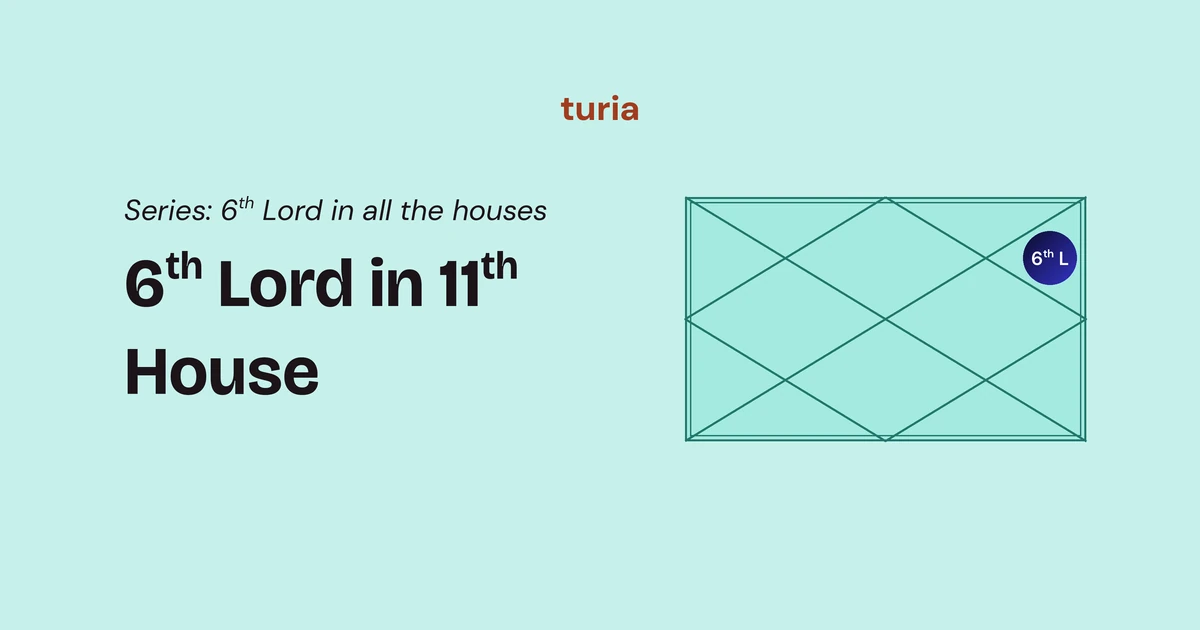
6th lord in the 11th house places the lord of rivals, service and debts (Ari Bhava) in the house of income, gains and networks (Labha Bhava). BPHS says the native "will gain wealth through his enemies, be virtuous, adventurous and will be somewhat bereft of progenic happiness" (Ch. 24, Sl. 71). In practice: income grows through competition, disputes and service, with a bold and principled character, and some strain or delay around children. A full exchange with the 11th lord in the 6th forms Dainya Yoga.
What "6th Lord in the 11th House" Actually Means
Find the sign on your 6th cusp and note its ruler. For a Leo lagna the 6th sign is Capricorn, so Saturn is the 6th lord. For a Libra lagna the 6th sign is Pisces, so Jupiter is.
If that planet sits in the 11th house, you have this placement.
BPHS Ch. 11 gives the 11th two helpful labels:
"Dhan, Putr, Randhr and Labh Bhava are Panapharas (succedents)." (BPHS, Ch. 11, Sl. 33-36)
"Sahaj, Ari, Karm and Labh Bhava are Upachaya Bhavas." (BPHS, Ch. 11, Sl. 33-36)
A succedent house, tied to continuity and accumulation. And an Upachaya, a house that grows with time. A dusthana lord in an Upachaya house is working in a place where difficulty turns into advantage.
The Core Classical Result (BPHS Ch. 24, Sl. 71)
The sloka, in full:
"If Ari's Lord is in Labh Bhava, the native will gain wealth through his enemies, be virtuous, adventurous and will be somewhat bereft of progenic happiness." (BPHS, Ch. 24, Sl. 71)
Count again. Three strengths: wealth through enemies, virtuous, adventurous. One shortfall: progenic happiness is somewhat missing.
Somewhat is a mild word. The text does not say the native has no children or no joy in them. It says some part of that happiness is lacking.
Gain Through Enemies: What It Looks Like
The 6th lord is the planet of rivals. The 11th is income. Put them together and the pattern is straightforward: your competitors, opponents and difficult people end up feeding your income.
Some real forms of this.
A business that grows by taking over the clients of a failing competitor. A lawyer whose fees come from the other side's disputes. A salaried person who is promoted because the rival team collapsed. A consultant hired to fix what a predecessor broke. A court settlement that arrives after years of litigation.
Another form is subtler. A rival pushes you to improve, and the improved version earns more.
The word enemies also covers the whole category of difficult people, such as the old employer who let you go and whose client you now serve.
Character: Virtuous and Adventurous
Virtuous and adventurous in the same sentence is an interesting pair.
The sloka describes a person who takes risks without losing their principles. They compete hard but tend to play by rules, partly because their income depends on a reputation for fairness among rivals.
Think of a trader in a crowded market who is known to honour every cheque.
If this is you, protect the reputation. Rivals who respect you become clients and partners. Rivals who distrust you stay rivals.
Children and Friends
Somewhat bereft of progenic happiness. Read it carefully, because it is the line that worries people.
The 11th is the house of gains and elder siblings and friends. Its connection to children is indirect, which is why the sloka phrases it softly. In real charts it can show up as delay in having children, a smaller family, living apart from children for work, or a parent-child bond that needs conscious effort.
It does not predict childlessness. For that, the 5th house, its lord and Jupiter as the natural significator are examined together with the divisional charts.
The practical side: if work competes with family time, set the boundary early. The children line eases when presence is scheduled, not left to spare time.
The Dainya Question: When It's a Full Exchange
Most readers will not have an exchange, since it needs two planets in each other's houses.
When two house lords occupy each other's houses it is called Parivartana. Phaladeepika calls the exchanges among the 6th, 8th and 12th lords Dainya Yogas, and number ten on its list is:
"(10) the lord of 6th in the 11th and the lord of the 11th in the 6th" (Phaladeepika, Dainya Yogas)
Phaladeepika is blunt about the result: "will encounter obstacles in all his ventures" (Phaladeepika, Yoga Adhyaya, v. 33).
Read it as a pointer to effort. A well-placed 11th lord in the 6th often shows income that comes through service, loans handled well, or work in healthcare, law or competitive trades. The yoga marks where the struggle sits, not whether the struggle succeeds.
Strength: What Changes the Outcome
Own sign or exalted 6th lord in the 11th is the best version. Gains from competition are larger and the character lines are brighter.
Debilitated 6th lord in the 11th needs a check for cancellation of debilitation (Neecha Bhanga). Without it, income is uneven and rivals are harder to turn into allies.
Combust 6th lord, too close to the Sun, mutes the gains until its own dasha.
Aspected by Jupiter is a real help. It widens income and warms the children themes.
Conjunct Saturn, Mars or Rahu makes the competition sharper and the wait for results longer.
When the Results Actually Show Up
The 6th lord's Mahadasha and Antardasha are the main windows. A big client won from a rival, a settlement, a debt cleared through a lucrative deal, a competitor leaving the market.
The 11th lord's dasha, and Jupiter's transit over the 11th, bring income themes forward.
Since the 11th is an Upachaya, results usually improve with age.
6th Lord in the 11th House vs Other Placements
| Placement | Core theme | How it differs from the 11th house |
|---|---|---|
| 6th lord in 11th house | Income from competition, virtuous character | The comparison point here |
| 6th lord in 9th house | Wood and stones, fluctuating fortunes (Sl. 69) | Luck-led, cyclical |
| 6th lord in 10th house | Public career, foreign comfort (Sl. 70) | Status, not income |
| 6th lord in 12th house | Spends on vices, hostile to learned (Sl. 72) | Outflow, not gain |
FAQ
What does 6th lord in 11th house mean?
Your house of rivals, debts and service sits inside your house of income and gains. BPHS says the native gains wealth through enemies, is virtuous and adventurous, and lacks some progenic happiness.
Is 6th lord in 11th house good or bad?
Largely good for income. The 11th is an Upachaya house, so results improve with time. The children line is the soft spot and needs a gentle, proportionate reading.
How do you gain wealth through enemies with 6th lord in 11th?
Usually through competition: winning clients from rivals, settlements, promotions after a rival's exit, or work that fixes what others broke. Planet strength and dasha decide the scale.
Does 6th lord in 11th house affect children?
The sloka says somewhat bereft of progenic happiness, which can mean delay, distance or extra effort. It does not predict childlessness. Check the 5th house, its lord and Jupiter as well.
Is 6th lord in 11th house a Dainya Yoga?
Only as a full exchange: 6th lord in the 11th and 11th lord in the 6th together. Phaladeepika lists it as Dainya Yoga number ten. Without the reciprocal placement, the plain BPHS result applies.
What if the 6th lord is afflicted in the 11th house?
Expect uneven income, tougher rivals and more strain around children. Jupiter's aspect, a strong 11th lord and a supportive dasha ease the pattern.
Closing
So is 6th lord in the 11th house a good placement for money? Yes, for the person who learns from competition and keeps a clean name.
Thank the rival who made you better. Then send the invoice.