Introduction
Someone spots their 3rd lord sitting in the 7th house and the first question isn't really about courage or communication.
It's almost always: "Does this mean I'll marry more than once? Is my spouse going to be difficult? Is this placement even safe, since I've read the 7th house can be a maraka — a 'killer' house?"
That last worry, honestly, is the one that sends people down a rabbit hole of half-explained forum posts, skipping the actual classical texture of this placement to get straight to the scary part.
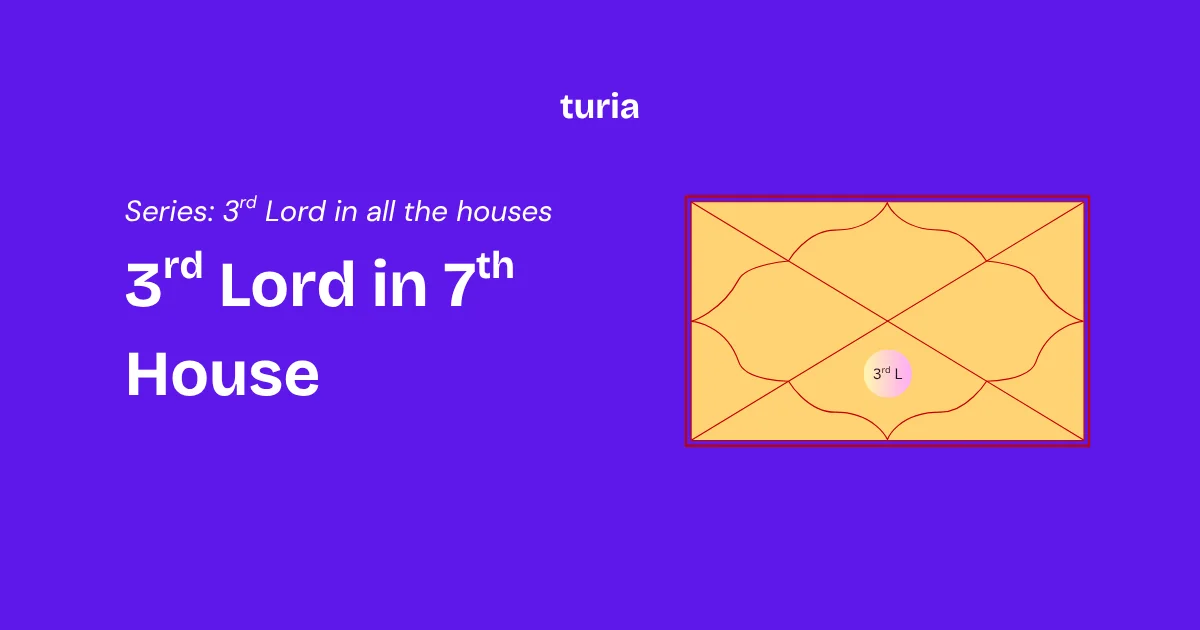
Here's the thing — the 3rd house, Parakrama Bhava, is your significator of courage, self-effort, communication, and siblings. The 7th house, Yuvati Bhava, is where marriage, spouse, and every kind of partnership — business, legal, public — live. When the lord of the first travels into the second, your effort and your voice get pulled directly into how you partner with other people. In this guide, we'll cover what that means for marriage and business, why the "maraka" fear is usually overstated, what the classical texts say word for word, and how this compares to the 3rd lord elsewhere in the chart.
Quick answer
3rd lord in the 7th house means the planet ruling your Parakrama Bhava (courage, effort, siblings, communication) sits in your Yuvati Bhava (marriage, spouse, partnerships, trade). BPHS says this native "will be interested in serving the king" — engaging with authority or institutions — and "will not be happy during boyhood, but... will be happy" later in life. Since the 3rd is an Upachaya (growth) house and the 7th is a Kendra (angle), this placement often rewards patience: marriage and partnerships that improve with maturity, real aptitude for business collaboration, and a maraka consideration that only activates with genuine affliction — not by default.
What "3rd Lord in the 7th House" Actually Means
Your 3rd house, Parakrama Bhava, governs courage, self-effort, short journeys, communication, and your relationship with siblings. The Sahajesh — the 3rd lord — is whichever planet rules the sign on your 3rd house cusp. Wherever this planet physically sits shows where your effort, voice, and courage actually get spent.
The 7th house, Yuvati Bhava, governs spouse, marriage, business partnerships, contracts, and — in classical terms — "the other": anyone you deal with on equal footing, whether in a marriage bed or a boardroom. Structurally, these two houses aren't the same weight class. BPHS classifies them plainly:
"The Kendras are specially known, as Lagn (the ascendant), Bandhu Bhava, Yuvati Bhava (the descendant) and Karm Bhava (mid-heaven)... Sahaj, Ari, Dharm and Vyaya Bhava are called Apoklimas (cadents)... Sahaj, Ari, Karm and Labh Bhava are Upachaya Bhavas." (BPHS, Ch. 11, Sl. 33-36)
So the 3rd house is both an Apoklima (a cadent, structurally quieter house) and an Upachaya Bhava — a growth house whose results are delayed but cumulative, typically strengthening from the native's 30s onward. The 7th house, by contrast, is a Kendra — one of the chart's four pillars, carrying real visibility and weight. Here, an Apoklima/Upachaya lord walks into an angle — effort and courage get channeled straight into the most public, relationship-defining house in the chart, a different flavor from 3rd lord in the 5th (Apoklima/Upachaya into a trine).
Quick disambiguation, since search results conflate the two constantly: this is not the same as the 7th lord sitting in the 3rd house. That's the reverse combination — a completely different chart, discussed separately in BPHS. Similar-sounding, structurally distinct.
The Direct Classical Verse
Here's the one line in BPHS that speaks to this exact placement, word for word:
"If Sahaj's Lord is in Yuvati Bhava, the native will be interested in serving the king. He will not be happy during boyhood, but the end of his life he will be happy." (BPHS, Ch. 24, Sl. 31)
Two things worth unpacking. First, "serving the king" — in a modern reading, working closely with authority: government service, corporate hierarchies, institutions, rather than purely independent work. Second, and more important — the life-arc note. Difficulty in boyhood (read broadly: youth), with real happiness arriving later. That lines up precisely with the 3rd house's Upachaya nature — a placement that takes its time before it pays off.
Effects on Marriage and Spouse
This is usually the first thing people want to know, so let's address it directly.
Because the 7th house carries the classical baseline of "wife, travel, trade" —
"Indications of Yuvati Bhava. Wife, travel, trade, loss of sight, death etc. be known from Yuvati Bhava." (BPHS, Ch. 11, Sl. 8)
— your 3rd lord's presence here means courage, effort, and communication become deeply entangled with the marriage itself. In practice, this often shows up as a spouse who is articulate, socially active, and genuinely a partner in effort — someone you build things with, not just share a household with. Marriages under this placement tend to involve real conversation, shared projects, and frequent short trips together rather than a quiet, static domestic routine.
The honest caveat: because the 3rd house also carries a loose association with plurality and restlessness, this placement is sometimes read as increasing the chance of more than one significant relationship, or a spouse met through effort-driven circumstances (introduced by a sibling, a colleague, during travel) rather than a traditionally arranged setup. That's a tendency, not a rule — it depends heavily on the planet's own dignity and what else aspects the 7th house.
Business Partnerships and the "Others" Theme
The 3rd and 7th houses share an interesting structural relationship: the 3rd is about your own effort, and the 7th is about others — clients, partners, the public, the marketplace. When your 3rd lord physically sits in the 7th, that relationship becomes literal instead of theoretical.
This is consistently read as one of the more favorable business signatures for the 3rd lord across all twelve houses. Your own hustle, communication skill, and courage get funneled directly into partnership-based work — joint ventures, client-facing roles, sales, consulting, or any business built on trust between two or more people rather than a solo operation. A common shape of this: someone whose own hard work quietly ends up benefiting a business partner or spouse's career more than it seems to benefit them directly at first — and only later, often in the native's 30s or beyond, does the return clearly come back around.
Foreign connections show up here too, but web-level sources often overstate this into a guarantee of settling abroad. Classically, foreign settlement leans more on the 9th and 12th houses and their lords. What the 3rd lord in the 7th reliably adds is travel tied to partnership — business trips, a partner with international connections, deals that cross borders — not settlement by itself. If the 3rd lord sits in an enemy sign here, the pull toward distance from the homeland does tend to strengthen.
Siblings' Role in This Placement
The 3rd house's baseline domain — siblings and co-borns — doesn't vanish just because its lord has moved house. BPHS is direct about what Sahaj Bhava governs at root:
"Should Sahaj Bhava be yuti with, or drishtied by a benefic, the native will be endowed with co-born and be courageous." (BPHS, Ch. 14, Sl. 1)
With the 3rd lord sitting in the 7th, siblings frequently play a genuine, practical role in the native's marriage or business life — introducing a spouse or business partner, offering counsel before a big decision, or even becoming a collaborator themselves later on. A brother or sister showing up at a pivotal relationship or business juncture is a specific, recurring pattern here, not just a vague "close family" claim.
The Maraka Question — Addressed Honestly
Since this comes up constantly in searches for this placement, let's deal with it directly instead of dancing around it.
The 7th house is classically one of two Maraka Bhavas (killer houses) in Jyotish:
"Sahaj and Randhr Bhava are the two Bhavas of longevity. The Bhavas, related to death, are the 12th from each of these, i.e. Dhan and Yuvati Bhava are Marak Bhavas... The Lords of Dhan and Yuvati Bhava, malefics in Dhan and Yuvati Bhava... are all known, as Marakas." (BPHS, Ch. 44, Sl. 2-5)
Notice precisely what this says: it's the 7th house itself and its own lord (Yuvati's Lord) that carry the primary maraka designation — not automatically every planet that happens to sit inside the 7th house. Your 3rd lord occupying the 7th house is not, by that fact alone, a killer influence. In later, secondary commentary, the 3rd (and 11th) lord is sometimes described as a mild maraka in specific dasha periods — conditional on real affliction (debilitation, malefic conjunction, weak dignity), not a default outcome of this placement.
Read plainly: this is a classical nuance worth understanding, not a reason to worry. What actually matters is the planet's overall strength and the dasha periods that activate it — the same rule that governs every placement in Jyotish.
Strength Considerations: What Actually Changes the Outcome
As always, the house tells you where; the planet's condition tells you how well.
Exalted or own-sign 3rd lord in the 7th — the strongest version. Expect a genuinely capable, communicative spouse or partner, real success in joint ventures, and courage that serves the native well in negotiations and partnership decisions.
Debilitated 3rd lord in the 7th — worth checking for Neecha Bhanga (cancellation of debilitation), since the 7th is a Kendra and cancellation conditions are relatively easier to meet in angles. Even without full cancellation, the 3rd house's Upachaya nature means outcomes here often improve steadily with age.
Combust 3rd lord — partnership and marriage themes stay muted until the relevant dasha periods bring the placement into clearer focus.
Aspected by natural benefics (Jupiter, Venus, unafflicted Mercury) — the placement's most generous form: a happy, communicative marriage, genuine success in business partnerships, and a spouse supportive of the native's efforts.
Conjunct malefics, especially Mars, Saturn, or Rahu — this is where the "mild maraka" and "multiple relationships" cautions become more relevant, along with a higher chance of friction in partnerships. Worth a proper chart reading rather than assuming the worst.
The rule stays the same across every placement in this series: don't judge from the house alone. Check the sign, the planet's dignity, its aspects, and the dasha periods that activate it.
3rd Lord in the 7th House vs Other Placements
Since this is one part of a series covering the 3rd lord across all 12 houses, it helps to see how the 7th house placement compares.
| Placement | Core theme | How it differs from the 7th house |
|---|---|---|
| 3rd lord in 1st house | Courage and effort tied directly to self-image and personality | Effort shapes identity and physical presence, not partnership dynamics |
| 3rd lord in 3rd house (own house) | Strong, self-reliant effort and sibling bonds, a conventional expression | An Upachaya lord in its own Apoklima house — solid, cumulative growth, without the Kendra "weight" the 7th adds |
| 3rd lord in 5th house | Effort and courage channeled into creativity, intelligence, and speculation | Apoklima/Upachaya lord entering a Kona (trine) — different flavor from entering a Kendra |
| 3rd lord in 7th house | Effort and courage channeled into marriage, spouse, and business partnership | The comparison point for this article |
| 3rd lord in 10th house | Effort translating into career visibility and self-made public standing | Also a Kendra, but Karm Bhava's focus is career and public status rather than personal partnership |
| 3rd lord in 6th/8th/12th house | Effort tied to service, sudden change, or loss; more volatility | Dusthana houses — a rockier path for the 3rd lord's energy compared to the Kendra strength of the 7th |
It's also worth flagging how this differs from the Lagna Lord in the 7th house, covered elsewhere in this site's house-by-house series: that placement is Kendra-to-Kendra (1st and 7th are both angles), one of the more structurally decisive placements for identity-partnership fusion. The 3rd lord in the 7th is a different animal — an Apoklima/Upachaya lord entering a Kendra — genuinely workable, often rewarding with age, but one whose weight depends more heavily on the planet's own strength.
FAQ
Does 3rd lord in 7th house mean multiple marriages?
Not automatically, but it's a recognized tendency in classical and contemporary reading, especially if the 3rd lord is weak or afflicted. The 3rd house's loose association with restlessness and plurality can extend into relationship patterns. A well-placed, dignified 3rd lord here is far more likely to show one stable, effort-driven partnership than repeated marriages.
What does 3rd lord in 7th house mean for spouse's appearance or nature?
Commonly read as an articulate, socially active spouse who becomes a genuine partner in effort — someone you build things with rather than someone who just shares a household. Expect a marriage with real conversation, shared projects, and frequent short travel together. Exact appearance depends on the specific planet and sign involved.
Is 3rd lord in 7th house good for business partnerships?
Generally, yes. Since the 3rd house is your own effort and the 7th is "others," this placement channels personal hustle and communication skill directly into joint ventures, client-facing work, and collaborative business. Because the 3rd is an Upachaya house, the strongest results often arrive from the native's 30s onward rather than early on.
Does this placement create maraka (killer-house) risk since the 7th is a maraka house?
Only conditionally. BPHS assigns the primary maraka status to the 7th house and its own lord, not automatically to every planet sitting inside it. The 3rd lord is sometimes described as a mild maraka in later life, but only when it's genuinely afflicted, weak, or badly aspected — not as a default outcome of this placement.
Does 3rd lord in 7th house indicate travel or settling abroad?
It reliably adds travel connected to partnership — business trips, a spouse or partner with international ties, cross-border deals. Full settlement abroad, though, classically depends more on the 9th and 12th houses and their lords. If the 3rd lord sits in an enemy sign in the 7th, the pull toward distance from the homeland tends to strengthen.
What's the difference between 3rd lord in 7th house and 7th lord in 3rd house?
They're reverse combinations from different starting points, and BPHS treats them separately. 3rd lord in 7th house channels effort and courage into marriage and partnership. 7th lord in 3rd house is about how marriage and "the other" affect communication, siblings, and short travel — a genuinely different chart, even though the two get confused constantly in search results.
What if my 3rd lord is debilitated in the 7th house?
Worth checking for Neecha Bhanga (cancellation of debilitation) first, since the 7th is a Kendra and cancellation conditions are comparatively easier to satisfy in angles. Even without full cancellation, the 3rd house's Upachaya nature means these outcomes often improve steadily as the native matures, rather than staying weak throughout life.
Closing
So when someone asks, "Is my 3rd lord in the 7th house risky, since the 7th is a maraka house and I keep reading about multiple marriages?" — the honest answer is: mostly, no, not by default.
This placement puts your significator of courage, effort, and communication inside the chart's most partnership-defining Kendra, and the classical texts describe a life that may take its time in youth but genuinely improves — a communicative marriage, real aptitude for business collaboration, and a maraka consideration that only bites when there's actual affliction.
What decides the real outcome is the planet involved, its dignity, its aspects, and the dasha periods that activate it — worth checking properly, rather than reacting to a reputation this placement doesn't fully deserve.
Hope this gives you a clearer picture of your own placement.