By Ram Dewani
Introduction
Someone generates their own kundali, sees their 3rd lord sitting in the 5th house, and the first thing they Google isn't "will I have creative children."
It's usually something closer to: "the 3rd house is a bad house, right? So is this placement in my 5th house also bad?"
That worry comes from a half-truth. The 3rd house does carry a slightly rough classical reputation — it's not a Kendra, not a Kona, and older texts don't always speak of it kindly. But that reputation doesn't automatically transfer to wherever its lord travels. Honestly… when the 3rd lord lands in the 5th house, something genuinely favorable tends to happen.
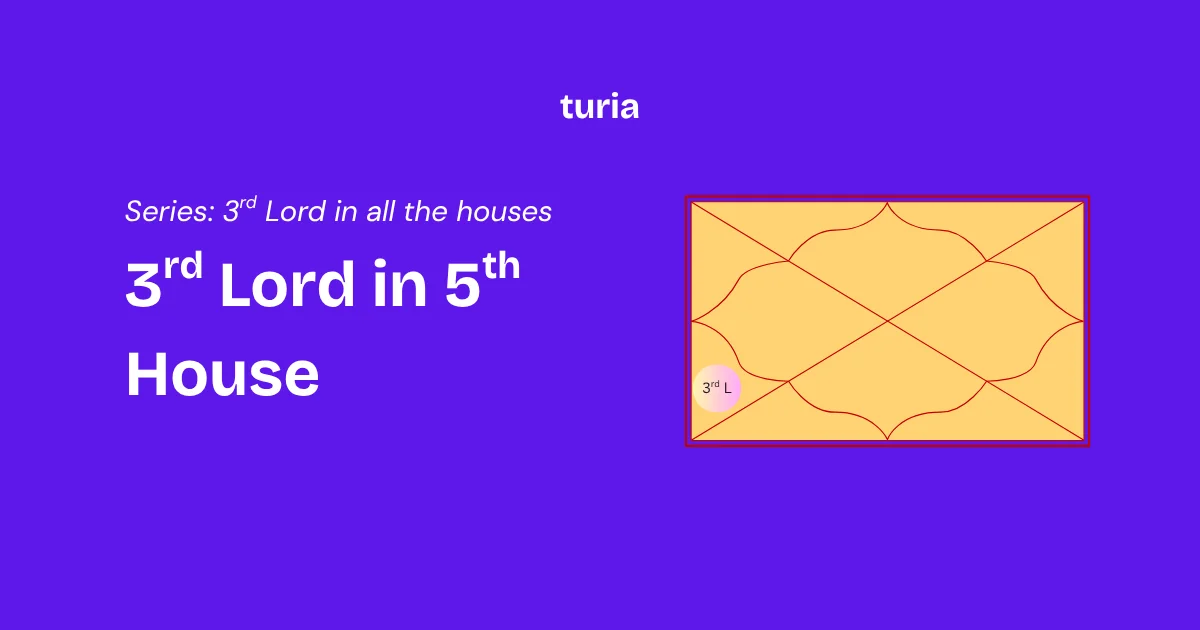
The 5th house — Putra Bhava — is one of the chart's three trines, and your 3rd lord landing there usually means your effort, courage, and communication skills get pulled into creative, intellectual, and even speculative expression. In this guide, we'll cover what this placement actually means, why the 3rd house's "mild malefic" tag isn't the full story here, how it shapes children, creativity, and speculative income, and how it compares to the 3rd lord sitting in other houses — since this is part of a 12-part series across every house.
Quick answer
3rd lord in the 5th house means the planet ruling your Parakrama Bhava (courage, self-effort, siblings, communication) sits in your Putra Bhava (children, intelligence, creativity, speculation, past-life merit). Classically, BPHS says the native "will have sons and be virtuous" — a genuinely positive result, with affliction pointing only to a strong-willed spouse, not to danger for children. Because the 3rd house is an Upachaya Bhava, this placement's benefits often strengthen with age rather than showing up early. Expect close sibling-child bonds, a talent for creative or speculative income, and — as always — outcomes that depend heavily on the planet's dignity and aspects.
What "3rd Lord in the 5th House" Actually Means
Your 3rd house is called Parakrama Bhava — the house of courage, self-effort, communication, short journeys, and your relationship with siblings. The Sahajesh, or 3rd lord, is the planet ruling the sign on your 3rd house cusp. If you're a Mesh (Aries) ascendant, Budh (Mercury) rules your 3rd house; if Vrishabha (Taurus), it's Surya (Sun) and Chandra (Moon) shares nearby rulership depending on the exact scheme used. Wherever that planet physically sits shows where your effort and communicative energy actually get spent.
The 5th house, Putra Bhava, governs children, intelligence, creativity, speculation, romance, and Purva Punya — merit carried over from a past life. Structurally, these two houses aren't equals. BPHS classifies them like this:
"Sahaj, Ari, Dharm and Vyaya Bhava are called Apoklimas (cadents)... Putr and Dharm Bhava are known by the name Kon (or trine)... Sahaj, Ari, Karm and Labh Bhava are Upachaya Bhavas." (BPHS, Ch. 11, Sl. 33-36)
So the 3rd house is both an Apoklima (a relatively weaker, cadent house) and an Upachaya Bhava — a "growth" house whose results improve with time and sustained effort. The 5th, meanwhile, is a Kona (trine), one of the three most auspicious house types in Parashari astrology. That combination matters: this isn't trine-to-trine the way Lagna Lord in the 5th house is, and it isn't Panaphara-to-trine the way 2nd Lord in the 5th house is. It's an Apoklima/Upachaya lord moving into a trine — a third, distinct flavor of "favorable," one that tends to reward patience.
Quick disambiguation, since it trips people up constantly in search results: this placement is not the same as the 5th lord sitting in the 3rd house. That's the reverse combination, and BPHS treats it separately — describing a native who is "attached to his co-born," but also "a tale bearer and a miser" (BPHS, Ch. 24, Sl. 51). Similar-sounding, genuinely different chart.
Effects on Children, Intelligence, and Creativity
This is the placement's clearest, most direct classical result.
"If Sahaj's Lord is in Putr Bhava, the native will have sons and be virtuous. If in the process Sahaj's Lord be yuti with, or receives a Drishti from a malefic, the native will have a formidable wife." (BPHS, Ch. 24, Sl. 29)
Two things stand out. First, the core result is unambiguous — good progeny, paired with personal virtue and sound moral judgment. Second, the caution attached to affliction is specific and limited: a "formidable" (strong-willed, difficult) spouse — not a warning about the children themselves, and not a threat to wealth or longevity. That's worth sitting with for a second, because it's exactly the kind of nuance that gets flattened online into a vague "this placement can be risky" line.
Baseline, the 5th house's own signification reinforces this reading. BPHS's dedicated chapter on Putra Bhava opens with:
"If the Lords of Lagn and Putr are in their own Rāśis, or in an angle, or in a trine, one will enjoy thorough happiness through his children." (BPHS, Ch. 16, Sl. 1-3)
Your 3rd lord isn't the 5th lord itself, but it's now physically occupying the house of children — so its own significations (courage, effort, communication) blend into how those children, and that intelligence, actually express themselves. In practice, this often shows up as children who are articulate, courageous, or entrepreneurial, and a native whose own intellect leans toward expressive or communicative skill rather than quiet, solitary study.
Siblings, Effort, and How They Actually Show Up Here
The 3rd house's baseline domain doesn't disappear just because its lord has moved. BPHS is direct about what Sahaj Bhava governs at its root:
"Should Sahaj Bhava be yuti with, or drishtied by a benefic, the native will be endowed with co-born and be courageous." (BPHS, Ch. 14, Sl. 1)
With the 3rd lord sitting in the 5th, courage and sibling-connection get filtered through Putra Bhava's creative, intellectual lens. In practice, this frequently shows up as siblings and children who are close to each other — not just emotionally, but through shared hobbies, creative projects, or even business collaboration. A younger sibling who becomes a co-founder. A brother who ends up mentoring the native's own children. It's a specific, recurring pattern rather than a vague "family closeness" claim.
Phaladeepika cross-checks the same territory independently:
"The names given...to third house are... army valour, prowess and brother... The fifth house deals with... intelligence, knowledge of the future... progeny... Vedic knowledge and other religious scriptures." (Phaladeepika, Ch. 1, Sl. 11-12)
Courage and prowess (3rd) landing inside intelligence and knowledge (5th) is a genuinely good combination for anyone whose work depends on both nerve and intellect — teaching under pressure, writing on deadline, or presenting ideas persuasively in front of people.
Speculation, Money, and Calculated Risk
The 5th house is the classical house of speculation — trading, the stock market, and any venture where the payoff isn't guaranteed upfront. With the 3rd lord — your significator of effort, courage, and communication — physically present here, speculative activity tends to feel less like blind gambling and more like a skill the native actively develops.
This tracks with how the placement shows up in practice: natives often display real flair for calculated risk, whether that's trading, a creative venture with uncertain returns, or a business built on communication skills (sales, media, content, consulting). The 3rd house's association with effort means this rarely feels effortless or lucky — it feels earned, the result of genuinely working at reading markets or refining a craft.
The honest caveat, consistent with the 3rd house's more mixed classical reputation: if the 3rd lord is weak or heavily afflicted here, that same appetite for risk can just as easily produce losses through the same channels — impulsive trades, creative ventures abandoned midway, or mental strain from constantly chasing an uncertain outcome. The direction depends on the planet's dignity, not the placement alone.
Is the 3rd House's "Mild Malefic" Reputation a Problem Here?
Here's the fear that usually brings people to this article, so let's deal with it directly instead of dancing around it.
The 3rd house is often called a mild malefic or Trishadaya-adjacent house in casual commentary — it's an Apoklima, not a Kendra or Kona, and its natural significations (effort, struggle, short travel) are sometimes framed as "lesser" compared to the trines and angles.
"Sahaj, Ari, Karm and Labh Bhava are Upachaya Bhavas." (BPHS, Ch. 11, Sl. 33-36)
Notice what this classification actually says: Upachaya houses are growth houses. Their results are not weak — they're delayed and cumulative. A planet's placement connected to an Upachaya Bhava tends to show its strongest results as the native matures, often from the early-to-mid 30s onward, rather than early in life. That's a structural fact, not a value judgment, and it's the opposite of a warning.
So when your 3rd lord sits in the 5th — a trine — you're combining a house that rewards patience and effort with a house that's inherently auspicious. If anything, that's a reason for optimism about how this placement ages, not a reason to expect trouble. The genuine caution here isn't the 3rd house's reputation; it's the same caution that applies to every placement in Jyotish — check the planet's actual condition before assuming either the best or the worst.
Strength Considerations: What Actually Changes the Outcome
As with every placement, the house tells you where; the planet's condition tells you how well.
Exalted or own-sign 3rd lord in the 5th — the strongest version. Expect genuine creative or intellectual talent, courage that serves the native well in speculative decisions, and children who are confident and articulate.
Debilitated 3rd lord in the 5th — since the 5th is a trine, this is a real candidate for Neecha Bhanga (cancellation of debilitation), especially if the sign's dispositor is well-placed. Even without full cancellation, practical examples show debilitated 3rd lords here still producing strong creative outcomes when the sign's ruling planet supports it — a debilitated Surya as 3rd lord sitting in Venus's sign in the 5th, for instance, is often read as still favoring a creative career.
Combust 3rd lord — the placement's benefits get muted until the relevant dasha periods activate more clearly.
Aspected by natural benefics (Jupiter, Venus, unafflicted Mercury) — expect the placement's most generous form: genuine happiness through children, steady creative or speculative income, and courage that stays measured rather than reckless.
Conjunct malefics, especially Mars, Saturn, or Rahu — speculative activity becomes genuinely riskier, and the "formidable spouse" caution from BPHS Ch. 24, Sl. 29 becomes more likely to show up as real friction at home. Worth a proper chart reading rather than assuming either extreme.
The single most important rule: don't judge this placement from the house alone. Check the sign, the planet's own dignity, its aspects, and the dasha periods that actually activate it.
3rd Lord in the 5th House vs Other Placements
Since this is one part of a series covering the 3rd lord across all 12 houses, it helps to see how the 5th house placement compares.
| Placement | Core theme | How it differs from the 5th house |
|---|---|---|
| 3rd lord in 1st house | Courage and effort tied directly to self-image and personality | Effort shapes identity and physical presence, not creative or speculative expression |
| 3rd lord in 3rd house (own house) | Strong, self-reliant effort and sibling bonds, but a more conventional expression | An Upachaya lord in its own house — solid, cumulative growth, without the trine "lift" the 5th house adds |
| 3rd lord in 5th house | Effort and courage channeled into creativity, intelligence, and speculation | The comparison point for this article |
| 3rd lord in 11th house | Effort translating into gains, networks, and multiple income streams | 11th is a house of gains generally; 5th is more specifically about creative and speculative channels |
| 3rd lord in 6th/8th/12th house | Effort tied to service, sudden change, or loss; more volatility | Dusthana houses — a rockier path for the 3rd lord's energy compared to the trine ease of the 5th |
It's also worth flagging how this differs from the Lagna Lord in the 5th house, covered elsewhere in this site's house-by-house series: that placement is trikona-to-trikona (1st and 5th are both trines), making it one of the most structurally auspicious combinations possible. The 2nd Lord in the 5th house is a Panaphara-to-trine placement. The 3rd lord in the 5th is a third distinct flavor — an Apoklima/Upachaya lord entering a trine — genuinely favorable, but one whose full benefits often take longer to arrive.
FAQ
Does 3rd lord in 5th house guarantee good children?
Not a guarantee, but a strong classical indicator. BPHS states directly that this placement brings sons and personal virtue to the native. The actual expression depends on the planet's dignity, aspects, and the dasha periods that activate it — the placement sets the direction, not the exact outcome.
Is this a bad placement since the 3rd house is called a mild malefic house?
Generally no. The 3rd house's Upachaya classification means its results are delayed and cumulative, not weak — they tend to strengthen with age. Combined with the 5th house's trine status, this placement is structurally favorable; the "mild malefic" tag describes timing, not quality.
Can this placement bring success in speculation or stock trading?
Yes, this is one of its more distinctive features. The 5th house governs speculation, and with the 3rd lord — your significator of effort and courage — sitting there, calculated risk-taking becomes a genuinely developed skill rather than blind luck. A weak or afflicted 3rd lord here can just as easily mean losses through impulsive risk-taking instead.
What's the difference between 3rd lord in 5th house and 5th lord in 3rd house?
They're reverse combinations from different starting points, and BPHS treats them separately. 3rd lord in 5th emphasizes good children, virtue, and creative or speculative expression. 5th lord in 3rd (BPHS Ch. 24, Sl. 51) emphasizes closeness with siblings alongside miserliness and gossip — similar-sounding but structurally distinct.
Does this placement affect the bond with siblings?
Yes, often positively. Since the 3rd house's baseline domain is siblings and courage, this placement frequently shows up as close sibling-child relationships — shared creative projects, hobbies, or even business collaboration between siblings and the native's children.
What if my 3rd lord is debilitated in the 5th house?
Less concerning than it sounds. Since the 5th is a trine, a debilitated 3rd lord here is a genuine candidate for Neecha Bhanga (cancellation of debilitation), especially if that sign's ruling planet is well-placed elsewhere. Practical chart examples show creative talent often persisting even without full cancellation.
Does age matter for when this placement's results show up?
Yes, meaningfully. Because the 3rd house is an Upachaya Bhava, placements connected to it typically strengthen as the native matures — often becoming clearly visible from the early-to-mid 30s onward, rather than showing their full effect earlier in life.
Closing
So when someone asks, "Is my 3rd lord in the 5th house something to worry about because the 3rd house has a rough reputation?" — the honest answer is: not for the reason they're usually worried about.
This placement puts your significator of courage and effort inside one of the chart's three trine houses, and classical texts are direct about the result — good children, personal virtue, and a genuine talent for creative or speculative expression that tends to deepen with age rather than fade. The 3rd house's Upachaya nature isn't a flaw here; it's the reason this placement often rewards patience.
What actually shapes the outcome is the planet involved, its dignity, its aspects, and the periods that activate it. That's worth checking properly, rather than reacting to a reputation the 3rd house doesn't fully deserve in this context.
Hope this gives you a clearer picture of your own placement.