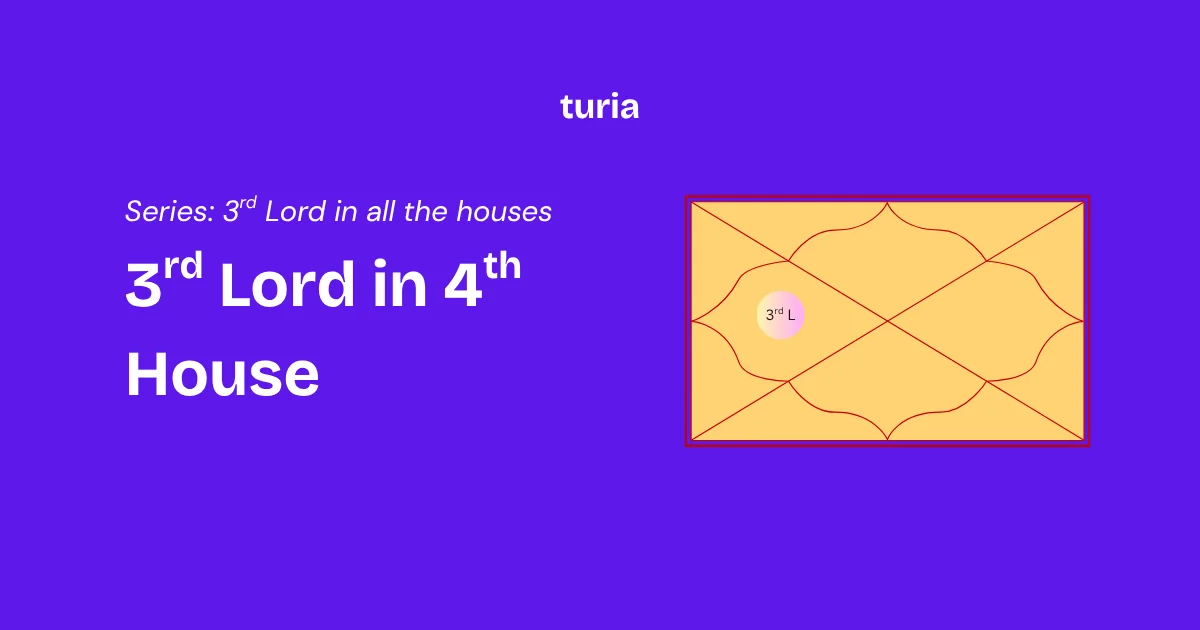
Introduction
Someone runs their own kundali, spots the 3rd lord sitting in the 4th house, and the first question isn't usually about siblings or courage.
It's almost always: "Does this mean I'll get my own house? Or does it mean trouble with my mother?"
Both instincts are half-right, and that's exactly why this placement gets flattened online into either a blanket "great for property" line or a vague warning about the mother's health.
The 3rd house — Parakrama Bhava — is your house of courage, self-effort, communication, and siblings. The 4th house — Sukha Bhava, also called Bandhu Bhava — is home, mother, property, vehicles, and inner peace. When your 3rd lord physically sits in the 4th, your own hustle becomes the actual engine behind your domestic comfort. Not inheritance. Effort. In this guide, we'll cover what BPHS actually says about this placement, why it isn't automatically the "Maha Yoga" some blogs imply, what changes when the 3rd lord is afflicted, and how it compares to the 3rd lord sitting elsewhere in the chart.
Quick answer
3rd lord in the 4th house places your significator of effort, courage, and communication (Parakrama Bhava) inside your house of home, mother, and property (Sukha Bhava). BPHS is direct: the native will be "happy, wealthy and intelligent" (Ch. 24, Sl. 28) — comfort and property that are largely self-earned rather than inherited. The one classical caveat baked into that same sloka is a difficult spouse. If this placement also involves a full sign exchange with the 4th lord, it forms a Kahala Yoga — not one of the 28 Maha Yogas, but a yoga of hard-won, sometimes fluctuating prosperity. Afflicted, expect friction with the mother's health or property disputes with siblings instead of ease.
What "3rd Lord in the 4th House" Actually Means
Your 3rd house is Parakrama Bhava — courage, self-effort, communication, short journeys, and your relationship with siblings. The Sahajesh, or 3rd lord, is the planet ruling whichever sign falls on your 3rd house cusp. BPHS sets out the baseline:
"Should Sahaj Bhava be yuti with, or drishtied by a benefic, the native will be endowed with co-born and be courageous." (BPHS, Ch. 14, Sl. 1)
The 4th house, Sukha Bhava, governs home, mother, property, vehicles, education, and inner peace. Structurally, it's a Kendra (angle) — one of the four most powerful houses in the chart, alongside the 1st, 7th, and 10th. The 3rd house, by contrast, is classified as both an Apoklima (a cadent, relatively weaker house by position) and an Upachaya Bhava — a growth house whose results improve with sustained effort and age:
"Sahaj, Ari, Dharm and Vyaya Bhava are called Apoklimas (cadents)... Chaturasras are Bandhu and Randhr Bhava... Sahaj, Ari, Karm and Labh Bhava are Upachaya Bhavas." (BPHS, Ch. 11, Sl. 33-38)
That combination is worth sitting with: an effort-and-growth house lord physically moving into one of the chart's strongest angles. It's your own initiative getting planted directly into the house of home and roots.
Quick disambiguation, since it trips up almost every reader landing on this topic: this is not the same as the 4th lord sitting in the 3rd house. That's the reverse placement, with its own distinct result — property and domestic matters filtered through effort and communication, rather than the other way around. Similar-sounding, genuinely different chart.
The Core Classical Result: Self-Made Comfort
This is the placement's clearest, most direct classical statement, and it should anchor everything else in this article.
"If Sahaj's Lord is in Bandhu Bhava, the native will be happy, wealthy and intelligent, but will acquire a wicked spouse." (BPHS, Ch. 24, Sl. 28)
Three things stand out. First, "happy, wealthy and intelligent" is a strong, unambiguous core result. Second, this wealth reads as earned rather than inherited, because the source planet is the 3rd lord — your significator of personal effort — not the 4th lord or a natural benefic simply occupying Bandhu Bhava by chance. Third, the caveat is specific and limited: "a wicked spouse," not danger to health, wealth, or the mother. Worth being honest about that rather than ignoring it, or overplaying it into a marriage-doom warning the way a couple of competitor pages do.
Modern practitioner consensus, cross-checked across several ranking pages, converges on the same reading independently: natives with this placement tend to be "rich, learned, and clever… self-made" people who "achieve success, happiness, and materialistic gains like properties and vehicles through their self-efforts." A rare case of the classical text and the modern web agreeing almost word for word.
Property, Vehicles, and the Home
The 4th house's own domain — land, houses, conveyances — gets a natural boost when the planet occupying it is your significator of effort and initiative. Phaladeepika's description of a strong, well-placed 4th house (the Jaladhi Yoga condition) reinforces why this combination reads so favorably for property themes generally:
"If the fourth house is similarly disposed the Yoga formed is known as Jaladhi. The person born with this Yoga will be rich in cattle wealth and grains. He will own a beautifully constructed mansion full of relatives." (Phaladeepika, Yoga Adhyaya)
In an Indian context, this frequently plays out as a recognizable pattern: the person who finances their own flat through freelancing income or a side business — not a parent's down payment. Someone who builds an extension on the family home from their own earnings, or whose first vehicle was bought, not gifted. The 4th house also governs agricultural land classically, so for natives with rural or semi-urban roots, this can show up as income tied to ancestral land the native personally works to develop, rather than land that simply sits idle.
The honest caveat: because the 3rd house is an Upachaya Bhava, these gains often arrive later rather than early — picking up from the late 20s onward and compounding through the 30s and 40s, rather than showing up as an inheritance-style windfall in youth.
Mother, Siblings, and the Family Picture
Bandhu Bhava is, before anything else, the house of the mother. BPHS's own chapter on this house links its strength directly to her wellbeing:
"If Bandhu Bhava is occupied by a benefic, while its Lord is in his exaltation Rāśi, as the indicator of mother is endowed with strength, the native will have a long-living mother." (BPHS, Ch. 15, Sl. 6)
With the 3rd lord — your significator of communication and effort — sitting here, the mother-child relationship frequently takes on a specific character: close, frequent, almost daily conversation, and a mother who genuinely shapes how the native learns to speak and argue their point. "I call my mother every single day" is a common, recognizable version of this.
Siblings don't disappear from the picture either, since the 3rd house's baseline domain remains courage and co-borns wherever its lord travels:
"Happiness in this respect will come to pass, if Mangal, or Sahaj's Lord is in an angle, or in a trine, or in exaltation, or friendly divisions." (BPHS, Ch. 14, Sl. 5-6)
Since the 4th is precisely such an angle, this supports a favorable sibling picture by default — younger siblings who prosper, and a native who takes an active, almost parental interest in their wellbeing, often through jointly investing in family property.
The Kahala Yoga Question: Is This a Maha Yoga?
Here's the differentiator most articles on this exact topic get wrong or blur entirely, so it deserves its own clearly labeled section.
When two house lords sit in each other's houses, that's a Parivartana Yoga — a mutual exchange. Phaladeepika catalogs exactly 66 such exchanges across the chart and is explicit that they don't all carry equal weight:
"8 such Parivartana Yogas are caused by the lord of the 3rd and are termed as Kahala yogas. The remaining 28 are known as Maha Yogas." (Phaladeepika, Yoga Adhyaya)
And specifically, among the eight Kahala Yogas listed:
"(3) the lord of the 4th in the 3rd and the lord of the 3rd in the 4th..." (Phaladeepika, Kahala Yoga list)
So if your 3rd lord sits in the 4th house and your 4th lord simultaneously sits in the 3rd house — a full mutual exchange, not just a one-way placement — that specific combination is a Kahala Yoga, not one of the 28 Maha Yogas. Several generic yoga blogs get this right in isolation but almost never connect it back to this exact search query. What does Kahala Yoga actually promise?
"The native with Kahala Yoga will occasionally be haughty and sometimes sweet in his speech. There will be occasions when he will be very prosperous and then will be driven to poverty, unhappiness and misery." (Phaladeepika, Kahala Yoga effects)
An honest, fluctuating picture — prosperity that swings, rather than arrives and stays. Earned through real effort, and it can dip as easily as it rises. Phaladeepika softens this elsewhere for a strength-qualified version: when the exchanged planets are well-dignified — exalted, own sign, or otherwise strongly placed — the same yoga instead brings someone "prosperous, noble, benevolent, kind and propitious… very popular in the public." So the swings trend positive when the planets are strong, and volatile when they aren't.
Important precision point: most readers with "3rd lord in 4th house" don't have the full reciprocal exchange — the 4th lord sits somewhere else entirely. That's simply the BPHS Ch. 24 Sl. 28 result on its own terms, not Kahala Yoga. Only check for Kahala Yoga specifically if your 4th lord also sits in your 3rd house.
When It Turns Difficult: Affliction and the Mother's Health
No placement in Jyotish is unconditionally good, and this one has a genuine technical reason to be cautious under bad conditions.
The 3rd house sits exactly twelve houses from the 4th — the house of loss and expenditure counted from Bandhu Bhava's own position. That's part of why an afflicted 3rd lord sitting in the 4th is treated seriously rather than dismissed. A weak, combust, or heavily malefic-aspected 3rd lord here tends to show up as friction with the mother's health, restlessness at home rather than the "inner peace" Sukha Bhava is meant to provide, or — the theme that recurs most consistently across modern practitioner accounts — property and land disputes between siblings.
Overindulgence is another recurring pattern: a native who, especially in early adulthood, overextends financially on property, vehicles, or renovation before the means to sustain it are really there — consistent with an Upachaya-ruled house pushing for results before its natural, later-arriving timeline supports them.
Career, Communication, and Working From Home
Because the 3rd lord governs communication and effort, and it's now anchored inside the house of home, a specific career pattern shows up often: work that happens from the home, or work that blends communication skill with property-related subject matter. Think a consultancy run out of a spare room, a YouTube channel or tuition class recorded at home, a family business operated from the ground floor, or a career in real estate and property dealing.
This isn't a guarantee — it's a tendency, worth checking against the rest of the chart, particularly the 10th house and its lord.
Strength Considerations: What Actually Changes the Outcome
As always, the house tells you where; the planet's condition tells you how well.
Exalted or own-sign 3rd lord in the 4th — the strongest version. Expect genuinely self-made property, a warm bond with the mother, and siblings who prosper alongside the native.
Debilitated 3rd lord in the 4th — check first for Neecha Bhanga (cancellation of debilitation), especially if the sign's dispositor is well-placed in a Kendra or Trikona. Even without full cancellation, the effort-based drive doesn't disappear — it just takes longer to show results.
Combust 3rd lord — comfort and property gains stay muted until the relevant dasha periods bring the planet's strength forward.
Aspected by natural benefics (Jupiter, Venus, unafflicted Mercury) — the most generous form: real inner peace at home and property gains that arrive without excessive struggle.
Conjunct malefics, especially Saturn, Mars, or Rahu — the affliction pattern above becomes more likely: mother's health concerns or sibling-property friction.
Don't judge this placement from the house alone. Check the sign, the planet's dignity, its aspects, and the dashas that actually activate it.
3rd Lord in the 4th House vs Other Placements
Since this is one part of a series covering the 3rd lord across all 12 houses, it helps to see how the 4th house placement compares.
| Placement | Core theme | How it differs from the 4th house |
|---|---|---|
| 3rd lord in 1st house | Courage and effort tied directly to self-image and personality | Effort shapes identity and physical drive, not domestic comfort or property |
| 3rd lord in 4th house | Effort channeled into home, property, and the mother relationship | The comparison point for this article |
| 3rd lord in 10th house | Self-made career growth, an Upachaya lord entering another Upachaya | Effort compounds into public standing and career rather than private domestic peace |
| 3rd lord in 11th house | Effort translating into gains, networks, and multiple income streams | 11th is a house of gains and social circle; 4th is specifically home and roots |
| 3rd lord in 6th/8th/12th house | Effort tied to service, sudden change, or loss; more volatility | Dusthana houses — a rockier path for the 3rd lord's energy compared to the Kendra stability of the 4th |
Worth flagging the reverse combination once more, since it's the most common point of confusion in search results: the 4th lord in the 3rd house channels property and domestic themes through effort and short travel — a distinct chart, sometimes linked to foreign settlement, covered separately. If your 4th lord also sits in your 3rd house while your 3rd lord sits in your 4th, that's the Kahala Yoga condition above — otherwise, you simply have the BPHS Ch. 24 Sl. 28 result on its own.
FAQ
Does 3rd lord in 4th house mean I'll get my own house or property?
Often, yes, but earned rather than inherited. BPHS ties this placement to wealth and intelligence, and modern practitioner consensus consistently links it to property, vehicles, and material comfort achieved through personal effort. The dignity of the 3rd lord decides how smoothly that comfort actually arrives.
Does 3rd lord in 4th house affect the relationship with the mother?
Yes, usually in a close, communicative way — frequent contact and a mother who shapes the native's speaking and reasoning style. Under affliction, BPHS's link between Bandhu Bhava's strength and the mother's wellbeing means health concerns or emotional distance are the caution instead.
Is 3rd lord in 4th house the same as Kahala Yoga?
Not automatically. Kahala Yoga requires a full mutual exchange — the 3rd lord in the 4th house and the 4th lord in the 3rd house at the same time. Without that reciprocal placement, you simply have the standalone BPHS Ch. 24 Sl. 28 result: happy, wealthy, and intelligent.
Is the 3rd-4th exchange a Maha Yoga?
No, a commonly blurred point. Phaladeepika separates all eight exchanges involving the 3rd lord into their own category, Kahala Yoga, distinct from the 28 Maha Yogas. Kahala Yoga brings hard-won, sometimes fluctuating prosperity rather than the smoother fortune Maha Yogas typically describe.
Does this placement affect siblings?
Generally favorably. Since the 3rd house's baseline domain is siblings and courage, and the 4th is a supportive angle, younger siblings often prosper alongside the native, sometimes through shared involvement in family property.
What happens if the 3rd lord is afflicted in the 4th house?
Expect friction rather than the placement's usual comfort: mother's health concerns, property or land disputes with siblings, or restlessness at home despite material comfort. This ties to a technical detail — the 3rd house is twelve houses from the 4th, the loss axis counted from Bandhu Bhava.
Does 3rd lord in 4th house support working from home or a home-based business?
Often, yes. With communication and effort anchored inside the house of home, careers run from a home office, a family business, or property-related fields are common, though this should be checked against the 10th house and its lord too.
Closing
So when someone asks, "Is 3rd lord in 4th house good for property and family?" — the honest answer is: usually yes, specifically because of your own effort, not an inheritance or a shortcut.
BPHS is direct about the core result — happy, wealthy, intelligent — with a mother relationship built on real closeness and communication. The one caution worth holding onto isn't a vague warning; it's the honest technical point that the 3rd-4th exchange forms a Kahala Yoga, not a smooth Maha Yoga, and a poorly placed 3rd lord here can turn self-made comfort into friction with the mother or siblings instead.
What decides which version you get is the planet's own dignity, its aspects, and the dasha that activates it — worth checking properly before assuming either extreme.
Hope this gives you a clearer picture of your own placement.