Introduction
The article is very good deep dive into what Saturn really means - not what the scary perception in everyone's mind. If you want a quick summary of the article, you can watch this interactive video
Before Starting…
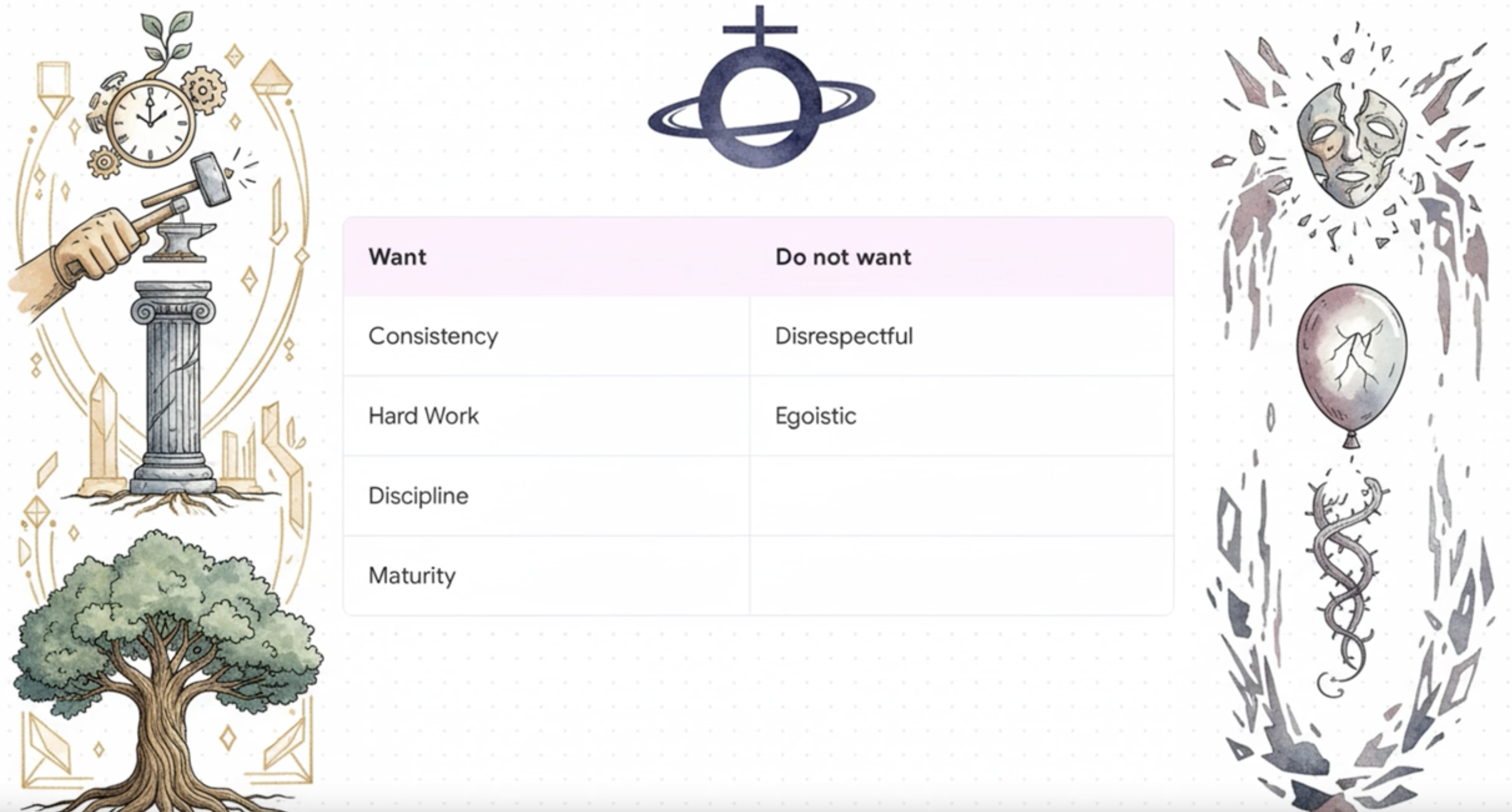
Before starting - I have a quick exercise for you. I want you to quickly place the following habits that you want in life and what you want to discard:
Consistency
Hard Work
Discipline
Disrespectful
Egoistic
Maturity
Put them into one of the columns - Want and Do not Want
Well, you get the idea - I’m assuming you’ve placed Consistency, Hard Work, Discipline, and Maturity in the “Want” section.
There’s something common in all these qualities -
They can’t be taught in a classroom. They’re life lessons.
And they’re hard.
These qualities are required for anything you want to build long term - businesses, relationships, a good career.
Because nothing in life comes easy. It requires us to move away from comfort zones. It’s hard to work sixteen hours a day, or stay disciplined when no one’s watching. But those who do have a much higher chance of success.
Since these aren’t classroom skills, there’s a teacher who comes to teach them. He’s strict. He tests your limits. But he guarantees the rewards to be lifelong and real.
He’s the only one that truly cares for your growth - Shani.
The qualities we admire - consistency, maturity, humility - are all shaped through time and pressure. And nowhere is that truth captured better than in the story of Shani Mahatmya.
The Story of Shani: The King Who Had to Learn Surrender
In the Shani Mahatmya, there’s a story about a king who had everything - power, respect, a spotless reputation for justice. His name was Vikramaditya.
One day, when the nine planetary deities gathered in his court, they asked him to rank their influence on human life. The king, confident in his wisdom, placed Saturn last. He believed that hard work and fairness could outshine fate itself.
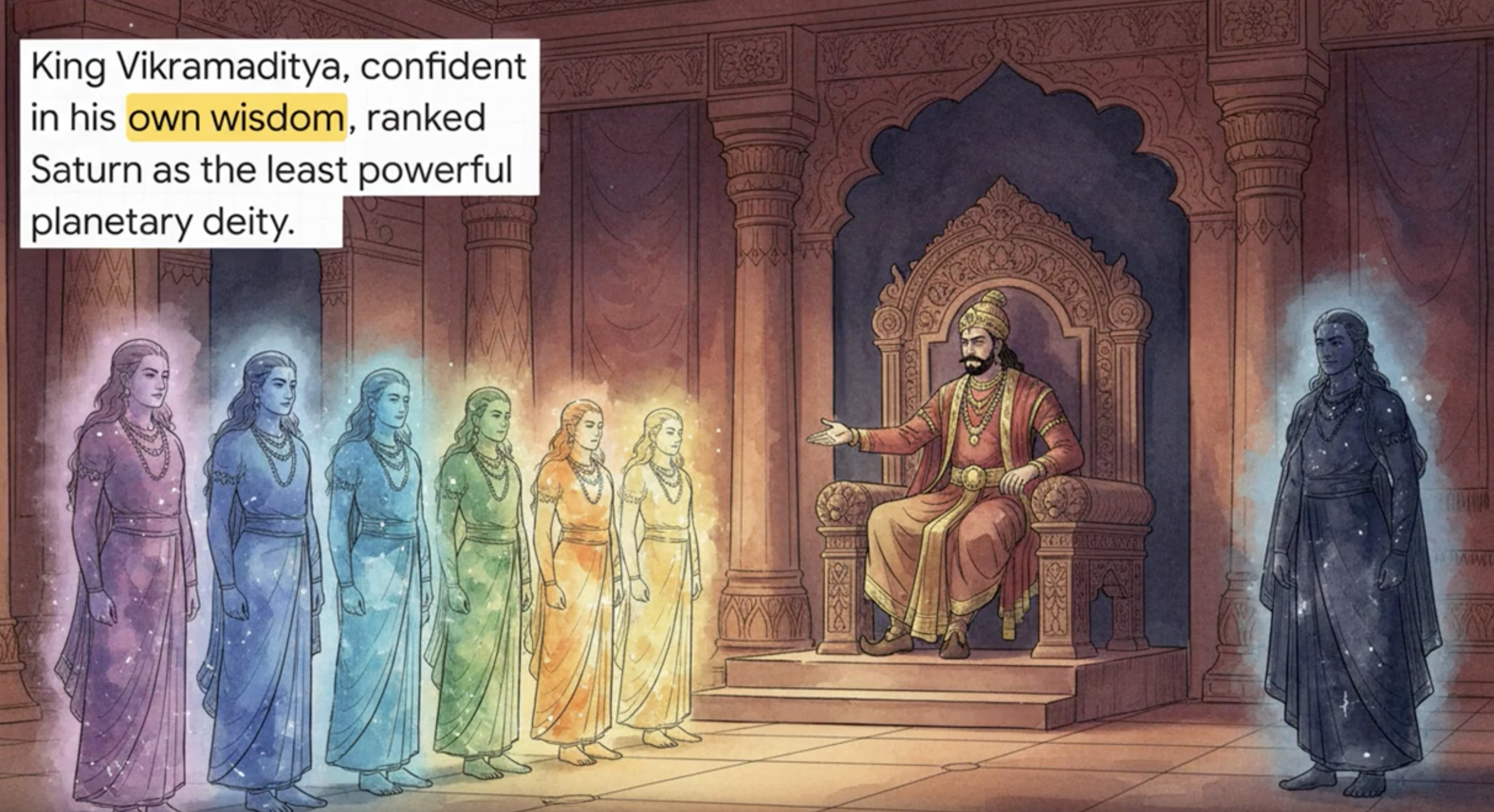
Shani didn’t argue. He only said, “Time will show you my place.”
Soon after, the king entered his Sadesati - a seven-and-a-half-year period ruled by Saturn. In a matter of time, he lost everything that had once defined him: his kingdom, wealth, power, and name. He wandered from place to place, reduced to the very vulnerability he once thought he was above.
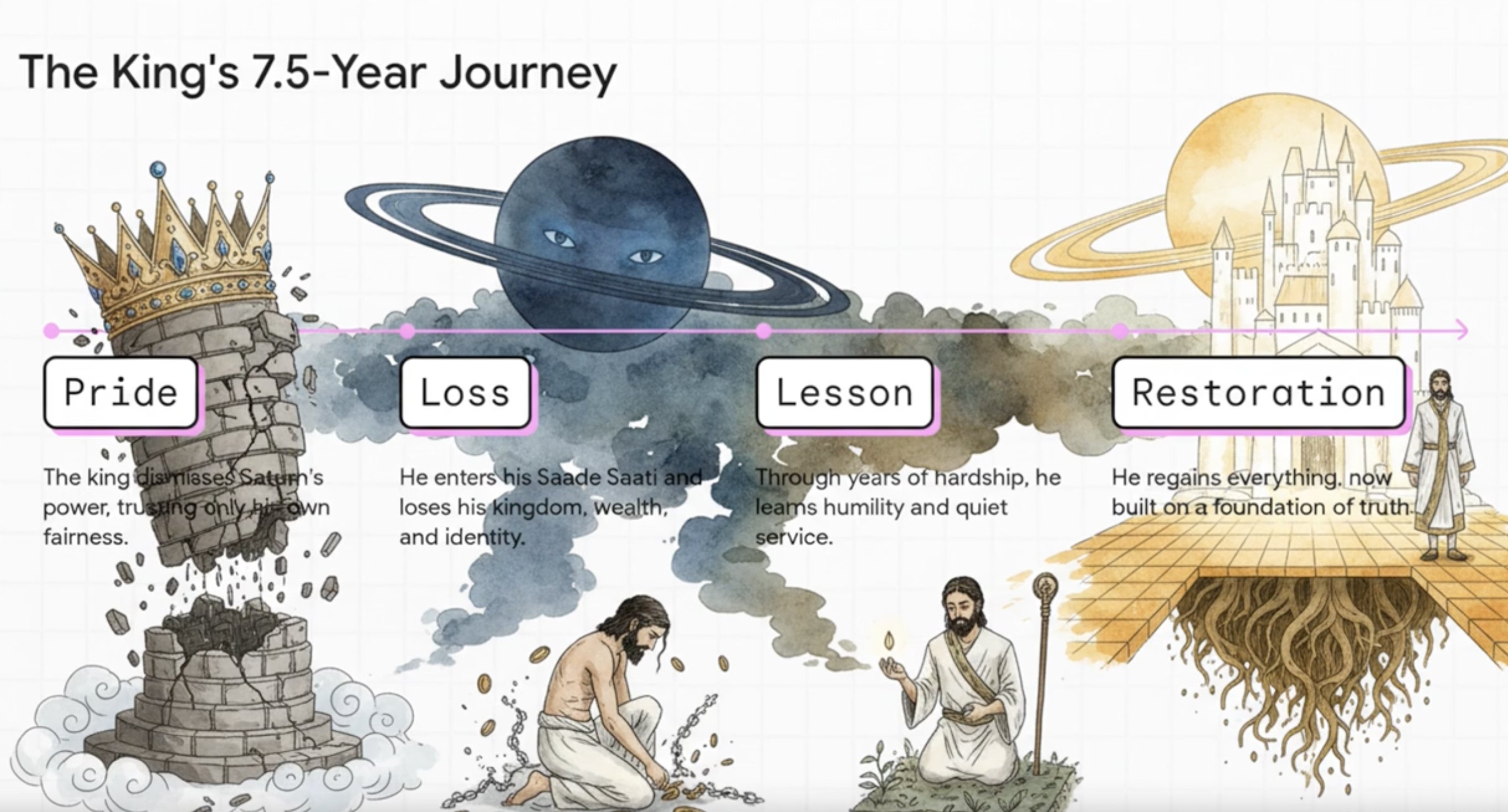
But through those years of loss, something shifted. He began to serve others quietly. He worked with his hands. He listened more than he spoke. And when the years finally passed, Saturn appeared before him and said,
“I never punished you. I only returned what your pride had forgotten - that truth lives in humility, not control.”
That’s what Saturn does. He slows you down, not to make you suffer, but to help you see what you couldn’t when life was easy. He takes away what’s built on ego, leaving only what’s built on truth.
Every Sade sati - whether it happens to a king or to you - carries that same invitation: to meet reality without resistance, and rebuild from what’s real.
Why Saturn Is Misunderstood
Most people hear the word Saturn and think: bad luck, delays, or struggle. You’ll often hear stories of Sadesati ruining lives - as if this planet’s only job is to make things hard. But that’s not how Saturn works.
Saturn’s energy feels heavy because it makes you face what you’ve been avoiding. It doesn’t let you get away with shortcuts. If there’s a weak spot in your life - a habit, a boundary, a commitment you keep breaking - Saturn will quietly expose it. Not to shame you, but to help you fix it.
It’s like a strict mentor who doesn’t raise their voice but also doesn’t let you escape the truth.
During this phase, you can’t coast on luck or charm. You have to show up - do the work, keep your word, build things that can actually last.
That’s why people call Saturn a punisher. But look closer, and it’s actually the planet that stabilizes your life. Once you pass its tests, what you build doesn’t collapse again. It becomes real - relationships that survive time, careers that rest on integrity, confidence that doesn’t need applause.
So the question isn’t, “Why is Saturn so harsh?”
It’s “What is Saturn asking me to take seriously right now?”
The Nature of Shani: Time, Karma, and Truth
If you look closely, Saturn’s lessons all come down to three words - time, karma, and truth.
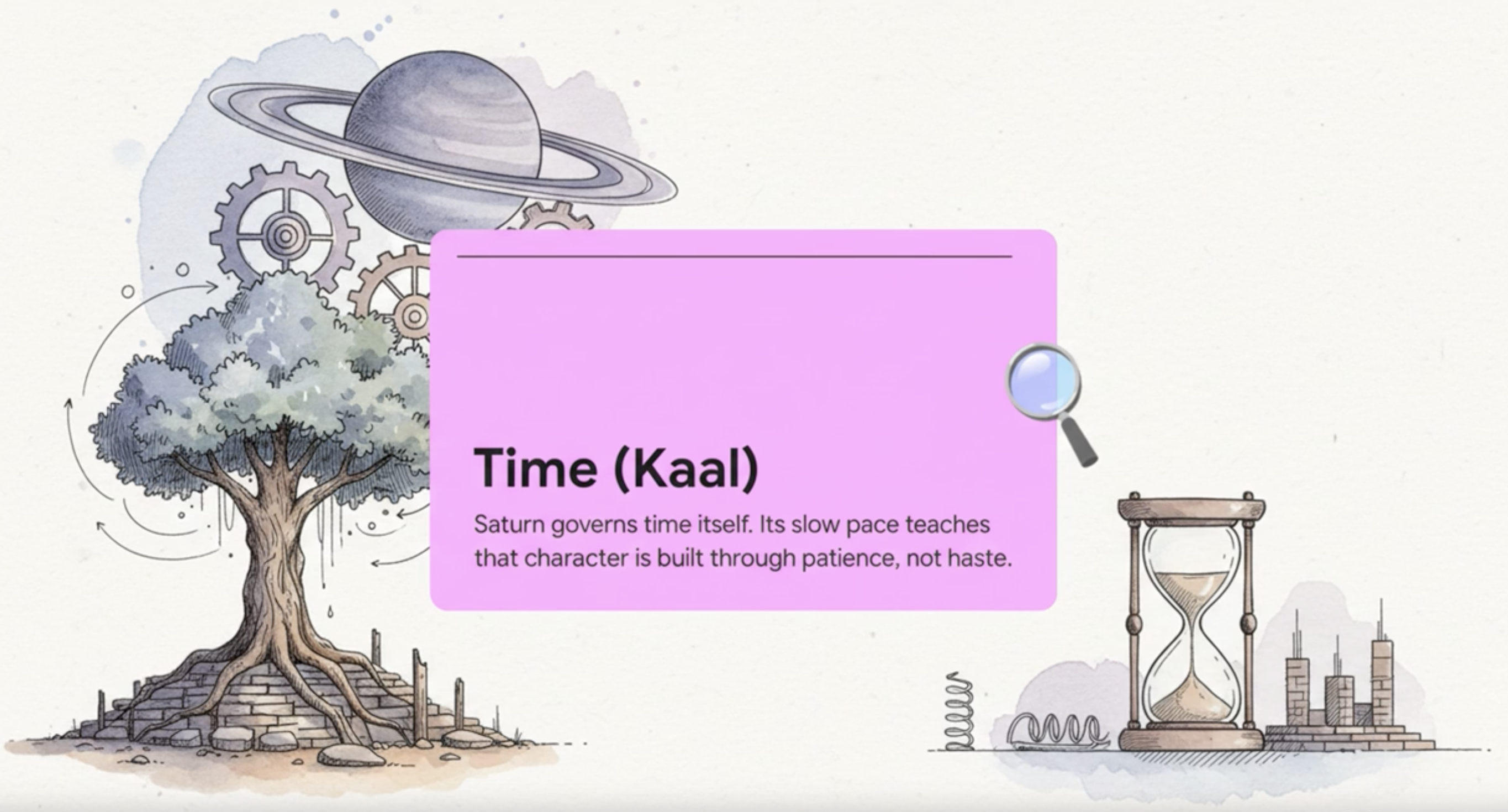
Shani governs Kaal - time itself. That’s why it moves slowly through the zodiac, spending years in each sign. It doesn’t rush; it observes. Every delay under Saturn is really an invitation to pace yourself with life instead of racing ahead of it. We think of time as the enemy - the thing that makes us wait - but for Saturn, time is how character is built.
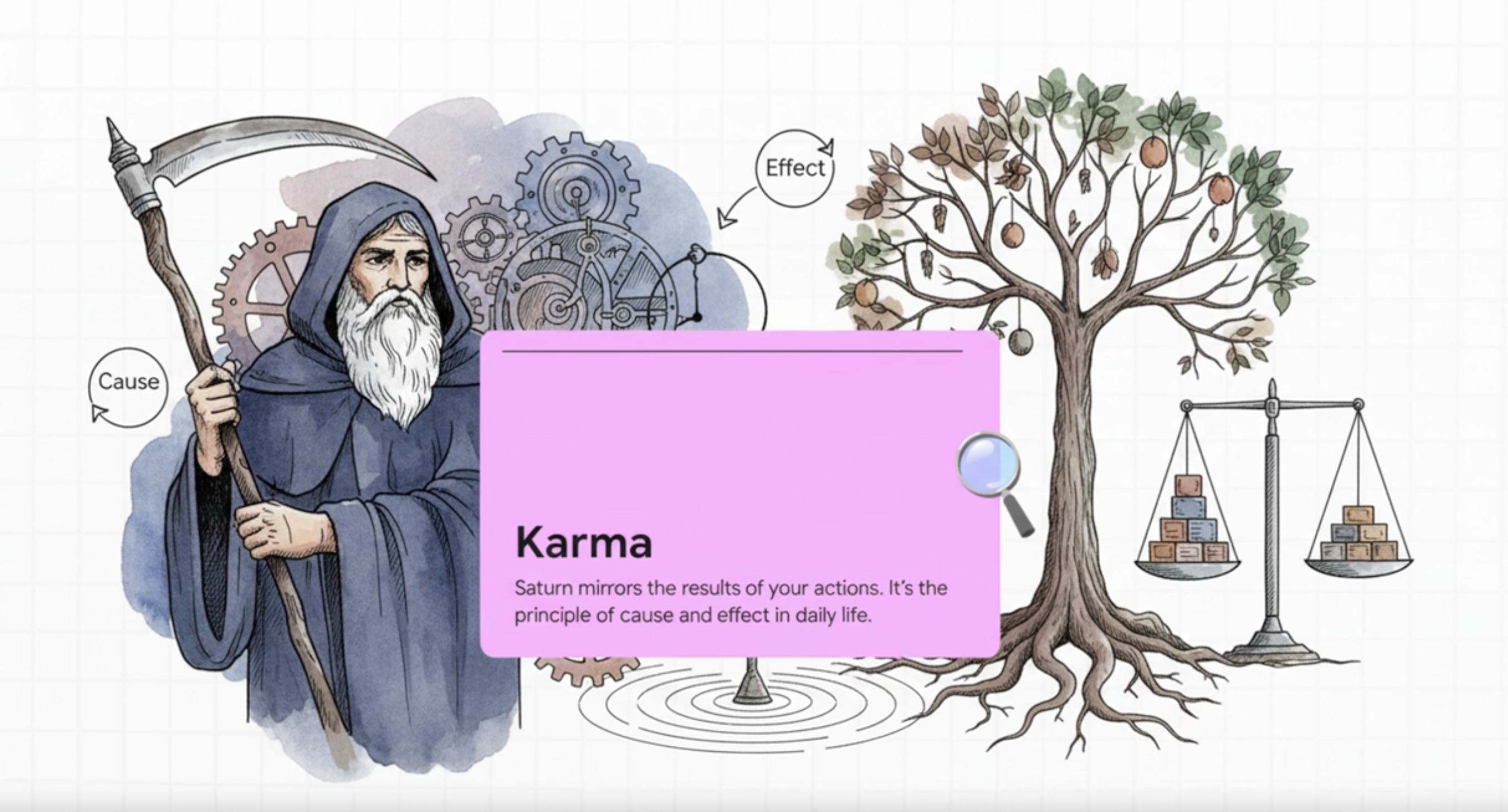
Saturn also rules karma. Not in a mystical sense, but in the plain, everyday way life works. If you avoid responsibility, consequences catch up. If you stay consistent, results compound. Saturn isn’t keeping score - it’s simply mirroring what you’ve built through your choices. That’s why people who take ownership of their lives often end up thriving during Saturn periods. The planet starts to feel like an ally when your actions align with your values.
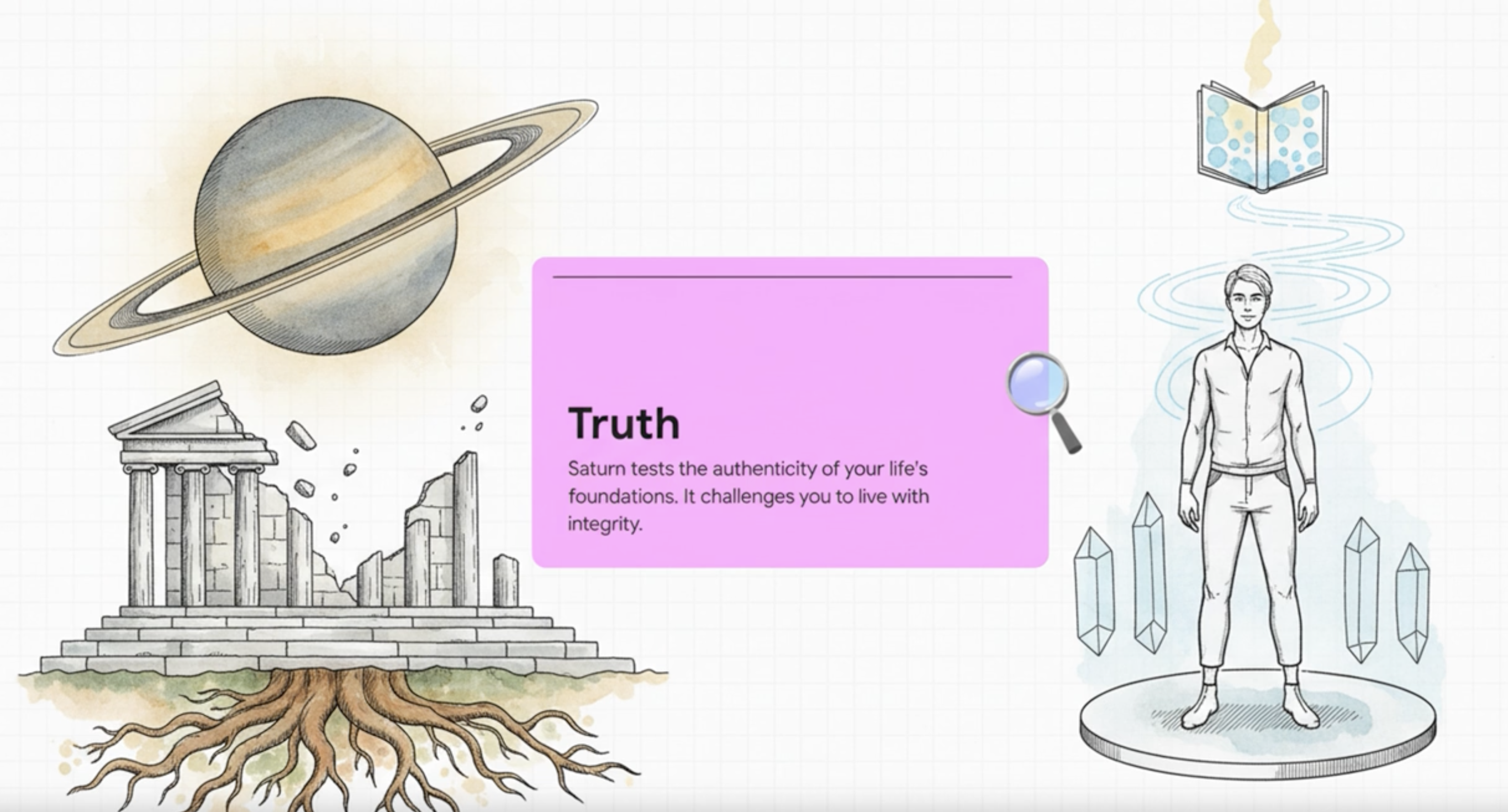
And above all, Saturn stands for truth. Not the kind you speak, but the kind you live. It tests whether your inner foundation is real or borrowed. Are your ambitions self-defined, or shaped by comparison? Are your relationships built on honesty, or comfort? When Saturn transits activate these parts of your chart, those questions don’t stay theoretical - they show up in real life, through situations that make you choose.
When you understand this, Saturn stops feeling like a punishment and starts feeling like mentorship. It’s the energy that says, “You don’t need to prove yourself - just be consistent enough to become who you say you are.”
When Saturn Tests You (Sade Sati & Saturn Mahadasha or Shani Mahadasha)
Every person meets Saturn more closely a few times in life - during Sadesati or their Saturn mahadasha / Shani mahadasha. These are phases when time itself starts to slow down, and life becomes very literal. You can’t escape the small details anymore - your habits, your discipline, your commitments. They start showing results, for better or worse.
Sade sati lasts about seven and a half years. It begins when Saturn enters the sign before your Moon and continues until it leaves the sign after. This is when your emotional life and outer responsibilities start speaking to each other. The gap between what you feel and what you do becomes harder to ignore. You might find yourself growing quieter, more selective about people, or more aware of where your energy goes.
The Saturn Mahadasha/ Shani Mahadasha, on the other hand, is more about structure. It’s a long phase - often 19 years - where you’re asked to grow up in one area of life. Sometimes it’s career; sometimes it’s self-worth, family, or health. It’s rarely dramatic at first. Instead, it builds slowly, demanding focus, follow-through, and inner steadiness.
If you resist the rhythm, it feels like friction - deadlines that never end, relationships that demand boundaries, or fatigue that pushes you toward better routines. But if you align with it, these same years often become turning points: when you learn emotional endurance, build something stable, or finally understand what commitment really means.
That’s what Saturn does best. It removes the unnecessary and keeps what can last. When you stop fighting its pace, you start moving with life instead of against it.
The Faces of Saturn: How It Works Through the 12 Houses
Wherever Saturn sits in your chart, that’s the area of life where you’ll have to earn things slowly - not because you’re denied them, but because you’re meant to build them consciously.
1st House – Self and Identity
You learn to grow into your own skin. Life may start with self-doubt or pressure to mature early. But over time, you become someone others trust - grounded, responsible, real.
2nd House – Money and Values
Security doesn’t come easily; you have to create it. This placement teaches you the difference between survival and stability - how to manage what you earn, and how to speak with intention.
3rd House – Communication and Courage
You find your voice slowly. There’s hesitation at first, but Saturn here turns you into someone whose words carry weight - practical, measured, and reliable. Consistency becomes your quiet power.
4th House – Home and Emotional Roots
You might grow up feeling emotionally self-reliant. Saturn teaches you to build your own sense of safety, to become your own anchor. Home becomes something you create through steadiness, not escape.
5th House – Creativity and Expression
Joy takes structure here. You can’t force inspiration - it grows through patience. Over time, you learn that real creativity comes from discipline, not mood. What you build lasts.
6th House – Work and Health
You’re wired for service and systems. Life tests your boundaries around work and burnout until you learn balance. Saturn rewards small, daily discipline - showing up, one steady act at a time.
7th House – Relationships and Commitment
You don’t rush into partnership. Saturn makes you see relationships as responsibility, not romance alone. You attract maturity - or you learn it through experience.
8th House – Transformation and Control
This is Saturn’s deep lab. It brings themes of loss, secrecy, or emotional power until you learn to face what you fear. Out of that comes resilience - the kind that can’t be taught, only earned.
9th House – Belief and Higher Learning
Faith becomes practical. Instead of blind optimism, you develop conviction grounded in study, effort, and lived experience. You learn to walk your talk.
10th House – Career and Legacy
The climb is slow, but it’s real. Saturn here asks for consistency, humility, and skill. Recognition often comes later - but it’s lasting, and built on integrity, not noise.
11th House – Community and Long-Term Goals
You prefer depth over popularity. Saturn teaches you to build meaningful connections and networks that serve purpose, not validation. You learn the value of steady collaboration.
12th House – Solitude and Surrender
You’re pushed to face what can’t be controlled - endings, solitude, or emotional release. Saturn here teaches quiet mastery: how to stay grounded even when nothing feels certain.
The Astronomical Saturn: The Planet of Time and Motion
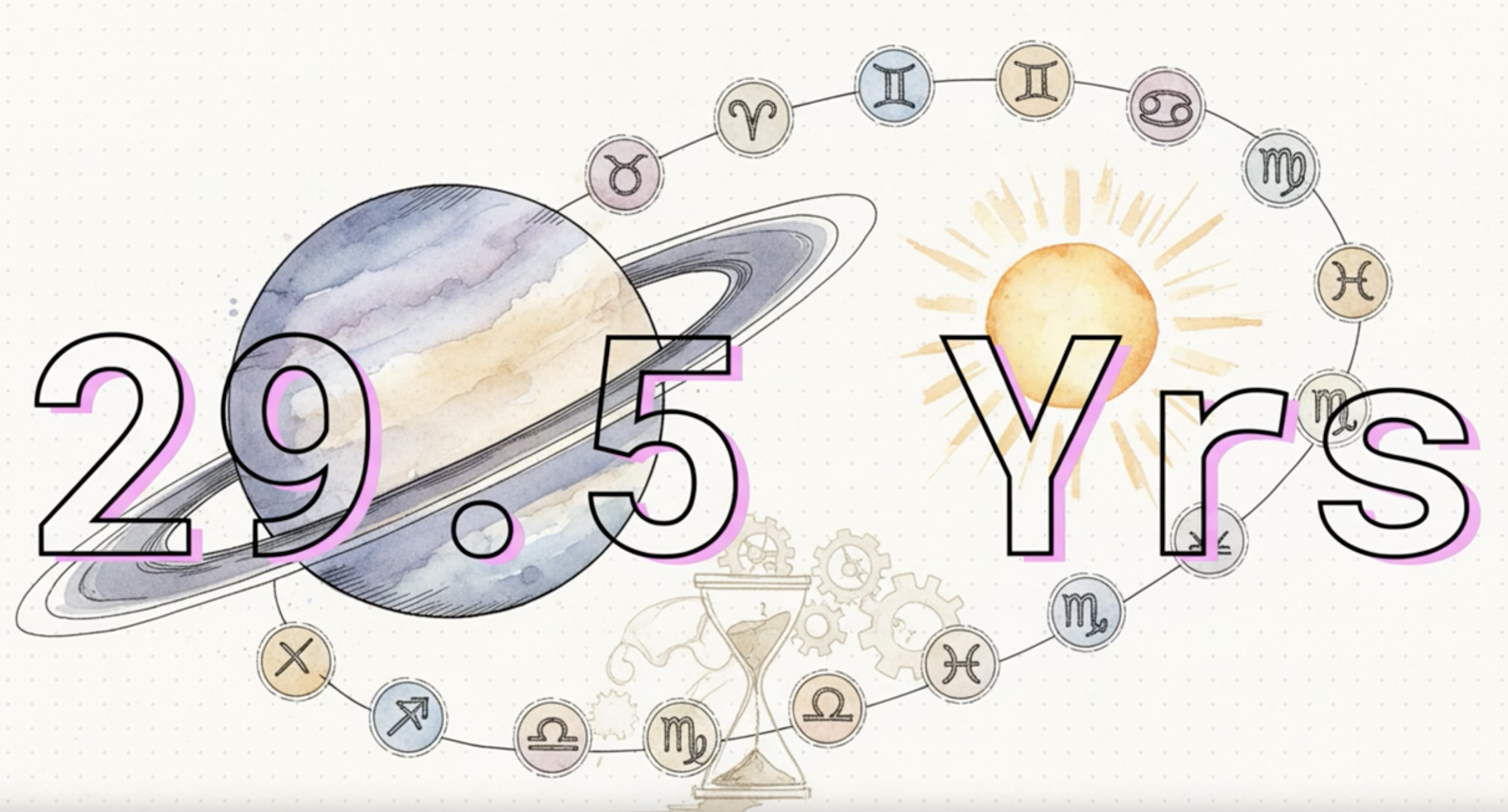
From an astronomical view, Saturn is the sixth planet from the Sun - slow, steady, and disciplined in its rhythm. It takes about 29.5 years to complete one full orbit around the Sun, which means it spends roughly 2.5 years in each zodiac sign.
This steady pace is why Saturn’s influence feels long-term. When it enters a new sign, the lessons it brings unfold gradually - giving enough time for real change to take root.
Every so often, Saturn appears to move backward in the sky - a motion called retrograde. It’s not truly moving backward; it’s an optical effect caused by Earth’s relative speed. But symbolically, retrograde periods represent review and realignment. Plans slow down, patterns repeat, and we’re asked to revisit old lessons before moving forward again.
Saturn is also known for its rings, which act as a visible reminder of boundaries - order in motion. Among the planets, none display structure so clearly. And that’s exactly what Saturn governs: the balance between movement and control, growth and restraint.
Understanding Saturn astronomically helps demystify its reputation. It’s not a planet of chaos, but of timing - one that insists life unfold at a sustainable pace.
The Astrological Saturn: Structure, Dignity, and Mastery
In astrology, Saturn represents structure, responsibility, and time. It is the planet that teaches you how to build things that last not through shortcuts, but through discipline and clarity.
Saturn rules two zodiac signs: Capricorn and Aquarius.
In Capricorn, it means tangible goals, systems, and the discipline needed to sustain them. It’s where Saturn teaches you how to execute, to lead by example, and to work with precision.
In Aquarius, Saturn becomes visionary - it builds frameworks not just for personal success, but for collective good. It’s where principles, communities, and long-term impact matter more than ego.
Saturn is exalted in Libra, the sign of balance and justice. Here, it operates with fairness and integrity - the ability to weigh both sides before acting. People with this placement often hold quiet authority because their sense of duty feels natural, not forced.
It’s debilitated in Aries, where impulse and impatience clash with Saturn’s slow rhythm. When this happens, frustration can arise - the urge to act before the foundation is ready. But even here, the lesson is simple: timing matters more than speed. Debilitation doesn’t mean failure; it means learning restraint.
Across all placements, Saturn rewards the same things:
Integrity over image. Effort over entitlement. Systems over chaos.
It’s the planet that asks, “Are you doing the work?” - not to judge, but to make sure that what you’re building can stand the test of time.
Working With Saturn’s Energy
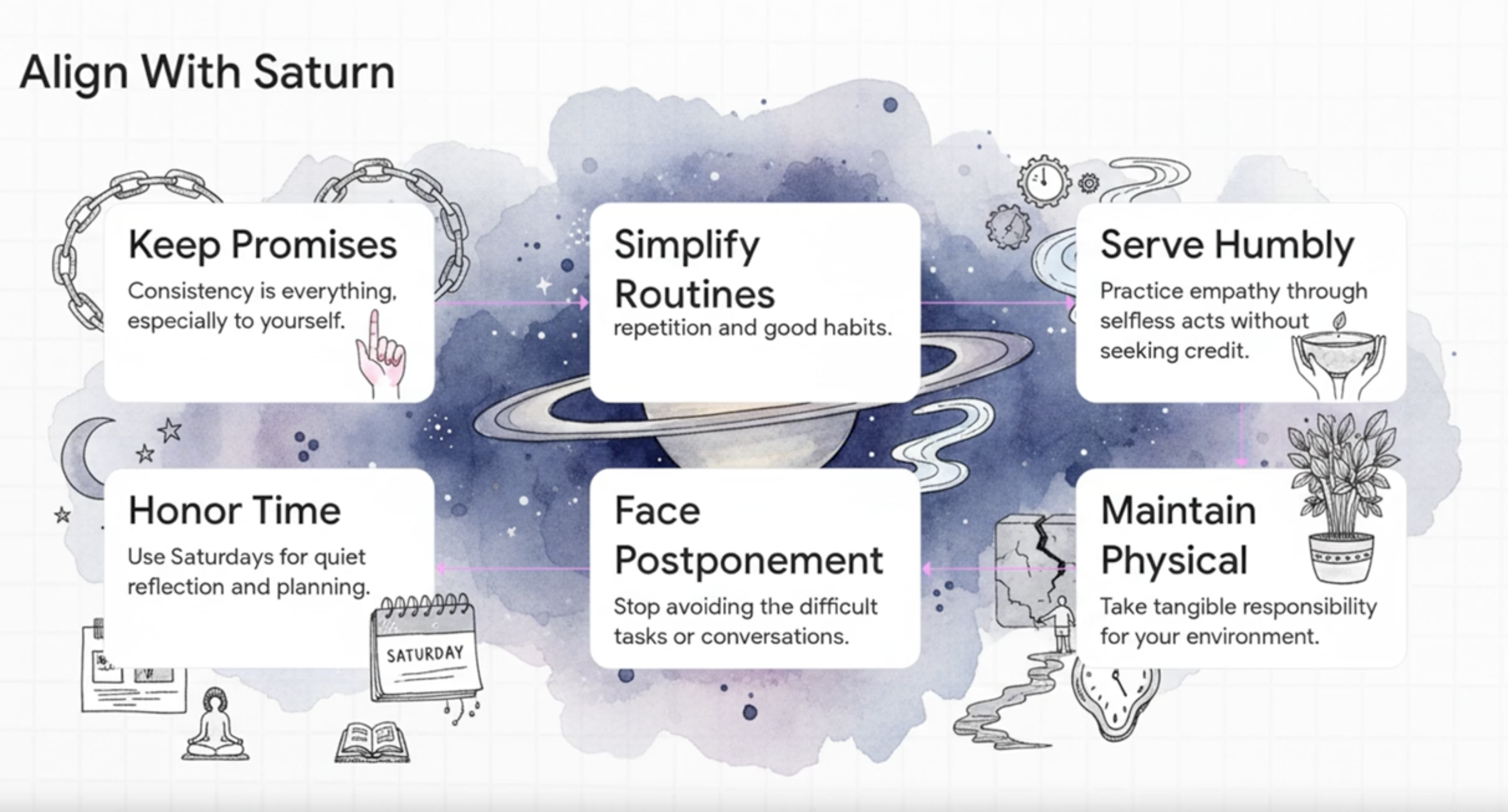
You can’t outsmart Saturn - but you can work with it.
The planet doesn’t respond to shortcuts, only to sincerity. Its energy balances best when you bring order to the parts of your life that have gone quiet, cluttered, or ignored.
Here are ways to align with Saturn - not as superstition, but as structure.
1. Keep promises - especially to yourself.
Every time you do what you said you would, you strengthen Saturn’s presence in your life. It doesn’t care about speed - only consistency. Whether it’s showing up to the gym, paying a bill on time, or calling a parent back - this is how Saturn softens.
2. Simplify your routines.
Saturn’s language is repetition. Regular sleep, steady meals, clear time blocks - these small things create stability when everything else feels uncertain. The planet rules habits and systems; that’s where it blesses you most.
3. Serve without seeking credit.
In traditional texts, Shani’s remedies often involve seva - acts of humble service. Feed or help those who carry weight silently: workers, elders, animals, or anyone in hardship. The point isn’t charity - it’s empathy. It’s about balancing the karmic scales through awareness of others’ effort.
4. Clean and maintain something physical.
Saturn loves responsibility in visible form - a home corner you fix, a machine you care for, a plant you keep alive. Maintenance is meditation here.
5. Face what you’ve been postponing.
There’s always that one thing - the document, the conversation, the self-care habit you keep pushing away. Start there. Saturn strengthens wherever you stop avoiding reality.
6. Honor time.
You can do this in simple ways - plan your week, review your progress, or pause every Saturday to reflect. Classical texts call Saturday Shanivar, the day ruled by Saturn. Instead of fear-based rituals, use it for reflection. Ask: Where was I consistent this week? Where did I escape? What needs attention now?
Working with Saturn isn’t about worship - it’s about alignment. When you live with integrity, structure, and service, Saturn turns from judge to mentor.
Shani as the Teacher of Maturity
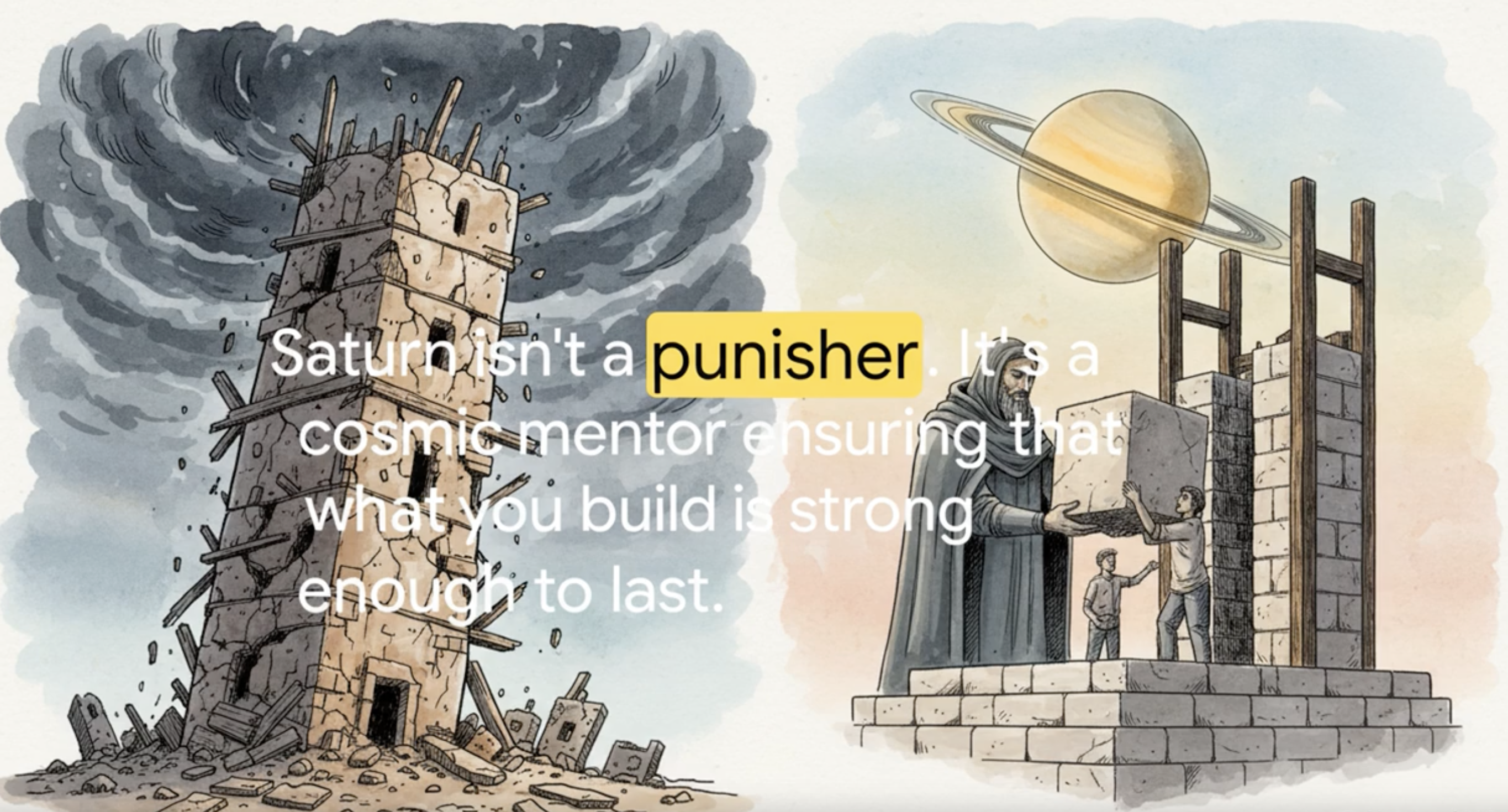
Saturn doesn’t promise an easy life, but it promises a real one.
If you trace every major turning point in your life - the moments when you had to rebuild, take responsibility, or start again - Saturn was likely close by.
It teaches in silence, not spectacle. While other planets inspire movement or emotion, Saturn waits until you act. That’s why its lessons last. They’re not built on motivation; they’re built on habit.
Over time, you begin to see the pattern: what Saturn takes away is never the essence of who you are - only the excess, the noise, the shortcuts. What remains is steadier, truer, and far more sustainable.
To work with Saturn is to accept that growth happens in real time - through effort, patience, and follow-through. It’s to understand that every structure, whether emotional or material, needs maintenance.
Shani’s grace arrives quietly. Not in miracles, but in moments of self-respect - when you say no without guilt, when you keep a promise you almost broke, when you stay steady while others rush.
That’s how you know Saturn has done its work. You’ve grown into someone who doesn’t need to prove stability - you embody it.