Introduction
Someone runs their kundali, sees "lagna lord in 9th house," and goes looking for what it means. Within five minutes, they've read two completely different things.
One article says the 9th house lord — a different placement entirely — sitting in the 1st house makes someone dharmic and fortunate. Another talks about the lagna lord itself sitting in the 9th. The two get mixed up constantly, and the reader ends up more confused than when they started.
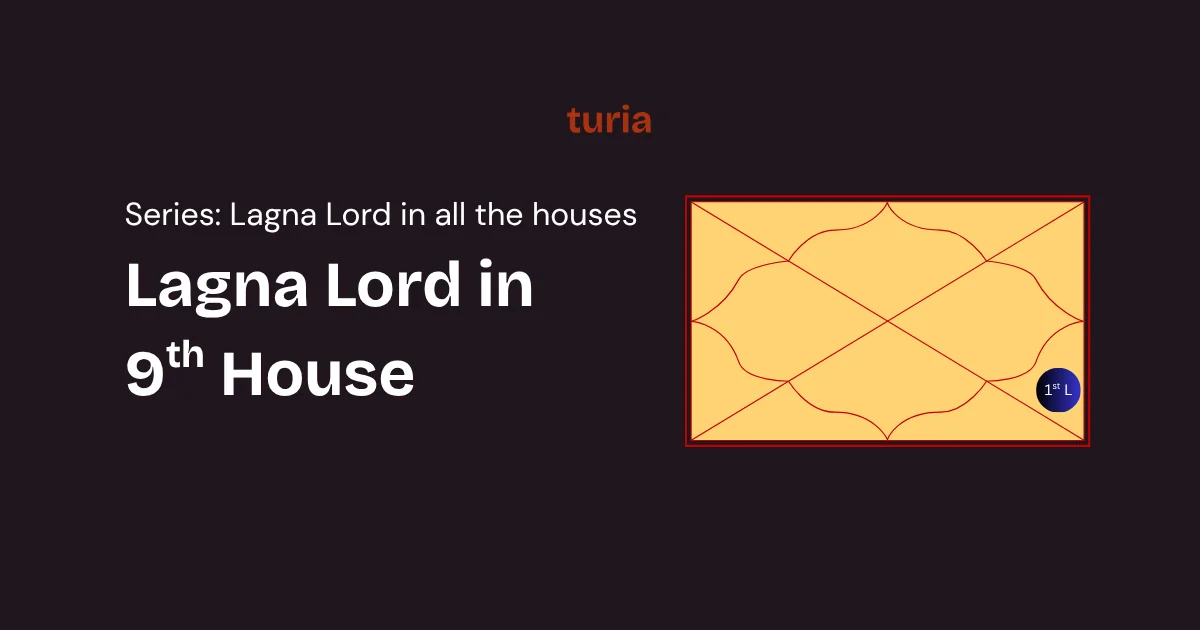
Here's the clarity worth starting with. The lagna lord is the planet ruling your ascendant — your identity, your body, your basic sense of self. Where that planet sits shows you where your core identity gets expressed most strongly. When it sits in the 9th house — Dharma Bhava, the house of fortune, father, faith, and higher wisdom — your very sense of self becomes entangled with luck, learning, and meaning. It's one of the reasons this placement shows up on almost every "best placements" list in Vedic astrology, and honestly… for once, the SERP hype is mostly earned.
This is the ninth in our 12-part series on where the lagna lord can sit. In this guide, we'll cover what this placement actually means, why it's structurally one of the strongest in the entire series, what the classical texts say about fortune and father, what strength changes, and how it compares to the other eleven.
Quick answer
Lagna Lord in the 9th house means the planet ruling your ascendant sits in Dharma Bhava — the house of fortune, father, faith, and higher learning. Because both the 1st and 9th houses are Trikona (trine) houses, this is a trikona lord sitting in a trikona — structurally one of the most auspicious placements in the entire 12-house series. BPHS (Ch. 24, Sloka 9) states plainly that this makes the native "fortunate, dear to people... skilful, eloquent in speech and endowed with wife, sons and wealth." Expect a strong pull toward dharma, respect for father and gurus, natural luck, and an interest in higher learning, philosophy, or long-distance travel. As with every placement in this series, the specific planet, its dignity, and any affliction decide how fully these results actually show up.
What "Lagna Lord in the 9th House" Actually Means
Your lagna is the sign rising on the eastern horizon at the exact moment of your birth — it's your ascendant, and it anchors your entire chart. The lagnesh, or lagna lord, is the planet that rules that sign. If you're a Mesh (Aries) ascendant, that's Mangal (Mars). If you're a Dhanu (Sagittarius) ascendant, that's Guru (Jupiter). Wherever this planet physically sits in your kundali tells you where your identity finds its strongest expression.
The 9th house is Dharma Bhava — the house of righteousness, fortune, father, one's guru or preceptor, higher learning, long pilgrimages, and one's overall relationship with faith. Classical texts group the 1st, 5th, and 9th houses together as Trikona (trine) houses — the single most auspicious classification in Parashari astrology, ahead even of the Kendra (angle) houses in terms of pure benefic potential:
"Putr and Dharm Bhava are known by the name Kon (or trine)." — BPHS, Ch. 6, Sloka 33-36
Since the 1st house — home to the lagna itself — is also a trikona, having the lagna lord land in the 9th house means a trikona lord sitting in another trikona. Of the two trikona placements possible for the lagna lord (5th and 9th), classical astrologers often treat the 9th as the stronger of the two, because the 9th is specifically the Bhagya Sthana — the house of fortune itself, not just of intelligence and creativity the way the 5th is.
BPHS states the core result directly, in the same sequence of verses used to describe the lagna lord's placement in every one of the 12 houses:
"If Lagn's Lord is in Dharm Bhava, the native will be fortunate, dear to people, be a devotee of Śrī Vishnu, be skilful, eloquent in speech and be endowed with wife, sons and wealth." — BPHS, Ch. 24, Sloka 9
One quick clarification, because the mix-up is common: this article is about the lagna lord landing in the 9th house. That's a different topic from the 9th house's own lord moving through the 12 houses — a related but separate placement question. If what you've read online talks about "9th lord in 1st house" or "9th lord in different houses," that's the reverse side of this coin, not this placement.
Fortune and Luck — Why This Is Called One of the Best Placements
This is usually the first thing that gets said about this placement, and for once, it holds up under scrutiny.
The 9th house's core signification is Bhagya — fortune, in the sense of unearned support, good timing, and things simply working out. When your lagna lord — your very identity — sits here, that fortune isn't a background feature of your chart. It's close to the center of who you are.
Phaladeepika describes this concretely, under what it calls Bhagya Yoga — formed when the trikona lords are strongly placed relative to the 9th house:
"The 9th house disposed in the same manner gives rise to Bhagya Yoga. The person who has his birth in the Bhagya yoga will move in palanquins (excellent vehicles) in the midst of sounds of musical instruments... will always be equipped with wealth and will observe a righteous code of conduct. Gods and Brahmins will be pleased with him for his devotion and virtues. He will make his family illustrious." — Phaladeepika, Ch. 6, Para 9
Translate the imagery for today and it reads like this: recognition, resources, and a reputation that outlasts one's own effort. Think of the person who gets picked for the scholarship almost by accident, or whose family's name quietly opens doors they never had to knock on. That's Bhagya, at work through identity.
But — and this matters for the rest of this article — Phaladeepika is equally direct about what happens when the same house is afflicted instead of supported:
"The Nirbhagya Yoga which concerns the 9th house (the house of Bhagya) causes the native to lose all his paternal property... He will have no regard for good people and elders and will be irreligious. He will be dressed in old and worn out clothes, will be poor and miserable." — Phaladeepika, Ch. 6, Para 66
So the 9th house itself isn't automatically lucky — it's a house where fortune is possible at scale, in either direction, depending on how it's supported. That's the honest nuance most SERP content skips when it calls this placement unconditionally "the best."
Dharma and Righteous Conduct
Beyond luck, the 9th house governs dharma — one's inner code of right conduct, not in a rigid rule-following sense, but as a lived value system.
With the lagna lord here, values and identity fuse. This often shows up as someone who feels genuinely uncomfortable cutting corners — not because they're afraid of getting caught, but because acting against their own principles feels like acting against themselves. BPHS's phrase "dear to people" (Sloka 9) points at exactly this: a person whose sense of fairness and honesty tends to earn quiet, lasting trust rather than performative popularity.
This isn't the same as rigid orthodoxy, and it's worth saying clearly — a strong 9th-house lagna lord doesn't automatically mean someone who's dogmatic or preachy about religion. It more often shows up as a person with a coherent worldview, someone others instinctively go to for a grounded opinion, whether that's about a family decision, a business deal, or which college to choose.
Relationship With Father and Guru
This is where the placement gets personal, and where the classical texts are careful to add real nuance rather than a blanket promise.
The 9th house is the primary house for father (alongside some classical debate over whether the 10th house should also be consulted — Phaladeepika itself notes this isn't fully settled among older texts). When the lagna lord sits here, the relationship with father tends to be foundational to identity — the native often treats their father, or later a guru or senior mentor, as a genuine compass for decisions.
BPHS's Dharma Bhava chapter lays out the specific conditions that shape how this plays out:
"Fortunate (Affluent) Father. If Dharm's Lord is with strength, as Śukr is in Dharm, while Guru is in an angle from Tanu Bhava, the native's father is fortunate." — BPHS, Ch. 20, Sloka 3
And, just as importantly, the counter-condition:
"Inimical to Father. There will be mutual enmity between the father and the native, if Lagn's Lord is in Dharm Bhava, but with the Lord of Ari [6th house lord]. Further, the native's father will be of contemptible disposition." — BPHS, Ch. 20, Sloka 11
Read this the way it's meant to be read: the lagna lord in the 9th house is not, on its own, a guarantee of a warm father relationship. It's a placement where the father-relationship carries real weight in shaping identity — and whether that weight feels like support or friction depends on what else touches the lagna lord, particularly any connection to the 6th house (the house of conflict). This is the same "conditional, not automatic" pattern that runs through every placement in this series.
Higher Learning, Philosophy, and the Guru Figure
The 9th house also governs para vidya — higher knowledge, as distinct from the 3rd or 4th house's more basic or formal schooling. Think philosophy, scripture, research at the doctoral level, spiritual study, or any learning pursued for its own sake rather than a job requirement.
With the lagna lord placed here, learning tends to feel like part of one's identity rather than a phase of life that ends after a degree. This is the native who goes back for a second Master's out of genuine interest, who reads philosophy on weekends, or who becomes the person their friend group calls when a real ethical or existential question comes up — not because they have all the answers, but because thinking it through feels natural to them.
Jupiter (Guru) is the natural karak (significator) for both the 9th house and for wisdom generally. When Jupiter is well-placed or aspects this lagna lord, expect the intellectual and spiritual dimension of this placement to show up strongly — sometimes as a formal academic path, sometimes as an informal but serious pursuit of meaning.
Travel and Foreign Connection
The 9th house also covers long-distance travel — historically pilgrimages, today often reframed as study abroad, international work, or a career built across borders.
This is a genuinely common question with this placement: does it mean I'll settle abroad? Not automatically — but there's a real pull toward distance, toward encountering different belief systems and cultures as part of one's own growth. Picture the young professional who takes a foreign posting almost on a whim and ends up staying for a decade, not because they were running from home, but because something about being elsewhere clarified who they were. That's a common, ordinary expression of this placement — a far cry from displacement or rootlessness, and closer to expansion.
Strength Considerations: What Actually Changes the Outcome
As with every placement in this series, the house tells you where — the planet's own condition tells you how well.
- Exalted lagna lord in the 9th: One of the strongest combinations in the entire zodiac. Phaladeepika's example of Parvata Yoga illustrates this directly — in a chart where the lagna lord (Mars) sits in the 9th house while the 9th lord (Jupiter) is exalted in a kendra, the text notes this produces genuine elevation and stability, true to the yoga's name ("mountain"). Expect real Raja Yoga potential when this kind of mutual strength shows up.
- Debilitated lagna lord in the 9th: Softened considerably by the trikona's own protective nature. A debilitated lagna lord in a trikona house is a strong candidate for Neecha Bhanga (cancellation of debilitation), especially if the sign's dispositor is well-placed elsewhere — a pattern flagged repeatedly across "rare yoga" content in current SERP coverage of this exact placement.
- Combust lagna lord: The placement's generosity gets muted until relevant dasha periods activate it more clearly — fortune exists in potential but doesn't show up as readily in daily life.
- Conjunct or aspected by natural benefics (Jupiter, Venus, unafflicted Mercury): The placement's most generous form — genuine luck, a warm father/guru relationship, real intellectual depth.
- Conjunct malefics, especially the 6th lord (Ari's Lord) or Rahu/Ketu: This is where BPHS's own caution about father-relationship friction becomes relevant (Ch. 20, Sloka 11) — worth a proper chart reading rather than assuming either the best or worst case from the house alone.
The single rule worth repeating across this entire series: never judge a placement from the house alone. Check the sign, the planet's dignity, its aspects, and the dasha periods that activate it.
How Lagna Lord in the 9th Compares to Other Placements
Since this closes out the series — the 9th house was the final placement documented — here's a full comparison across all 12 possible lagna lord placements.
| Lagna Lord In | Core Flavour |
|---|---|
| 1st House | Strong, self-directed identity; vitality expressed directly |
| 2nd House | Identity tied to wealth, family, speech, accumulated values |
| 3rd House | Courage, effort, communication-driven self-image |
| 4th House | Identity rooted in home, emotional security, land/property |
| 5th House | Creative, intelligent, children- and recognition-oriented identity |
| 6th House | Identity forged through service, competition, or health struggles |
| 7th House | Identity expressed through partnership and one-on-one relationships |
| 8th House | Deep, transformative, research-and-crisis-oriented identity |
| 9th House | Identity built around fortune, dharma, father/guru, and higher learning |
| 10th House | Career- and reputation-defined identity, public-facing life |
| 11th House | Identity tied to gains, networks, and long-term aspirations |
| 12th House | Inward, foreign-connected, loss-and-liberation identity |
Compared to the 5th house — the other trikona placement in this series — the 9th leans more toward fortune, belief, and father/guru figures, while the 5th leans toward intellect, creativity, and children. Compared to Kendra placements like the 1st, 7th, or 10th, the 9th's strength comes from grace and support rather than direct, self-built effort — it's less "I built this" and more "this arrived because I stayed aligned with something larger." And compared to the Dusthana placements — 6th, 8th, 12th — the difference is stark: those houses ask identity to be forged through struggle, while the 9th offers it largely as a gift, provided the lagna lord isn't afflicted.
FAQs
What does it mean when the lagna lord is in the 9th house?
It means the planet ruling your ascendant — your core identity — sits in Dharma Bhava, the house of fortune, father, faith, and higher learning. BPHS (Ch. 24, Sloka 9) ties this to being fortunate, well-liked, eloquent, and generally blessed with good fortune in family life. It's one of the more auspicious placements in the 12-house series, since both the 1st and 9th houses are trikonas.
Is lagna lord in 9th house the same as 9th lord in 1st house?
No, and this is a common mix-up. This article covers the lagna lord (ruler of your ascendant) sitting in the 9th house. "9th lord in 1st house" describes the reverse — the 9th house's own ruling planet placed in your ascendant. They're related but separate placements with different technical implications.
Does this placement guarantee I'll be rich and famous?
Not automatically. The 9th house's own texts describe both Bhagya Yoga (fortune) and Nirbhagya Yoga (loss of paternal property, poverty) depending on whether the house and its lord are supported or afflicted. The placement gives strong potential — dignity, aspects, and dasha timing decide how much of it actually materializes.
Does lagna lord in 9th house mean a good relationship with father?
Usually, yes — but BPHS is specific that this weakens if the lagna lord is also connected to the 6th house lord (Ch. 20, Sloka 11), which can bring real friction instead. The house makes the father relationship central to identity either way; whether that's warmth or tension depends on affliction.
Does this placement mean I'll settle abroad?
Not automatically, but there's a genuine pull toward distance, foreign study, or international careers, since the 9th house governs long-distance travel. Many people with this placement build careers or relationships across borders without it being a permanent, forced relocation.
What if my lagna lord is debilitated in the 9th house?
Less concerning than it sounds. Because the 9th is a trikona, a debilitated lagna lord here is a strong candidate for Neecha Bhanga (cancellation of debilitation), especially if the sign's ruling planet is well-placed elsewhere.
Is lagna lord in 9th house a Raja Yoga?
It can contribute to one. When the lagna lord and 9th lord are mutually well-placed — as in Phaladeepika's Parvata Yoga example, where an exalted 9th lord in a kendra supports the lagna lord's placement in the 9th — the combination produces genuine status and stability. It's not automatic just from the house placement alone; the supporting planetary strength has to be there too.
Closing Thoughts
So if someone asks, "Is lagna lord in the 9th house a good placement?" — the honest answer, same as every other placement in this series, is: it depends on dignity, aspects, and what else touches the lagna lord. But the pattern most charts with this placement share is real — a person whose sense of self is quietly tied to something larger than personal effort: family fortune, a father or guru's guidance, a body of higher knowledge, or simply a run of good timing they didn't have to force.
That's not luck in the shallow sense. That's dharma, working through identity.
This closes our 12-part look at where the lagna lord can sit — from the outward confidence of the 1st house to the inward depth of the 12th, and now this: the quietly fortunate 9th. Read together, they're less a ranking of "good" and "bad" placements and more a map of the different ways one identity can express itself, depending on where it's rooted.