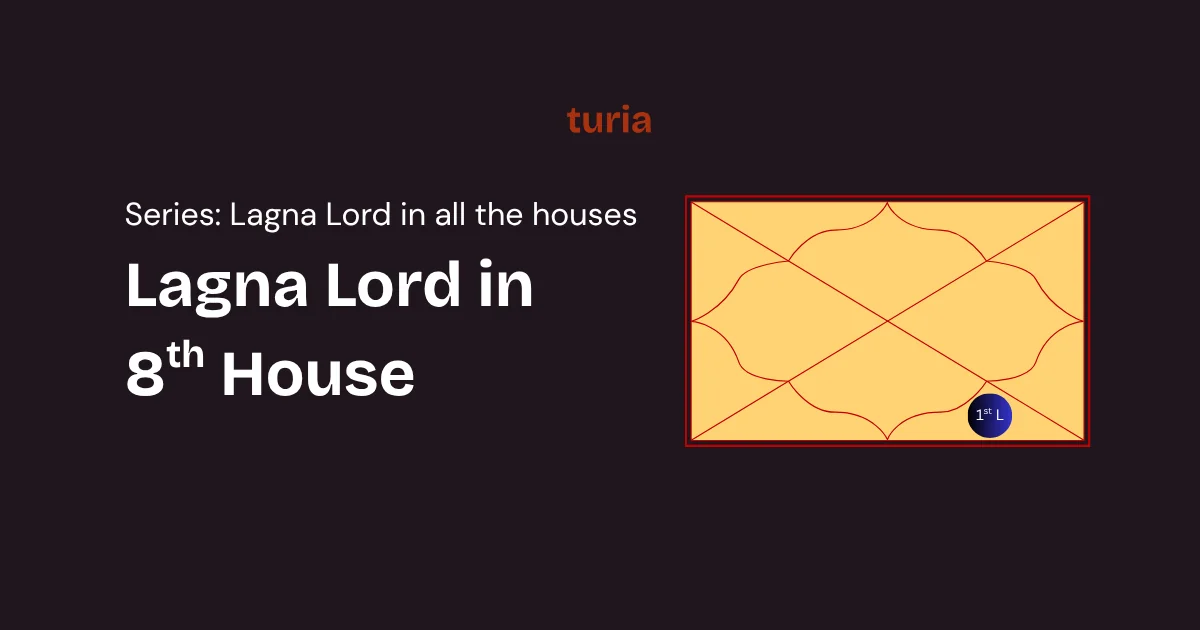
Every time someone finds out their lagna lord — the ruling planet of their own ascendant — sits in the 8th house, the reaction is almost always the same. Panic.
"Does this mean I'll die young? Is my life going to be full of accidents and disease?"
Most of that fear comes from blogs that stack words like "problems," "sickness," and "death" straight into the headline, without ever explaining what actually decides the outcome.
And honestly… the truth here is a lot more layered than any of those headlines let on.
Yes, the 8th house — called Randhra Bhava in classical texts — is one of the harder houses. Classical astrology itself classifies it as a Dusthana (a difficult house). That part isn't a myth invented by fear-mongering blogs. But the same texts that call it difficult also tie its results directly to the strength of the lagna lord, not to the placement alone. A weak, afflicted lagna lord in the 8th house tells a very different story than an exalted or well-aspected one.
This is the eighth article in our 12-part series on where the lagna lord sits in each house. In this guide, we'll cover what this placement actually means, what classical texts like Brihat Parashara Hora Shastra (BPHS) say about it, the real nuance around longevity, the surprisingly strong case for occult and research talent, the inheritance angle, and how strength changes everything — plus a quick comparison to how the lagna lord behaves in a few other challenging houses.
Quick answer
When your lagna lord (ascendant lord) sits in the 8th house, your sense of self gets tied to transformation, depth, and the unseen — the 8th house rules longevity, sudden events, inheritance, in-laws' wealth, and occult or research interests. BPHS (Ch. 24.8) calls this native "an accomplished scholar" in the same verse it lists health and temperament challenges — both halves matter. Outcomes swing heavily on whether the lagna lord is strong (exalted, Vargottama, benefic-aspected) or weak (debilitated, malefic-conjunct). Strong placements often produce resilient people drawn to psychology, research, insurance, or astrology itself. Weak placements can genuinely affect health and stability. It is not a fixed "bad" placement — it's a demanding one.
What "lagna lord in the 8th house" actually means
Quick terms, so the rest of this makes sense:
| Term | Meaning |
|---|---|
| Lagna | Your ascendant — the sign rising on the eastern horizon at your birth moment. The "1st house" of your kundali. |
| Lagna Lord (Lagnesh) | The planet that rules your lagna sign. Also called the ascendant lord or chart-ruler — it represents you, your body, your core identity. |
| 8th house (Randhra Bhava) | The house of longevity, transformation, sudden events, death and rebirth themes, inheritance, in-laws' wealth, and hidden/occult knowledge. |
| Dusthana | A classical grouping of the 6th, 8th, and 12th houses — considered inherently difficult houses, associated with struggle, loss, or dissolution. |
So when your lagna lord — the planet representing your core self — physically sits inside the 8th house of your own chart, your identity gets pulled toward everything the 8th house rules. Mantreswara's Phaladeepika describes the eighth house's territory plainly: "Mangalya (the living of the husband during the life time of the wife), Randhra, filthiness, mental pain, defeat or humiliation, longevity, sorrow, blame, death, impurity, impediments and slavery" (Phaladeepika, Ch. 1, Sloka 14). It's a wide net — longevity and inheritance sit right next to sorrow and impediments in the same verse. That's the 8th house in one sentence: it's never just one thing.
The longevity question — what classical texts actually say
This is the fear people carry into every reading of this placement, so let's deal with it directly.
BPHS devotes an entire chapter to Randhra Bhava specifically because longevity is its core subject. And the pattern across that chapter is consistent: outcome depends on strength, not on placement alone.
"If Randhr's Lord is in an angle, long life is indicated." (BPHS, Ch. 19, Sloka 1)
"Should Randhr's Lord join Lagn's Lord, or a malefic and be in Randhr itself, the native will be short lived." (BPHS, Ch. 19, Sloka 2)
Read the second verse again — it's not the lagna lord being in the 8th house that causes a short life. It's the lagna lord being afflicted — joined with malefics, weak, or debilitated — while sitting there. A few verses later, BPHS says it plainly:
"One will be long-lived, if Lagn's Lord is in exaltation... If Lagn's Lord is exceedingly strong and receives a Drishti [aspect] from a benefic... the person concerned will be wealthy, virtuous and long-lived." (BPHS, Ch. 19, Sloka 14–15)
Same house. Opposite outcome. The only variable that changed is strength.
There's also a related clause in BPHS's chapter on the 1st house itself: "Should Lagn Lord be yuti [conjunct] with a malefic, or be in Randhr, 6th, or 12th, physical felicity will diminish... With a benefic in an angle, or trine all diseases will disappear" (BPHS, Ch. 12, Sloka 1–2). Again — the placement creates a tendency, but a benefic's support can visibly offset it. Classical astrology was never claiming this placement is a death sentence. It was always describing a spectrum.
The transformation and resilience angle
Here's the part most fear-based content skips entirely.
The 8th house doesn't just rule endings — it rules what comes after endings. Rebirth, recovery, regeneration. People with a strong lagna lord here tend to develop a genuine resilience that people with easier placements never have to build. They've usually been through something — a health scare, a financial setback, a sudden family loss, a career upheaval — and came out the other side changed, but intact.
Think of it like a tree that's been through a storm and lost half its branches, but its roots have gone deeper because of it. That's often the shape of a life with a strong lagna lord in the 8th house: less smooth on the surface, but with a depth that people with a placid 1st-house-lord life simply don't develop.
This is also why people with this placement are often described as "hard to read" or mysterious. The 8th house is called a Leena Sthana — a hidden or dissolving house — in classical texts. Their inner world runs deeper than what they show, not because they're secretive by nature, but because their core identity is wired to process things privately before showing them to the world.
Occult, research, and psychological depth
This is the placement's best-kept secret, and it's sitting right there in the original verse that everyone quotes for the "bad" part.
"If Lagn's Lord is in Randhr Bhava, the native will be an accomplished scholar, be sickly, thievish, be given to much anger, be a gambler and will join others' wives." (BPHS, Ch. 24, Sloka 8)
Notice what comes first: accomplished scholar. Parashara pairs deep learning with the harder clauses in the very same breath — and most modern blogs quote only the second half.
Modern astrologers consistently read a strong 8th-house lagna lord as a marker for research ability, depth psychology, investigative work, and — recurring again and again across practicing astrologers — a genuine pull toward astrology and occult sciences themselves. If you've ever met someone who can sit with a difficult subject (death, trauma, the subconscious, insurance risk, forensic detail) without flinching, and actually finds it interesting rather than distressing — there's a good chance their lagna lord, or another key planet, sits in the 8th house.
Careers that suit this energy well: psychology and therapy, research (scientific or academic), insurance and actuarial work, investigative journalism, surgery, astrology and tarot, and anything involving other people's money or resources — banking, audits, inheritance law.
One often-cited illustrative case: Osho, whose 10th lord Saturn sat in the 8th house, built an entire life's work around mortality, transformation, and the subconscious — themes the 8th house governs directly. (Worth a precise note: career itself is read primarily from the 10th house and its lord, not the lagna lord — but it shows how naturally 8th-house placements gravitate toward exactly these themes.)
Sudden events, inheritance, and in-laws' wealth
The 8th house also rules sudden, unplanned events — windfalls as much as setbacks. When the lagna lord sits here with decent strength, it's commonly read as support for:
- Inheritance — property, wealth, or assets received from family, sometimes unexpectedly.
- In-laws' wealth — gains connected to the spouse's family, a theme that shows up repeatedly across classical and modern sources.
- Insurance and shared resources — this placement often correlates with income tied to other people's money: insurance payouts, joint accounts, partnership assets.
- Sudden turning points — a relocation, a windfall, a dramatic career pivot — arriving with little warning, for better or worse.
The common thread: this house rarely deals in "slow and steady." It deals in the sudden and the significant. Whether that sudden event helps or hurts, again, comes back to strength.
Strength considerations — what actually changes the story
If there's one section to actually remember from this article, it's this one.
Exaltation. An exalted lagna lord in the 8th house is a genuinely different placement from a debilitated one. Multiple classical and modern sources agree: exaltation here can substantially improve both longevity and the quality of the 8th house's other themes (research talent, inheritance gains).
Vargottama. If your lagna sign is Vargottama (the same sign repeats in both your birth chart and your navamsa/D9 chart), the lagna itself becomes considerably stronger — and practising astrologers consistently note that a Vargottama lagna significantly softens the harder edges of a lagna lord placed in the 8th house. As one long-running astrology forum discussion puts it: even where "Lagna Lord is weak in the 8th house" is the common dictum, a Vargottama lagna makes "life comfortable and easy even if Lagnesh occupied 8th house."
Aspects and conjunctions. A benefic's aspect (Jupiter, an unafflicted Moon, or Venus) on the lagna lord in the 8th house softens outcomes considerably — this is the exact mechanism BPHS points to in Ch. 12, Sloka 1–2. A malefic conjunction (especially Saturn, Mars, Rahu, or Ketu) intensifies the harder themes.
The special case. For a couple of ascendants, the lagna lord and the 8th house lord can end up closely tied through sign rulership (most commonly discussed for Aries and Scorpio ascendants, where Mars governs both houses). This doesn't automatically make the placement better or worse — it just means the lagna lord's own dasha periods carry more 8th-house flavor than usual, and it's worth a dedicated chart reading rather than a blanket rule.
Dasha timing. Even a well-placed lagna lord in the 8th house will show its sharper, more sudden themes more visibly during its own Mahadasha or Antardasha — and its steadier, deeper themes (research focus, resilience, inheritance) tend to show up more during other periods.
How this compares to other houses in the series
Since this is part of our 12-house series, here's a quick sense of how the 8th house placement sits relative to a few others we've already covered.
| Placement | Core theme | Typical demand on the native |
|---|---|---|
| Lagna lord in 1st house | Strong, self-directed identity | Low — this is the most "smooth" placement; self-made success with fewer external hurdles |
| Lagna lord in 6th house | Service, competition, health-consciousness | Medium — success through effort and overcoming daily friction (debt, disputes, routine health issues) |
| Lagna lord in 8th house | Transformation, depth, sudden change | High — success through resilience; identity tied to what's hidden, inherited, or unexpectedly encountered |
| Lagna lord in 12th house | Detachment, foreign lands, loss, spirituality | High — identity tied to letting go, isolation, or a pull toward the unseen and distant |
The 6th, 8th, and 12th houses are grouped together as Dusthanas for a reason — all three ask more of the native than a 1st or 10th house placement would. But they ask different things. The 6th house asks you to fight and compete. The 12th asks you to release and detach. The 8th house asks you to go deep, to sit with what's hidden, and to come back transformed. None of these are "bad" placements in any final sense — they're simply placements that demand more conscious work from the native, and tend to reward that work with unusual depth rather than easy comfort.
FAQ
Is lagna lord in 8th house good or bad?
Neither, by itself. Classical texts pair "accomplished scholar" with health and temperament challenges in the very same verse (BPHS Ch. 24.8). The outcome depends heavily on the lagna lord's strength — exalted or benefic-supported placements lean favorable; debilitated or malefic-afflicted placements lean difficult.
Does lagna lord in 8th house reduce longevity or lifespan?
Not automatically. BPHS ties short life specifically to an afflicted or debilitated lagna lord conjunct malefics in the 8th house — and ties long life to an exalted or benefic-aspected lagna lord in the very same house. The placement sets the theme; strength decides the outcome.
Does this placement give occult, research, or astrology talent?
Yes, commonly. Both classical texts (the "accomplished scholar" clause) and modern astrologers consistently associate a strong 8th-house lagna lord with research ability, psychological depth, and a genuine pull toward occult sciences or astrology itself.
What if the lagna lord is exalted in the 8th house?
Exaltation meaningfully improves outcomes — better longevity, and the 8th house's positive themes (research aptitude, inheritance, resilience) tend to dominate over the harder ones. A Vargottama lagna adds further support.
Can this placement bring inheritance or sudden wealth?
Yes, this is one of its more consistently positive themes. A reasonably strong lagna lord here is often read as support for inheritance, in-laws' wealth, insurance gains, or a sudden financial turning point.
Does lagna lord in 8th house affect marriage or physical health?
It can, particularly if the lagna lord is weak or afflicted — BPHS's chapter on the 1st house notes diminished physical comfort for a lagna lord placed in the 8th (among other dusthanas) without benefic support. A well-supported lagna lord largely offsets this.
Why do people say this placement makes someone mysterious or hard to read?
Because the 8th house is classically called a Leena Sthana — a hidden or dissolving house. People with this placement often process life internally before showing it externally, which reads to others as depth or mystery rather than distance.
The honest takeaway
So if someone asks you, "Is lagna lord in 8th house bad?" — the honest answer is: it depends on strength, not placement.
A weak, afflicted lagna lord here can genuinely mean a harder road — health sensitivity, instability, more turbulence than most people deal with. That's real, and no article should pretend otherwise.
But a strong lagna lord in the 8th house is one of the more quietly rewarding placements in the chart — resilience that's actually earned, a natural aptitude for research or the occult, and real potential for inheritance or gains through others. It asks more of the native than a 1st or 10th house placement does. It just doesn't ask for less in return.