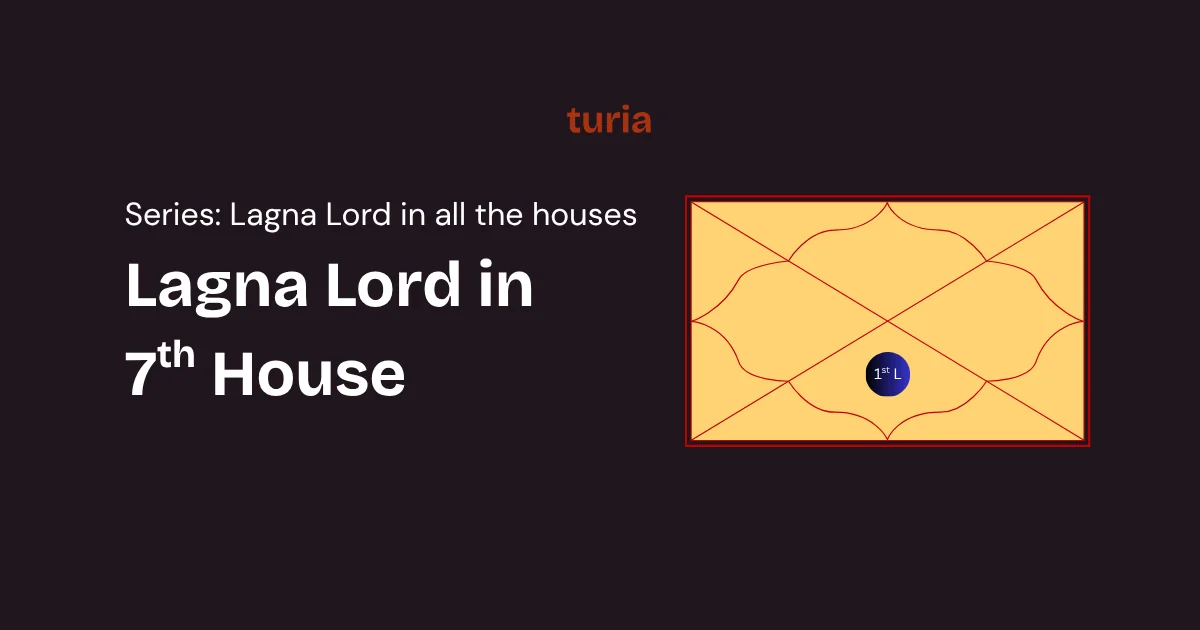
Ask any astrologer to look at a kundali and locate the lagna lord — the ruling planet of the ascendant — and one of the first things they'll check is where it sits. When it lands in the 7th house, people usually hear one of two very different reactions.
Some astrologers will say: "this is one of the best placements for marriage — your spouse will bring you fortune and status."
Others will pause and say: "be careful, this can mean friction, or even risk to your partner's health."
Both reactions are technically correct. And honestly… that's exactly what makes this placement confusing to read about online.
Here's the thing — the lagna lord in the 7th house isn't a single fixed outcome. It's a placement whose result swings hard depending on the planet's strength and nature. In this guide, we'll unpack what it actually means for marriage, business, and public life, what the classical texts say word for word, and how it compares to lagna lord placements in other houses — since this is part of a 12-house series on where your chart-ruler can sit.
Quick answer
When the lagna lord (ruler of the ascendant, or lagnesh) sits in the 7th house — called Yuvati Bhava in classical Jyotish — the native's core identity gets expressed through relationships: marriage, business partnerships, and public dealing. Brihat Parashara Hora Shastra (BPHS, Ch. 24) says the outcome depends entirely on the planet's strength: a strong, benefic lagna lord here can bring a devoted spouse and rising status — even royal favour, in classical language. A weak or malefic lagna lord can threaten the spouse's wellbeing or push the native toward restlessness. Independence, a strong pull toward client-facing careers, and themes of travel or settling abroad are common threads across both outcomes.
What "Lagna Lord in the 7th House" Actually Means
Let's define the pieces first, quickly, so nothing here feels like guesswork.
Lagna is your ascendant — the zodiac sign that was rising on the eastern horizon at the exact moment you were born. It sets the entire chart in motion.
Lagna lord (or lagnesh) is the planet that rules your ascendant sign. If you're an Aries ascendant, your lagna lord is Mars. If you're a Cancer ascendant, it's the Moon. This planet is treated in Jyotish as the "captain" of your chart — wherever it goes, a piece of your core identity goes with it.
The 7th house is classically called Yuvati Bhava — literally, the house of the young woman or spouse. It governs marriage, the type of partner you attract, business partnerships, contracts, public negotiation, and even what the texts call "open enemies." Modern Jyotish blogs describe it simply: whatever the 1st house is to you, the 7th house is to the other person you deal with directly — spouse, business partner, client, the public.
So when your lagna lord — your own significator — physically sits inside the house of "the other," your sense of self gets tied to how you relate to people. That's the plain-language version of what every classical and modern source agrees on.
Effects on Marriage and Spouse
This is where most readers land here from a Google search, so let's be direct about it.
Brihat Parashara Hora Shastra addresses this placement specifically in Chapter 24, "Effects of the Bhava Lords":
"If Lagn's Lord is a malefic and is placed in Yuvati Bhava, the native's wife will not live (long). If the Grah in question is a benefic, one will wander aimlessly, face penury and be dejected. He will alternatively become a king (if the said Grah is strong)." — BPHS, Ch. 24, verse 7
Read that slowly, because it's doing two things at once. It's telling you the same house placement forks into opposite outcomes based on (a) whether the lagna lord is naturally malefic or benefic, and (b) how strong it is. A weak placement is a warning about the spouse's health. A strong one is described, in classical language, as being capable of making someone "a king."
BPHS elsewhere reinforces the positive branch directly. In the marriage-timing section of Chapter 12, it says a native will get a spouse "endowed with the seven principal virtues… if the 7th Lord is exalted, while Yuvati is occupied by strong Lagna Lord and a benefic." In plain terms: a strong lagna lord in the 7th house, supported by good influences, is one of the classical markers of a genuinely virtuous, high-quality marriage — not a lukewarm or risky one.
So the honest answer to "is this good for marriage" is: it depends on strength, exactly like the sloka says. A well-placed, well-aspected lagna lord here tends to give a marriage that's central to the native's success and happiness — real partnership, not just companionship. A weak or afflicted one can bring ego conflict, since the ascendant lord sitting in the 7th also casts its gaze back on the 1st house, meaning both partners can end up equally strong-willed and unwilling to adjust.
Effects on Business Partnerships and Public Dealing
The 7th house doesn't only mean marriage — it's the house of any formal, one-on-one dealing. Contracts. Business partnerships. Clients. The public.
That's why lagna lord in the 7th house shows up so often in the charts of people whose careers depend on other people directly: consultants, lawyers, negotiators, PR professionals, salespeople, therapists, and anyone running a partnership-based business rather than a solo one.
Think of a chartered accountant who does far better running a firm with two partners than working solo — because the placement means the native's identity, drive, and success genuinely need a "other" to work through. That's not a metaphor pulled from nowhere — it's the direct extension of the same principle BPHS states: the self (lagna) finds its expression through the other (7th house).
The Foreign Settlement and Travel Theme
Across nearly every modern source that discusses this placement, one theme repeats: travel, and often a stronger-than-average chance of living or prospering away from the native place.
The reasoning given is straightforward — the 7th house is directly opposite the 1st, the house of "here and now, home ground." When your own significator moves to the opposite house, part of your life's centre of gravity shifts away from where you started. This gets amplified further when the lagna lord in the 7th also connects with the 9th house (long journeys, fortune) or the 3rd house (short travel, effort) lords.
Worth being honest about the limits here: this is a supporting theme, not an automatic guarantee. Nobody should conclude "I will definitely settle abroad" from this placement alone — it needs corroboration elsewhere in the chart, particularly from the 9th and 12th lords.
Strength and Affliction: What Actually Changes the Outcome
Since the entire placement hinges on strength, here's what astrologers actually check before reading it either way:
- Is the lagna lord exalted, in its own sign, or in a friendly sign in the 7th house? That leans the reading positive — status, a capable spouse, partnership success.
- Is it debilitated, combust, or in an enemy sign? That leans toward the difficult branch — friction, or health concerns for the spouse.
- Is it aspected by natural benefics (Jupiter, Venus, a well-placed Mercury) or malefics (Saturn, Mars, Rahu/Ketu)? Benefic aspects soften and support; malefic aspects harden the difficult branch.
- What's the dasha (planetary period) running? A native can carry this placement quietly for years and feel its full effect specifically during the lagna lord's own mahadasha or antardasha.
This is the same principle that runs through every placement in this series — a house tells you the area of life affected; strength tells you how it plays out.
The Classical View: A Parivartana Yoga Worth Knowing
There's a specific, more powerful version of this placement that classical texts single out by name.
Mantreswara's Phaladeepika lists 28 "Maha Yogas" — great yogas — formed when two house lords sit in each other's houses, a mutual exchange called Parivartana Yoga. Fourth on that list: "the lord of the Lagna in the 7th and the Lord of the 7th in Lagna." Phaladeepika says a person born with a Maha Yoga "will have the beneficence of the Goddess Sri… will hold a high position and will be rewarded of authority by the king."
Mantreswara doesn't leave this abstract — he gives a real chart as the worked example: Indira Gandhi's. Her ascendant is Cancer, ruled by the Moon. Her Moon sits in the 7th house, in Capricorn. Capricorn's ruler, Saturn, sits back in her lagna — a textbook exchange. Modern chart-analysis sites independently confirm this same placement and connect it directly to her public life: the 7th house representing "the masses," Capricorn representing "government, authority, and law." Two more house-lord exchanges appear in her chart alongside it, which is partly why classical commentators treat her chart as an unusually strong example of Parivartana Yoga at work.
The takeaway isn't "you'll become a Prime Minister." It's that when lagna lord in the 7th house comes with the additional exchange — 7th lord also sitting in the lagna — classical texts treat it as meaningfully more powerful than the simple placement alone, tying the native's personal authority directly to public life and relationships.
Comparison: Lagna Lord in the 7th House vs. Other Houses
Since this placement is one of twelve in the series, here's how it sits next to a few others for quick reference.
| Placement | Core theme | BPHS framing |
|---|---|---|
| Lagna lord in 1st house | Self stays centred on self; strong physical vitality, direct personality | "The native will be endowed with physical happiness and prowess" |
| Lagna lord in 7th house | Self expressed through spouse, partners, public dealing | Outcome forks on strength — spouse's welfare or the native's own status, per Ch. 24 v.7 |
| Lagna lord in 10th house | Self expressed through career and public reputation | "Endowed with paternal happiness, royal honour, fame among men" |
| Lagna lord in 12th house | Self turned inward — loss, foreign lands, spiritual withdrawal | "Bereft of physical happiness… given to much anger" if unsupported |
The pattern across the series: wherever the lagna lord sits, that house becomes the arena where your core identity plays out its story. In the 7th house, that arena is other people.
A Quick Note by Ascendant
Because the lagna lord is a different planet for every ascendant, this placement never looks identical twice. A Mars lagna lord (Aries or Scorpio ascendant) sitting in the 7th house brings assertiveness and potential friction into partnerships. A Venus lagna lord (Taurus or Libra ascendant) here tends to soften relationships but can pull focus too heavily toward comfort and compromise. A Saturn lagna lord (Capricorn or Aquarius ascendant) brings duty and delay into marriage timing, but often real long-term stability once it settles. The house stays the same; the planet running it changes the flavour completely — which is exactly why a full reading always needs the specific planet, not just the house number.
FAQ
Does lagna lord in the 7th house guarantee a happy marriage?
No. BPHS is explicit that the outcome depends on the planet's strength and nature. A strong, well-aspected lagna lord here tends to support a happy, high-quality marriage. A weak or afflicted one can bring friction or concerns about the spouse's wellbeing. Strength decides the story, not the placement alone.
Is lagna lord in 7th house the same as 7th lord in lagna?
No, and this is a common mix-up. They're two separate placements. When both happen at once — your lagna lord sits in the 7th and your 7th lord sits in the lagna — that's a specific mutual exchange called Parivartana Yoga, which classical texts treat as considerably stronger than either placement alone.
Does this placement mean I'll settle abroad?
It's a supporting theme, not a guarantee. The 7th house sits opposite your home-ground 1st house, so this placement can pull life away from where you started, especially when it also connects to the 9th or 12th house lords. On its own, it's suggestive, not conclusive.
Is this a good placement for business partnerships?
Generally, yes — this placement often favours people whose work depends on direct dealing with others: consultants, lawyers, salespeople, anyone in a partnership-run business rather than solo work. The native's core drive genuinely activates through working with people, not around them.
What happens if the lagna lord is afflicted in the 7th house?
Classical texts flag this specifically as a concern for the spouse's health and longevity, along with a general risk of ego conflict and instability in the relationship. It doesn't mean disaster is certain — but it does mean this chart deserves a closer look at supporting factors before drawing conclusions.
Does the dasha of the lagna lord matter for this placement?
Yes, significantly. Many people carry this placement quietly until the lagna lord's own mahadasha or antardasha arrives — that's typically when marriage, a major partnership, or a public-facing career shift tends to activate.
How is this different from having Venus in the 7th house?
Venus is the 7th house's natural significator regardless of ascendant, so Venus there is a general marriage-and-relationship indicator for everyone. Lagna lord in the 7th is personal — it only applies to your specific chart-ruler, and it ties your individual identity, not just relationship themes in general, to that house.
Where This Leaves You
So if someone asks you, "is lagna lord in the 7th house good or bad?" — the honest answer is that the question is incomplete. It depends on whether that planet is strong, well-aspected, and free of affliction, and it depends on which dasha you're moving through.
What's consistent, though, is the theme: this placement makes relationships — marriage, business, the public — the arena where your own story plays out. That's true whether the result leans favourable or difficult. Look at the specific planet, its strength, and its aspects before drawing conclusions about your own chart — that's the pattern that holds across every house in this series, and the 7th house is no exception.