By Ram Dewani
Every time someone finds out their lagna lord — the ruler of their ascendant — sits in the 6th house, the first reaction is usually a small jolt of worry. "Does this mean I'll be sick all the time? Am I going to be in debt? Are people going to be my enemies?"
Honestly, most of that fear comes from a half-read WhatsApp forward that treats every dusthana placement the same way — a curse to be managed, not understood.
And that's not what the classical texts actually say.
The 6th house is genuinely one of the more complicated houses to have your lagna lord in. Not a placement I'd wave away as "nothing to worry about." But not the disaster most quick-take astrology content makes it out to be, either.
This is the sixth article in our series on lagna lord placements across the 12 houses. In this guide: what it means for your lagnesh to sit in the 6th house, how it plays out in health, career, competition, and debt, why classical texts treat this house differently from other dusthanas, and a short comparison to the 8th and 12th house placements.
Quick answer
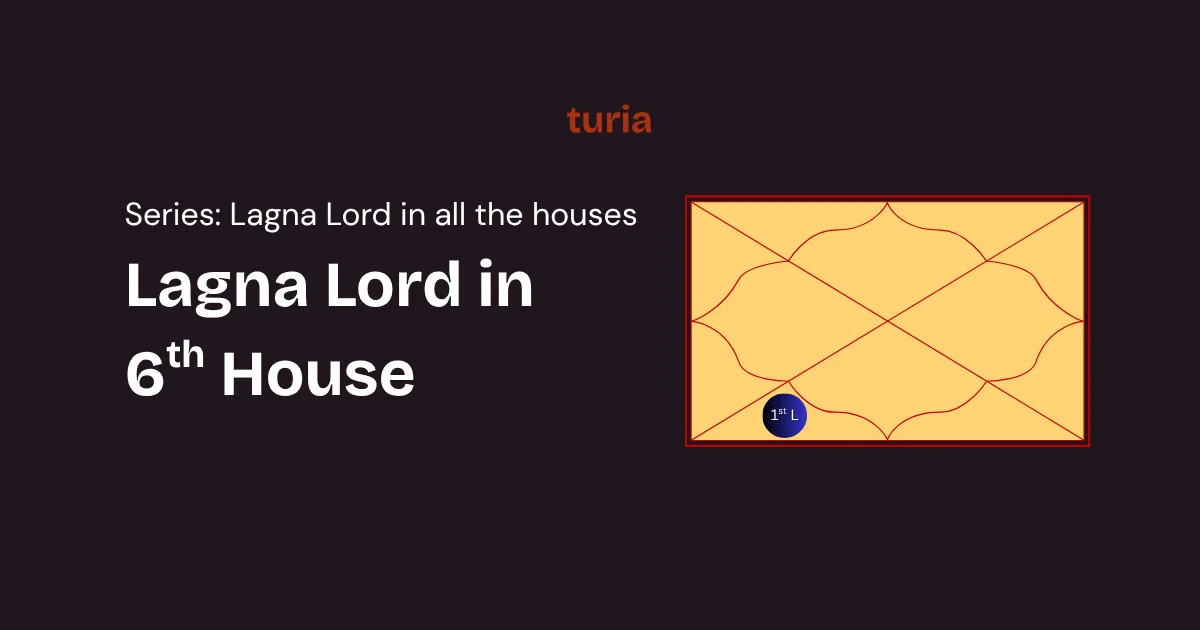
When your lagna lord sits in the 6th house, your identity, body, and life direction get pulled into the affairs of the 6th house — health, daily work, rivals, debt, and competition. Classical texts call the 6th house Ari Bhava ("house of enemies") and group it with the 8th and 12th as a dusthana, a difficult house. But the 6th is unusual: it's also an upachaya house, one of four houses where results are meant to improve with age and effort rather than stay fixed. So this placement often means real struggle early on — especially in health and finances — followed by a native who gets genuinely good at overcoming obstacles, in service professions, competitive fields, litigation, or medicine. Strength of the lagna lord decides which side of that story dominates.
What "Lagna Lord in the 6th House" Actually Means
Your lagna is your ascendant — the zodiac sign rising on the eastern horizon at the exact moment you were born. Whichever planet rules that sign is your lagnesh, or lagna lord, and it acts as a stand-in for you: your body, your vitality, your sense of self.
The 6th house from the lagna is called Ari Bhava in classical texts — literally, the house of enemies. Brihat Parashara Hora Shastra lists what this house governs directly: "Maternal uncle, doubts about death, enemies, ulcers, step-mother etc. are to be estimated from Ari Bhava" (BPHS, Ch. 3, v.7). In plain terms: health and disease, debts, daily work and service, competitors, litigation, and the maternal uncle's side of the family.
| Term | What it means |
|---|---|
| Lagna / Lagnesh | The ascendant / the planet that rules it |
| Ari Bhava | The 6th house — enemies, disease, debt, service |
| Dusthana / Trik Bhava | The "difficult" houses: 6th, 8th, 12th |
| Upachaya Bhava | "Growth" houses: 3rd, 6th, 10th, 11th — improve with effort and age |
| Drishti | Planetary aspect |
When your lagna lord lands here, it doesn't ruin your chart. It means a chunk of your core identity and vitality gets tangled up in these themes — you're likely to spend real energy across your life dealing with health, work friction, competitors, or financial obligations, in a way someone with their lagna lord in the 5th or 9th house simply won't.
Why Classical Texts Call This a Difficult Placement
There's no point sugarcoating this part. Classical astrology is fairly direct about the 6th house being one of the tougher spots for a lagna lord to sit.
BPHS states it plainly: "If Lagna's Lord is in Ari Bhava and related to a malefic the native will be devoid of physical happiness and will be troubled by enemies, if there is no benefic Drishti" (BPHS, Ch. 17, v.6).
Read that sentence carefully, though — Parashara isn't handing down a blanket verdict. He names two specific conditions, "related to a malefic" and "no benefic Drishti [aspect]," before predicting trouble. That's conditional, not fixed. It tells you exactly what tips this placement toward difficulty — which also tells you what softens it: a benefic connection or aspect changes the story considerably.
This is also why the 6th, 8th, and 12th houses are grouped together as dusthanas — literally "bad places" — in the classical framework (BPHS, Ch. 4, v.35-37). A lagna lord placed in any dusthana is expected to face some degree of struggle, simply because the house itself deals in hardship: disease, loss, debt, endings.
So yes — expect some real friction in life, especially early on. That's honest. What most modern content skips is the next part.
The Upachaya Twist — Why the 6th Is Different From the 8th and 12th
Here's the thing most quick astrology posts leave out: the 6th house carries a second classification that the 8th and 12th don't share.
Classical texts group the 3rd, 6th, 10th, and 11th houses as upachaya bhavas — literally, "growth houses." BPHS is explicit that the 6th is both: "Ari, Randhr and Vyaya are Trikas, Dusthan, or malefic Bhavas... Sahaj, Ari, Karm and Labh are Upachayas" (BPHS, Ch. 4, v.35-37) — Ari Bhava appears on both lists.
Practically: unlike the 8th or 12th house (pure dusthanas, no upachaya status), the 6th house is designed, structurally, to improve. Upachaya houses are the ones classical astrologers read as building over time — the effects at 20 are not the effects at 40. Effort compounds here in a way it doesn't in the 8th, which deals more in sudden, less controllable events.
This is why a lagna lord in the 6th so often produces a specific life pattern: real struggle early on — health issues, financial pressure, friction with rivals or authority — followed by a native who becomes noticeably better at handling exactly those things by their thirties and forties. Not because the difficulty disappears, but because upachaya houses reward sustained, repeated effort over luck or ease.
Classical texts even encode a placement where the 6th house turns unusually auspicious. Phaladeepika's Harsha Yoga describes what happens when the lords of the 6th, 8th, and 12th occupy the 6th house itself: "the native will be blessed with happiness and good fortune and a strong constitution. He will conquer his enemies... He will be wealthy, splendourous, famous and will have friends and sons" (Phaladeepika, Ch. 6, v.63). A strong reminder that dusthana placements aren't automatically bad outcomes waiting to happen.
Effects on Health and the Body
Since the 6th house governs disease directly, and the lagna lord represents your physical body, this is usually the area readers ask about first.
The classical read is fairly consistent: expect some vulnerability — recurring minor illness, low stamina in phases, or a health issue that needs ongoing management rather than a one-time fix. This tends to show up more in the early decades of life.
But this is also where the upachaya nature does real work. A lagna lord here often builds a body — and a relationship with health — that gets stronger with deliberate care. Think of someone who struggled with fitness through their twenties, then built serious discipline around it by their late thirties: better routines, more self-awareness, sometimes a career built around health itself. That arc is almost a signature of this placement when the lagna lord has any real strength.
If the lagna lord is weak or afflicted, without a benefic aspect — exactly the condition BPHS names — health struggles can be more persistent and harder to shake.
Effects on Career, Service, and Competitive Success
This is where the 6th house lagna lord genuinely shines, and it's the part most fear-driven content underplays.
Because the 6th governs service, daily work, and competition, this placement shows up repeatedly in charts of people who do well in fields built around exactly those things: medicine, dentistry, pharmacy, engineering (especially biomedical and civil), law, teaching, and government service — including police, defense, and armed forces roles reached through competitive exams.
A strong lagna lord in the 6th often describes someone wired for service and systems — the kind of person who thrives inside structured, competitive environments rather than unstructured ones. A doctor who does her best work under the pressure of a busy government hospital. A civil services aspirant who treats years of exam prep as routine rather than punishment. A litigator energized, not drained, by an adversarial courtroom.
Litigation and competition specifically tend to favor this placement — classical readings associate a well-placed lagna lord here with the native emerging as the one who wins disputes and out-competes rivals, rather than the one who loses to them.
Effects on Enemies, Debt, and Daily Struggle
The 6th house's other core domains — enemies, debt, and daily grind — do show up, and it would be dishonest to skip them.
Financial pressure is common, particularly earlier in life: money that doesn't stretch as far as it should, obligations that feel heavier than they look on paper, sometimes actual debt needing active management. On the relationship side, this placement can bring friction with rivals, colleagues, or people working against the native's interests — not necessarily dramatic enemies, more often the ordinary friction of competitive environments.
The honest reframe classical texts offer: this is also the house of facing enemies and debt, not just having them. The native with a reasonably strong lagna lord here usually ends up the one who resolves the dispute, clears the debt, or outlasts the rival — because that's precisely the skill this placement builds through repeated exposure.
Why Strength of the Lagna Lord Changes Everything
If there's one thing to take from this article, it's this: the house a planet sits in is only half the story. The other half is how strong that planet is.
Phaladeepika states this almost as a rule: "If the lords of the 6th, 8th and 12th houses vested with strength are posited in Kendra or Trikona and the lords of 1st, 10th, 4th and 9th houses be weak or combust... the yoga so arising is named Duryoga. If, however, the above dispositions are in the reverse order... the native will become a king, fortunate, wealthy, happy and virtuous" (Phaladeepika, Ch. 6, v.70). When the lagna lord is stronger than the dusthana lords, results swing favorable — even from a difficult house.
A few practical markers worth checking in your own chart:
- Own sign or exaltation. A lagna lord in its own sign, or exalted, in the 6th house handles the house's themes far better — turning a service-oriented career into genuine mastery, rather than burnout.
- Debilitation. A debilitated lagna lord here is the weaker version of this placement — more prone to chronic issues, financial strain, or a victim-leaning mindset. Even here, classical astrology allows for Neecha Bhanga Raja Yoga — conditions that cancel debilitation and convert weakness into unusual strength.
- Benefic aspects. A benefic drishti — from Jupiter, Venus, or a well-placed Mercury — softens the harder edges considerably. Exactly the condition BPHS names when it says trouble comes "if there is no benefic Drishti."
- Yogas involving the 6th lord. If the lagna lord and 6th lord are in mutual exchange (a parivartana), classical texts name this a Dainya Yoga — a yoga of hardship (Phaladeepika, Ch. 6, v.30). This combination is called out by name as demanding, even while other conditions in the same chart can offset it.
None of this is about finding loopholes to declare a "bad" placement secretly good. It's about reading the whole chart — sign, aspects, yogas, dasha — rather than stopping at "lagna lord is in the 6th house, therefore X."
Comparing the 6th to the 8th and 12th House
Since this is part of a series on the lagna lord across all 12 houses, it helps to place the 6th alongside its fellow dusthanas — the 8th and 12th.
| 6th House | 8th House | 12th House | |
|---|---|---|---|
| Classical name | Ari Bhava (enemies) | Randhra Bhava (transformation) | Vyaya Bhava (loss) |
| Also classified as | Upachaya (growth house) | Neither upachaya nor kendra/kona | Neither upachaya nor kendra/kona |
| Core theme | Competition, service, health, debt | Sudden change, hidden matters, deep transformation | Detachment, foreign lands, endings, spirituality |
| General life arc | Struggle early, strength through repeated effort | Unpredictable, high highs and lows, deep psychological growth | Loss of the familiar, often a pull toward solitude or the spiritual |
| Common strength signature | Wins competitions, builds service-based mastery | Resilience through crisis, sometimes occult or research interest | Selfless service, foreign connection, quiet inner growth |
The practical difference: the 6th house is the one dusthana explicitly built for improvement over time. The 8th and 12th test you differently — the 8th through sudden reversals, the 12th through loss and detachment — but neither carries the 6th's structural promise that sustained effort compounds into visible results.
FAQ
Is lagna lord in 6th house good or bad?
Neither, on its own. It's a dusthana placement, so classical texts expect real early-life struggle around health, finances, or rivals. But the 6th is also an upachaya house, meaning results tend to improve with age and effort. The real answer depends on the lagna lord's sign strength, aspects, and any yogas it forms — not the house alone.
Does this placement mean I'll always have health problems?
Not always, and not permanently. Health vulnerability is more common earlier in life with this placement. A reasonably strong lagna lord — own sign, exalted, or benefic-aspected — usually means the native builds real resilience and better health habits over time, rather than staying stuck.
What careers suit a lagna lord in the 6th house?
Service and competition-based fields tend to fit well: medicine, dentistry, pharmacy, engineering, law, teaching, and government or defense roles reached through competitive exams. The 6th house's themes of daily work and competition translate naturally into these careers when the lagna lord has decent strength.
What if my lagna lord is debilitated in the 6th house?
A debilitated lagna lord here is the more difficult version of this placement — more prone to chronic health issues, financial strain, or persistent friction with others. Classical astrology does allow for Neecha Bhanga Raja Yoga, a set of cancellation conditions that can turn this weakness into an unusual strength — worth checking for in the full chart before assuming the worst.
How is lagna lord in 6th house different from lagna lord in 8th or 12th house?
The 6th is uniquely classified as both a dusthana and an upachaya (growth) house, meaning results generally improve with sustained effort. The 8th deals more in sudden reversals and deep transformation; the 12th deals in loss, detachment, and endings. All three demand something from the native, but the 6th is the one built structurally to reward persistence.
Does age matter for this placement?
Yes, more than most. Because the 6th is an upachaya house, classical logic treats it as improving through the years rather than staying fixed. Many people with this placement describe a noticeably harder first half of life and a stronger, more capable second half — especially once they've built real experience handling the 6th house's themes.
Can a lagna lord in the 6th house still form a good yoga?
Yes. Phaladeepika's Harsha Yoga specifically describes the 6th, 8th, and 12th lords occupying the 6th house as producing happiness, strong constitution, and victory over enemies. Dusthana lordships are not automatically negative — classical texts name several conditions where they turn genuinely auspicious.
Bringing It Together
So when someone asks, "Is lagna lord in 6th house bad?" — the honest answer is: it's a placement that asks more of you, especially early on, and pays you back clearly once you've put in the work.
Health needs more attention. Money needs more discipline. Competitors and disputes show up more often than for other placements. But the same house that creates that friction is also the one classical texts single out as a growth house — where effort compounds instead of evaporating.
If you're going through this series house by house, notice this pattern: dusthana placements are not verdicts. They're descriptions of where your life will ask you to do real work. The 6th house just happens to be the one that pays that work back most reliably, over time.