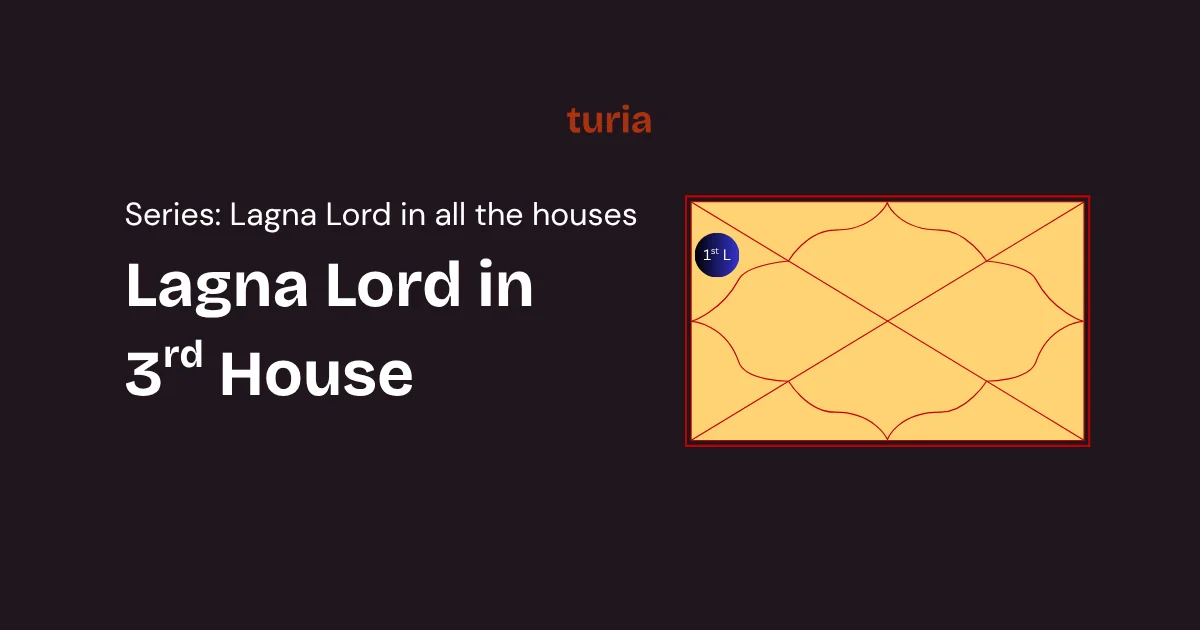
Someone finds out their lagna lord sits in the 3rd house and the first question is almost always the same: "Is this good or bad?"
Fair question. Most placement write-ups online just list traits — brave, hardworking, communicative — without explaining why, or what to actually watch for.
And honestly… this is one of the more misunderstood placements, because it looks intense on paper (valour, risk, sibling friction) but plays out, in most charts, as one of the more quietly rewarding positions for the ascendant lord.
In this guide, we'll cover what the 3rd house represents, what it means specifically when your lagna lord sits there, what the classical texts say, how it shows up in career, siblings, and communication, what strengthens or weakens the placement, and how it compares to the lagna lord sitting elsewhere in the series.
Quick answer
When the lagna lord — the ruling planet of your ascendant — sits in the 3rd house, Brihat Parashara Hora Shastra (Ch. 24, v. 3) says the native "will equal a lion in valour, be endowed with all kinds of wealth, be honourable... intelligent and happy." The 3rd house, called Parakrama Sthana (house of courage) and Sahaja Sthana (house of siblings), is one of four Upachaya (growth) houses — meaning results here build through the native's own effort rather than arrive early or by inheritance. This placement typically produces a courageous, communicative, self-made person whose success often accelerates after their early 30s, sometimes at the cost of some friction with siblings.
What the 3rd House Actually Governs
Before we talk about the lagna lord sitting here, it helps to know what this house is actually about.
BPHS (Ch. 11, v. 4) lists it directly:
"From Sahaj Bhava know of the following: valour, servants, brothers, sisters etc., initiatory instructions (Upadesh), journey and parent's death."
Two Sanskrit names carry the weight of this house.
Parakrama Sthana — the house of courage, valour, prowess. Parakrama isn't dramatic, cinematic bravery. It's the everyday willingness to act — to make the call, take the meeting, start the business, put your hand up.
Sahaja Sthana — the house of the sahaja, literally "the co-born." Your siblings, particularly younger ones. (In Indian convention, the 11th house governs elder siblings; the 3rd governs younger ones.)
Beyond these two anchors, the 3rd also rules communication, writing, short-distance travel, hands and arms, hobbies, and self-effort in general — the things you build with your own two hands rather than what's handed to you.
That last point matters more than it looks. The 4th house gives you a home you're born into. The 11th gives you networks and gains that often arrive through others. The 3rd gives you nothing — it only gives you the capacity to go get it.
Why the 3rd House Is Different: The Upachaya Effect
Here's the detail that changes how you should read this entire placement.
The 3rd house is one of four Upachaya houses — along with the 6th, 10th, and 11th. Upachaya means "growth" or "increase." These are the houses that don't hand you results at birth. They build.
Most houses show you what you're born with. Upachaya houses show you what you'll earn — provided you put in the work.
This is also why classical Jyotish is comfortable with even harsh planets sitting in these houses. A malefic in a Kendra (angle) or Trikona (trine) can create instability. The same malefic in an Upachaya house often thrives, because the house rewards exactly the qualities a "difficult" planet brings — grit, push, aggression, endurance.
When your lagna lord — the planet that represents you, your body, your basic nature — sits in an Upachaya house, the message is direct: your core identity is not handed a smooth, early script. It's handed a growth curve. Struggle in your 20s is common. Real traction from the mid-30s onward is the more typical pattern.
This single fact explains almost every other trait attributed to this placement.
Lagna Lord in the 3rd House — What Classical Texts Say
The direct citation comes from Brihat Parashara Hora Shastra, Chapter 24 ("Effects of the Bhava Lords"), verse 3:
"If Lagn's Lord is in Sahaj Bhava, the native will equal a lion in valour, be endowed with all kinds of wealth, be honourable, will have two wives, be intelligent and happy."
Three things stand out in that one line.
"Equal a lion in valour" — Parashara isn't being subtle. This is one of the more direct courage-affirmations in the entire chapter on lagna lord placements. Wherever the ascendant lord goes, it carries the native's fundamental nature with it — and here, that nature is fearless.
"Endowed with all kinds of wealth... honourable" — this isn't a struggling placement. The classical framing is positive, not cautionary.
"Will have two wives" — a period-specific detail from a text written centuries ago in a polygamous social context. Modern commentary generally reads this less literally — as multiple sources of partnership, comfort, or relationship complexity across a lifetime, rather than a literal prescription.
BPHS (Ch. 14, v. 1) adds a supporting note: a well-aspected 3rd house — touched by a benefic — makes the native "endowed with co-born and courageous" — the courage and the sibling theme rising and falling together, which is worth remembering when you get to the sibling-relations section below.
Phaladeepika (Mantreswara, Ch. 2, v. 11–12), an independent classical source, confirms the same core theme from a different angle, listing the 3rd house's significations as "army, valour, prowess and brother" — valour and siblings, again, named in the same breath.
Courage: What It Actually Looks Like
"Courageous like a lion" sounds impressive on a page. In real life, this placement usually shows up in quieter, more specific ways.
The native who switches careers without a backup plan because they trust their own hands. The one who starts a business while everyone around them takes the safe government job. The person who argues their case directly instead of going through three intermediaries — a very Indian workplace habit this placement often resists.
This isn't recklessness (though it can tip that way if the lagna lord is afflicted — more on that below). It's a baseline willingness to act rather than wait for permission or perfect conditions.
Where this often shows up concretely: a person with this placement is frequently the one in a joint family who breaks from the expected path — the family runs a textile business, but this person insists on doing something entirely their own, and years later, is the one who actually built something independently, even if it took longer than everyone else's "safe" route.
Siblings: Where the Friction Usually Comes From
This is the part of the placement people are least prepared for.
The native's assertive, take-charge nature — useful everywhere else — can create real friction with brothers and sisters. Not always. But often enough that classical and modern sources both flag it.
The pattern isn't cruelty or conflict for its own sake. It's usually a mismatch of pace and temperament. The native moves fast, speaks directly, takes initiative without asking. A sibling — especially one with a more cautious or traditional temperament — can read that as the native being quarrelsome, dominant, or dismissive, even when no offense was intended.
BPHS itself hints at this dual nature — the same house that grants valour also governs siblings, and the placement of the lagna lord here means the native's fundamental self-expression runs directly through that relationship. When the lagna lord is well-placed (own sign, exalted, or well-aspected by a benefic), the friction softens — you get a protective, capable older or younger sibling dynamic instead of a strained one. When the lagna lord is weak or afflicted, the friction is more likely to surface as actual distance or rivalry.
Good news: this rarely means estrangement. It usually means a relationship that needs a little more deliberate warmth than it would otherwise, because the native's natural mode isn't accommodating — it's assertive.
Communication and Self-Made Effort
The 3rd house also governs speech, writing, short trips, and hands-on skill — and a lagna lord placed here tends to channel identity through exactly these things.
People with this placement are often unusually good at making their case — in a meeting, in a negotiation, in a family discussion. Not necessarily eloquent in a literary sense, but convincing. They know how to explain an idea so it lands.
Many are strong self-learners too — the kind of person who picks up a new skill from YouTube tutorials and forum threads rather than waiting for a formal course. Given the 3rd house's link to short-distance travel and hands-on learning, this placement suits people who build capability through doing, not just studying.
Career-wise, this shows up as sales, marketing, writing, journalism, coaching, small business, or any field where results depend on personal initiative rather than institutional backing. The recurring theme across modern Indian astrology commentary is consistent: success arrives, but it's earned, typically picking up real pace only after the early-to-mid 30s — a direct echo of the Upachaya-house timing pattern.
Strength Considerations: What Makes This Placement Work Well or Poorly
Not every lagna lord in the 3rd house behaves identically. Strength and affliction change the outcome considerably.
Signs the placement is working well:
- Lagna lord in own sign, exaltation, or a friendly sign while placed in the 3rd
- A benefic (Jupiter, Venus, well-placed Mercury) aspecting the 3rd house or the lagna lord
- Kahala Yoga present — see below
- No close conjunction with malefics like Rahu, Saturn, or Mars in a weak dignity
Signs the placement may struggle:
- Lagna lord debilitated or combust while in the 3rd
- Heavy affliction from malefics without any benefic support — courage can tip into rashness, and self-made effort can turn into constant, exhausting struggle rather than compounding growth
- 3rd house lord poorly placed as well, compounding the difficulty
Kahala Yoga — the exchange worth knowing about
Phaladeepika (Mantreswara, Ch. 6) names a specific yoga that often accompanies this placement: Kahala Yoga, formed when the lagna lord sits in the 3rd house and the 3rd house's lord sits back in the lagna — a mutual exchange (parivartana) between the two.
Classical texts describe this exchange as giving occasional swings — "haughty" at times, "sweet in speech" at others, prosperity followed by leaner periods rather than one smooth, flat trajectory. It's not a guarantee of ease. It's a guarantee of movement — and for a house that's fundamentally about growth through effort, that's arguably the more honest promise.
Worth separating this from Shaurya Yoga — a different, related yoga that forms when the 3rd house itself (not the lagna lord specifically) is well-aspected and its own lord is strong. Shaurya Yoga speaks to the general strength of courage and siblings in the chart; Kahala Yoga speaks specifically to the lagna lord's exchange with the 3rd. Both are worth checking, but they answer slightly different questions.
Comparing Lagna Lord in the 3rd House to Other Placements
Since this is one entry in a 12-part series on lagna lord placements, here's how the 3rd compares to its immediate neighbours.
| Placement | Core Theme | How Identity Expresses |
|---|---|---|
| Lagna Lord in 1st House | Self, physique, personality | Identity is direct and unfiltered — what you see is largely what you get; strong sense of self from an early age |
| Lagna Lord in 2nd House | Wealth, speech, family values | Identity is tied to resources, values, and the voice — self-worth often measured through accumulation and family standing |
| Lagna Lord in 3rd House | Courage, siblings, self-effort | Identity is expressed through action and initiative — you become who you are by doing, not by being handed a script |
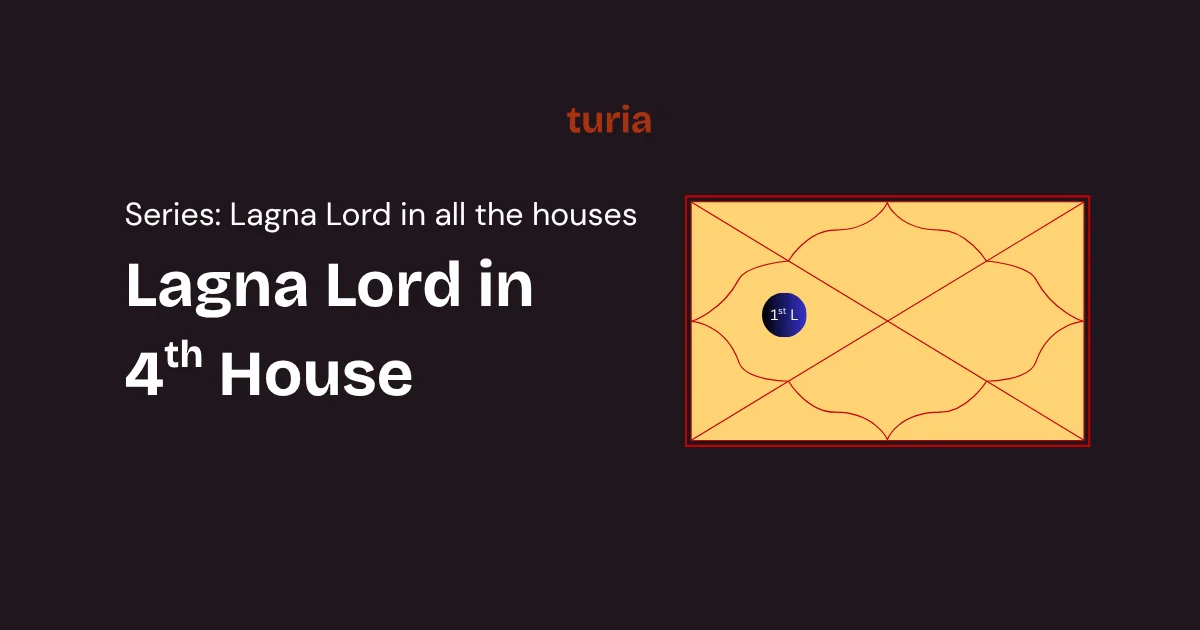
| Lagna Lord in 4th House | Home, mother, emotional roots | Identity is anchored in comfort, domestic peace, and emotional security rather than external achievement |
The pattern across the first four houses is worth noticing: 1st is being, 2nd is having, 3rd is doing, 4th is belonging. The 3rd house lagna lord is arguably the most "self-made" of the early houses — precisely because it's the one placement in this stretch that offers nothing automatically. Everything is earned through the native's own hands, voice, and nerve.
Conclusion
So when someone asks, "is lagna lord in the 3rd house good or bad?" — the honest answer is: it's one of the more favourable placements for the ascendant lord, provided you understand what kind of favour it is.
It doesn't hand you an easy first act. It hands you courage, sharp communication, and the capacity to build something entirely your own — and asks you to actually use it. The sibling friction is real but usually manageable. The late-blooming success isn't a flaw in the chart; it's the Upachaya pattern doing exactly what it's designed to do.
The person with this placement who looks back at 45 and says "I built this myself" isn't exaggerating. That's the placement working as intended.
FAQ
Is lagna lord in the 3rd house a good or bad placement?
Generally favourable. BPHS (Ch. 24, v. 3) describes the native as courageous ("equal a lion in valour"), wealthy, honourable, and happy. The 3rd house is an Upachaya (growth) house, so results build over time through effort rather than arriving early. It's rarely a "bad" placement — it's a placement that asks for patience and initiative rather than passive comfort.
Does lagna lord in the 3rd house affect relationship with siblings?
Often, yes. The native's assertive, take-initiative nature can create friction with siblings, who may perceive them as dominant or quarrelsome — even without real conflict intended. This softens considerably when the lagna lord is well-dignified or benefic-aspected. It rarely means estrangement, but the relationship usually needs a little more deliberate warmth than it would with other placements.
What does lagna lord in the 3rd house mean for career?
Strong fit for self-driven fields: sales, marketing, writing, journalism, coaching, entrepreneurship, or anything where personal initiative and communication drive results more than institutional backing. Success is typically earned rather than inherited, and tends to accelerate from the early-to-mid 30s onward, matching the Upachaya timing pattern.
Is success delayed when the lagna lord is in the 3rd house?
Often, yes — but "delayed" is the wrong lens. Because the 3rd is an Upachaya house, results compound rather than arrive fully formed. Many natives experience real struggle through their 20s, followed by a noticeable acceleration in their 30s and 40s as accumulated effort starts paying off. This is the house's normal pattern, not a sign of a weak chart.
What is Kahala Yoga and how does it relate to lagna lord in 3rd house?
Kahala Yoga (Phaladeepika, Ch. 6) forms when the lagna lord sits in the 3rd house and the 3rd house's own lord sits back in the lagna — a mutual exchange between the two. Classical texts describe this as giving swings between assertiveness and warmth, and between prosperity and leaner periods, rather than one flat trajectory. It's a specific, checkable yoga worth looking for alongside the plain placement.
What happens if the lagna lord in the 3rd house is afflicted?
Affliction — debilitation, combustion, or heavy malefic conjunction without benefic support — can tip courage into rashness and turn self-made effort into constant, draining struggle rather than compounding growth. The core themes (courage, siblings, communication) don't disappear, but they express with more friction and less ease.
How is lagna lord in 3rd house different from lagna lord in 1st or 2nd house?
Lagna lord in the 1st keeps identity direct and self-contained — a strong, largely unfiltered sense of self. Lagna lord in the 2nd ties identity to resources, speech, and family values. Lagna lord in the 3rd ties identity to action — courage, communication, and self-built success rather than something inherited or immediately given. Of the three, the 3rd is the one most defined by effort rather than by simply being or having.
This article is part of a 12-part series on where the lagna lord (ascendant lord) sits across the 12 houses of the kundali. Read the other placements in the series for the full picture of how this single planetary position shapes personality, effort, and life outcomes.