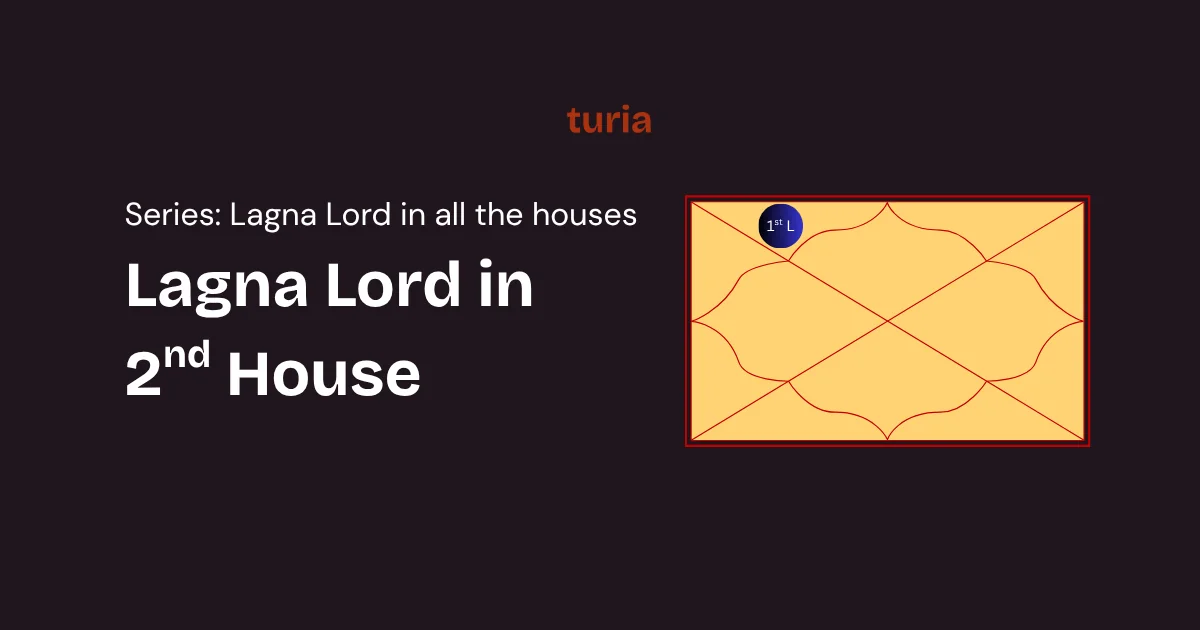
Someone gets their kundali read, hears "your lagna lord is in the 2nd house," and the first question that comes out is almost always the same.
"Does that mean I'll be rich?"
Close behind it — usually with a slightly nervous laugh — is the second question: "Wait, does this mean I'll have more than one marriage?"
Honestly… both questions come from the same place. People have read a stray line somewhere, out of context, and jumped to the extreme version of it.
The real answer is more layered — and more useful — than either a flat yes or no.
This is the second piece in our series on lagna lord placements across the 12 houses. If the lagna lord in the 1st house is about identity turned inward, the lagna lord in the 2nd house is about identity turned toward resources — money, family, speech, and the values you build your life on. In this guide: what this placement means, what BPHS and Phaladeepika say about it, how it plays out in wealth, family, marriage and career, why strength (exaltation, debilitation, combustion) changes the story, and how it compares to other placements in the series.
Quick answer
When your lagna lord — the ruling planet of your ascendant — sits in the 2nd house, your sense of self gets tied to wealth, family, and speech. Classical texts like BPHS call this a gainful, honourable placement that often forms a mild dhana yoga (wealth combination), because the "self" house and the "wealth" house are directly linked. Expect self-made money, a strong pull toward family, and persuasive, often magnetic speech. But the placement's real strength depends on how strong the lagna lord itself is — exalted or in its own sign, it's genuinely powerful; debilitated or combust, the same themes (money, family, self-worth) become areas of struggle instead.
What "Lagna Lord in the 2nd House" Actually Means
Let's get the mechanics right first, because this is where a lot of confusion starts.
Your lagna is your ascendant — the zodiac sign rising on the eastern horizon at the exact moment you were born. Every ascendant has a ruling planet, called the lagnesh or lagna lord — Mars if you're Aries or Scorpio rising, Venus if you're Taurus or Libra rising, and so on. The lagna represents you — your body, vitality, basic nature, how the world sees you at first glance.
The 2nd house, called Dhan Bhava, represents wealth, savings, family, food, speech, and personal values. It's not income in the sense of "how much comes in" (that's the 11th house). It's what you keep and hold — your bank balance, your family's standing, the words you choose.
So when your lagna lord sits in the 2nd house, the planet that represents you has physically moved into the house of wealth and family. Your sense of identity gets wrapped up in what you accumulate and how you speak.
The Brihat Parashara Hora Shastra (BPHS), one of the foundational texts of Vedic astrology, states this plainly in its chapter on the effects of the bhava lords:
"If the Lagna's Lord is in Dhan [the 2nd house], he will be gainful, scholarly, happy, endowed with good qualities, be religious, honourable and will have many wives." — BPHS, Chapter 24, Sloka 2
Notice the range — it's not just about money. "Gainful" covers wealth, but "scholarly," "religious," and "honourable" point to values and reputation too. That "many wives" line trips a lot of modern readers up — more on that in the marriage section below.
One quick clarification, since it comes up constantly in searches: this article is about the lagna lord sitting in the 2nd house — different from "the 2nd house lord sitting in various houses," which studies a different planet's journey entirely. If you're mapping your wealth potential fully, you eventually want both, but they answer different questions.
Effects on Wealth and Material Life
This is the part everyone wants to know first, so let's start here.
When the lagna lord sits in the 2nd house, it creates what's classically called a dhana yoga — a wealth-producing combination — because the lord of the self (1st house) is directly connected to the house of wealth (2nd house). Your core identity is literally housed inside your resource base.
In real life, this tends to mean earning through your own efforts rather than pure inheritance. Not always — family wealth can still be part of the picture — but the classical framing consistently uses words like "gainful" and "self-earned." You'll often see steady accumulation rather than sudden windfalls: someone who saves consistently, invests sensibly, and builds a reputation for financial reliability within family and social circle.
The Phaladeepika by Mantreswara reinforces this same logic when discussing the mutual relationship between the lagna and the 2nd house:
"If the lord of the 2nd house be posited in the Lagna and benefics occupy the 2nd house, the person concerned will be endowed with the best qualities, have a prosperous family, will be rich, affable, and far-sighted." — Phaladeepika, Adhyaya XVI, Sloka 5
This sloka technically describes the mirror placement (2nd lord in Lagna), but Phaladeepika treats the lagna-lord/2nd-lord relationship as a linked pair — when these two houses talk to each other, wealth and family fortune both improve.
One honest caveat: a dhana yoga on paper doesn't guarantee a bank balance on its own. The 2nd house also needs to be checked for what planets sit there, what aspects reach it, and which dasha periods activate it. Think of the placement as a strong tailwind, not an automatic outcome.
Effects on Family, Speech, and Values
The 2nd house isn't just money — it's kutumb (family) and vaani (speech), and this placement pulls both strongly into your identity.
Family orientation. People with this placement tend to be deeply committed to family — protective of parents, involved with siblings, invested in the family's collective reputation. It's common for the native to feel a real sense of duty here, not out of obligation but because family genuinely becomes part of how they see themselves. This can go either way depending on other factors in the chart — sometimes it shows up as generous support for family, sometimes as a heavier sense of responsibility than siblings carry.
Speech and communication. This is one of the more consistently observed traits across classical and modern sources — a natural gift with words. Not necessarily loud or showy, but persuasive, warm, and memorable. In today's context, this shows up well in careers that live and die by communication: sales, teaching, content creation, anchoring, public relations, even something as simple as being "the one who always explains things clearly" in a friend group or family WhatsApp thread.
Values. The 2nd house also governs personal values — what you consider worth having, worth saying, worth protecting. This placement tends to make values concrete rather than abstract: money matters because it buys security for family, words matter because they build trust, food and comfort matter because they're how care gets expressed at home.
Marriage and Relationships
Here's the line that makes most people pause: BPHS says the native "will have many wives" when the lagna lord sits in the 2nd house.
Read literally in 2026, that doesn't map to how most people live. What it's actually pointing to is a pattern of magnetism — this placement often gives a personality that's naturally attractive to others, sometimes drawing more than one serious relationship over a lifetime, and often blessed with a partner who is socially prominent, financially capable, or transformative in some way.
Modern astrologers reading this placement generally describe a supportive, values-aligned partner — someone who brings stability and material comfort into the relationship, and who often becomes closely tied to the native's family. Whether the marriage is arranged or a love match, family approval and financial compatibility tend to matter a lot here, because — unsurprisingly — the 2nd house's themes of family and resources bleed directly into how relationships get evaluated.
The honest takeaway: don't read "many wives" as a prophecy. Read it as "this placement makes you someone people are drawn to, and relationships here tend to be entangled with family and finances" — which is a much more useful thing to actually watch for in your own life.
Career and Life Path
Career-wise, this placement tends to favor fields connected to 2nd house significations — wealth, speech, food, and values.
That commonly translates into: banking and finance, jewellery and gems, cosmetics and garments, food and hospitality businesses, real estate, education, and anything built around public speaking or persuasive communication — sales, media, anchoring, teaching, content creation. The common thread across all of these is that they reward the same two strengths the placement gives: financial instinct and communication skill.
Success in career, per the classical texts, tends to come through the native's own effort rather than being handed down — consistent with the "self-earned" language that shows up again and again for this placement. It's also frequently associated with steady upward movement rather than early, dramatic success — wealth and reputation that compound over the years rather than arrive overnight.
How Strength Changes the Story
Everything above describes the default tendency of this placement. But in real chart reading, the strength of the lagna lord itself decides how much of that potential actually shows up. This is the part most generic articles skip — and it matters more than the placement itself.
Phaladeepika is direct about this:
"If at the birth of a person, the lord of the Lagna be of brilliant rays, he will become famous; if the planet be well-placed, the person will be happy and prosperous. But if he should occupy a dusthana, be in the house of a malefic or an enemy or occupy his depression sign, the native will be miserable... If the Lagna is strong, the person concerned will live happy, thrive well... But if the Lagna be without strength, the man will constantly be overcome by calamities, be sad and will suffer from disease." — Phaladeepika, Adhyaya XVI
Here's how that plays out specifically for a lagna lord placed in the 2nd house:
| Strength condition | What it tends to look like |
|---|---|
| Own sign (swakshetra) | The dhana yoga stabilizes fully — steady, self-sustained wealth and a strong, secure family standing. This is the placement working close to its classical best. |
| Exalted (uchcha) | The strongest version — self-made wealth, respected family name, genuinely persuasive speech, and visible upward mobility over time. |
| Debilitated (neech) | The same themes — money, family, self-worth — become sources of anxiety instead of strength. Financial instability or friction within the family is more likely, unless there's a neecha bhanga (debilitation-cancelling combination) elsewhere in the chart. |
| Combust (asta) | Too close to the Sun, the lord's self-expression around money and family gets overshadowed — often by a dominant father figure or authority in the family. Results tend to be delayed rather than destroyed, and a strong underlying dignity (like exaltation) can still push good outcomes through despite the combustion. |
| With benefic influence (Jupiter, Venus, well-placed Mercury) | Strengthens the ethical, value-driven side — wealth earned honestly, wisdom, generosity. |
| With malefic affliction (Saturn, Rahu, Ketu) | Can create delays, unconventional income sources, or friction in family communication — worth watching, not fearing. |
The point isn't to memorize this table — it's to internalize the principle: the house tells you the theme, the planet's strength tells you the outcome. A weak lagna lord in the 2nd house doesn't erase the wealth-and-family theme; it just means that theme becomes the area of life you have to work at, rather than the area that comes easily.
How This Compares to Other Lagna Lord Placements
Since this is one placement out of twelve in this series, it helps to zoom out for a second.
When the lagna lord sits in the 1st house (its own house), the energy stays centered on the self — body, personality, vitality. It's a placement about being, not necessarily about accumulating. Per BPHS, it gives "physical happiness and prowess" and intelligence — but wealth isn't the automatic outcome the way it is in the 2nd house placement.
When the lagna lord moves to the 2nd house, that same self-energy gets channeled outward into resources — wealth, family, speech. It's a placement about building, specifically building material and relational security.
As a general pattern across the series: placements in the kendra (angular: 1, 4, 7, 10) and kona (trinal: 1, 5, 9) houses tend to be read as classically strong and auspicious. Placements in the dusthana houses (6, 8, 12) tend to bring more friction and effort-coded growth. The 2nd house — along with the 3rd and 11th — sits in a middle category: genuinely favorable houses whose actual results lean heavily on how strong the lagna lord is, more so than in the kendra/kona houses where the position itself carries more automatic weight.
So if you're comparing notes with a friend whose lagna lord sits in the 7th house instead, don't assume one placement is simply "better." They're answering different questions — this placement is about wealth, family, and speech; theirs is about partnership and public dealings. The right question isn't "which placement is best," but "what is my chart asking me to build, and how strong is the planet in charge of building it?"
FAQs
What does it mean when the lagna lord is in the 2nd house?
It means the planet ruling your ascendant — your core identity — is placed in the house of wealth, family, and speech. Classically, this creates a mild dhana yoga (wealth combination), pointing toward self-earned money, a strong pull toward family, and persuasive speech. The exact strength of these results depends on how strong that ruling planet is in your specific chart.
Is lagna lord in 2nd house good for wealth?
Generally, yes — classical texts like BPHS describe it as a "gainful" placement and a recognized dhana yoga. It usually points to steady, self-made wealth rather than sudden windfalls or pure inheritance. But the 2nd house's other occupants, aspects, and the lagna lord's own strength (exalted vs. debilitated) all shape how strongly this potential actually plays out.
Does lagna lord in 2nd house cause multiple marriages?
Not literally, and not automatically. The classical line about "many wives" is better read as a sign of personal magnetism and multiple meaningful relationships or attractions over a lifetime, not a guaranteed prediction of remarriage. Most modern readings focus instead on a supportive, family-oriented, financially capable partner rather than a literal multiple-marriage outcome.
What if the lagna lord is debilitated in the 2nd house?
The core themes — wealth, family, speech, self-worth — remain the same, but they become areas of struggle rather than strength. Expect more financial ups and downs or friction within the family unless there's a debilitation-cancelling (neecha bhanga) combination elsewhere in the chart. It's a call to build these areas consciously, not a permanent verdict.
What if the lagna lord is combust in the 2nd house?
Combustion (being too close to the Sun) tends to overshadow the native's self-expression around money and family, sometimes due to a dominant father or authority figure in the household. Results are usually delayed rather than destroyed — and if the same planet is also exalted, the underlying strength can still push good outcomes through over time.
Is lagna lord in 2nd house a dhana yoga?
Yes, this is one of the recognized dhana yoga (wealth combination) patterns in Parashari astrology, because it directly links the lagna (self) with the 2nd house (wealth). Its actual strength still depends on the lagna lord's dignity, the planets occupying the 2nd house, and the dasha periods that activate it during your life.
Which career suits a person with lagna lord in the 2nd house?
Careers tied to 2nd house themes tend to suit this placement well — finance and banking, jewellery and gems, food and hospitality, real estate, education, and communication-heavy fields like sales, media, anchoring, and content creation. The common thread is that these careers reward financial instinct and persuasive speech, both natural strengths of this placement.
The Bottom Line
So when someone asks, "is lagna lord in the 2nd house good?" — the honest answer is: it's a genuinely favorable placement for building wealth, family standing, and a persuasive voice, but "favorable" isn't the same as "automatic." The house sets the theme. The planet's strength — its sign, its dignity, its company — decides how much of that theme actually shows up in your life, and your dasha periods decide when.
If this is your placement, the practical takeaway is simple: your chart is nudging you to build security consciously — through steady effort, honest speech, and real investment in family — rather than waiting for it to arrive on its own. That's not a limitation. That's usually the difference between potential and results, in any chart.