Introduction
Someone gets their kundali read, and the astrologer says: "Your lagna lord is sitting in your 1st house."
The first reaction is almost always the same. Is that good? Is that bad? What does it actually mean for me?
Most explanations online either oversell it — "this is the best placement possible, you're destined for greatness" — or bury you in Sanskrit terms without ever answering the question you actually came with.
And honestly… the truth sits in between.
Lagna lord in the 1st house is genuinely one of the stronger placements in Vedic astrology. But "strong" doesn't mean "automatically good" — it depends on the planet, its dignity, and what's aspecting it. In this guide, we'll cover what this placement actually means, how it shapes personality and health, what decides whether it plays out well, and how it compares to lagna lord placements in the other eleven houses — since this is the first article in a series covering all twelve.
Quick answer
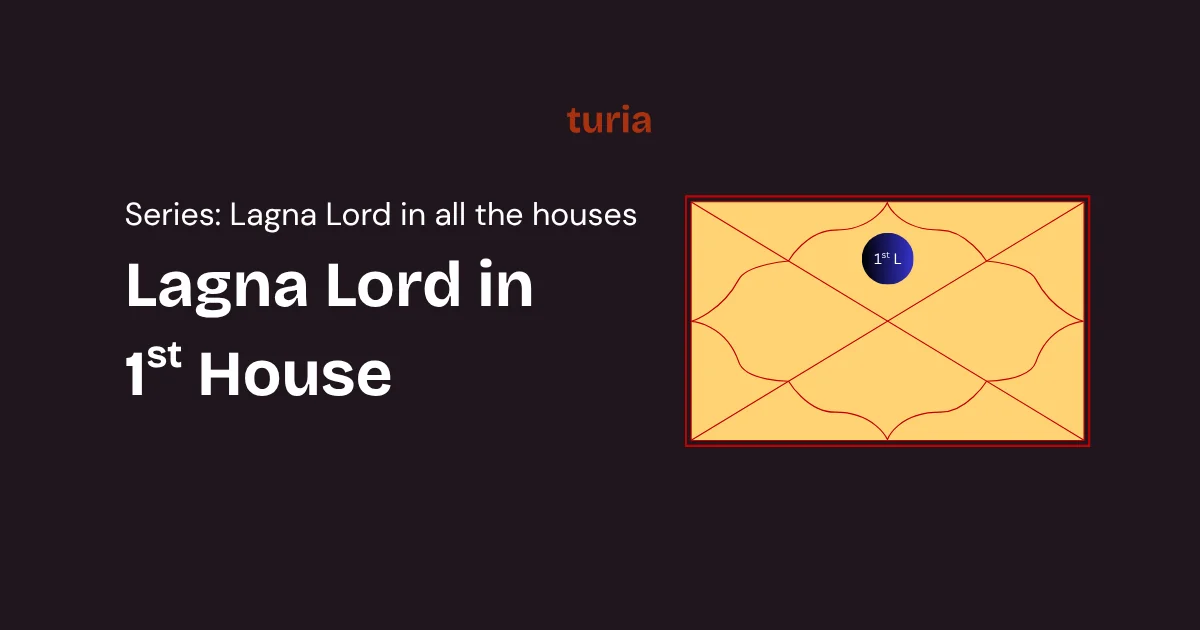
When the lagna lord (the ruler of your ascendant sign, also called lagnesh) sits in the 1st house itself, it means the planet governing your identity is placed exactly where your identity lives. Classical texts like Brihat Parashara Hora Shastra call this a placement of "physical happiness and prowess" — it generally gives strong vitality, a clear sense of self, independence, and a personality that doesn't lean heavily on others for validation. It's considered one of the most favourable lagna lord placements — but the actual results still depend on the planet's dignity (exalted, own sign, or debilitated), and whether it's conjunct or aspected by malefics. A well-placed lagna lord in the 1st house tends to bring early recognition and good health; an afflicted one can bring health issues and a shakier sense of identity despite the placement's basic strength.
What "Lagna Lord in 1st House" Actually Means
Let's clear up the terminology first, because this is where a lot of confusion starts.
Your lagna is your ascendant — the zodiac sign that was rising on the eastern horizon at your exact time and place of birth. Every sign has a ruling planet. That ruling planet is your lagna lord, or lagnesh.
Now, your lagna lord can sit anywhere in your chart — in the 2nd house, the 7th, the 10th, wherever it landed at the moment you were born. When it happens to sit in the 1st house — its own house of origin — astrologers call this "lagna lord in lagna" or "1st lord in 1st house."
Here's the mix-up people commonly make: this is not the same as saying "a planet is exalted in the 1st house." Exaltation is about the sign a planet sits in. Lagna lord in the 1st house is about the house the ruling planet occupies, regardless of sign. A planet can be your lagna lord, sit in the 1st house, and still be in its sign of debilitation. Those are two different strength questions, and we'll get into both.
Think of it like this: the 1st house is your home base — your body, your presence, your sense of self. When the very planet in charge of your identity is standing in that home base instead of wandering off into another house, its influence on who you are is direct and undiluted. There's no detour through someone else's house (a partner's 7th, a boss's 10th) before it reaches you.
What Classical Texts Say
This isn't a modern internet interpretation — it goes back to Parashara himself.
The Brihat Parashara Hora Shastra (BPHS), in the chapter on the effects of Bhava lords, states it plainly: "Should Lagn's Lord be in Lagn itself, the native will be endowed with physical happiness and prowess. He will be intelligent... " (BPHS, Chapter 24, Sloka 1). Strip away the archaic phrasing and the core idea is simple — vitality, sharpness, and a strong physical presence.
Parashara goes further in an earlier chapter dedicated to the 1st house itself. In Chapter 12, on the effects of Tanu Bhava (the body-house), he writes: "If [Lagna Lord] is in an angle, or trine there will be at all times comforts of the body. If Lagn Lord is in debilitation, combustion, or enemy's Rāśi, there will be diseases." (BPHS, Chapter 12, Sloka 1-2)
Notice the conditional language. The 1st house is technically a kendra (angle) — one of the four strongest positional categories in a chart. So the lagna lord being there is structurally solid to begin with. But Parashara immediately flags the counter-case: debilitation, combustion, or sitting in an enemy's sign can undo the benefit. This is the pattern you'll see throughout classical astrology, and it's the pattern this entire article is built around — placement gives potential, dignity decides delivery.
Personality Effects
People with a well-placed lagna lord in the 1st house tend to share a recognisable pattern.
A strong, self-defined identity. These natives usually know who they are early in life. They're not waiting for a job title, a marriage, or a family business to tell them their place in the world — they carve it out themselves.
Self-reliance over dependence. Where someone with lagna lord in the 7th house might build identity through a partner, or lagna lord in the 10th through career and status, this person's sense of self doesn't route through anyone else. It's a very "figure it out myself" energy.
Physical presence. BPHS ties a benefic influence on Lagna to a pleasing, noticeable appearance (BPHS, Chapter 12, Sloka 4). This shows up less as conventional good looks and more as presence — the kind of person people notice when they walk into a room.
A real, honest shadow side. Because the identity is so self-contained, this placement can tip into self-centredness if unchecked — a person so focused on their own goals that they miss what people around them need. This isn't a curse, it's a tendency worth being aware of. Think of your friend who's incredibly self-made and driven, but sometimes forgets to check in on anyone else while chasing the next goal. That's this placement's shadow, not its verdict.
Health and Vitality
This is one of the more practically useful parts of this placement, and also one of the more misunderstood.
Because the 1st house governs the physical body, having its own ruling planet seated there — undiluted, un-detoured — generally supports good vitality and a body that recovers well. BPHS again is direct about the conditions: "With a benefic in an angle, or trine all diseases will disappear" — but the flip side is equally real. If the lagna lord is afflicted (conjunct a malefic, aspected by one without any benefic relief, or in an enemy's sign), the same placement that should give vitality can instead show up as recurring health issues, especially if the 6th lord (the house of disease) gets involved through conjunction or aspect.
So "lagna lord in 1st house = good health" is an oversimplification you'll see on a lot of astrology blogs. The more accurate version: this placement gives the body a strong baseline, but that baseline still needs to be checked against affliction before you can call it a clean bill of health.
Life Direction and Timing
A commonly repeated observation — both in classical texts and in modern practice — is that natives with a strong lagna lord in the 1st house tend to see success earlier rather than later. Sports, competitive exams, creative fields, entrepreneurship — anywhere self-effort is the main currency, this placement tends to reward it faster than placements where success routes through other people or institutions.
That tracks with the underlying logic. If your identity-ruling planet sits in your identity-house, your efforts on yourself show results directly. There's no "waiting on the 7th house" (partnership) or "waiting on the 10th house" (external recognition through career structures) — the feedback loop is shorter.
BPHS also links a well-placed lagna lord (in angle or trine, alongside Mercury, Jupiter, or Venus) to long life, wealth, intelligence, and standing with people in positions of authority (BPHS, Chapter 12, Sloka 5-7). Again — conditional on dignity, not automatic.
What Decides the Strength
This is the section that actually matters most, because it's what separates "textbook good placement" from "how it plays out in your actual life."
A few factors decide whether a lagna lord in the 1st house delivers on its promise:
- Sign dignity. Is the lagna lord exalted, in its own sign, in a friendly sign, in an enemy's sign, or debilitated? This alone shifts the outcome dramatically.
- Combustion. A lagna lord sitting too close to the Sun can get combust — weakened, even if otherwise well-placed.
- Conjunctions and aspects. A benefic conjunction or aspect (from Jupiter or Venus, for instance) reinforces the good effects. A malefic conjunction or aspect — especially from the 6th lord — chips away at them.
- Directional strength (Dig Bala). Here's a specific, lesser-known classical rule: Mercury and Jupiter get full directional strength (Dig Bala) specifically when placed in the 1st house (Phaladeepika, Chapter 4). So if your lagna lord happens to be Mercury or Jupiter, this placement carries an extra layer of classical reinforcement that other planets don't automatically get here.
Here's a simple comparison of how this plays out:
| Factor | Strong / Well-placed Lagna Lord in 1st House | Weak / Afflicted Lagna Lord in 1st House |
|---|---|---|
| Personality | Confident, self-assured, clear sense of identity | Uncertain, self-doubting despite outward independence |
| Health | Good vitality, quick recovery, strong constitution | Recurring health issues, especially if 6th lord is involved |
| Life pattern | Early recognition, self-made success | Delayed or effortful success, obstacles from self-created patterns |
| Relationships | Independent, sometimes self-focused | Can swing to either isolation or over-dependence |
| Classical basis | BPHS: in angle/trine, "comforts of the body... at all times" | BPHS: "if Lagn Lord is in debilitation, combustion, or enemy's Rāśi, there will be diseases" |
A quick note on which planet is your lagna lord
Because the same placement (1st house) filters differently through different planets, here's a fast reference for how the "lagna lord in lagna" flavour tends to shift by planet:
| Lagna Lord | General Flavour in the 1st House |
|---|---|
| Sun | Strong will, leadership instinct, can tip into ego if unchecked |
| Moon | Emotionally driven identity, moods visibly shape how the person shows up |
| Mars | High energy, competitive drive, quick temper if afflicted |
| Mercury | Sharp, communicative, gets extra classical strength here (Dig Bala) |
| Jupiter | Wise, respected, optimistic; also gets extra classical strength here (Dig Bala) |
| Venus | Charming, aesthetic sense, magnetic presence |
| Saturn | Serious, disciplined, matures late but builds lasting stability |
The Neecha Bhanga Nuance — When "Weak" Isn't Really Weak
Here's something most surface-level articles skip entirely.
A debilitated lagna lord in the 1st house isn't an automatic red flag. Classical texts describe a condition called Neecha Bhanga (cancellation of debilitation) — where a debilitated planet can still deliver strong, even exceptional, results if certain conditions are met.
Phaladeepika puts it directly: "Even a single planet, even if he be in debilitation, is capable of making a person equal to a king, if not being posited in Dusthana (6th, 8th or 12th) or combust and be possessed of brilliant rays and be in retrograde motion." It also describes a specific combination — Parvata Yoga — where the dispositor of the sign the lagna lord sits in is itself exalted or well-placed in a kendra or trikona, which can lift the whole placement despite the debilitation.
In plain terms: don't panic if your lagna lord is debilitated in the 1st house. Check where the ruler of that sign sits. If it's strong, the story changes completely. This is exactly the kind of nuance that separates fear-based astrology from astrology used as an actual framework for reflection.
How This Compares to Lagna Lord in Other Houses
Since this is the first piece in a twelve-part series on lagna lord placements, here's a quick sense of how the 1st house placement differs from the rest.
- Lagna lord in 1st house — identity is self-contained and self-built. The shortest possible route between effort and result.
- Lagna lord in 7th house — identity develops largely through partnerships and marriage; the native often needs "the other" to feel complete.
- Lagna lord in 10th house — identity is built through career, public standing, and structure; validation comes from the outside world of work.
- Lagna lord in 6th house or 8th house — identity is shaped through struggle, service, or transformation; growth tends to come the hard way, through obstacles rather than ease.
- Lagna lord in 12th house — identity turns inward or outward-bound (literally, often linked to foreign settlement, spirituality, or solitude); the self feels less anchored to the immediate, visible world.
The common thread across the whole series: house placement tells you where the self's energy is directed. Sign dignity and aspects tell you how well that direction is likely to work out. The 1st house placement is unique in that it keeps the energy pointed squarely at the self — nothing detoured, nothing borrowed.
FAQs
What does it mean when the lagna lord is in the 1st house?
It means the planet that rules your ascendant sign is also sitting in your 1st house — the house representing your body, personality, and sense of self. This creates a direct, undiluted link between your identity-ruling planet and your actual identity, which classical texts describe as generally favourable for vitality, confidence, and a strong, self-built sense of who you are.
Is lagna lord in the 1st house a good placement?
Generally, yes — it's considered one of the stronger lagna lord placements because the 1st house is a kendra (angle), and having the ruling planet there is direct rather than routed through another house. But "good" isn't automatic. The planet's dignity, conjunctions, and aspects still decide whether the potential actually shows up as good results in your life.
What if the lagna lord is debilitated in the 1st house?
It's not an automatic problem. Classical texts describe Neecha Bhanga (cancellation of debilitation), where a debilitated lagna lord can still perform well if it avoids the 6th, 8th, or 12th houses and if the ruler of its sign is strong elsewhere. Check the full chart before assuming the worst.
Does the lagna lord in the 1st house affect health and longevity?
Yes, directly — since the 1st house governs the physical body. A well-placed, undamaged lagna lord here generally supports strong vitality and recovery. An afflicted one, especially with 6th-lord involvement, can show up as recurring health concerns despite the placement's underlying strength.
Which planet gives the best results as lagna lord in the 1st house?
There's no single "best" — it depends on your life priorities. Mercury and Jupiter get extra classical reinforcement here through Dig Bala (directional strength). But Sun, Mars, Venus, Moon, and Saturn all give strong results in their own way when well-dignified; the flavour of the result changes by planet, not just the strength.
How is lagna lord in 1st house different from lagna lord in other houses?
In the 1st house, identity is self-contained — the person builds their sense of self through their own effort, without routing it through a partner (7th house), career structure (10th house), or external institutions. Other placements make identity depend more on those external factors.
Is lagna lord in lagna better than being exalted elsewhere?
They're different kinds of strength, not directly comparable. Exaltation is about sign dignity; lagna lord in lagna is about house placement. Some astrologers consider lagna lord in lagna especially valuable because it reinforces the house of self directly — but a lagna lord that's both exalted and well-housed will always outperform either condition alone.
Closing
So if someone asks you, "Is lagna lord in the 1st house a good placement?" — the honest answer is: it's a strong foundation, not a guaranteed outcome. The 1st house gives the lagna lord a direct, undiluted line to your identity. What that identity actually looks like — confident and grounded, or self-focused and unsteady — depends on dignity, conjunctions, and the checks we've walked through above.
This is the first placement in the series. As we move through lagna lord in the 2nd house, the 7th, the 10th, and the rest, you'll start to see the same principle repeat in different rooms of the chart — the house tells you where the self is looking; the planet's condition tells you what it finds there.
Hope this helps :)