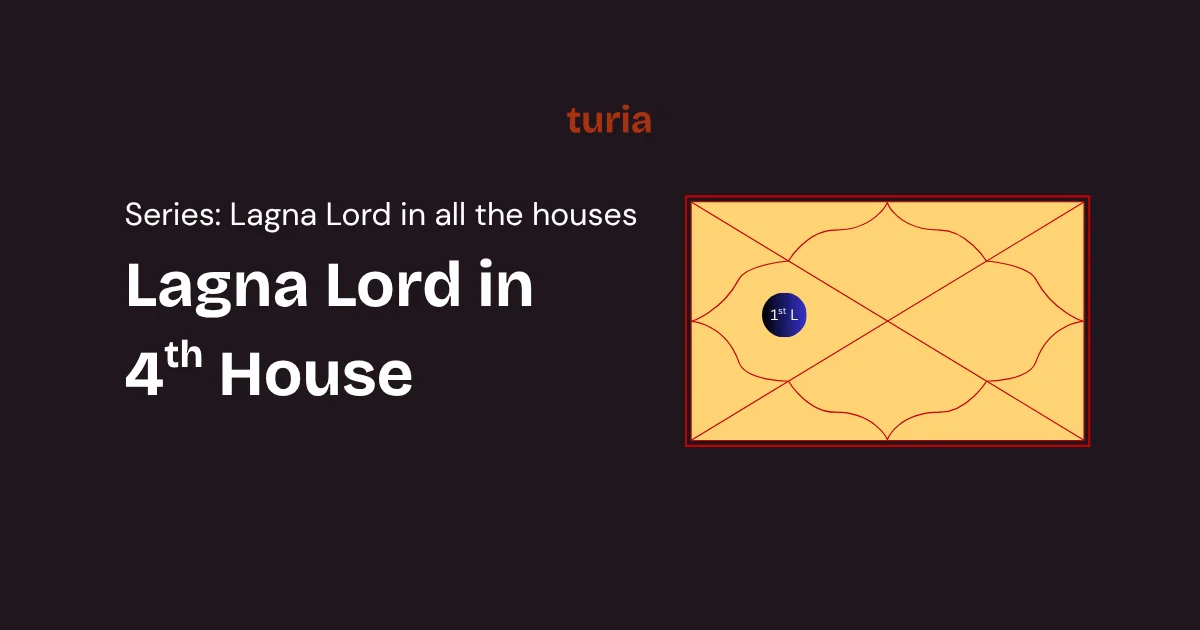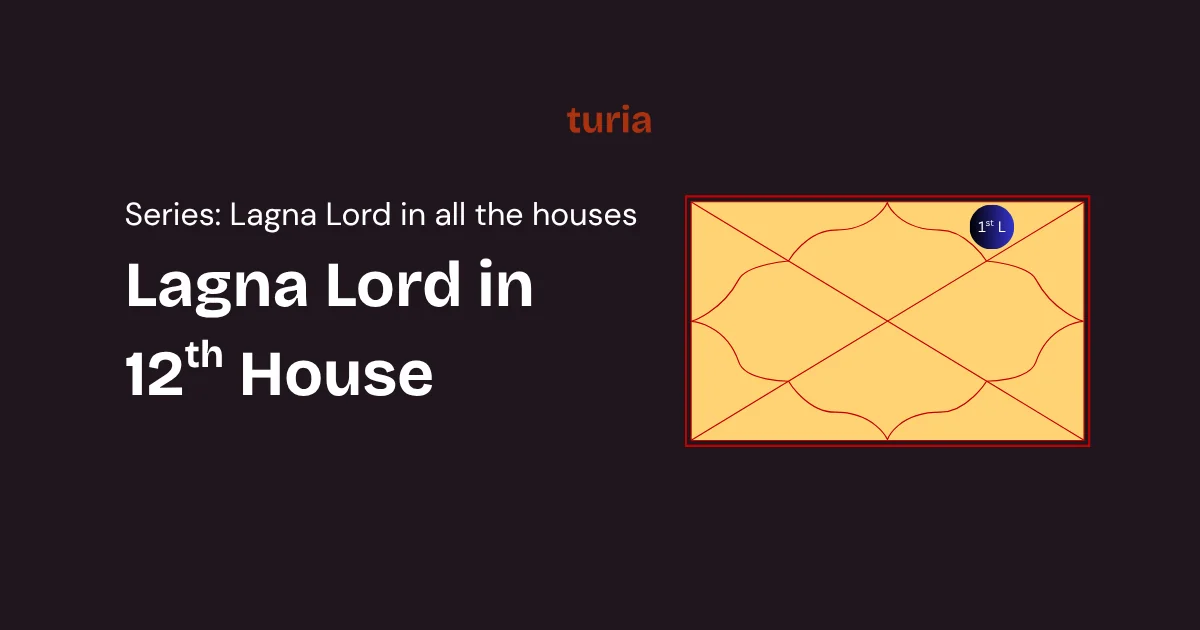
Introduction
Someone gets their kundali read, hears "your lagna lord is in the 12th house," and the room goes quiet for a second.
Because the 12th house has a reputation. Vyaya Bhava — the house of losses. Hospitals. Foreign lands. Isolation. The word "moksha" gets mentioned, but somehow the loss part is what sticks.
And honestly… most of what's floating around on the internet doesn't help. Type this placement into Google and you'll find words like "addiction," "poverty," "liar," stacked one after another with barely a caveat.
Here's the thing though. The lagna lord is the planet that owns your ascendant — the ruler of your identity, your body, your basic life force. Where it sits shapes how that identity expresses itself. Every house changes the story a little. The 12th house doesn't make it a bad story. It makes it a quieter, more inward one — with real challenges, yes, but also a depth that most of the fear-based content skips entirely.
This is the last placement in our 12-part series on where the lagna lord can sit. In this guide, we'll cover what this placement actually means, what the classical texts say about it, how strength changes the outcome, and where it genuinely differs from the other eleven.
Quick answer
When the lagna lord sits in the 12th house (Vyaya Bhava), the native's core identity operates through the house of losses, foreign lands, isolation, sleep, and moksha (spiritual liberation). Expect a personality that's private, reflective, and often pulled toward solitude, spirituality, or life abroad. Money and energy tend to move outward — sometimes as waste, sometimes as generosity or sacred spending. Classically (BPHS 24.12), the negative reading applies only "if devoid of benefic aspect or conjunction" — meaning a well-supported lagna lord here can bring genuine depth, foreign success, and spiritual maturity rather than pure loss. It is one of the more misunderstood placements in the series, not one of the worst.
What "Lagna Lord in the 12th House" Actually Means
The lagna lord is simply the ruler of whichever sign rises on the eastern horizon at the moment of birth. If you're an Aries ascendant, that's Mars. If you're a Cancer ascendant, that's the Moon. Wherever this planet sits in your kundali, that house becomes deeply entangled with your sense of self.
The 12th house from the lagna is Vyaya Bhava — literally, the house of expenditure. Classical texts group it as a Dusthana (a difficult house, alongside the 6th and 8th) and as an Apoklima (a cadent house — structurally the weakest of the three angle types, alongside the 3rd, 6th, and 9th). That's not a moral judgement. It's a structural one: planets here don't build momentum the way they do in a Kendra (angle) or Trikona (trine). They tend to release, dissolve, or turn inward instead.
Brihat Parashara Hora Shastra addresses this exact combination directly:
"If Lagn's Lord is in Vyaya Bhava and is devoid of benefic Drishti and/or Yuti, the native will be bereft of physical happiness, will spend unfruitfully and be given to much anger."
— BPHS, Ch. 24, Sloka 12
Notice the condition built into that sentence: devoid of benefic aspect or conjunction. Parashara isn't saying this placement is automatically difficult — he's saying it's difficult when unsupported. That single clause is the difference between the fear-based version of this placement you'll find on most sites, and the more accurate, classical one.
One quick clarification, because the two get confused often: this article is about the lagna lord (ruler of your ascendant) sitting in the 12th house. That's different from the 12th house's own lord moving through various houses — a related but separate topic. If you've read about "12th lord in 12 houses" somewhere, that's the other side of this coin.
Losses, Expenses, and Where the Money Goes
The most literal reading of Vyaya Bhava is expenditure — and when the lagna lord sits here, the native's own identity is wired toward outward flow of money and energy.
This doesn't always mean poverty. It means resources move. Sometimes that's wasteful spending, impulsive purchases, or the classic modern-India experience of a good salary that somehow never seems to accumulate — EMIs, family obligations, medical bills, one expense quietly replacing another. Sometimes it's the opposite: spending with purpose, on things that matter.
BPHS actually distinguishes between these outcomes rather than treating all 12th-house spending the same way:
"There will be expenses on good accounts, if Vyaya's Lord is with a benefic, or in his own Bhava, or exalted... The said native will live with rich clothes and ornaments, be learned and Lordly."
— BPHS, Ch. 23, Slokas 1–4
There's even a specific verse for when the lagna lord itself is in Vyaya:
"If Lagn's Lord is in Vyaya, while Vyaya's Lord is in Lagn with Sukr, expenses will be on religious grounds."
— BPHS, Ch. 23, Sloka 14
In other words — the same placement that can drain a bank account can also fund a temple renovation, a pilgrimage, or years of tuition for someone else's child. The direction the money flows depends heavily on what else is happening in the chart, not on the house alone.
Foreign Lands, Travel, and Settling Abroad
This is usually the first question anyone asks once they learn their lagna lord sits in the 12th house: does this mean I'm moving abroad?
The 12th house has always carried this association — foreign lands, distant journeys, life away from where you were born. When your core identity (lagna lord) operates from here, there's often a genuine pull outward. Not restlessness for its own sake, but a sense that opportunity, growth, or even peace of mind is easier to find at a distance from home.
Think of the young engineer who always assumed she'd work in Bangalore, then somehow ends up building her career in Germany or Canada without ever having planned it that way. Or the person who feels more like themselves on a long solo trip than they ever do at a family gathering. That's the lagna lord in the 12th house showing up in an ordinary life.
But BPHS is careful here too — this outcome is conditional, not automatic:
"One will wander from country to country, if Vyaya's Lord and Vyaya Bhava are with malefics and Vyaya's Lord gives a Drishti to, or receives a Drishti from malefics."
— BPHS, Ch. 23, Sloka 11
And the counter-verse, right after it:
"One will move in his own country, if Vyaya's Lord and Vyaya Bhava are with benefics..."
— BPHS, Ch. 23, Sloka 12
So no — this placement doesn't guarantee an NRI life or force permanent relocation. It shows a tendency toward foreign connection, which can express as settling abroad, but just as often as a foreign spouse, an international career, a long-distance degree, or simply feeling more "at home" in unfamiliar places. Whether that becomes permanent or just a chapter depends on the rest of the chart.
Isolation, Sleep, Hospitals, and the Quiet Side of Life
Beyond money and geography, the 12th house governs the parts of life that happen out of view — sleep, the subconscious, hospitals, ashrams, research labs, anywhere someone withdraws from the visible world for a while.
A lagna lord here often produces someone who needs more solitude than most people around them expect. Not necessarily unhappy solitude — sometimes it's simply where they recharge. They may sleep more, dream vividly, or feel drained rather than energised by constant social contact. During the pandemic, a lot of people got an unplanned crash course in what a strong 12th house feels like — enforced stillness, isolation, time alone with their own thoughts. For someone with the lagna lord here, that experience isn't unusual. It's closer to their baseline.
This can also show up as health being tied to quiet, behind-the-scenes care — recurring hospital visits, a period of convalescence, or simply a constitution that needs more rest and less exposure than others. None of this is destiny locked in stone. It's a leaning, and a strong or well-aspected lagna lord softens it considerably.
Spirituality and Moksha — the Upside Most People Skip
Here's where most articles on this placement fall short — they mention "spirituality" as an afterthought and move on. But this is arguably the most important dimension of the lagna lord in the 12th house, not a footnote.
The 12th house sits in the Moksha Trikona — the triangle of houses (4th, 8th, 12th) tied to liberation from the cycle of rebirth. When your core identity operates through this house, there's often a real, quiet pull toward meaning beyond material accumulation — meditation, solitude retreats, service without recognition, or simply less attachment to outcomes than most people carry.
BPHS states this plainly:
"If there is a benefic in Vyaya, while its Lord is exalted, or is yuti with, or receives a Drishti from a benefic, one will attain final emancipation."
— BPHS, Ch. 23, Sloka 10
There's a classical yoga worth knowing here too — Vimala Yoga, described in Mantreswara's Phaladeepika, which forms when the 12th house's own lord sits in another difficult house (6th, 8th, or 12th itself). It's a slightly different technical condition from the lagna lord in the 12th, but it makes the same point from another angle: this house's difficulty is designed to cancel itself out under the right conditions, not compound endlessly.
"The person with his birth in Vimala Yoga will be frugal in his expenses and clever in saving money... will enjoy happiness, will be independent, will follow a respectable profession... and will be well known for his good qualities."
— Phaladeepika, Para 69
Picture the corporate professional who spends years chasing promotions, then finds far more peace after a few months at an ashram in Rishikesh than any bonus ever gave them. Or someone who never quite fit the "achievement" mould their family expected, but built a quietly meaningful life around service, teaching, or healing work instead. That's this placement, working the way it's meant to.
Marriage and Relationships
This is the other big anxiety this placement triggers — does the lagna lord in the 12th house block marriage?
Short answer: no, not by itself. What it can do is add a layer of distance or difference to the marital picture. Some natives find partners from a different culture, region, or country. Others experience delays, or a marriage that looks unconventional by family standards but works well for the two people in it. The 12th house's association with "bed comforts" also ties this placement to a private, less performative intimacy — closeness that isn't loud or public, but is still real.
Where this genuinely gets complicated is if the lagna lord is also afflicted — heavily conjunct malefics, debilitated, or combust — which can bring real friction into partnership. But affliction is the actual variable to watch, not the house placement on its own.
How Strength Changes the Story
If there's one section of this article to read twice, it's this one. Strength is what separates the "wandering, spendthrift, low-vitality" reading from the "spiritually rich, foreign-connected, quietly successful" reading — and they come from the exact same placement.
- Own sign or exalted lagna lord in the 12th: Considerably softened results. BPHS's own Sloka 12 makes the negative outcome conditional on the lord being "devoid of benefic Drishti and/or Yuti" — a strong, dignified lagna lord doesn't meet that condition. Expect depth, spiritual inclination, and foreign success rather than drain.
- Debilitated or combust lagna lord: The classic difficult version — low vitality, scattered focus, expenses that genuinely feel wasted, and a harder time trusting one's own instincts. This is the condition worth actually watching, not the house itself.
- Conjunct or aspected by a natural benefic (Jupiter, Venus, well-placed Mercury): Tends to soften debilitation and lean the placement toward its generous, spiritual, service-oriented side rather than its draining side.
- Conjunct or aspected by malefics (Saturn, Mars, Rahu, Ketu) without benefic support: Leans toward the harder outcomes — genuine financial drain, health concerns, or a restless, ungrounded quality to life abroad.
- Retrograde while exalted: Worth a specific note — a planet retrograde in its own exaltation sign doesn't carry full exaltation strength, so this combination needs closer individual reading rather than an assumption of automatic strength.
The pattern across all of this: the 12th house itself sets the terrain — losses, foreign connection, isolation, spirituality. The lagna lord's strength decides whether the native walks that terrain drained and lost, or walks it with purpose and depth.
How This Compares to Other Lagna Lord Placements
Since this closes out the series, here's where the 12th house sits relative to the other eleven — a quick reference if you're comparing placements across a family's charts, or simply curious how your own compares to a sibling's.
| Lagna Lord In | Core Flavour |
|---|---|
| 1st House | Strong, self-directed identity; vitality expressed directly |
| 2nd House | Identity tied to wealth, family, speech, accumulated values |
| 3rd House | Courage, effort, communication-driven self-image |
| 4th House | Identity rooted in home, emotional security, land/property |
| 5th House | Creative, intelligent, children- and recognition-oriented identity |
| 6th House | Identity forged through service, competition, or health struggles |
| 7th House | Identity expressed through partnership and one-on-one relationships |
| 8th House | Deep, transformative, research-and-crisis-oriented identity |
| 9th House | Identity built around belief, philosophy, higher learning, fortune |
| 10th House | Career- and reputation-defined identity, public-facing life |
| 11th House | Identity tied to gains, networks, and long-term aspirations |
| 12th House | Inward, foreign-connected, loss-and-liberation identity |
Compared to the 1st house placement (identity turned fully outward) or the 10th (identity built through career and public standing), the 12th house is the most inward-facing placement in the entire series. It's less about building something visible and more about releasing, refining, and eventually transcending the need to prove anything at all. That's not a weaker path — it's a different one.
FAQs
What does it mean when the lagna lord is in the 12th house?
It means the planet ruling your ascendant — your core identity and vitality — operates through the house of losses, foreign lands, isolation, sleep, and spiritual liberation. Expect a more private, reflective personality, a pull toward distant places, and outward-moving finances, with the exact flavour shaped heavily by the lord's strength.
Is lagna lord in the 12th house always a bad placement?
No. BPHS itself makes the negative reading conditional — "devoid of benefic Drishti and/or Yuti" (Ch. 24, Sloka 12). A well-aspected or dignified lagna lord here often brings spiritual depth, foreign success, and quiet fulfilment rather than pure loss.
Does lagna lord in the 12th house guarantee settling abroad?
Not automatically. Classical texts tie strong foreign-travel results to malefic involvement specifically (BPHS 23.11), with a counter-verse (23.12) showing benefic influence can keep the native rooted at home while still building foreign connections through work, study, or relationships.
Does this placement cause problems in marriage?
Not inherently. It can bring a partner from a different background, some delay, or an unconventional match — but it doesn't block marriage. Real friction usually traces back to affliction (debilitation, malefic conjunction) rather than the house placement itself.
What changes if the lagna lord is debilitated, combust, or exalted in the 12th house?
A great deal. Debilitation or combustion tends toward the classic difficult reading — low vitality, wasted expenses, scattered focus. Exaltation or a strong benefic conjunction/aspect softens this considerably, often producing depth and foreign success instead of drain.
Is lagna lord in the 12th house good for spirituality and moksha?
Often, yes. The 12th house sits in the Moksha Trikona, and BPHS ties a well-supported Vyaya lord directly to "final emancipation" (Ch. 23, Sloka 10). This is one of the more genuinely spiritual placements in the entire series, not just a "consolation prize" for material loss.
Can this placement affect sleep, hospitals, or health?
Yes, these are core 12th house themes — deeper need for rest, vivid dreams, occasional hospital stays, or health tied to quiet, private care rather than public activity. It's a leaning, not a fixed diagnosis, and strength in the chart changes its intensity considerably.
Closing Thoughts
So if someone asks you, "Is lagna lord in the 12th house a bad placement?" — the honest answer is: it depends on strength, aspects, and what else is happening in the chart, exactly like every other placement in this series. But the pattern most charts with this placement share is this — a person who is quieter than they look on paper, who finds meaning in places others overlook, and who often ends up building a life somewhere far from where they started.
That's not loss. That's just a different shape of a full life.
This closes our 12-part look at where the lagna lord can sit — from the outward confidence of the 1st house to the inward depth of the 12th. Read together, they're less a ranking of "good" and "bad" placements and more a reminder that every house gives the ascendant lord something to work with.