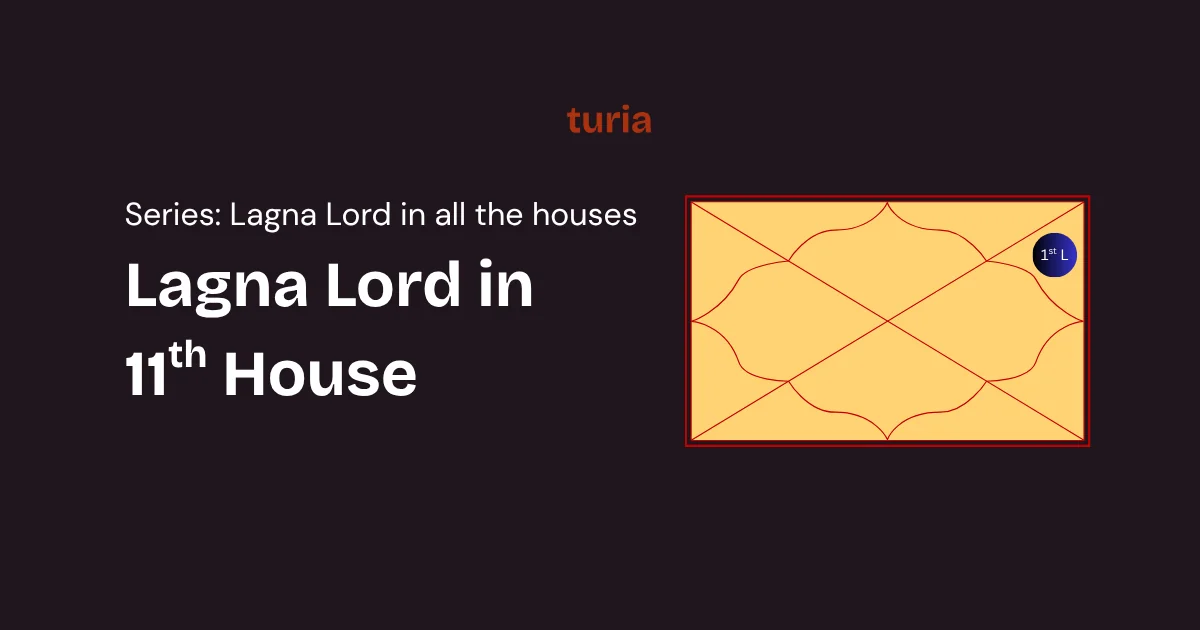
Someone once told you your lagna lord sits in the 11th house, and the first thing you probably heard back was "good placement, paisa aayega" — money will come.
And then… nothing more.
No timeline. No nuance. No answer to the quieter question underneath: if it's such a good placement, why doesn't it always feel that way?
Here's the thing… the lagna lord's placement is one of the first things a serious astrologer checks in any kundali, because wherever it sits, the native's core identity, drive, and life direction get filtered through that house's themes. In the 11th house — the house of gains, income, ambitions, and social networks — that filtering produces one of the more sought-after placements in the entire chart.
But "good placement" is doing a lot of work in that sentence, and most articles stop right there.
This is Page 11 of our 12-part series on lagna lord placements — one page per house. In this guide, we'll cover what this placement actually means structurally, why the 11th house behaves differently from other houses, its effects on income and ambition, what it does for your network and elder siblings, how strength changes the story, and how it compares to the other 11 placements in this series.
Quick answer
When your lagna lord (the ruler of your ascendant) sits in the 11th house, your core identity and life direction get expressed through gains, income, ambitions, and social networks. This is one of the stronger placements for material life — the 11th is an Upachaya (growth) house, meaning results build steadily rather than arriving early, typically becoming visible from your late 20s onward. You tend to be goal-oriented, socially resourceful, and someone whose desires get fulfilled through sustained effort and the right connections rather than instant luck. The catch: if the lagna lord is debilitated, combust, or heavily afflicted, the same placement can produce restlessness, dependency on others' approval, or gains that don't stay. Strength and dignity decide which version you get.
What "Lagna Lord in the 11th House" Actually Means
Your lagna is your ascendant — the zodiac sign rising on the eastern horizon at the exact moment you were born. Every kundali has a lagnesh, the ruling planet of that ascendant, and classical Jyotish treats this planet as one of the most important single points in the entire chart. Wherever it sits, it carries the 1st house's significations — self, body, identity, overall life direction — into whichever house it occupies.
When the lagna lord lands in the 11th house, it's placing "who you are" directly into Labha Bhava — the house of gains.
Brihat Parashara Hora Shastra describes the 11th house plainly: "All articles, son's wife, income, prosperity, quadrupeds etc. are to be understood from Labh Bhava" (BPHS, Ch. 11, Para 12). Phaladeepika expands the list further: "gains, income, acquisition, receipt of wealth, accomplishment, splendor and prosperity, profits, veneration, elder brother or sister, left ear, anything juicy, delightful news" (Phaladeepika, Ch. 1, Para 15).
So structurally, this placement means: your identity, drive, and sense of self are wired toward accumulation, ambition, and outcomes — not just working hard for its own sake, but working toward something you can see the return on.
Why the 11th House Is Different — The Upachaya Effect
Here's the part most competitor pages skip entirely, and it's the single most useful thing to understand about this placement.
Classical texts sort houses into categories. The 1st, 4th, 7th, and 10th are Kendras (angles) — pillars of the chart. The 1st, 5th, and 9th are Trikonas (trines) — houses of fortune and grace. And then there's a third category that gets far less attention: the Upachaya houses — the 3rd, 6th, 10th, and 11th (Phaladeepika, Ch. 1, Para 18; confirmed in BPHS).
Upachaya literally means "growth." These are houses that don't hand out results immediately. They improve with time, age, and effort.
BPHS is direct about how strongly it favors the lagna lord sitting in an angle or trine: "If [the lagna lord], Budh, Guru, or Śukr be in an angle, or in a trine, the native will be long lived, wealthy, intelligent and liked by the king" (BPHS, Ch. 12, Paras 5–7). The 11th isn't a Kendra or a Trikona — so it doesn't get that unconditional, automatic praise.
What it gets instead is something arguably more interesting: a placement where results compound.
This is why so many people with this placement feel underwhelmed in their early twenties, then look back at their thirties and realize things clicked into place gradually rather than all at once. It's not a delayed placement in the sense of "bad until later" — it's a building placement. The gains are real. They just aren't handed to you at birth the way a strong Kendra placement sometimes is.
Even more telling: classical texts note that malefic planets tend to behave unusually well in Upachaya houses — "malefics are in Sahaj and Labh Bhava, full life-span will [be indicated]" is one such reference. If your lagna lord happens to be a functional malefic for your ascendant — Saturn for an Aries or Taurus rising, Mars for a Cancer or Leo rising — the 11th house tends to soften its harder edges and redirect that drive into gains rather than friction.
Effects on Income, Gains, and Ambitions Fulfilled
BPHS actually gives us a strong anchor here, and it's worth sitting with. In its chapter cataloguing what happens when a house's lord sits in each of the 12 houses, BPHS describes a lord placed in the 11th house this way: "gain in all his undertakings, while his learning and happiness will be on the increase day by day" (BPHS, Ch. 24, Para 131). Of all twelve placements discussed in that chapter, this is treated as the strongest — genuinely the best-case outcome in that framework.
Applied to the lagna lord specifically, this translates into a native whose undertakings — career moves, business decisions, personal goals — tend to produce gains more often than not, and whose knowledge, skill, and contentment grow steadily rather than plateauing.
The 11th house is sometimes called Iccha Sthana — the house of desires — and that's a more accurate frame than "just the money house." This placement isn't only about how much you earn. It's about whether your ambitions, whatever they are, tend to get fulfilled. For one person that's financial independence. For another it's a specific professional milestone, a coveted degree, or simply the freedom to make their own choices without asking permission.
Real example: think of the person who spends their twenties in a fairly ordinary job, unremarkable by outside standards, but is quietly building a professional network, picking up skills, staying visible in the right rooms — and by their mid-thirties, that same "ordinary" groundwork turns into a partnership offer, a senior referral, or a business opportunity that looks, from the outside, like it came out of nowhere. It didn't. It was Upachaya the whole time.
Social Circle, Networks, and Elder Siblings
The 11th house governs your social network directly — friendships, group affiliations, and the web of people who end up mattering to your gains.
For a lagna lord placed here, social capital isn't incidental — it's central to how the person operates. These are usually people who are genuinely good at maintaining networks: staying in touch with the right batch-mates, showing up for people, and, in turn, having people show up for them when it counts.
This maps very cleanly onto modern Indian professional life. An IIT or IIM alumni WhatsApp group that quietly becomes someone's biggest career lever. A CA article-ship batchmate who refers a client years later. The "sifarish" — a trusted recommendation — that gets someone's file moved to the top of the pile for a government posting. None of this is superstition; it's the 11th house's classical signification of gains through connection, expressing itself in a 2026 Indian context.
The 11th house also classically governs the elder sibling — Phaladeepika lists "elder brother or sister" directly among its significations. A lagna lord here often means the native's identity and life path are meaningfully tied to an elder sibling's influence, whether that's financial support early on, career guidance, or simply a close, formative relationship. It's a smaller signification than income or ambition, but worth knowing — most competitor content skips it entirely in favor of an all-wealth focus.
Career and Material Life
Career-wise, this placement tends to favor paths where growth is visible and cumulative — sales, business development, consulting, finance, anything where performance compounds and networks matter. It also suits entrepreneurship and self-employment reasonably well, since the native's drive (1st house) is already wired toward gain-seeking (11th house) — steady growth in a business or independent practice is a natural expression rather than a stretch.
Material life in general tends to improve gradually across the native's working life rather than peaking early and flattening. Assets, income streams, and professional standing tend to be things this person actively builds rather than things that were simply handed to them — which, if you think about it, tends to make the eventual success feel more earned and more stable.
Marriage and Relationships
This isn't a placement classical texts associate heavily with either strong marital blessings or strong marital difficulty on its own — the 7th house and its lord carry that weight more directly. But there's a real secondary effect worth knowing: BPHS's marriage-timing section repeatedly references configurations involving the lagna lord and the Labha (11th) house together — for instance, an exchange between the 2nd lord (wealth) and the 11th lord (gains) is noted as bringing marriage and prosperity together, often in the years following the union rather than before it (BPHS marriage-timing slokas).
The practical takeaway: for many with this placement, marriage and financial stability tend to arrive as connected events rather than separate ones — a person's earning capacity or professional standing steps up around the same period marriage happens, rather than years before or long after.
How Strength Changes the Story — Own Sign, Exaltation, Debilitation, Combustion
This is the section that actually determines whether you get the confident, compounding version of this placement or a version with real friction. The 11th house being a strong house doesn't override how well or poorly the lagna lord itself is placed within it.
Own sign or exalted lagna lord in the 11th — the cleanest expression. Gains arrive with less struggle, ambitions get realized with fewer detours, and the native's social network tends to genuinely work in their favor rather than draining their time and energy.
Lagna lord in a friendly sign, well-aspected — still a strong, largely positive placement. Growth is steady; the native has to put in real effort, but the effort reliably pays off.
Debilitated lagna lord in the 11th — this dilutes the placement meaningfully. Gains may feel inconsistent, hard-won, or slower to arrive than the person's effort deserves. If there's a genuine neecha bhanga (debilitation cancellation — the sign lord or exalting planet placed in a Kendra from lagna or Moon), much of this weakness reverses; without it, expect real delays and frustration before eventual stabilization.
Combust lagna lord in the 11th (too close to the Sun) — ego, ambition, or authority issues can overshadow the house's natural generosity. The native may struggle with recognition — doing the work, but not getting adequate credit — or may burn bridges within their own network through pride or impatience.
Afflicted by malefic conjunction or aspect, without benefic relief — this is where Phaladeepika's Daridrya Yoga becomes relevant: "Incoming debts constantly will be the way of life for the person with this yoga… He will be deprived of good brotherhood" (Phaladeepika, Ch. 3, Para 68). This isn't the typical result of this placement — it requires genuine, compounding affliction — but it's the classical counterweight that keeps this placement from being oversold as unconditionally good.
The honest summary: the 11th house sets a favorable stage, but the lagna lord's own dignity is still what decides whether the native walks onto that stage confidently or with a limp.
How This Compares to Other Lagna Lord Placements
Since this is one page in a 12-part series, here's how the 11th house placement's flavor differs from its neighbors and from the other Upachaya houses.
| Placement | Core flavor | Pace of results |
|---|---|---|
| Lagna lord in 1st | Self-made, independent, strong personal presence | Immediate — results show up early and consistently |
| Lagna lord in 10th (Kendra + Upachaya) | Career and public reputation define identity | Builds steadily, but with earlier visibility than 11th due to Kendra strength |
| Lagna lord in 3rd (Upachaya) | Courage, effort, communication-driven growth | Slow build, driven by personal initiative |
| Lagna lord in 6th (Upachaya) | Growth through overcoming obstacles, service, competition | Slow build, often through struggle before the gain |
| Lagna lord in 11th (Upachaya) | Ambition, income, and network-driven fulfillment | Slow build, but the smoothest and most rewarding of the four Upachaya placements |
| Lagna lord in 12th | Detachment, foreign connection, spiritual focus | Gains often dissipate or redirect elsewhere; less material accumulation |
Of the four Upachaya placements, the 11th is generally considered the most favorable — the "growth" here is specifically growth in gains and desire-fulfillment, rather than growth through obstacles (6th) or growth through sheer effort with less guaranteed payoff (3rd). It shares its "compounding over time" nature with 10th, 6th, and 3rd, but stands apart from Kendra placements like the 1st, 4th, and 7th, where results tend to be more immediate and less dependent on years of accumulated effort.
If you're comparing your own placement against a sibling's or a partner's, remember dignity always outranks house category — a debilitated lagna lord in the 11th can underperform a well-placed lagna lord in a technically "lesser" house.
FAQs
What does it mean when the lagna lord is in the 11th house?
It means your core identity and life direction (1st house) express themselves through gains, ambitions, and social networks (11th house). You tend to be goal-oriented, socially resourceful, and someone whose desires get fulfilled gradually through sustained effort and the right connections, rather than through sudden luck.
Is lagna lord in 11th house good for wealth?
Generally yes — it's considered one of the stronger placements for material life, since the 11th is the house of gains and a growth (Upachaya) house. But wealth outcomes depend heavily on the lagna lord's dignity; a debilitated or badly afflicted lagna lord dilutes the benefit significantly, even in this house.
Is lagna lord in 11th house a dhana yoga?
Not automatically, but it often supports one. Classical dhana (wealth) yogas typically require a specific connection between the 2nd house (wealth) and 11th house (gains) lords. Lagna lord in the 11th on its own is a favorable gains placement; it becomes a stronger dhana yoga when the 2nd lord is also well-placed or connected to it.
If this placement is so good, why isn't everyone who has it rich?
Because one placement is a signal, not a guarantee. Astrology reads the whole chart — dasha timing, divisional charts like the D9 and D10, overall planetary strength, and effort all shape the outcome. Lakhs of people share this exact placement; what separates outcomes is the dignity of the lagna lord, the strength of the rest of the chart, and what the person actually does with the years the Upachaya nature demands.
What happens if the lagna lord is debilitated or combust in the 11th house?
Results become inconsistent or delayed. A debilitated lagna lord can mean gains that are hard-won and slower than the effort deserves, unless a genuine debilitation cancellation applies. A combust lagna lord often shows up as an ego or recognition problem — doing solid work but not getting due credit, or friction within one's own network.
Does lagna lord in 11th house affect marriage or relationships?
Not as directly as the 7th house does, but classical texts note that marriage and financial or professional stability often arrive as connected events for this placement — earning capacity or standing tends to step up around the same period marriage happens, rather than long before or after.
Is lagna lord in 11th house better than lagna lord in 1st house or 10th house?
"Better" depends on what you're optimizing for. Lagna lord in the 1st gives the most immediate, self-made strength. Lagna lord in the 10th (a Kendra and Upachaya combined) gives career visibility sooner. Lagna lord in the 11th gives the smoothest long-term compounding of gains and desire-fulfillment among the growth houses — arguably the most rewarding of the Upachaya placements, just not the fastest.
The pattern worth remembering
If someone asks you whether lagna lord in the 11th house is a good placement, the honest answer is: yes, structurally — it's one of the better placements for gains, ambition, and social capital in the entire chart. But "good" here means compounding, not instant. The 11th house doesn't reward impatience; it rewards people who keep showing up, keep the right people close, and let effort accumulate past the point where it usually feels worth it.
The dignity of the lagna lord still decides how smooth or bumpy that road is. But the direction — gains that build with age, ambitions that eventually land — is written into the placement itself.
Hope this gives you a clearer picture of what this specific piece of your kundali is actually saying.