By Ram Dewani · Jul 04, 2026
Introduction
Someone once told me they never actually "chose" ambition. It just showed up early — in school projects, in the way they answered "what do you want to be" before anyone else in class had an answer, in how relatives introduced them at family functions by their designation before their name.
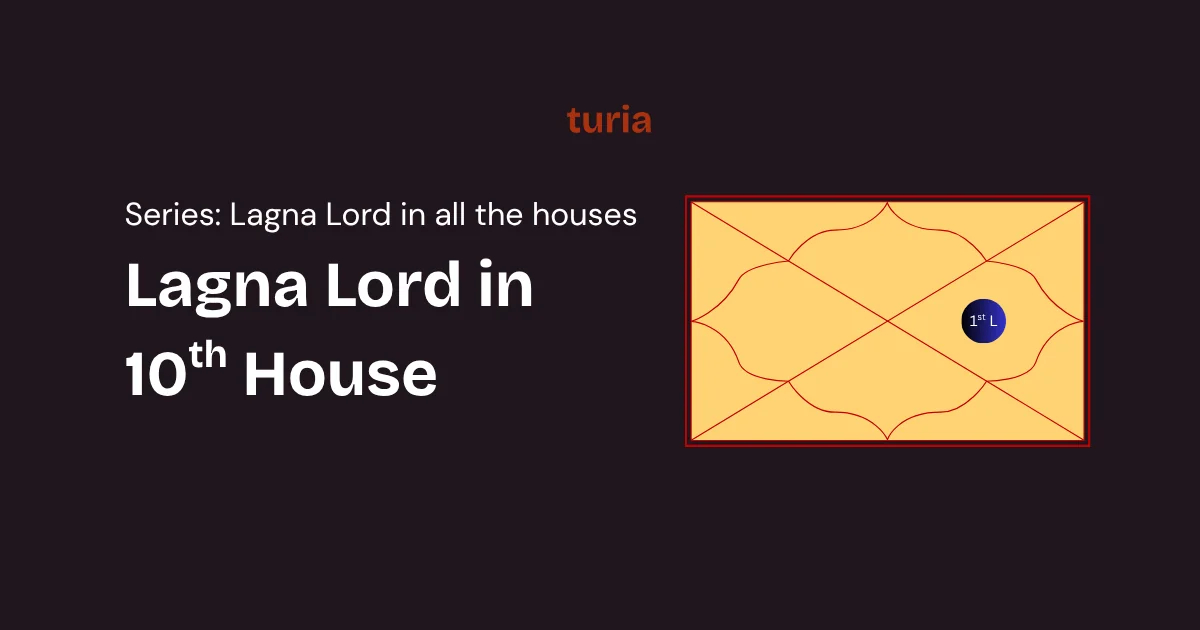
That's usually the first sign of a lagna lord sitting in the 10th house.
The lagna lord is the planet that rules your ascendant — your Lagna, or the rising sign at the exact moment you were born. Think of it as the planet in charge of your core self: your body, your personality, the "you" that walks into a room before you say a word.
The 10th house, or Karm Bhava, is the house of career, public status, authority, and your karma in the world — literally, the house of action.
So when the lagna lord — the ruler of who you are — sits inside the house of career and public life… your identity and your profession stop being two separate things.
And honestly, that fusion shows up everywhere. In how you introduce yourself. In how uncomfortable you feel during a career lull, even a short one. In how much validation you draw from being seen as competent, capable, in-charge.
This is article 10 of 12 in our series on lagna lord placements across the houses. In this guide, we'll cover what this placement means classically, how it plays out in career and reputation, what changes based on planetary strength, and how it compares to a few of the other lagna lord placements in the series.
Quick answer
Lagna lord in the 10th house is one of the strongest kendra (angular) placements in Vedic astrology. It fuses your core identity with your career, public image, and sense of authority — success, recognition, and reputation tend to come through your own effort rather than inheritance. Classical texts like the Brihat Parashara Hora Shastra associate this placement with paternal happiness, royal honour, and self-earned wealth. When the lagna lord also combines with the 10th lord here, it can form a Raja Yoga — a powerful combination for status and achievement. The strength of the placement matters a lot: exalted or own-sign lagna lords bring quick rise and public respect, while a debilitated or combust lagna lord can bring career instability, delays, or reputation struggles until the affliction resolves.
What It Means When the Lagna Lord Sits in the 10th House
In Vedic astrology, the 1st house (Lagna) and the 10th house (Karm Bhava) are both kendras — angular houses considered pillars of strength in a kundali. The other two kendras are the 4th and 7th.
When a planet rules your lagna and then physically sits in another kendra, it's generally considered auspicious. Kendra lords placed in kendras rarely create the kind of weakness that trikona (5th, 9th) lords can create when poorly placed. This is one of the reasons lagna lord in the 10th is treated as one of the more favourable placements in the entire "lagna lord across 12 houses" series.
The classical text Brihat Parashara Hora Shastra is direct about this. In its chapter on the effects of the bhava lords, it states:
"If Lagn's Lord is in Karm Bhava, the native will be endowed with paternal happiness, royal honour, fame among men and will doubtlessly have self-earned wealth." — BPHS, Chapter 24, Sloka 10
Three things stand out in that one line — paternal happiness, royal honour (read: respect from people in positions of authority), and self-earned wealth. Not inherited. Not through a spouse. Earned.
That last part is worth sitting with. This placement isn't a free pass to success. It's a placement that rewards direct, personal effort — the native's own work is what builds the reputation, not family background or luck.
Career and Professional Life
This is the section most people land on this page for, so let's get direct about it.
Lagna lord in the 10th house makes career and public identity almost inseparable. The native usually can't separate "who I am" from "what I do for a living" — and this isn't always a bad thing. It just means career setbacks hit harder emotionally, and career wins feel like personal validation, not just professional milestones.
A few patterns that show up repeatedly with this placement:
- Early drive. Many natives show career-focus young — in school, in choosing a stream, in picking up responsibility before their peers do.
- Authority and administration. Strong association with roles that involve leadership, government connections, bureaucracy, or managing people. Not universal, but common enough to be a pattern classical astrologers flag.
- Self-made success. The wealth and recognition that comes tends to be built, not inherited. Family business houses often see this placement in the sibling who "makes it bigger" rather than just maintaining what was handed to them.
- Quick rise, if the lagna lord is strong. When well-placed, natives often reach senior positions of responsibility earlier than their peers — sometimes before their mid-30s.
- Public visibility. Even outside conventional corporate careers, there's a pull toward recognition — teaching, public speaking, politics, media, or any field where performance is visible to others.
Take a common Indian example: a person whose parents pushed them gently toward the "safe" government exam route — UPSC, banking, PSU jobs — not because the parents were controlling, but because this native genuinely gravitated there too. The pull toward authority, structure, and public respect wasn't imposed. It was already wired in.
Raja Yoga Potential
Here's where this placement gets genuinely interesting from a technical standpoint.
A Raja Yoga forms when the lord of a kendra (1st, 4th, 7th, 10th) combines — through conjunction, mutual aspect, or sign exchange — with the lord of a trikona (1st, 5th, 9th). Since the lagna itself counts as both a kendra and a trikona, the lagna lord is always a natural Raja Yoga karaka waiting for the right combination.
When the lagna lord sits in the 10th house along with the 10th house's own lord — or receives a strong aspect from it — this is textbook Raja Yoga territory. BPHS itself hints at this in its chapter on Karm Bhava, noting that fame comes "if Karm's Lord is in a trine from Karm Bhava and Lagn's Lord is in Lagn's angle" — essentially describing the interlocking relationship between the lagna and career houses that produces recognition.
This doesn't mean every lagna lord in the 10th automatically creates a Raja Yoga. It depends on where the 10th lord itself sits, and whether the two form an actual planetary relationship. But the placement sets up the conditions for it more naturally than most other houses would.
Reputation, Public Image, and Authority
Public perception matters more to this placement than almost any other. The 10th house rules not just career but karma in the broadest sense — your standing in society, how the world sees your actions.
With the lagna lord here, reputation becomes something the native actively protects, sometimes without realizing how much weight they give it. A bad performance review, a public failure, a demotion — these land differently for someone with this placement. It's not just a professional setback; it can feel like a dent in their sense of self.
The upside is proportional. Recognition, awards, promotions, and public acknowledgment feel deeply satisfying — not just financially useful, but identity-affirming.
This also tends to show up as a natural comfort around authority figures — bosses, government officials, elders in a professional hierarchy. Natives with this placement often build genuine, useful relationships with people in positions of power, not through flattery, but because they're wired to understand and work within structures of authority.
Father and Family Themes
Classical texts consistently connect the 10th house's effects on the lagna lord to paternal happiness — the idea that the father benefits, directly or indirectly, around or after the native's birth.
This isn't just symbolic. The 10th house is one of the houses associated with the father figure (alongside the 9th, depending on the school of thought), and having your core identity planet sitting there creates a strong energetic thread between the native's public life and the father's standing.
In practice, this often plays out as the native feeling a strong pull to make the father proud through career achievement specifically — more so than through other life milestones like marriage or personal choices. Many people with this placement describe career success as something that "means more" when a parent, especially the father, is present to witness it.
Strength Matters More Than the Placement Itself
This is the part that separates a good placement from an actually lived good outcome.
When the lagna lord is strong — exalted, in its own sign, or well-aspected by benefics — this placement delivers close to its textbook promise: recognition, authority, self-made wealth, and a reputation the native genuinely earns.
When the lagna lord is weak, combust, or debilitated, BPHS is blunt about the flip side: "If Karm's Lord is devoid of strength, the native will face obstructions in his work." Career delays, public setbacks, or a reputation that doesn't match the native's actual effort can show up instead.
Debilitation isn't always the final word, though. Classical astrology recognizes neecha bhanga — cancellation of debilitation — which can happen when the dispositor of the debilitated sign sits in a kendra from the lagna or Moon, or when an exalted planet occupies that kendra position. This is a detail worth checking with a proper kundali reading rather than assuming the worst from a single weak placement.
A few other strength factors worth knowing:
| Condition | General Effect |
|---|---|
| Exalted or own sign | Strong career rise, high public respect, smoother authority |
| Well-aspected by benefics (Jupiter, Venus, well-placed Mercury) | Ethical success, good reputation, mentorship from seniors |
| Combust (too close to the Sun) | Self-doubt in professional settings, image struggles despite real ability |
| Debilitated, unsupported | Career instability, delays, reputation not matching effort |
| Conjunct or aspected by malefics (Saturn, Mars, Rahu, Ketu) | Slower, harder-earned success — but often more durable once achieved |
How This Compares to Other Lagna Lord Placements
Since this is part of a 12-house series, it's worth placing this alongside a few other lagna lord positions so the pattern is clear.
- Lagna lord in the 1st house (self-placed) leans more into personality, physical vitality, and self-focus — the native is primarily oriented around being, not achieving. The 10th house placement redirects that same energy outward, into public action.
- Lagna lord in the 4th house ties identity to home, emotional roots, and inner peace — a more private, inward version of security. The 10th house is its public mirror: security through visible achievement rather than emotional grounding.
- Lagna lord in the 7th house fuses identity with partnership and marriage — the native often finds themselves through a significant other. The 10th house instead finds identity through vocation.
- Lagna lord in the 11th house focuses on gains, networks, and long-term goals — success through community and association. The 10th house version is more solitary and self-driven — success through personal authority rather than group belonging.
Broadly: kendra placements (1st, 4th, 7th, 10th) for the lagna lord are all considered strong by classical standards, but each channels that strength into a different life area. The 10th is specifically the public kendra — it's where your inner sense of self gets tested against the world's judgment, and where classical texts promise the most tangible, visible rewards if the planet is strong.
Frequently Asked Questions
Is lagna lord in the 10th house good or bad?
It's generally considered one of the more favourable placements in Vedic astrology. Because the 10th house is a kendra, a lagna lord placed here is naturally strong and tends to bring career success, public respect, and self-earned wealth. Whether it plays out fully positive depends on the planet's strength — exaltation and good aspects amplify the benefits, while debilitation or combustion can bring career obstacles instead.
Does lagna lord in the 10th house always create a Raja Yoga?
Not automatically. A Raja Yoga forms when the lagna lord specifically combines with the 10th lord — through conjunction, mutual aspect, or sign exchange. Simply having the lagna lord sit in the 10th house is a strong placement on its own, but it only becomes a classical Raja Yoga when that additional planetary relationship with the 10th lord is present.
What happens if the lagna lord is debilitated or combust in the 10th house?
BPHS notes that when the lord of the karma house lacks strength, the native faces obstructions in their work — this can mean career delays, instability, or a reputation that doesn't match actual effort. Debilitation can sometimes be cancelled (neecha bhanga) under specific classical conditions, so it's worth a full chart reading before assuming the worst.
Does this placement affect marriage or family life?
It can, mainly through imbalance rather than direct harm. Because identity and career are so tightly linked, natives with this placement sometimes prioritize professional growth over personal relationships, especially earlier in life. This isn't a fixed rule — the 7th house and its lord still matter more directly for marriage — but ambition here can occasionally spill into other life areas if not consciously balanced.
What kind of professions suit lagna lord in the 10th house?
Roles involving authority, visibility, and structure tend to suit this placement well — government service, administration, corporate leadership, teaching, public-facing careers, and politics are commonly seen. The specific field depends heavily on which planet is the lagna lord and its sign, so this is a general tendency rather than a fixed rule.
How is lagna lord in the 10th house different from lagna lord in the 1st house?
Lagna lord in the 1st house keeps the native's energy centered on self and personality — vitality, appearance, individual identity. Lagna lord in the 10th house takes that same core energy and channels it outward into career and public life. Both are strong kendra placements, but one is inward-facing and the other is outward-facing.
Does lagna lord in the 10th house affect the relationship with the father?
Classical texts frequently connect this placement to paternal happiness — the idea that the father's fortunes improve around or after the native's birth, and that the native often feels a strong pull to achieve specifically to make the father proud. This is a recurring classical theme, though individual family dynamics will always add their own layer to it.
Closing
So if someone asks you whether lagna lord in the 10th house is a "good" placement — the honest answer is: it's one of the stronger ones in this entire series, but it comes with a catch. It asks you to build your identity through action, visibly, in front of other people, and to keep building even after the recognition arrives.
The reward is real when the planet is strong — self-earned wealth, authority, a reputation you don't have to explain. But it's also one of the placements where the classical texts are clearest: strength decides everything. A well-placed lagna lord here doesn't just hand you a career. It hands you a life where your work and your sense of self were never really separate to begin with.
Hope this helps :)