2 People work equally hard, yet one succeeds and the other fails. We will discuss this life imbalance in this article.
Disclaimer: In this article, I’ll touch on topics like astrology. I know many people see it as pseudoscience — and that’s fair. I use it here as a framework for reflection, not as unquestioned truth.
A Personal Story
Back in 2019, I joined one of the top AI ed-tech companies in a growth role. I worked hard, planned and executed relentlessly..
But after a year and a half, I realised something important: this wasn’t my calling. Growth / marketing was fine, but deep down I knew I wanted to build products. Product management felt like the path I was meant for.
The problem? I had no real product experience and I was at a disadvantage at applying for the role. So, I went up to my manager and said: I want to move into a product role.
It wasn’t an easy conversation. But I made my case, and within a month, I got the transition.
Yay! All the past effort I had put in the company paid off!
Not really.
Later, I found out that the other PM had resigned in the same week. What a coincidence!
That’s when it hit me - sometimes it’s not just effort. Fate plays a bigger role than we like to admit.
Even the world’s most successful people admit this.
- Malcolm Gladwell, in Outliers, describes success as a “patchwork of lucky breaks and arbitrary advantages.”
- Warren Buffett famously calls himself a member of the “lucky sperm club” and a winner of the “ovarian lottery.”
- Jeff Bezos has credited Amazon’s rise to an “incredible planetary alignment,” joking that it was “half luck, half good timing, and the rest brains.”
- Bill Gates once admitted he was “lucky to be born with certain skills.”
If people at the very top point to luck and timing, it shows us that effort alone isn’t the full story.
The Belief I Grew Up With
All my life, I was told: if you put in the effort, you’ll be successful.
And for a long time, I believed that.
In school or college, it just makes sense. Everyone is playing on the same field - same exams, same teachers, same age. You work harder, you usually get ahead.
But once you step into the real world, you realise things don’t work like that. The field is uneven.
Your friend who barely passed maths gets into his father’s business and lives comfortably.
You might want to become a cricketer, but your family needs money, so you drop the dream and pick up a random job.
That’s when you realise: effort is not the only thing.
Luck vs Fate
People often call these uneven outcomes “luck.” But I see a difference.
Luck is random — like a coin toss. A father and daughter meet with an accident: the father dies on the spot, while the daughter walks away unharmed. That’s pure chance, impossible to control or prepare for.
Fate, on the other hand, feels more patterned. It suggests that events — good or bad — unfold for a reason, whether through karma, timing, or some larger design. And because there’s a pattern, it’s something we can try to study and anticipate.
That’s why, in this article, I choose the word fate over luck. Luck is blind, but fate gives us tools — frameworks like astrology — to make sense of the currents we’re rowing in.
Success = Effort × Fate

After watching how life works - in my case and in others - I’ve come to a different conclusion:
Success = Effort × Fate.
Not plus, multiply. Because if one is close to zero, the result is close to zero too.
Effort is what you can control: your hard work, your discipline, your choices. Fate is what you can’t: timing, opportunities, setbacks, the random stuff life throws at you.
Both matter. Both decide how far you go.
Effort vs Fate: Clear Definitions
Effort is everything you can directly control. The energy you put in every day: discipline, consistency, choices, practice, and skill-building.
- High Effort Zone: You’re proactive, disciplined, and deliberate.
- Low Effort Zone: You let life happen to you. Decisions are passive, inconsistent, or avoided altogether.

Fate is what you cannot control. The external forces and timing that shape outcomes regardless of your effort. Call it timing, chance, karma, or alignment of circumstances - it is the wind that pushes with or against you.
- Favorable Fate: These are Tailwinds. External conditions make progress smoother.
- Unfavorable Fate: These are Headwinds. Circumstances resist you no matter how hard you try.

Think of it like this: effort is rowing the boat, fate is the current of the river. Sometimes the current flows with you, sometimes against you.
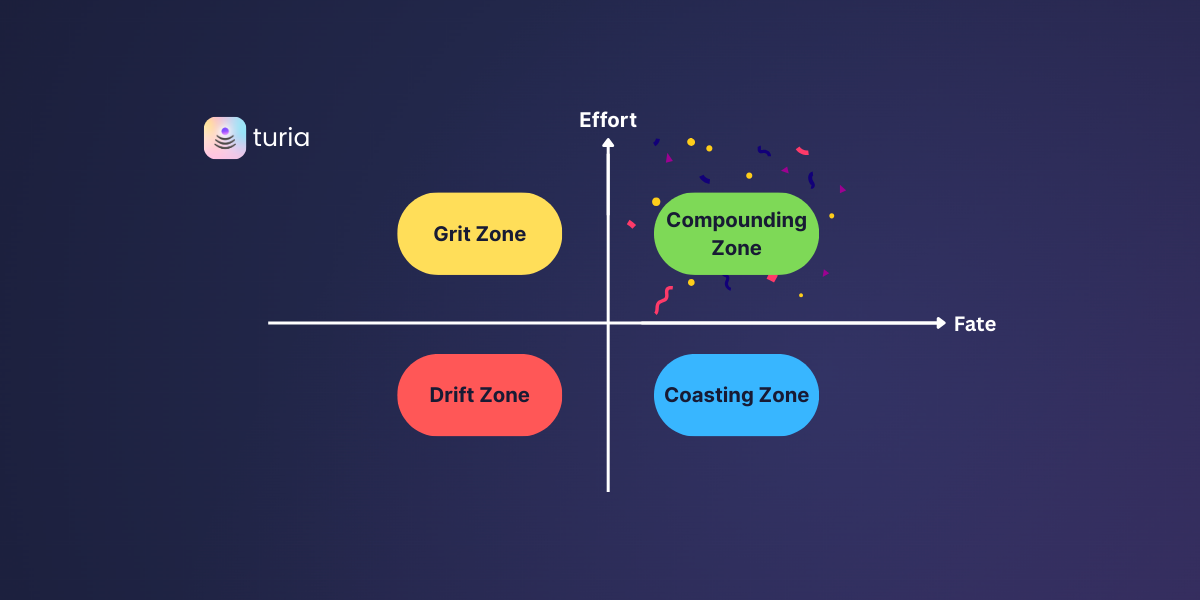
The 2×2 Framework
%20(1)_lxFA1IT.png)
When you put these two forces together - Effort (high or low) and Fate (favorable or unfavorable) - you get four possible zones.
1. Low Effort × Unfavorable Fate = The Drift Zone
The weakest quadrant. Life throws challenges, and you aren’t rowing. You drift wherever the current takes you.
Example: Someone stuck in a tough macro-economic situation, but instead of reskilling or seeking opportunities, they resign themselves to “this is just my destiny.”
2. High Effort × Unfavorable Fate = The Grit Zone
Conditions are rough, but you keep working. Results may not show immediately, but you build resilience, skill, and character.
Example: A founder launches during a downturn. Customers are scarce, investors cautious. The company doesn’t take off — but the lessons and network become the foundation for their next success.
3. Low Effort × Favorable Fate → The Coasting Zone
External conditions are good, but effort is lacking. Opportunities fall into your lap, but without consistency, they rarely compound.
Example: A naturally athletic person makes it to a sports team with minimal training. But without discipline, they plateau quickly while others surpass them.
4. High Effort × Favorable Fate → The Compounding Zone
The sweet spot. Your discipline meets the right timing, and results multiply.
Example: A student prepares relentlessly for years for a competitive exam. When their effort aligns with the right timing, they crack it and unlock opportunities that reshape their future.
The key point: you don’t stay in one quadrant forever. Life shifts. In one area, you might be compounding; in another, you’re in the grit zone. The goal isn’t perfection everywhere. It’s to stay consistently in the High Effort lane, so that when fate turns favorable, you’re ready to catch the wave.
The Real Challenge: Timing

So yes, effort matters. Without it, nothing moves. But if there’s one thing my story - and countless others - has shown me, it’s this: effort alone isn’t enough. Timing makes all the difference.
And that’s the hard part. You can always choose effort. You can’t always choose timing.
Sometimes you work relentlessly, but the market collapses. Sometimes you make one small move and doors swing open. That’s fate at play. The real challenge is not just rowing hard, but knowing when the current is with you.
Humans Have Always Tried to Read It
This isn’t a new problem. For as long as we’ve existed, people have searched for ways to read timing.
- Farmers watched the skies to predict when to plant and harvest.
- Sailors studied winds and stars before venturing out.
- Traders mapped booms and busts to anticipate the right moment to buy or sell.
Different methods, same instinct: to make effort more effective by understanding the currents of fate.
Astrology as a Map of Fate
Among these systems, one has endured for thousands of years - astrology.
Not the daily horoscope, but the deeper framework that leaders and thinkers used to navigate life. At its core, astrology doesn’t control fate. It gives you a language to understand it - both the innate patterns you carry and the cycles you move through.
Two Layers of Fate in Astrology
- Innate Fate (Your Patterns)
Your birth chart reflects natural tendencies:- Where you feel confident and where you hesitate.
- What motivates you and what drains you.
Emotional habits, relationship patterns, ways you handle success and failure.
These aren’t rigid rules, but mirrors. Often, astrology names things you’ve always felt but never had the words for.
- Cyclical Fate (Your Timing Windows)
Life also moves in seasons. Astrology maps these through cycles. Some periods bring tailwinds - progress comes faster. Others bring headwinds - effort feels heavier.
Knowing which season you’re in doesn’t change the work required, but it changes how you work. You can push harder when currents are with you, and focus on resilience when they aren’t.
Astrology + Effort
Effort is rowing the boat. Astrology shows both the shape of your boat (your patterns) and the flow of the river (your timing). Together, they help you row where your energy counts most.
Used this way, astrology isn’t superstition. It's a strategy. It doesn’t replace effort - it multiplies it.
Welcome, turia
This is the philosophy behind turia. We built it on the Effort × Fate framework. Your birth chart becomes the input - not to overwhelm you with jargon, but to give you clear, actionable insights.
It helps you:
- Understand your natural strengths and blind spots.
- See when external cycles are with you or against you.
- Turn both into daily actions, reflections, and tools that keep you in the High Effort Zone.
So you’re not just drifting or waiting for luck. You’re rowing hard, with the current in mind.
Final Thought
You can’t control the wind. But you can set your sail, and you can learn the weather. That’s how success compounds.
In the next article, I’ll share how you can actively work with fate through astrology and conscious self-work — so your effort counts where it matters most.