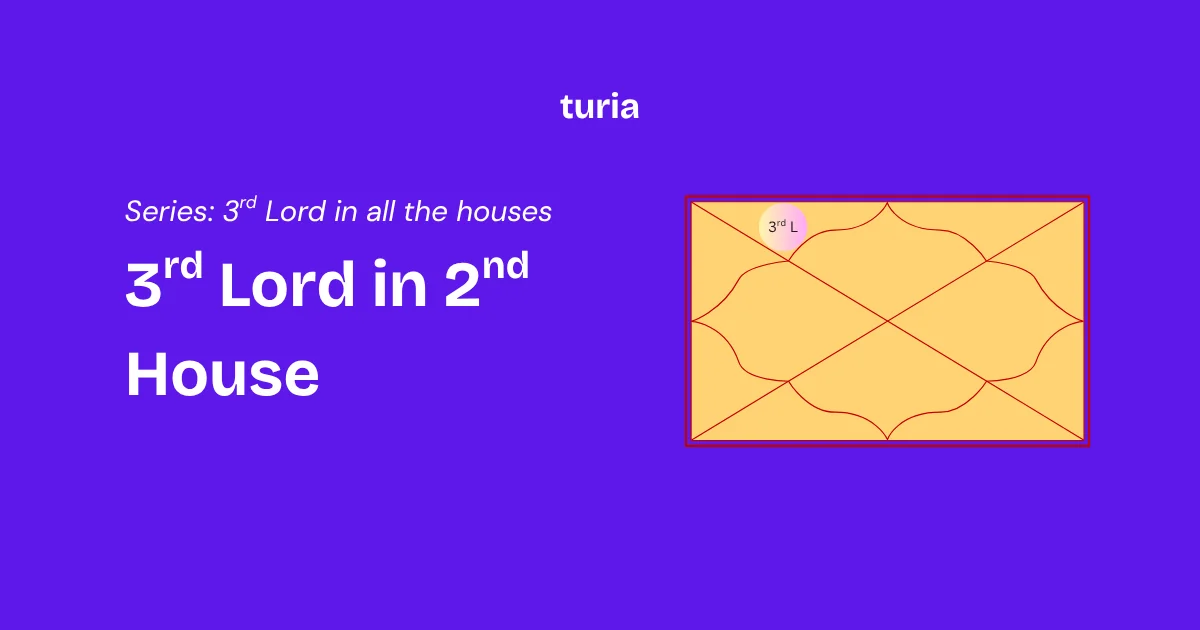
Someone finds out their 3rd lord sits in the 2nd house of their kundali, and the first thing they usually search is whether this is "good" or "bad."
Fair question. The 3rd house and the 2nd house don't obviously belong together. One is about courage, hustle, siblings and short trips. The other is about wealth, speech and family resources.
And this is where it gets interesting.
When the 3rd lord moves into the 2nd house, it doesn't erase either house's meaning — it blends them. Effort starts showing up in the wallet. Communication starts becoming a way to earn. Siblings start getting tangled up with money matters, for better or worse.
In this guide, we'll cover what this placement actually means, what BPHS and Phaladeepika say about it, how it shows up in money, siblings, speech and marriage, and how it compares to the reverse placement — the 2nd lord sitting in the 3rd house.
Quick answer
The 3rd lord in the 2nd house blends Parakrama Bhava (courage, effort, siblings, communication) with Dhana Bhava (wealth, speech, family). In practice, it usually means money and family resources get built through self-effort, hustle, or communication skills — sales, writing, teaching, negotiation. Siblings often get financially linked to the native, for gain or dependence. Classical texts read this placement as double-edged: favourable when the 3rd lord is strong and well-placed, prone to laziness or over-focus on comfort when it's weak or afflicted.
What Parakrama Bhava and Dhana Bhava Actually Cover
Before getting into the blend, it helps to separate the two houses cleanly.
| Bhava | Sanskrit name | What it governs |
|---|---|---|
| 3rd house | Parakrama Bhava (also Sahaj Bhava) | Courage, self-effort, valour, younger siblings, short journeys, communication, hobbies, skill |
| 2nd house | Dhana Bhava | Wealth, accumulated resources, speech (Vak), family (Kutumba), food habits, face, the right eye |
The Brihat Parashara Hora Shastra lists both sets of karakatwas plainly: "From Sahaj Bhava know of the following: valour, servants, brothers, sisters etc., initiatory instructions, journey and parent's death," and for Dhan Bhava, "Wealth, grains (food etc.), family, death, enemies, metals, precious stones etc. are to be understood" (BPHS, Ch. 11, v.3-4).
Phaladeepika phrases it slightly differently but points the same direction — the 2nd house also covers Vidya (learning) and Patrika (documents), and the 3rd house is tied to "army, valour, prowess and brother" (Phaladeepika, house-signification verses).
So when the lord ruling the 3rd house physically sits inside the 2nd house of the kundali, you're watching the planet in charge of courage and self-effort go to work inside the house of money, speech and family.
What 3rd Lord in 2nd House Means, in Plain Terms
Think of it like this: the 3rd house is your hustle muscle. The 2nd house is your bank account and your voice.
Put the hustle muscle inside the bank account, and the most common pattern is straightforward — effort becomes the engine of wealth. Not inherited money, not sudden windfalls. Earned money. Money that comes from showing up, pitching, negotiating, writing, teaching, or simply outworking the next person.
This is why several Indian astrology sites frame this exact placement as "self-made wealth" territory — the person who builds a family business from scratch, or the sales professional whose commission checks are bigger than their base salary, or the writer who turns a communication skill into a livelihood.
But — and this is important — the same placement carries a second, more cautionary reading in the classical texts, which we'll get to next.
What the Classical Texts Say
This exact placement has a direct citation in the Brihat Parashara Hora Shastra. In the chapter on the effects of Sahaj Bhava, Parashara writes:
"If Sahaj's Lord is in Dhan Bhava, the native will be corpulent, devoid of valour, will not make much efforts, be not happy and will have an eye on others' wives and others' wealth." (BPHS, Ch. 14, v.26)
Read literally, that's a warning, not a blessing. Parashara is flagging that courage and effort (3rd house) can go soft once they're absorbed into comfort and possession (2nd house) — the native gets comfortable, stops pushing, and in the worst readings develops a wandering, covetous eye.
That's not the whole story though. BPHS also lays out the general rule for any lord sitting in Dhan Bhava: "If the Lord of Dhan is in Dhan, or is in an angle, or in trine, he will promote one's wealth. Should he be in Ari/8th/12th, financial conditions will decline. A benefic in Dhan will give wealth, while a malefic instead will destroy wealth" (BPHS, Ch. 13, v.1-2).
So the dignity of the 3rd lord is really what decides which version of this placement shows up. A strong, well-placed 3rd lord — own sign, exalted, in good company — leans toward the "self-made wealth" story. A weak, combust, or badly afflicted 3rd lord leans toward Parashara's more cautionary reading.
Phaladeepika adds useful context here through Shaurya Yoga — formed when the 3rd house is aspected by benefics and its lord is strong, uncombust, and well-placed. That yoga's native "has younger brothers devoted to him. The younger brothers will attain glory and will be brave and valiant... he will be engrossed in state affairs, will be loved by everybody and will be very renowned" (Phaladeepika). A 3rd lord carrying that kind of strength into the 2nd house tends to bring courage and sibling goodwill into the family's resources, rather than draining them.
Money: How the Placement Tends to Show Up
The clearest theme across both classical logic and modern astrology writing is that wealth here is earned, not passive.
- Effort-driven income. Commission-based sales, freelancing, consulting, small business — anything where output is directly tied to income tends to suit this placement.
- Speech becomes a tool. Because the 2nd house rules Vak (speech), and the 3rd lord brings communication skill into that house, careers built on talking — marketing, teaching, negotiation, broadcasting, even a family shop where the owner is the best salesperson on the floor — often do well.
- Family money, family effort. Wealth built here often runs through the family unit rather than around it — think of a joint family business where every sibling's hustle adds to the shared pot.
- Swings with dignity. A debilitated or combust 3rd lord in the 2nd house is more often linked to inconsistent income, half-finished ventures, or money that comes but doesn't stay — echoing BPHS's own caution above.
Siblings and Family Ties
Because the 3rd house rules younger siblings, and its lord has now walked into the wealth house, sibling relationships and money tend to get linked — for good or for strain.
BPHS ties the fate of co-borns directly to the strength of Sahaj Bhava's lord: "Should Sahaj Bhava be yuti with, or drishtied by a benefic, the native will be endowed with co-born and be courageous" (BPHS, Ch. 14, v.1), and the same chapter (v.7-11) reads the number, strength and longevity of siblings off this same lord's placement and dignity.
In practical terms, Indian astrology sites reading this exact placement describe two common patterns: the native ends up financially supporting a younger sibling, or — just as often — a younger sibling becomes a genuine contributor to the family's finances, sometimes even outperforming the native financially. Which version plays out again comes down to whether the 3rd lord is strong or weak in the 2nd house.
Marriage and Family Life
This is where forums and SERP content converge on a fairly consistent picture: the placement adds emotional intensity to domestic life, not necessarily conflict.
Natives with this placement are often described as spouses who give a lot of time and attention to family, but who can also slip into telling the spouse how to think, spend, or behave — a "my way of running this household" tendency that needs watching. Kept in check, this reads as a stable, communicative marriage where both partners manage money jointly and talk things through rather than avoid them.
When the 3rd Lord Is Strong vs Weak or Afflicted
Since dignity decides so much of the reading, it's worth laying out the spectrum plainly.
- Own sign or exalted, well-aspected: effort and courage translate cleanly into earned wealth, confident speech, and supportive siblings. Closer to Shaurya Yoga territory.
- Combust: courage and initiative get "burned out." BPHS-adjacent tradition and modern practitioners both flag strained sibling relationships and reduced follow-through on effort here.
- Debilitated or in an enemy sign, malefic-aspected: money that's harder to hold onto, throat or speech-related friction, and — per Parashara's own v.26 above — a tendency toward laziness or wandering attention.
- Conjunct or aspected by Mangal (natural karaka for siblings and courage): tends to sharpen the effort-and-money theme, sometimes with more assertive, even blunt, communication about finances.
None of this is meant to read as fixed fate — it's a starting map. The dasha the native is running through, the navamsa (D9) placement of this same lord, and the overall shadbala (planetary strength) all refine the picture further.
3rd Lord in 2nd House vs 2nd Lord in 3rd House
These two placements get confused constantly because they involve the same two houses, just with the roles flipped. Worth separating clearly.
| 3rd Lord in 2nd House | 2nd Lord in 3rd House | |
|---|---|---|
| Direction of energy | Effort/courage flows into wealth and family | Wealth-thinking flows into effort and action |
| Primary theme | Money and speech absorb the native's hustle — can mean earned wealth, can mean comfort dulling drive | Personal effort and communication actively generate income — often read as more proactive |
| Siblings | Sibling fortunes get tied to family wealth; native may support or be supported by siblings | Siblings often help directly with earning or business |
| Classical tone (BPHS) | Cautionary by default (v.26) unless the lord is strong | Generally read as favourable for self-earned gains through effort |
| Marriage texture | More emotionally intense, "my way" tendencies to watch | Less emphasized in classical texts; practical, resourceful spouse commonly noted |
Neither placement is simply "better." They're mirror images of the same two houses working in opposite directions.
FAQs
What does 3rd lord in 2nd house mean in simple terms?
It means the planet ruling your 3rd house of courage, effort, siblings and communication is sitting in your 2nd house of wealth, speech and family. In plain terms, your hustle and communication skills tend to become tools for building family resources and income — the exact flavour depends on how strong or weak that ruling planet is.
Is this a good placement for building wealth?
It can be, especially if the 3rd lord is strong, exalted, or in its own sign — this leans toward earned, self-made wealth built through effort, sales, or communication-based work. If the lord is weak, combust, or afflicted, BPHS itself cautions toward reduced effort and financial inconsistency, so dignity matters more than the placement alone.
Are my siblings financially linked to me with this placement?
Often, yes, in some form. Classical texts tie sibling outcomes to the strength of this same lord, and modern readings commonly describe either the native supporting a younger sibling financially, or a sibling becoming a genuine contributor to the family's income. Which direction it leans depends on the lord's dignity and aspects.
Does this placement affect speech or career choices?
Yes — because the 2nd house rules speech (Vak), a 3rd lord placed here often points toward careers where talking is the actual skill being monetised: sales, teaching, marketing, negotiation, writing, broadcasting. Family businesses run on strong salesmanship also fit this pattern well.
What happens if the 3rd lord is combust or debilitated in the 2nd house?
Expect more friction. Combustion tends to show up as strained sibling relationships and reduced courage or follow-through on effort. Debilitation or malefic affliction leans toward Parashara's own reading in BPHS — money that's harder to retain, laziness, or scattered focus rather than steady building.
How is this different from the 2nd lord placed in the 3rd house?
They're the same two houses in reverse. 3rd lord in 2nd house means effort and courage get absorbed into wealth and family life. 2nd lord in 3rd house means the wish for wealth actively drives effort and communication — generally read as a more proactive, self-earning combination. Neither is automatically stronger; it's a difference in direction, not quality.
Does the navamsa (D9) placement of the 3rd lord matter here?
Yes. The D1 (birth chart) placement gives the broad theme, but the navamsa confirms whether it holds up under closer scrutiny — particularly for sibling matters and marriage. If the 3rd lord is well-placed in both D1 and navamsa, the favourable reading (earned wealth, supportive siblings) tends to be more reliable.
The Honest Takeaway
So if someone asks whether the 3rd lord in the 2nd house is good or bad, the honest answer is: it depends on the lord's dignity, not the placement itself. Classical texts hand you both sides — a caution about comfort dulling effort, and a template (Shaurya Yoga) for what real strength here looks like. What stays constant is the theme — courage, siblings and communication get woven directly into how this person builds and holds onto family wealth.
Hope this gives you a clearer picture.