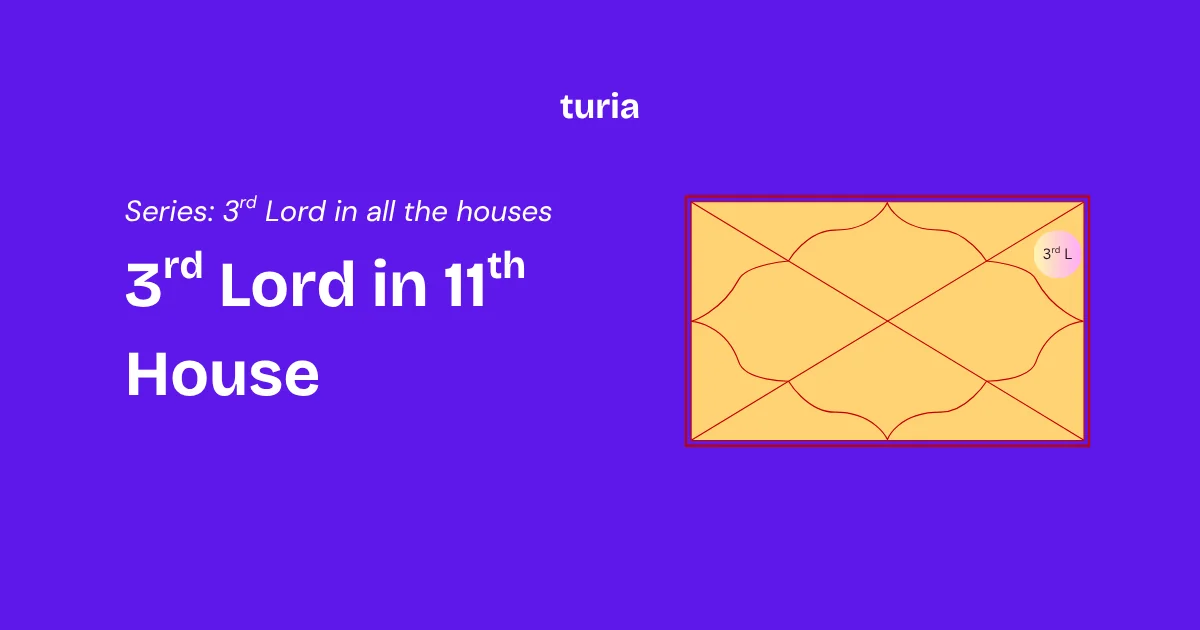
Someone finds out their 3rd house lord sits in the 11th house, and the first question is usually about money. "Does this mean I'll be rich? Will my effort actually pay off?"
Most of the scattered answers online stop at "good for gains" and leave it there, without explaining why, or what it costs.
And honestly… there's a cleaner story underneath the one-liners.
The 3rd lord in the 11th house is one of the more quietly powerful placements in Vedic astrology — because it takes the house of personal effort and drops it straight into the house of gains, networks and fulfilled desires. In this guide, we'll cover what that actually does to your finances, your siblings, your career, and your relationships — plus what the classical texts, BPHS and Phaladeepika, say about it directly.
Quick answer
When the 3rd house lord sits in the 11th house, effort, courage and communication (3rd house themes) get channelled into gains, networks and fulfilled desires (11th house themes). Classically, BPHS ties this placement to steady gains through trade, intelligence, and an adventurous, service-minded nature. In practice, it usually produces someone whose personal hustle — not luck — builds wealth, connections and career growth over time, with results that compound and strengthen through the thirties and beyond, since both houses involved are Upachaya (growth) houses.
What Parakrama Bhava and Labha Bhava Actually Represent
Before getting into the placement itself, it helps to separate the two houses doing the talking here.
The 3rd house is called Parakrama Bhava — the house of courage, effort and self-initiative. BPHS lists its domain plainly: "valour, servants, brothers, sisters, initiatory instructions (Upadesh), journey and parent's death." In everyday terms — your siblings, your short trips, your communication skill, and your sheer will to push through something on your own steam.
The 11th house is Labha Bhava — the house of gains, income and fulfilled desires. BPHS describes it as governing "all articles, son's wife, income, prosperity, quadrupeds" — in plain modern terms, the house most closely tied to money coming in, elder siblings, friend circles, and the things you want and eventually get.
| 3rd House (Parakrama Bhava) | 11th House (Labha Bhava) | |
|---|---|---|
| Core theme | Effort, courage, communication | Gains, income, fulfilled desires |
| Family link | Younger siblings | Elder siblings |
| Nature | Upachaya (grows with effort) | Upachaya (grows with effort) |
| Best decade | Improves through the 30s | Improves through the 30s |
The Core Meaning of 3rd Lord in the 11th House
Put the 3rd lord — the planet ruling your effort, courage and communication — inside the 11th house, and something distinctly favourable tends to happen. The energy of "trying hard, speaking up, making things happen" moves house, and it lands in the one part of the kundali built entirely around gains.
This is the reason this placement shows up so often in people whose income and network genuinely grow through their own hands-on effort — not inheritance, not a lucky break, but repeated, visible hustle that eventually compounds. The 3rd house builds the skill and the courage; the 11th house is where that skill gets converted into income, contacts and standing among groups.
There's also a scale dimension worth noting. The 3rd house works at a personal, individual level — your own initiative, your own siblings. The 11th house works at a group level — large organisations, professional networks, communities. When the 3rd lord sits in the 11th, personal effort tends to get amplified by whatever bigger group or network the native is plugged into — a corporate structure, a trade body, a circle of friends who become genuine collaborators.
Both houses involved here are also Upachaya Bhavas — a specific classical category of houses that don't hand out results immediately. They grow instead, quietly, in proportion to sustained effort and time. That's a meaningfully different promise than a trine (Kona) placement, which tends to bless more passively. This placement asks for consistency first and pays out later — but when it pays out, the growth tends to be durable rather than a flash in the pan.
What the Classical Texts Say
This isn't guesswork — Parashara addressed this exact combination directly.
Brihat Parashara Hora Shastra, in the chapter "Effects of the Bhava Lords," states it in one clean line:
"If Sahaj's Lord is in Labh Bhava, then native will always gain in trading, be intelligent, although not literate, be adventurous and will serve others." — BPHS, Ch. 24, verse 35
Three threads in that single sutra: steady gain — particularly through trade or commerce — genuine intelligence (though not necessarily formal, bookish education), and an adventurous, service-oriented temperament. Note the word "always" — Parashara frames the gains here as a recurring, dependable pattern rather than a one-off windfall.
Phaladeepika, in its chapter on Bhava-lord combinations, adds another angle entirely — through the mutual-exchange (Parivartana) principle:
"If Labh's Lord is in Sahaj Bhava, as Sahaj's Lord is in Labh Bhava, one will gain wealth through co-borns and will be endowed with excellent ornaments." — BPHS, Ch. 22, verse 10
This describes what happens when both lords swap houses simultaneously — a stronger, mutual version of the placement — and it names siblings specifically as a channel for that wealth. More on this exchange, and its named classical yoga, further below.
Effect on Siblings
Since the 3rd house governs younger siblings and the 11th governs elder siblings, this placement often creates an interesting role-reversal within the family: a younger sibling ends up carrying the responsibilities, temperament, or protective instincts more commonly associated with being the eldest.
In real families, this often looks like a younger brother or sister who becomes the one everyone leans on — organising things, stepping up financially, or simply acting like the dependable elder well before their turn in birth order would suggest. Phaladeepika supports the positive read here too: a strong, well-conjoined 3rd lord assures "the prosperity of brothers," and this placement, sitting in a growth-oriented Upachaya house rather than a difficult one, tends to lean favourable more often than not.
The native's own courage and effort (the core 3rd house themes) also tend to show up clearly in how they treat siblings — protective, generous, willing to take responsibility rather than stepping back from it.
Effect on Wealth, Gains and Effort-Driven Success
This is the section most people are actually searching for, so it deserves the direct answer up front: yes, this is generally read as one of the stronger effort-linked wealth combinations in the system.
The reasoning is straightforward once you see the mechanics. The 3rd house is the house of personal effort. The 11th house is the house of gains. Put the ruler of effort inside the house of gains, and the classical texts consistently read this as "you get out roughly what you put in" — a wealth pattern built on hustle rather than luck, connections rather than coincidence, and consistency rather than a single big break.
That said, "always gain" doesn't mean uninterrupted. Several modern commentators note the gains under this placement can move in cycles — a strong run followed by a flatter patch, then another strong run — rather than a single unbroken upward line. This tracks with the Upachaya nature of both houses: growth through repeated effort, not a straight escalator.
Career, Networks and Large Organisations
Because the 11th house governs groups, networks and large organisations, and the 3rd house governs communication and initiative, this placement consistently shows up in careers built around scaling personal effort through other people — sales, business development, corporate leadership, trade, marketing, PR, and any self-employed or entrepreneurial path where hustle directly converts to income.
The native typically does well in roles where they're not working alone — where their communication skill and initiative get to interact with a wider circle: a sales team, a client network, a trade association, a large company's internal structure. Entrepreneurship suits this placement particularly well for the same reason — self-effort (3rd) feeding directly into income (11th) is, structurally, what a good business does.
Since both houses are Upachaya, expect a slower build in the twenties, with visibly stronger results from the early thirties onward, once professional networks and reputations have had time to compound.
Marriage and Relationships
Multiple modern sources tie this placement to a financially and emotionally stable married life, with communication between partners described as dynamic and oriented toward shared goals — a natural extension of the 3rd house's communication strength meeting the 11th house's theme of fulfilled desires.
This isn't a placement classical texts single out heavily for marriage timing or spouse appearance the way some 7th-house-linked placements are, so treat the marriage angle here as a supportive tendency rather than a primary indicator. The 7th house, its lord, and the relevant dasha still carry the main weight of marriage-specific predictions.
3rd Lord in 11th vs. Related Placements
It helps to see this placement next to its two closest relatives — the reverse exchange, and the 3rd lord simply staying home.
| Placement | Siblings | Wealth/Gains | Career theme |
|---|---|---|---|
| 3rd lord in 11th house | Younger sibling may act like an elder; generally supported | Strong effort-driven gains, builds through the 30s | Sales, networks, entrepreneurship, large organisations |
| 11th lord in 3rd house | Elder sibling connection more grounded, day-to-day | Gains tied closely to personal initiative and daily effort | Effort-driven fortune, more individually earned |
| 3rd lord in 3rd house (own house) | Strongly supported, close sibling bond | Solid but more self-contained, less network-amplified | Pure self-effort, courage-led career |
The key difference: when the 3rd lord goes into the 11th, personal effort gets pulled toward the domain of gains and groups — amplified by whoever the native is connected to. When the 11th lord comes into the 3rd instead, gains get pulled toward the domain of daily effort — a more grounded, less network-dependent flavour of the same basic theme.
Special Case: When the 11th Lord Also Sits in the 3rd House
Sometimes both placements happen at once — the 3rd lord sits in the 11th house and the 11th lord sits in the 3rd house. This mutual exchange is called Kahala Yoga in Phaladeepika, one of eight recognised Parivartana yogas involving the 3rd lord.
Classically, this specific version of Kahala Yoga is read favourably — Phaladeepika describes the native as "prosperous, noble, benevolent, kind and propitious," someone who becomes "very popular in the public." That's a notably brighter read than some of the other seven Kahala combinations, which tend to describe more mixed, oscillating fortunes. It makes sense given the houses involved: both 3rd and 11th are Upachaya houses built around effort and growth, so a mutual exchange between them tends to double down on the placement's natural strengths rather than introducing friction.
If you notice both lords involved in your own chart, this is worth flagging specifically — it changes the reading from a simple placement to a named, generally auspicious classical yoga.
Does the Planet Matter?
Yes — significantly. A few examples worth knowing:
- Sun as 3rd lord in the 11th (common for Gemini ascendants) often shows up as leadership within networks or organisations, and gains that arrive through authority figures or people in positions of power.
- Mercury as 3rd lord in the 11th (Taurus ascendants) tends to sharpen analytical and communication-driven income — writing, consulting, sales built on clear explanation.
- Venus as 3rd lord in the 11th (Leo ascendants) often brings gains through creative work or relationship-based networking — collaborations, partnerships, and social capital converting into income.
- Mars as 3rd lord in the 11th can add competitive drive and quick decisiveness to how gains are pursued, though it benefits from a benefic's moderating influence to avoid impatience.
The general placement gives the theme; the specific planet, its strength, and any conjunctions or aspects shape how it actually plays out.
FAQ
Is 3rd lord in the 11th house a good placement for wealth?
Generally, yes. BPHS ties this placement to steady gains, particularly through trade or business, driven by personal effort rather than luck. Results tend to build gradually and compound with age, since both houses involved are Upachaya, growth-oriented houses that reward sustained work over quick windfalls.
Does this placement affect how many siblings I'll have?
It can support having siblings and a generally positive relationship with them, especially if the 3rd lord is strong and unafflicted. Phaladeepika ties a strong 3rd lord to the prosperity of brothers. The exact number of siblings depends on more specific factors, like the 3rd house's occupants and its karaka, Mars.
Does it mean my younger sibling will act like an elder in the family?
That's a common practical reading, yes. Since the 3rd house rules younger siblings and the 11th rules elder siblings, this placement often shows up as a younger sibling taking on elder-like responsibility, organisation or protectiveness within the family, sometimes well before their actual birth order would suggest.
What career suits someone with 3rd lord in the 11th house?
Sales, business development, corporate leadership, trade, marketing, PR, and entrepreneurial paths tend to suit this placement well, since it's built around personal effort scaling through networks and larger groups. Self-employment often works especially well here, provided the native stays consistent through the slower early years.
Does this placement really improve with age?
Yes — both the 3rd and 11th houses are classified as Upachaya Bhavas in BPHS, meaning they strengthen through sustained effort and time rather than delivering results immediately. Expect a slower build in the twenties and noticeably stronger results from the early thirties onward.
What if the 11th lord is also placed in the 3rd house?
That's a mutual exchange called Kahala Yoga in Phaladeepika, and it's read favourably — the classical description is of someone prosperous, kind and genuinely popular. It amplifies the placement's natural strengths rather than adding the mixed results some other Kahala combinations carry.
Does the navamsa (D9) chart change this reading?
Yes, always check it. The D9 confirms or softens the D1 indication — if the 3rd lord is well-placed in navamsa too, the gains and network themes strengthen further; if it's weak there, the wealth pattern may arrive more slowly or unevenly than the D1 alone suggests.
So if someone asks you what 3rd lord in the 11th house really means — the honest answer is: it takes your effort and hands it to your gains, provided you actually put the effort in. There's a real, well-documented pattern of wealth and network growth here, one that tends to reward patience and consistency over the search for a quick break. Hope this gives you a clearer picture of your own placement.