Introduction
Ask someone with this placement how they got where they are professionally, and you'll rarely hear "I got lucky" or "it was handed to me." You'll hear something closer to: "Nobody opened doors for me. I pushed until they opened."
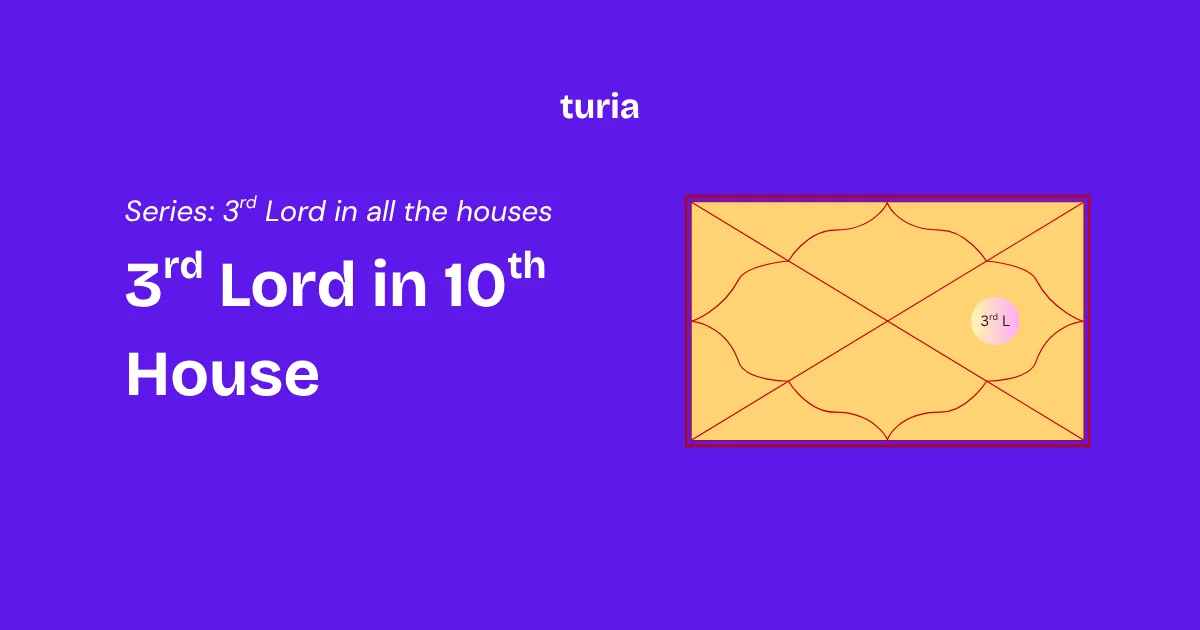
That's the signature of the 3rd lord — ruler of Parakrama Bhava, the house of courage, self-effort, siblings, and communication — sitting inside the 10th house, or Karma Bhava, the house of career, public standing, and authority.
Here's what makes this particular combination interesting. Both the 3rd and the 10th are what classical astrology calls Upachaya houses — houses that don't hand you results at birth. They build over time, through repeated effort, and they tend to strengthen rather than weaken as you age. When the lord of one Upachaya house sits inside another, you get a placement that's almost structurally designed around the idea of career growth earned the hard way.
And honestly, that's a reassuring placement to have, more than a flashy one. It doesn't promise a dramatic overnight rise. It promises that your effort actually counts.
This is part of our series on 3rd lord placements across the 12 houses. In this guide, we'll cover what this placement means classically, how it shows up in career and sibling relationships, what the classical texts specifically say about it, how dasha timing changes its expression, and how it compares to a few other placements in the series.
Quick answer
3rd lord in the 10th house ties courage, self-effort, and communication skills directly to career and public reputation — success here is earned through the native's own initiative, not inheritance or luck. Both the 3rd and 10th are Upachaya houses (alongside the 6th and 11th), meaning results typically strengthen with age and effort rather than arrive early. BPHS states this placement brings "self-made wealth," while classical sources also link it to communication-driven careers and siblings who genuinely help the native's professional life. Strength of the 3rd lord decides how smoothly and how early that promise plays out.
What It Means When the 3rd Lord Sits in the 10th House
The 3rd house governs Parakrama — courage, self-effort, communication, siblings, and short journeys. The 10th house governs Karma — career, authority, public standing, and how the world sees your actions.
Both houses belong to a special group in classical astrology called Upachaya Bhavas — literally, "houses of growth." BPHS is direct about which houses these are:
"Sahaj, Ari, Karm and Labh Bhava are Upachaya Bhavas." — BPHS, Ch. 7, Sloka 33-36
That's the 3rd (Sahaj), 6th (Ari), 10th (Karm), and 11th (Labh) houses. Phaladeepika confirms the same grouping independently:
"The 3rd, the 6th, the 10th and 11th are Upachaya houses." — Phaladeepika, Ch. 1
Upachaya houses share a defining trait: they don't deliver their full promise passively. They respond to effort, and they tend to improve with age rather than peak early. When the 3rd lord — already the natural ruler of self-effort — physically sits in the 10th, another Upachaya house, you get a kind of compounding effect. The house of "trying" lands inside the house of "career," and the result tends to be a professional life that's built brick by brick rather than inherited or gifted.
BPHS addresses the placement directly, in its chapter on bhava lord effects:
"If Sahaj's Lord is in Karm Bhava, the native will have all lands of happiness and self-made wealth and be interested in nurturing wicked females." — BPHS, Ch. 24, Sloka 34
Strip away the classical phrasing and two threads stand out. First, "self-made wealth" is stated plainly — not inherited, not through marriage, but through the native's own doing. Second, there's a character caveat about being "interested in nurturing wicked females," which is less a literal prophecy and more a classical shorthand for a tendency toward misplaced generosity or poor judgment in personal relationships. Classical texts rarely hand out a placement without some kind of counterweight, and this is theirs.
Career and Profession
This is probably why you landed on this page, so let's get direct about it.
The 10th house rules profession, authority, and public reputation. BPHS lists its indications plainly:
"Royalty (authority), place, profession (livelihood), honour, father, living in foreign lands and debts are to be understood from Karm Bhava." — BPHS, Ch. 11, Sloka 11
With the 3rd lord — the natural planet of communication, effort, and courage — sitting here, a few patterns show up repeatedly:
- Communication-linked careers. Since the 3rd house rules speech, writing, and short-distance connection, careers in media, journalism, teaching, marketing, sales, public speaking, and telecommunications are common. The 3rd house's older classical association with transport and short journeys also shows up as careers in logistics, railways, or courier and postal services.
- Self-effort over inheritance. The consistent thread across classical and modern readings alike is that success here comes from the native's own hustle, not family money or connections. Even in a family business, this native tends to earn their specific position rather than simply occupy it by birthright.
- Courage-driven leadership. Because Parakrama also means valour, natives with this placement often gravitate toward roles that require nerve — starting something new, negotiating hard, entering a competitive field without a safety net.
- Entrepreneurial streak. Since both houses reward initiative, self-employment and independent business are common outcomes, especially once the native realises that waiting for opportunity works less well than creating it.
- Sibling involvement. Since the 3rd house also rules co-borns, this is a placement where younger siblings often genuinely help the native's professional trajectory — through introductions, partnership, or simply shared ambition.
Take a common Indian example: the younger sibling in a family known for a modest transport or logistics business, who isn't handed the reins but insists on building a separate branch of it — negotiating new routes and contracts personally, often against family scepticism — and within a decade turns that stubborn insistence into the more profitable arm of the whole operation. That's this placement, doing exactly what the classical texts describe: valour and effort converted into career standing.
Siblings, Courage, and Public Recognition
Because the 3rd house also governs siblings and personal courage, this placement doesn't just shape the native's career — it shapes how visible and respected the native's valour becomes.
Phaladeepika describes a specific combination tied to a strong 3rd house called Shaurya Yoga:
"If the third house is occupied or aspected by benefic planets and the lord of the third house not being combust, is in an auspicious house, in his sign of exaltation or in his own sign, the yoga so formed is known as Shaurya Yoga. The person born with Shaurya Yoga has younger brothers devoted to him. The younger brothers will attain glory and will be brave and valiant... He will be engrossed in state affairs, will be loved by everybody and will be very renowned." — Phaladeepika, Ch. 6
The 10th house is a kendra — one of the four angular houses considered pillars of strength in a kundali. A 3rd lord placed there, especially if it's also in its own sign or exalted, edges toward exactly the conditions Shaurya Yoga describes: siblings who do well, a native known publicly for valour, and genuine renown.
Even without the full yoga forming, the general pattern holds. Younger siblings tend to be an asset rather than a rivalry in this native's professional story, and public recognition for the native's courage — professional or otherwise — tends to arrive alongside career growth, not separately from it.
Marriage and Family Life
This placement doesn't typically create direct marriage problems, but there's a shape worth understanding.
Because so much of this native's identity gets tied up in proving themselves professionally, partners sometimes experience this native as someone who's "always working on something" — a new pitch, a new venture, a new challenge to prove they can handle. It's rarely neglect in intention; it's simply that Parakrama — valour and effort — genuinely needs an outlet, and career is where this placement channels it most naturally.
The 7th house and its lord still govern the marriage itself far more directly than this placement does. What this combination mainly shapes is how much of the couple's shared life gets organised around the native's drive to keep proving something at work.
Dasha Timing and the Upachaya Effect
Here's a nuance worth being precise about, since it's one of the more distinctive features of Upachaya-house placements.
Unlike a kendra or trikona placement, which often shows its effects early in life, Upachaya house results are widely understood in classical practice to strengthen with age — many practitioners place the real activation somewhere after the late twenties to mid-thirties, once the native has had time to actually put in the effort the houses reward.
For 3rd lord in the 10th specifically, this usually means:
- Early career can feel unremarkable. In the native's twenties, this placement rarely announces itself with a dramatic break. Progress can look slow, ordinary, even a little frustrating compared to peers with flashier placements.
- The 3rd lord's own dasha or antardasha tends to activate it clearly. During the Mahadasha or Antardasha of the planet that rules the 3rd house, career movement — a promotion, a new venture, a visible recognition — tends to become far more noticeable.
- Persistence compounds. Because Upachaya houses reward sustained effort rather than one-time luck, the native who keeps showing up through the quieter years tends to see a genuinely steep late-career or mid-career rise, rather than a flash that fades.
This is arguably the most reassuring part of this placement. It's not a promise of an easy start. It's a promise that the effort you put in doesn't evaporate — it accumulates, and it pays out later, usually with more stability than a placement that peaks early.
Strength Matters More Than the Placement Itself
Like every placement in this series, the promise on paper depends heavily on how strong the 3rd lord actually is.
When the 3rd lord is strong — exalted, in its own sign, or well-aspected by benefics — this placement tends to deliver close to its textbook promise: self-made career success, respected courage, siblings who are genuinely helpful, and recognition that grows steadily.
When the 3rd lord is weak, debilitated, or afflicted, the general classical principle about weak bhava lords applies: benefics tend to support and strengthen a house's promised results, while malefic influence without support tends to delay or complicate them. A weak or afflicted 3rd lord in the 10th doesn't erase the placement's potential — Upachaya houses are famously forgiving of a rough start — but it usually means the self-made success comes with more visible struggle, more false starts, or a longer wait before the dasha period that finally activates it.
| Condition | General Effect |
|---|---|
| Exalted or own sign | Strong self-made career, genuine courage, siblings who actively help |
| Well-aspected by benefics (Jupiter, Venus) | Ethical, communication-driven success; smooth public recognition |
| Combust (too close to the Sun) | Effort feels invisible for long stretches; recognition delayed, not denied |
| Debilitated, unsupported | Slower rise, more visible struggle, sibling relationships more strained |
| Conjunct or aspected by malefics (Saturn, Mars, Rahu, Ketu) | Harder-earned success — but often more durable once it finally arrives |
How This Compares to Other 3rd Lord Placements
Since this is part of a 12-house series, it helps to see this placement next to a couple of others in the same set.
- 3rd lord in the 7th house channels courage and communication into partnership — the native's effort and valour show up through spouse or business partners, often making the native an assertive negotiator in relationships rather than in a solo career.
- 3rd lord in the 9th house connects effort to belief, higher learning, and long journeys — courage here fuels a philosophical or spiritual pursuit, or literal travel abroad, more than a public career ladder.
- 3rd lord in the 2nd house keeps effort closer to home, tying courage and communication to family wealth, speech, and accumulated resources rather than outward-facing career and authority.
Broadly: all three of these placements make the 3rd lord's core themes — effort, courage, communication — work well, since none of them place it in a difficult house. But the 10th house version is specifically the career-facing and publicly visible expression. It's the one where classical texts most directly connect valour and self-effort to profession, authority, and public renown, rather than to relationships, belief, or family resources.
It's also worth distinguishing this placement from its mirror image, 10th lord in the 3rd house — a genuinely different combination, not just a reversed label. BPHS treats it separately:
"If Karm's Lord is in Sahaj Bhava, the native will enjoy happiness from brothers and servants, be valorous, virtuous, eloquent and truthful." — BPHS, Ch. 24, Sloka 111
Both are favourable, but the direction of emphasis flips. 3rd lord in the 10th channels effort and courage into career and public life. 10th lord in the 3rd channels career-and-authority energy back into happiness through siblings and eloquence — more personal contentment, less outward professional push.
Frequently Asked Questions
Is 3rd lord in the 10th house a good placement?
Yes, generally. Both houses are Upachaya houses, meaning this placement rewards effort rather than demanding luck or inheritance. BPHS explicitly links it to "self-made wealth." The trade-off is that results usually build gradually rather than arriving early, so patience matters as much as ability here.
What professions suit 3rd lord in the 10th house?
Careers built on communication and initiative suit this placement well — media, journalism, teaching, marketing, sales, public speaking, telecommunications, logistics, and entrepreneurship are common. The exact field depends heavily on which planet is the 3rd lord and its sign, so treat this as a tendency, not a fixed rule.
Does 3rd lord in the 10th house affect siblings?
Yes, generally in a positive direction. Since the 3rd house rules co-borns, younger siblings often play an active, helpful role in the native's career — through partnership, introductions, or shared ambition. Classical Shaurya Yoga conditions specifically describe siblings attaining glory alongside the native.
What happens if the 3rd lord is weak or afflicted in the 10th house?
Career growth tends to be slower and more visibly effortful, and sibling relationships may carry more friction. This isn't a permanent verdict — Upachaya houses are known for improving with age regardless of a rough early chart, so a supportive dasha period later in life can still activate the placement's benefits.
How is 3rd lord in 10th house different from 10th lord in 3rd house?
These are two different placements, not mirror effects of each other. 3rd lord in the 10th channels self-effort and courage into career and public life. 10th lord in the 3rd channels career energy back into personal happiness through siblings and eloquence. Both are favourable, but the emphasis and direction of influence are reversed.
Does the dasha of the 3rd lord matter for this placement?
Significantly. Because Upachaya house results are widely understood to activate with age and effort, the Mahadasha or Antardasha of the planet ruling the 3rd house is often when this placement's career promise becomes clearly visible — a promotion, a new venture, or public recognition tends to cluster around that period.
Does this placement guarantee fame or public recognition?
Not automatically. It creates a strong structural link between effort and visibility, and Shaurya Yoga conditions (when the 3rd lord is also exalted, own-sign, or well-aspected) push toward genuine renown. Without that added strength, the placement still supports steady, respected career growth — just not necessarily fame in the dramatic sense.
Closing
So if someone asks whether 3rd lord in the 10th house is a strong placement — the honest answer is: yes, structurally, it's one of the more dependable combinations in this series, precisely because it doesn't rely on luck. Two Upachaya houses working together means effort actually compounds here.
What the classical texts keep returning to is this: the promise isn't a fast start, it's a fair one. Put in the work, and this placement tends to pay it back — later, slower, but more durably than placements that peak early and fade. Your siblings, your nerve, and your own persistence are the actual currency here. Career and public respect are just what that currency eventually buys.
Hope this helps :)