Introduction
Someone runs their kundali, sees "2nd lord in 9th house," and goes searching for what it means. Within five minutes, they've read two different placements that sound almost identical.
One article talks about the 9th house lord — the ruler of fortune and father — sitting in the 2nd house. Another talks about the 2nd lord itself sitting in the 9th. Astrosaxena runs both articles side by side on the same site. The two get mixed up constantly, and readers end up applying the wrong prediction to their own chart.
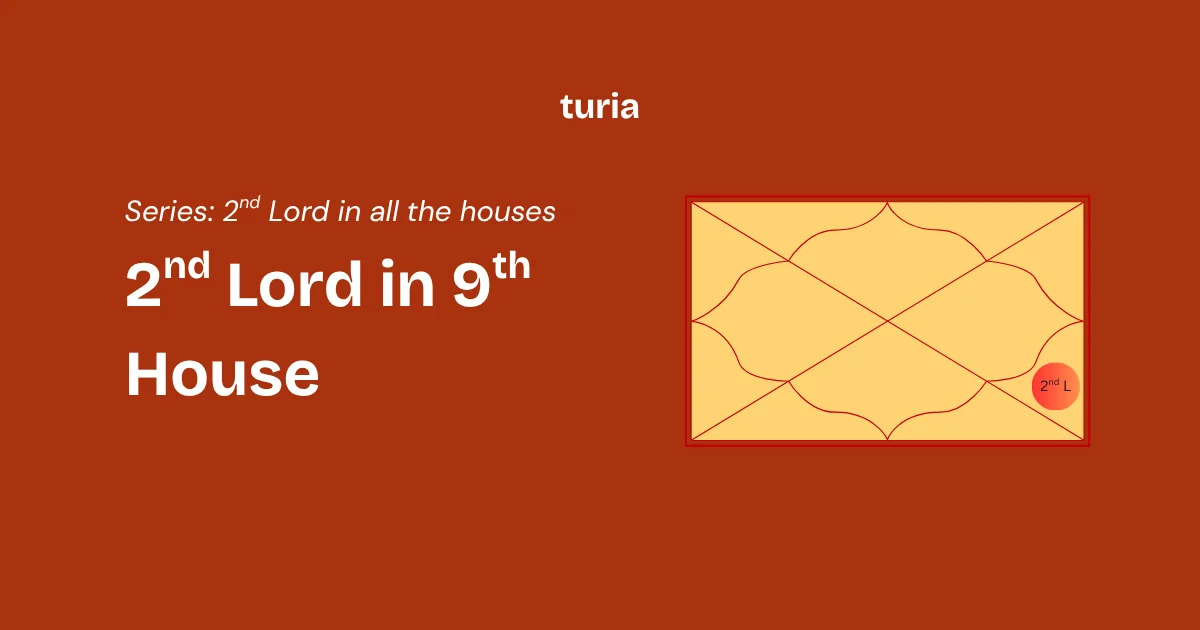
Here's the clarity worth starting with. The 2nd lord rules your 2nd house — Dhana Bhava, the house of wealth, family, speech, and accumulated values. Where that planet sits shows you where your money and family instincts get expressed most strongly. When it lands in the 9th house — Dharma Bhava, the house of fortune, father, faith, and higher learning — your wealth and family life become entangled with luck and something larger than personal effort. It's one of the reasons this placement shows up on almost every "good for wealth" list in Vedic astrology, and honestly… for once, that reputation holds up reasonably well.
This is one of twelve articles in our series on where the 2nd lord can sit. In this guide, we'll cover what this placement actually means, what the classical texts say about wealth and fortune combining, the father and family angle, career directions, what strength changes, and how it compares to a few other placements in the series.
Quick answer
2nd Lord in the 9th house means the planet ruling your wealth, speech, and family (Dhana Bhava) sits in Dharma Bhava — the house of fortune, father, faith, and higher learning. BPHS (Ch. 24, Sloka 21) states this makes the native "wealthy, diligent, skilful... and will later on be happy and will visit shrines, observing religious code." Because the 9th is one of the three Trikona (trine) houses — the most auspicious classification in Parashari astrology — this placement is widely read as wealth arriving through fortune, education, father's support, or long-distance connections, rather than through effort alone. Expect a prosperous or supportive father, ethical and persuasive speech, and career pulls toward law, teaching, publishing, or travel-linked work. As with every placement in this series, the specific planet, its dignity, and any affliction decide how fully these results actually show up.
What "2nd Lord in the 9th House" Actually Means
Your Dhana Bhava, the 2nd house, governs wealth, accumulated resources, family (kutumba), speech (vak), food habits, and the values you carry into adulthood. The Dhanesh, or 2nd lord, is the planet ruling this house from your ascendant. Wherever it physically sits in your kundali tells you where your relationship with money and family finds its strongest expression.
The 9th house is Dharma Bhava — the house of righteousness, fortune, father, one's guru, higher learning, and long-distance travel. Classical texts group the 1st, 5th, and 9th houses together as Trikona (trine) houses, the single most auspicious classification in Parashari astrology:
"Putr and Dharm Bhava are known by the name Kon (or trine)." — BPHS, Ch. 6, Sloka 33-36
Unlike the lagna lord — itself the ruler of a trikona house — the 2nd lord doesn't carry trikona status on its own. The 2nd house is neither a Kendra (angle) nor a Trikona house by classification. So this placement's strength works differently from, say, "lagna lord in 9th house": it isn't a trikona lord doubling down in another trikona. It's a wealth-and-family significator landing inside the chart's strongest fortune house, borrowing some of that auspiciousness for money matters.
BPHS states the core result directly, in the same sequence of verses used to describe the 2nd lord's placement in each of the 12 houses:
"If Dhan's Lord is in Dharm Bhava, the native will be wealthy, diligent, skilful, sick during childhood and will later on be happy and will visit shrines, observing religious code etc." — BPHS, Ch. 24, Sloka 21
That "sick during childhood" clause is worth pausing on. Classical texts rarely hand out an unqualified blessing — even this well-regarded placement comes with an early-life caveat before the wealth and happiness settle in during adulthood.
One quick clarification, because the mix-up is common: this article is about the 2nd lord landing in the 9th house. That's a different placement from the 9th house's own lord sitting in the 2nd house — a related but reversed question, and one several astrology sites publish right next to this one. If what you found online talks about "9th lord in 2nd house" or the 9th lord's movement through the 12 houses generally, that's the other side of this coin, not this placement.
Wealth Through Fortune — The Core of This Placement
This is usually the first thing said about this placement, and it's grounded in more than one classical source.
The 9th house's core signification is Bhagya — fortune, in the sense of unearned support, good timing, and doors opening without a direct push. When your 2nd lord — your money and family significator — sits here, wealth stops being purely a function of salary or savings discipline. It starts flowing through channels like education, a supportive father, or a lucky break.
BPHS carries a second, quietly powerful citation for this exact combination — a mutual exchange (parivartana) between the 2nd and 9th lords:
"Fortunes etc. Acquisition of fortunes, conveyances and fame will follow the 32nd year of age, if Dharm's Lord is in Dhan, while Dhan's Lord is in Dharm." — BPHS, Ch. 20, Sloka 10
This is a genuinely strong citation most SERP content on this placement skips entirely. When the 2nd lord sits in the 9th and the 9th lord sits in the 2nd — a full exchange, not just a one-way placement — BPHS names an approximate activation window: fortune, vehicles, and reputation arriving after the 32nd year. Even without the full exchange, the underlying logic holds: this is money that tends to compound with age rather than arrive early and fast.
Phaladeepika adds a related, independent wealth combination — Dhenu Yoga, formed when the 2nd house and its lord are simply strong and undamaged, regardless of which house the lord sits in:
"If the 2nd house is occupied or aspected by benefic planet and the lord of 2nd house not being combust is posited in an auspicious house in his sign of exaltation or in his own sign, the resulting Yoga is Dhenu Yoga, the person born with this yoga will be well equipped with gold, wealth, grains, and precious stones, and will be equal to king of kings." — Phaladeepika, Ch. 6 ("Yogas")
Read together, the pattern holds: a 2nd lord that's undamaged and sitting in "an auspicious house" — which the 9th certainly qualifies as — tends to produce real, lasting wealth. Translate the imagery for today: the person whose father quietly funds their first business attempt, or whose postgraduate degree abroad becomes the actual turning point in their finances. That's Dhana meeting Bhagya.
Father, Family, and Inherited Fortune
Because the 2nd house governs family and the 9th governs father, this placement often makes the father figure genuinely central to the native's financial story — not necessarily through direct inheritance, but through guidance, values, or quiet backing at the right moment.
BPHS's Dharma Bhava chapter lays out the conditions that shape how supportive the father actually is, and it's worth reading both sides:
"Fortunate (Affluent) Father. If Dharm's Lord is with strength, as Śukr is in Dharm, while Guru is in an angle from Tanu Bhava, the native's father is fortunate." — BPHS, Ch. 20, Sloka 3
"Indigent Father. If Dharm's Lord is debilitated, while the 2nd and/or the 4th from Dharm Bhava is occupied by Mangal, the native's father is poor." — BPHS, Ch. 20, Sloka 4
Notice that Sloka 4 specifically brings in the 2nd house counted from the 9th — a structural echo of the exact 2nd-9th relationship this article covers, even in a verse not directly describing this placement. The takeaway: a 2nd lord in the 9th tends to weave family fortune and father's condition together, but whether that weave produces support or strain depends on how well the 9th house itself is held.
One small classical footnote: some Northern-tradition astrologers examine father from the 10th house instead of the 9th, since the 10th is "7th from the 4th" (the house of mother). Phaladeepika ties father to the 9th because it's "5th from 5th" — five houses from progeny. Worth knowing the variance exists; it rarely changes the reading in practice, since most working astrologers lean on the 9th house first.
Career Directions and Speech
The 2nd house also governs speech — how persuasively, honestly, and fluently a person communicates. Phaladeepika lists this directly among the 2nd house's core significations:
"The second house deals with Vitta (wealth), Vidya (learning)... Speech (Vak) and Kutumba (family)." — Phaladeepika, Ch. 2, Verse 10
Pair that with the 9th house's own signification — "preceptor (guru), deity (devta), father... worship, penance, virtuous act" (Phaladeepika, Ch. 2, Verse 14) — and it's easy to see why speech touched by the 2nd lord in the 9th tends to pick up a dharmic, teaching-oriented quality rather than a purely persuasive or sales-driven one.
This shows up in career choices. Current web coverage of this placement consistently flags professions like teaching, law, publishing, religious or spiritual work, higher education, and anything tied to long-distance travel — import-export, foreign consulting, travel agencies. The common thread: money earned through knowledge, ethics, or distance rather than a straightforward transactional trade.
Think of the person who becomes a respected professor and is quietly better off financially than peers in "safer" careers, or the lawyer whose reputation for straight dealing becomes their client base. That's a fairly ordinary expression of this placement — wealth built on credibility rather than hustle.
Strength Considerations: What Actually Changes the Outcome
As with every placement in this series, the house tells you where — the planet's own condition tells you how well.
- Exalted or own-sign 2nd lord in the 9th: One of the stronger combinations for lasting, respected wealth in the series — it satisfies the Dhenu Yoga condition directly.
- 2nd lord in exchange (parivartana) with the 9th lord: The strongest version of this placement. BPHS names an approximate activation age — fortune and fame arriving after the 32nd year (Ch. 20, Sloka 10).
- Debilitated or combust 2nd lord in the 9th: The generosity gets muted, and BPHS's own "sick during childhood" clause (Ch. 24, Sloka 21) becomes more literal — early-life setbacks before things settle later.
- Conjunct or aspected by natural benefics (Jupiter, Venus, unafflicted Mercury): The most generous form — genuine fortune, a supportive father, real financial stability.
- 2nd lord in the 9th also connecting with the 7th lord: Worth flagging honestly, since current coverage links this combination to a more materialistic approach to marriage or added friction. Not a fear-based warning — a conditional worth a proper chart reading.
- Same planet ruling both the 2nd and 9th houses (a dual-rulership case for certain ascendants): Less a separate placement than an intensified version — wealth and fortune are already fused at the rulership level.
The single rule worth repeating across this entire series: never judge a placement from the house alone. Check the sign, the planet's dignity, its aspects, and the dasha periods that activate it.
How 2nd Lord in the 9th Compares to Other Placements
Since money and fortune show up differently depending on which house the 2nd lord actually lands in, here's how this placement stacks up against a few others in the series.
| 2nd Lord In | Core Flavour |
|---|---|
| 1st House | Wealth tied closely to personal identity and self-effort |
| 4th House | Wealth through property, home, vehicles, and emotional roots |
| 7th House | Wealth through partnership, marriage, or business collaboration |
| 9th House | Wealth through fortune, father, dharma, and higher learning |
| 10th House | Wealth through career, public reputation, and professional standing |
| 11th House | Wealth through networks, gains, and long-term accumulation |
| 12th House | Wealth that dissolves easily, or arrives through foreign/spiritual channels |
Compared to the 11th house — the other strong "gains" placement in this series — the 9th leans toward wealth earned through grace, ethics, or a father's backing, while the 11th leans toward wealth built through networks and sustained gain-seeking. Compared to the 10th, the 9th's wealth is less about career status and more about the quieter support of fortune and family. And compared to the 12th house — where resources tend to dissolve or flow outward — the 9th is close to the opposite: resources that consolidate and grow, provided the house isn't afflicted.
FAQs
What does it mean when the 2nd lord is in the 9th house?
It means the planet ruling your wealth, speech, and family (2nd house) sits in Dharma Bhava, the house of fortune, father, and higher learning. BPHS (Ch. 24, Sloka 21) ties this to being wealthy, diligent, skilful, and eventually happy after an early-life health caveat. It's a strong wealth placement in the 2nd-lord series, since the 9th is one of the three trikona houses.
Is 2nd lord in 9th house the same as 9th lord in 2nd house?
No, and this is a common mix-up — several astrology sites even publish both articles side by side. This piece covers the 2nd lord (ruler of wealth and family) sitting in the 9th house. "9th lord in 2nd house" describes the reverse: the 9th house's own ruling planet placed in your 2nd house. They're related but technically distinct placements.
Does this placement guarantee wealth?
Not automatically. BPHS's own verse includes a "sick during childhood" clause before the wealth and happiness settle in — a reminder that even auspicious placements aren't unconditional. Dignity, affliction, aspects, and dasha timing decide how much of the wealth potential actually materializes.
Does 2nd lord in 9th house mean a rich or supportive father?
Usually, yes, since the 9th house is the primary house for father. But BPHS is specific that this depends on how strong and unafflicted the 9th house itself is (Ch. 20, Slokas 3-4) — a weak or afflicted 9th house can mean the opposite, a father who struggles financially rather than one who supports the native.
What if the 2nd lord and 9th lord are the same planet?
This happens for certain ascendants and isn't a separate placement so much as an intensified version of the same theme — wealth and fortune significations are fused at the rulership level even before you look at where that shared planet actually sits in the chart. It generally strengthens the connection between money and luck rather than complicating it.
Is 2nd lord in 9th house good for marriage?
Mostly neutral to positive, but worth a real caveat: if the 2nd lord in the 9th also connects with the 7th house lord, some classical-adjacent readings flag a more materialistic approach to marriage or added friction. This isn't automatic — it depends on the specific chart, not the house placement alone.
Is this placement a Dhana Yoga?
It can contribute to one. Phaladeepika's Dhenu Yoga forms when an undamaged 2nd lord sits in an auspicious house — which the 9th qualifies as — and a related passage names the 2nd, 9th, and 11th house lords together as part of a larger wealth-and-power combination. The placement alone is a strong foundation; the planet's own dignity decides how far it goes.
Closing Thoughts
So if someone asks, "Is 2nd lord in the 9th house a good placement for money?" — the honest answer, same as every other placement in this series, is: it depends on dignity, affliction, and what else touches the 2nd lord. But the pattern most charts with this placement share is real — wealth and family security that lean on something larger than personal hustle: a father's quiet support, an education that opens doors, or simply a run of financial timing that works out more often than not.
That's not luck in the shallow sense. That's Dhana meeting Bhagya — wealth finding its way home through fortune.