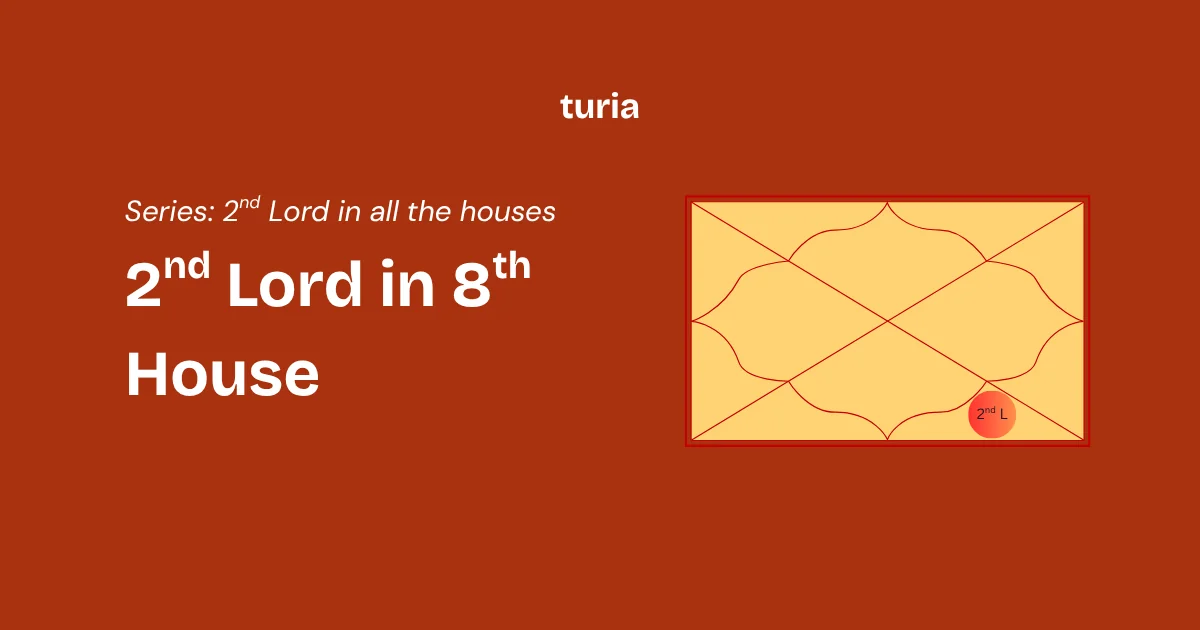
Someone recently described their own chart on an astrology forum — Venus as 2nd lord sitting in the 8th house, conjunct Saturn — and asked one question: "Am I doomed for life?"
That's usually the emotional starting point for this placement.
"Will I lose money suddenly? Will something happen to my family? Is my wealth cursed?"
Most of that fear comes from blogs that lead with "financial ruin" and "family conflict" in the headline, without explaining what actually decides the outcome.
And honestly… the classical texts themselves tell a more layered story than that.
The 2nd house — Dhana Bhava — rules your wealth, your family, your speech, and the values you accumulate over a lifetime. The 8th house — Randhra Bhava — rules sudden events, transformation, inheritance, in-laws' wealth, and the hidden and occult. When the 2nd lord, the planet in charge of your own money and family, sits inside the 8th house, your wealth story gets tied directly to the sudden and the unseen. Brihat Parashara Hora Shastra's own verse on this exact placement opens with abundant land and wealth — before it ever mentions a caveat. That's not the tone most SERP content uses.
This is the eighth article in our 12-part series on where the 2nd lord sits in each house. In this guide, we'll cover what classical texts actually say, the real pattern around sudden gains and losses, the honest answer to the "does this mean death in the family" question, the occult and research angle this placement is known for, how strength changes everything, and how it compares to a couple of other wealth-related placements in the series.
Quick answer
When your 2nd lord (the ruler of wealth, family, and speech) sits in the 8th house, your financial story gets tied to sudden events, inheritance, in-laws' wealth, and transformation rather than steady, self-earned accumulation. BPHS (Ch. 24.20) says this placement gives "abundant land and wealth" but "limited marital felicity" — both halves matter. Wealth here tends to arrive through other people's resources (inheritance, spouse's family, insurance, settlements) and can leave just as suddenly as it comes. It is not a curse on your family, despite the fear-heavy framing online — but it is a placement that rewards a strong, well-supported 2nd lord and asks more caution of a weak, afflicted one.
What "2nd lord in the 8th house" actually means
Quick terms first, so the rest of this makes sense:
| Term | Meaning |
|---|---|
| 2nd house (Dhana Bhava) | The house of wealth, family, speech, accumulated values, food, and the face/right eye. |
| 2nd Lord (Dhanesh) | The planet ruling your 2nd house sign — governs how you earn, hold, and speak about money and family. |
| 8th house (Randhra Bhava) | The house of longevity, transformation, sudden events, inheritance, in-laws' wealth, and hidden or occult knowledge. |
| Dusthana | A classical grouping of the 6th, 8th, and 12th houses — considered inherently difficult houses, tied to struggle, loss, or dissolution. |
So when your 2nd lord — the planet handling your money, your family ties, and your speech — physically sits inside your 8th house, all three of those areas get pulled toward 8th-house territory. Mantreswara's Phaladeepika defines the 2nd house's own scope plainly: "The second house deals with Vitta (wealth), Vidya (learning)... the right eye, face (Asya), letter or document (Patrika), Speech (Vak) and Kutumba (family)" (Phaladeepika, Ch. 1, Sloka 10). And the 8th house's territory: "Mangalya... Randhra, filthiness, mental pain, defeat or humiliation, longevity, sorrow, blame, death, impurity, impediments and slavery" (Phaladeepika, Ch. 1, Sloka 14). One house governs your bank balance and your dinner table conversations; the other governs sudden change and what's inherited from the dead. Put your 2nd lord in the second one, and your wealth stops being predictable — it becomes eventful.
Wealth, inheritance, and in-laws' money — what classical texts actually say
Here's where it gets genuinely interesting, because BPHS itself holds two readings side by side.
"If Dhan's Lord is in Randhr Bhava, the native will be endowed with abundant land and wealth. But he will have limited marital felicity and be bereft of happiness from his elder brother." (BPHS, Ch. 24, Sloka 20)
Read that again. The verse leads with abundant land and wealth — not loss, not ruin. The caveats that follow are specific: marital felicity, and happiness from an elder sibling. Not a blanket financial curse.
But a few chapters earlier, in the dedicated chapter on Dhan Bhava, BPHS says something that looks like the opposite:
"If the Lord of Dhan is in Dhan, or is in an angle, or in trine, he will promote one's wealth. Should he be in Ari/8th/12th, financial conditions will decline." (BPHS, Ch. 13, Sloka 1-2)
Two verses, two different tones — and that's not a contradiction so much as two different channels. Ch. 24.20 is describing wealth that arrives through the 8th house's own domain: inheritance, land, in-laws' resources, insurance, sudden windfalls. Ch. 13.1-2 is describing the steadier, self-earned kind of accumulation most people picture when they think "wealthy" — and that channel does genuinely strain when the 2nd lord sits in a Dusthana. Both are true at once. This placement rarely gives you slow, boring, compounding savings. It gives you eventful money — sometimes a lot of it, arriving through someone else's hands.
That's the classical root of what modern astrologers describe consistently: gains through a spouse's family, inheritance from parents or grandparents, insurance payouts, or a sudden financial turning point tied to a life transition — a family property settlement, a marriage that brings in resources, a windfall connected to someone else's crisis or passing.
The volatility pattern — why "it depends" is the honest answer
This is the part fear-based content skips, and it's also the part honest astrology can't skip.
The 8th house doesn't deal in "slow and steady." It deals in the sudden and the significant — for better or worse. A 2nd lord placed here tends to produce a financial life with real peaks and real dips, rather than a flat, predictable line. Money can arrive in a lump — an inheritance, a settlement, a spouse's family stepping in generously — and it can also leave quickly if it isn't managed with intention.
Think of it less like a steady salary and more like a family orchard that fruits unpredictably: some years, an unexpected harvest; other years, nothing, and you have to plan around that unevenness rather than pretend it isn't there.
This is also why several modern astrologers note that inheritance or insurance money through this placement "doesn't always stay" the way patiently built savings does. That's not a curse — it's a pattern worth planning around. A person with this placement genuinely benefits from treating windfalls differently than salary: parking them, not spending them at the speed they arrived.
Family, speech, and the "does this mean death" question
This is the single biggest source of anxiety around this placement, so let's deal with it directly and calmly.
The 2nd house is classically named a Marak Bhava — a "killer house" in the technical, dasha-timing sense used by Jyotish for longevity analysis:
"Sahaj and Randhr Bhava are the two Bhavas of longevity. The Bhavas, related to death, are the 12th from each of these, i.e. Dhan and Yuvati Bhava are Marak Bhavas. Out of the two, Dhan Bhava is a powerful Marak Bhava." (BPHS, Ch. 44, Sloka 2-5)
Here's the important part almost no fear-driven blog explains: this is a structural feature of every single kundali, not something this specific placement invents. Your 2nd lord carries Maraka significance no matter which house it sits in. Whether its dasha period actually coincides with a difficult health event for anyone depends on a convergence of multiple weak factors across the whole chart — not on this one placement in isolation. Putting the 2nd lord in the 8th house adds transformation and sudden-event flavor to its dasha periods. It does not manufacture a family curse that wasn't already a structural possibility in every chart.
On speech: BPHS notes that "If Dhan Bhava and its Lord are yuti with malefics, the native will be a talebearer, will speak untruth" (BPHS, Ch. 13, Sloka 13) — and modern astrologers commonly describe this placement's speech as intense, probing, even blunt when afflicted. But notice the condition: yuti with malefics. An unafflicted 2nd lord here more often produces the opposite — a magnetic, direct way of speaking that people find compelling rather than hurtful.
Family relationships, similarly, can run more intense or private with this placement — conversations about money that happen behind closed doors, an inheritance dispute worked through quietly, or a genuinely close bond forged through going through something difficult together as a family. Which version shows up comes back, again, to strength.
Occult, research, and the deeper pull
This is the placement's quieter reward, and it's a real, recurring pattern — not filler.
The 8th house rules hidden knowledge, and a 2nd lord placed here often develops a genuine interest in subjects that make most people uncomfortable: death, inheritance law, the subconscious, insurance risk, or astrology itself. If someone in your family handles a difficult subject calmly — settling an estate, researching a family history quietly, or genuinely finding astrology or psychology fascinating rather than eerie — this placement is a common signature behind it.
Careers that suit this energy: insurance and actuarial work, tax and audit, estate and inheritance law, research (scientific or academic), psychology, astrology, and any field built around handling other people's resources or crises with a level head.
Strength considerations — what actually changes the story
If there's one section worth remembering, it's this one.
Exaltation and own sign. A 2nd lord exalted or in its own sign in the 8th house behaves very differently from a debilitated one — practising astrologers consistently note that dignity here tips outcomes strongly toward the "abundant wealth" half of BPHS Ch. 24.20 rather than the volatility half.
Benefic aspects and conjunctions. A benefic's Drishti (aspect) — Jupiter, an unafflicted Moon, or Venus — on the 2nd lord in the 8th house softens the harder edges considerably: steadier speech, warmer family ties, more reliably positive inheritance outcomes. A malefic conjunction, especially with Saturn, Mars, Rahu, or Ketu, intensifies the volatility and the blunter speech pattern.
Planet-specific texture. Which planet actually rules your 2nd house changes the flavor. Modern astrologers frequently note, for instance, that Jupiter as 2nd lord in the 8th tends to read as generous, wealthy in-laws and a comfortable married life; Saturn in the same placement tends to read as a colder or slower-warming relationship with in-laws' resources, with benefits arriving later but more durably; Mars can add more friction into shared finances within a marriage. These are patterns worth checking against your specific chart, not fixed rules.
The dual-lordship case. For a handful of ascendants, the 2nd lord also happens to rule the 6th, 8th, or 12th house by sign lordship. When that overlap exists, the mechanics shift — the 2nd lord's dasha carries a stronger dusthana signature regardless of house placement, and it's worth a dedicated chart reading rather than a blanket rule.
Dasha timing. Even a well-placed 2nd lord in the 8th house shows its sharper, more sudden financial themes more visibly during its own Mahadasha or Antardasha — and its steadier gains (through inheritance settling, or occult/research work maturing) tend to surface more during supportive periods elsewhere in the chart.
How this compares to other wealth placements in the series
Since this is part of our 12-house series, here's how the 8th house placement sits relative to two other wealth-related houses already covered.
| Placement | Core wealth pattern | Typical financial texture |
|---|---|---|
| 2nd lord in 2nd house | Own-sign strength, steady accumulation — Dhenu Yoga territory when well-placed | Predictable — savings that compound quietly over time |
| 2nd lord in 8th house | Wealth through others — inheritance, in-laws, insurance, sudden turning points | Eventful — real peaks, real dips, money that needs active management |
| 2nd lord in 11th house | Gains through networks, income streams, a genuine Dhana Yoga trigger with the 11th lord | Expansive — multiple income sources, wealth that grows through connections |
The 2nd lord in its own house rewards patience. The 2nd lord in the 11th rewards networking and multiple streams. The 2nd lord in the 8th rewards something different entirely — the ability to receive well, hold steady through sudden change, and not panic when money behaves unpredictably. None of these are better or worse in any final sense. They're just different relationships with money, and the 8th house version asks for more emotional steadiness than the other two.
FAQ
Is 2nd lord in 8th house good or bad for wealth?
Neither, by itself. BPHS Ch. 24.20 leads with "abundant land and wealth" before mentioning caveats — but BPHS Ch. 13.1-2 also notes financial conditions can decline when the 2nd lord sits in a Dusthana. Both are true: this placement tends to trade steady, self-earned savings for eventful wealth through inheritance, in-laws, or sudden turning points.
Does 2nd lord in 8th house mean death in the family?
No, not on its own. The 2nd house is classically a Marak Bhava (BPHS Ch. 44) in every chart, regardless of where the 2nd lord sits — this placement adds sudden-event flavor to its dasha periods but doesn't create a family curse that wasn't already a structural feature of the chart.
Can this placement bring inheritance or in-laws' wealth?
Yes, this is one of its most consistent themes, both classically and in modern practice. A reasonably strong 2nd lord here often supports inheritance from family, a generous or supportive in-law relationship, insurance gains, or a sudden financial turning point tied to marriage or family transition.
Does this placement make speech intense or blunt?
It can, particularly when the 2nd lord is afflicted by malefics (BPHS Ch. 13.13 ties untruthful, sharp speech specifically to malefic conjunction). An unafflicted 2nd lord here more often produces direct, magnetic speech that people find compelling rather than hurtful.
What if the 2nd lord is exalted in the 8th house?
Exaltation or own-sign dignity meaningfully improves outcomes — wealth themes lean toward the "abundant" half of BPHS Ch. 24.20, family relationships run warmer, and speech stays measured rather than blunt. Benefic aspects add further support.
Does this placement give occult or research ability?
Commonly, yes. A 2nd lord in the 8th house often produces a genuine, calm interest in subjects like inheritance law, research, psychology, insurance, or astrology itself — fields built around handling other people's resources or difficult subjects without flinching.
Why does wealth from this placement sometimes not stay?
Because 8th-house gains tend to arrive suddenly rather than compound gradually — inheritance, insurance, or windfalls don't behave like patiently built savings. The honest approach is to treat windfalls differently than regular income: park them rather than spend them at the speed they arrived.
The honest takeaway
So if someone asks you, "Is 2nd lord in 8th house bad?" — the honest answer is: it depends on strength, and it depends on which channel of wealth you're measuring.
A weak, afflicted 2nd lord here can genuinely mean real financial volatility, tense family conversations about money, and speech that lands harder than intended. That's real, and no article should talk you out of taking it seriously.
But a strong 2nd lord in the 8th house is one of the more quietly generous placements in the chart for wealth through others — inheritance that actually arrives, in-laws who genuinely help, a mind drawn naturally to research or the occult. It trades the predictability of a 2nd lord in its own house for something less steady but often larger. It just asks you to manage what arrives with a little more intention than a straight salary would.