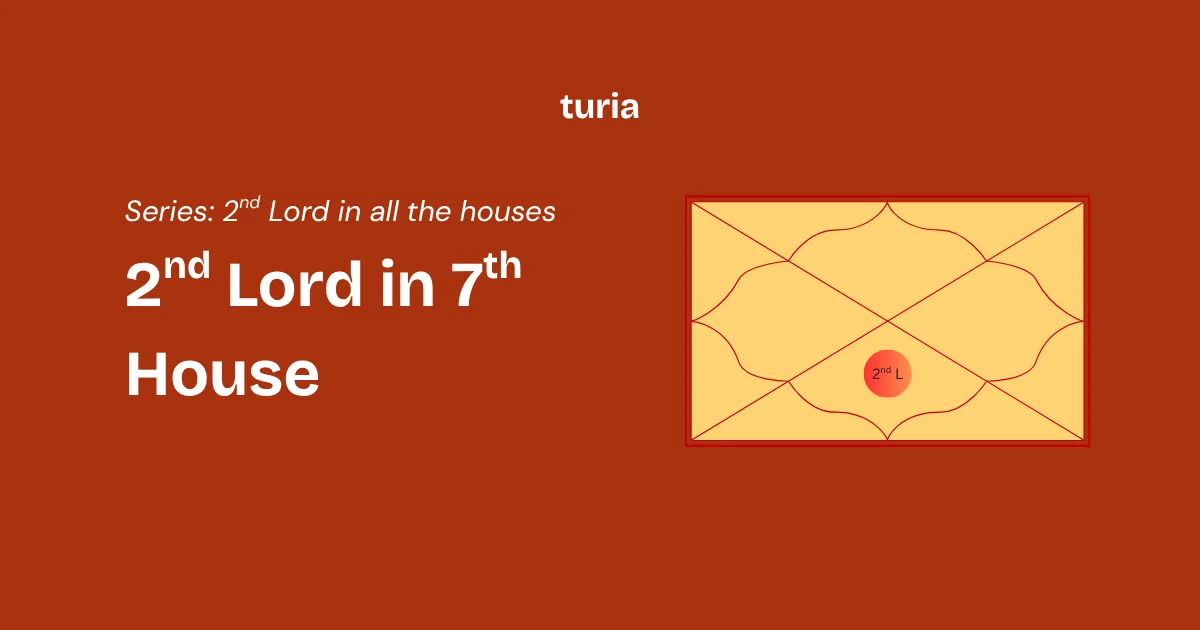
Ask around and you'll hear the same line about this placement over and over: "2nd lord in the 7th house means you'll get rich through your spouse."
It's repeated across so many astrology blogs that it's started to sound like settled fact. Match-making forums bring it up. Family astrologers mention it in the same breath as dowry and in-laws.
Here's the thing, though — that's only part of the picture, and honestly, it's the easier part to say out loud.
The classical texts read this placement with more nuance than "marry well, get rich." There's a genuine wealth-and-partnership thread running through it, yes. But there's also a caution classical Jyotish attaches to this exact combination that most modern posts skip entirely. In this guide, we'll unpack what the 2nd lord in the 7th house actually means for money, marriage, and business — what Brihat Parashara Hora Shastra (BPHS) and Phaladeepika say word for word, and how it compares to the 2nd lord sitting elsewhere in the chart, since this is part of a 12-house series.
Quick answer
When the 2nd lord (ruler of Dhana Bhava, the house of wealth, family, and speech) sits in the 7th house (Yuvati Bhava, the house of marriage and partnership), your wealth and your relationships become tightly linked. Modern practice reads this as money arriving through marriage, in-laws, or business partnership, and a real talent for negotiation and deal-making. Classical BPHS is more cautious — its own sloga for this placement flags a restless, wandering theme, sharpening into concerns about the spouse under affliction. Both 2nd and 7th are also classical Maraka (life-shortening) houses, so this placement is traditionally read as wealth-positive but worth a closer look at health and longevity, not a blanket "marry rich" promise.
What "2nd Lord in the 7th House" Actually Means
Let's define the pieces first, so nothing here feels like guesswork.
Dhana Bhava, the 2nd house, is the house of accumulated wealth — savings, family, food habits, and speech. It also governs the face, and how you're perceived when you speak.
2nd lord (or Dhanesh) is the planet that rules whichever sign falls in your 2nd house. If your 2nd house is Cancer, your 2nd lord is the Moon. If it's Capricorn, it's Saturn. This planet is treated in Jyotish as the caretaker of your wealth and your family line — wherever it sits, that's where your resources and your values get pulled toward.
Yuvati Bhava, the 7th house, is the house of marriage, spouse, business partnerships, contracts, and public dealing. Where the 1st house is "you," the 7th house is "the other" — spouse, business partner, client, the person across the table in any formal dealing.
So when your 2nd lord — the caretaker of your wealth — physically sits inside the house of "the other," your finances get tied to your relationships. That's the plain-language version every source, classical and modern, agrees on. What they disagree on is exactly how.
Effects on Wealth: Money Through Spouse and Partnership
This is the part almost every modern astrology blog leads with, and there's genuine classical backing for it — just not from the sloka you'd expect.
Mantreswara's Phaladeepika lists 28 "Maha Yogas" — great yogas — formed when two house lords sit in each other's houses, a mutual exchange called Parivartana Yoga. Tenth on that list: "the lord of the 2nd in the 7th and the lord of the 7th in the 2nd." When both halves are true — your 2nd lord in the 7th and your 7th lord in the 2nd — classical Jyotish treats it as a named wealth-and-status combination, not a loose guess. Phaladeepika describes the general effect of a Maha Yoga plainly: "he will be adorned with expensive and beautiful clothes and ornaments… will be blessed with sons and fully enjoy wealth and conveyances."
That's a real, named classical citation — but notice the condition. It's the exchange, both directions at once, that earns this description. The simple one-directional placement — just your 2nd lord sitting in the 7th, without the reciprocal exchange — carries a different, more specific classical reading, which we'll get to in a moment.
In everyday terms, modern astrologers translate the wealth theme like this: your financial picture noticeably shifts after marriage — sometimes because your spouse contributes income or brings family resources into the picture, sometimes because you end up building wealth with someone, through a business partnership rather than solo. Think of a chartered accountant who was breaking even working alone, then doubled income the year they brought in a partner and split the client load. That's the placement in action — money that grows specifically through partnership, not despite it.
Effects on Marriage and Spouse
Now for the part BPHS actually addresses directly — and it's more layered than "you'll marry rich."
Brihat Parashara Hora Shastra, in Chapter 24 ("Effects of the Bhava Lords"), gives this specific sloka for the 2nd lord in Yuvati Bhava:
"If Dhan's Lord is in Yuvati Bhava, the native will be addicted to others' wives and he will be a doctor. If a malefic is related to the said placement by yuti with Dhan's Lord, or by Drishti, the native's wife will be of questionable character." — BPHS, Ch. 24, verse 19
Read that carefully, because it isn't the "wealthy in-laws" story most blogs tell. Parashara's base-case reading points to restlessness — a wandering attention in relationships — alongside, interestingly, a recurring association with the medical profession. The sharper warning about the spouse only applies specifically when the placement is afflicted (a malefic conjunct or aspecting).
Frankly, this is a sloka that reads starkly by modern standards, and it shouldn't be taken as a life sentence. Classical texts often speak in absolutes that astrologers today weigh against the planet's strength, its sign, its aspects, and the rest of the chart — not read as a standalone verdict. But it's worth quoting honestly rather than smoothing it into a generic "good for marriage" line, because that's what the source actually says, and it's a more useful caution than most SEO posts give you credit for.
The honest synthesis: this placement makes marriage and money genuinely interdependent for you. Whether that interdependence plays out as prosperity or as restlessness depends heavily on the 2nd lord's strength and the company it keeps — same as every placement in this series.
Business Partnerships and Negotiation Skill
The 7th house isn't only about marriage — it's the house of any formal one-on-one dealing. Contracts. Clients. Trade.
That's why this placement shows up often in the charts of people who are naturally good at deal-making — negotiating a price, structuring a partnership agreement, closing a sale. The 2nd house governs speech, and when its lord sits in the house of "the other," that speech gets aimed directly at persuasion and negotiation with people you're doing business with.
This lines up with the wealth-yoga tradition too. General Dhana Yoga literature lists the 2nd–7th exchange among the recognised wealth-giving parivartana pairs — reinforcing that wealth built through relationships, not around them, is the throughline here, whether you're reading the classical Maha Yoga or the modern business-partnership gloss.
A practical example, Indian-context: a native running a small trading business alone, stuck at a modest turnover for years, who brings in a partner — a spouse, a brother-in-law, a childhood friend — and the business genuinely scales after that. Astrologers reading this placement would point to exactly this kind of story as its signature.
The Maraka Caveat: Why This Placement Needs a Closer Look
Here's the part almost no SEO blog mentions, and it's genuinely useful to know.
BPHS, in Chapter 44 ("Marak Grahas"), lays out which houses are classically considered Maraka — literally, "killer" houses, tied to longevity analysis:
"Dhan and Yuvati Bhava are Marak Bhavas... Out of the two, Dhan Bhava is a powerful Marak Bhava. The Lords of Dhan and Yuvati Bhava... are all known as Marakas." — BPHS, Ch. 44, sloka 2-3
In plain terms: the 2nd and 7th houses are the two primary Maraka houses in Jyotish, and their lords are named Marakas outright. So when the lord of one Maraka house (2nd) sits directly inside the other Maraka house (7th), that's not a red flag exactly — but it is a placement classical astrologers give a second look, specifically around health and longevity themes during that planet's dasha (planetary period), rather than treating the placement purely as a wealth bonus.
This isn't meant to worry anyone. Maraka status is a normal, routine part of longevity analysis in every single chart — everyone has 2nd and 7th house lords somewhere, and Maraka significance is about how it's read during a dasha, not a standalone doom clause. It's simply the honest counterweight to the "guaranteed wealth through marriage" framing: this placement ties money and relationships together strongly, and it also asks for the same closer look at strength and affliction that any Maraka-linked placement deserves.
Strength and Affliction: What Actually Changes the Outcome
Since the whole placement swings on strength, here's what astrologers actually check before reading it either way:
- Is the 2nd lord exalted, in its own sign, or in a friendly sign in the 7th house? That leans the reading positive — genuine wealth through partnership, a capable, resourceful spouse.
- Is it debilitated, combust, or in an enemy sign? That leans toward the restless branch BPHS describes — financial instability tied to relationship friction, or the spouse-related caution under affliction.
- Is it aspected by natural benefics (Jupiter, Venus, a well-placed Mercury) or malefics (Saturn, Mars, Rahu/Ketu)? Benefic aspects support the wealth-and-partnership story; malefic aspects sharpen the more cautionary branch.
- What's the dasha running? Many people carry this placement quietly for years and feel its full effect specifically during the 2nd lord's own mahadasha or antardasha — that's typically when marriage, a major financial shift, or a business partnership actually activates.
This is the same principle running through every placement in this series — the house tells you where the story plays out; strength tells you how.
The Classical View: A Parivartana Yoga Worth Knowing
We touched on this earlier, but it deserves its own space because it's the strongest classical citation for the positive branch of this placement.
When your 2nd lord sits in the 7th house and your 7th lord sits back in the 2nd house — a genuine mutual exchange — Phaladeepika names it explicitly as Maha Yoga #10 out of 28. That's not a minor footnote. Mantreswara treats these Maha Yogas as genuinely status-giving combinations, on par with the more famous Raja Yogas readers ask astrologers about.
One honesty note worth keeping in mind: this stronger reading only applies when both directions are true — the reciprocal exchange, not just your 2nd lord sitting in the 7th on its own. It's a common mix-up (Quora threads on this exact placement show readers asking about both directions in the same breath) — worth checking your own kundali carefully before assuming you have the full Maha Yoga rather than the simple placement.
Comparison: 2nd Lord in the 7th House vs. Other Houses
Since this placement is one of twelve in the series, here's how it sits next to a couple of others for quick reference.
| Placement | Core theme | Classical framing |
|---|---|---|
| 2nd lord in 1st house | Wealth and family identity merge with the self; wealth felt as personal identity | Wealth tends to build steadily around the native's own effort and presence |
| 2nd lord in 7th house | Wealth expressed through spouse, partners, and business dealing | Outcome forks on strength — restlessness/caution per BPHS Ch. 24 v.19, or Maha Yoga status if the exchange is mutual |
| 2nd lord in 11th house | Wealth expressed through gains, networks, and larger circles | Read as one of the strongest classical Dhana Yoga placements for steady income growth |
The pattern across the series: wherever the 2nd lord sits, that house becomes the arena where your wealth and your values actually get expressed. In the 7th house, that arena is other people — spouse, partner, client.
A Quick Note by Ascendant
Because the 2nd lord is a different planet for every ascendant, this placement never looks identical twice. A Mars 2nd lord (Aries or Scorpio ascendant, depending on where the 2nd house falls) in the 7th house tends to bring assertiveness — even friction — into financial decisions made jointly with a partner. A Venus 2nd lord here tends to bring genuine ease and taste into how wealth and relationships combine, often literally through a partner with financial or aesthetic sense. A Saturn 2nd lord brings delay and discipline — wealth through partnership that builds slowly, but tends to be durable once it arrives. The house stays the same; the planet running it changes the flavour completely, which is exactly why a full reading always needs the specific planet, not just the house number.
FAQ
Does 2nd lord in 7th house guarantee wealth through my spouse?
No. It's the dominant modern reading, and there's real classical support for it through the Maha Yoga (parivartana) tradition — but only when the exchange is mutual. BPHS's own sloka for the simple placement is more cautious, describing restlessness rather than guaranteed prosperity. Strength and affliction decide which branch you're closer to.
Is 2nd lord in 7th house the same as 7th lord in 2nd house?
No, and this is a common mix-up. They're two separate placements. When both happen at once — your 2nd lord sits in the 7th and your 7th lord sits in the 2nd — that's a mutual exchange Phaladeepika names as Maha Yoga #10, treated as considerably stronger than either placement alone.
Why is this placement linked to health or Maraka concerns?
Because the 2nd and 7th houses are classically the two primary Maraka (life-shortening) houses in Jyotish, and BPHS names their lords as Marakas outright. A lord of one Maraka house sitting in the other draws a closer look at longevity themes during its dasha — not a warning of doom, but a routine part of proper chart analysis.
Is this good for business partnerships?
Generally, yes. This placement often favours people whose income depends on direct dealing with others — trading, consultancy, sales, any partnership-run business rather than solo work. The 2nd house's gift for speech gets aimed directly at negotiation once it lands in the house of "the other."
What happens if the 2nd lord is afflicted in the 7th house?
BPHS specifically flags concerns about the spouse's character under affliction, along with a general theme of restlessness or wandering attention. It doesn't mean the marriage is doomed — but it does mean this chart deserves a closer look at the planet's aspects and the running dasha before drawing conclusions.
Does the dasha of the 2nd lord matter for this placement?
Yes, significantly. Many people carry this placement quietly for years until the 2nd lord's own mahadasha or antardasha arrives — that's typically when marriage, a major financial shift, or a business partnership actually activates in a felt way.
How is this different from having Venus in the 7th house?
Venus is the 7th house's natural significator regardless of ascendant, so Venus there is a general marriage-and-relationship indicator for everyone. 2nd lord in the 7th is personal — it only applies to your specific chart, and it ties your individual wealth and family line, not relationship themes in general, to that house.
Where This Leaves You
So if someone asks you, "is 2nd lord in the 7th house good or bad?" — the honest answer is that it's incomplete without knowing the planet's strength, its aspects, and whether the exchange runs both ways.
What's consistent, though, is the theme: this placement makes wealth and relationships genuinely interdependent for you. Money moves through partnership — marriage, business, negotiation — more than it moves through solo effort. Classical texts hold both branches at once: real caution in the base reading, real promise if the exchange completes into a Maha Yoga. Look at the specific planet, its strength, and its dasha before drawing conclusions about your own kundali — that's the pattern that holds across every house in this series, and the 7th house is no exception.