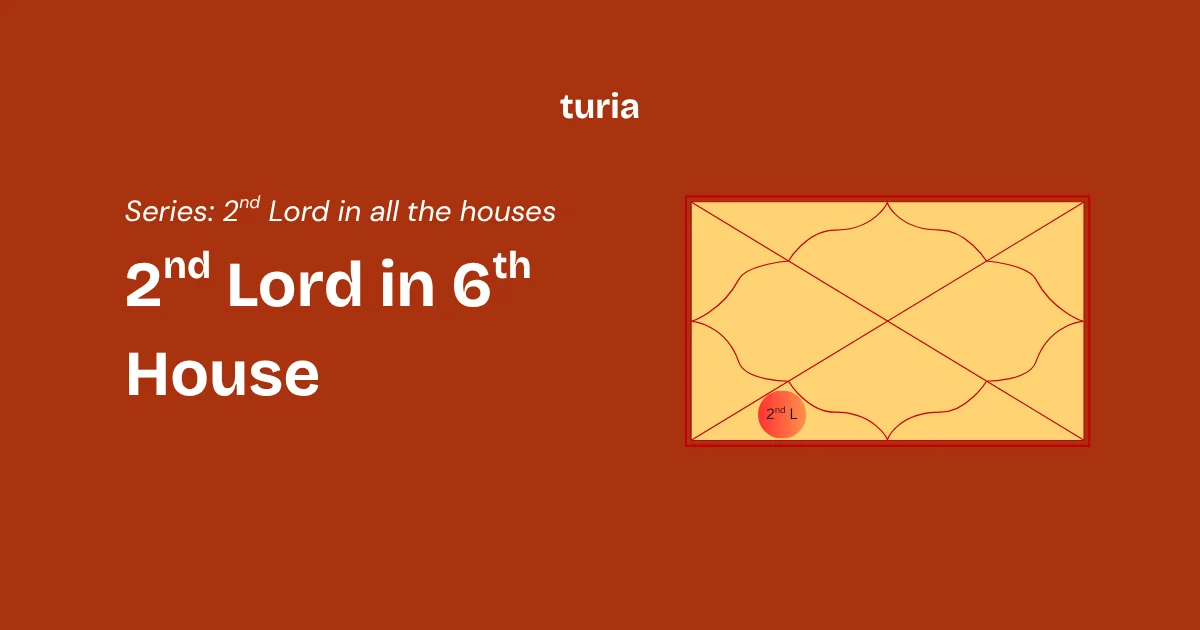
Every time someone finds out their 2nd lord sits in the 6th house, the first question is almost always some version of: "Does this mean I'll always struggle with money?"
Honestly, that fear is fair — the 6th house has a reputation. Debts, disputes, illness, enemies. Nobody wants their wealth-and-family house lord parked there.
But look closer, and it's actually more layered than that.
The 6th house is also one of the few houses in the kundali that's built to get better with time and effort. In this guide, we'll cover what the 2nd lord in the 6th house actually means, what the classical texts say about it, how it shows up in money, career, family and marriage, and where the real "it depends" lives — instead of flattening it into good or bad.
Quick answer
The 2nd lord (wealth, speech, family) placed in the 6th house (debts, disease, enemies, service) rarely means passive or inherited wealth. It means money, family stability and reputation that are earned — often through hard work, service professions, competition, or resolving other people's problems. Early life can bring real friction: family disputes, health-linked expenses, or blunt speech that causes conflict. But because the 6th is also an Upachaya (growth) house, results tend to steadily improve with age, especially from the mid-30s onward.
What the 2nd House and 6th House Actually Represent
Before mixing the two, it helps to know what each house carries on its own.
The 2nd house is Dhana Bhava — the house of wealth. But classical texts like the Phaladeepika describe it as covering far more than money: Vitta (wealth), Vidya (learning), food and eating habits, the right eye, the face, documents, Vak (speech) and Kutumba (family). It's your accumulated resources and your accumulated values — what you've saved, and what you've been taught to value.
The 6th house is Ari Bhava — literally, the house of enemies. Phaladeepika puts it plainly: "The sixth house deals with debts, arms, thieves, wounds, diseases, enemies, paternal relations, battle, wicked acts, sins, fear and humiliation." It's also the house of daily work, routine, service, and the effort it takes to keep obstacles at bay.
| Term | What it means |
|---|---|
| Dhana Bhava | The 2nd house — wealth, speech, family, accumulated values |
| Ari Bhava / Ripu Bhava | The 6th house — enemies, debt, disease, service, daily labour |
| Dhanesh / 2nd lord | The planet ruling the sign on the 2nd house cusp |
| Upachaya house | A "growth" house (3rd, 6th, 10th, 11th) — results improve with age and effort |
| Dusthana | A "difficult" house (6th, 8th, 12th) — inherent friction |
Here's the part most articles skip: the 6th house is both a dusthana and an upachaya at once. It's difficult, but it's also designed to grow. That contradiction is exactly why the 2nd lord landing here produces such a mixed classical verdict — and why the honest answer to "is this good or bad" is: it depends on when in life you're asking.
What It Means When the 2nd Lord Sits in the 6th House
Brihat Parashara Hora Shastra addresses this exact placement directly, and its answer is refreshingly specific. In the chapter on the effects of Bhava lords, it says:
"If Dhan's Lord is in Ari Bhava along with a benefic, the native will gain wealth through his enemies; if Dhan's Lord is yuti with a malefic, there will be loss through enemies apart from mutilation of shanks." — BPHS, Ch. 24, Sloka 18
Read that carefully — BPHS doesn't say this placement is simply good or bad. It splits the result on company. A well-associated 2nd lord (with a benefic like Jupiter or Venus, or in a benefic sign) tends to convert the 6th house's adversarial energy into an advantage — wealth won through competition, litigation, or triumphing over rivals. A poorly-associated 2nd lord (with malefics, afflicted) tends to produce the opposite — loss through enemies, plus health complications.
This single verse is really the whole placement in miniature. Everything else in this guide is detail underneath that principle.
Money: Earned Through Struggle, Not Given
The broader rule in BPHS about the 2nd lord's placement sets the tone before you even get to the 6th house specifically:
"If the Lord of Dhan is in Dhan, or is in an angle, or in trine, he will promote one's wealth. Should he be in Ari/8th/12th, financial conditions will decline." — BPHS, Ch. 13, Sloka 1-2
So classically, the 6th is grouped with the 8th and 12th as houses that challenge the 2nd lord's money significations. That's the source of the "money leaks" reputation this placement carries online.
In practice, here's what that tends to look like: income exists, sometimes quite good income, but it doesn't sit still. Money gets absorbed by debts, medical costs, legal fees, or supporting family members through their own struggles. Saving requires actual discipline — it doesn't happen by default the way it might for a 2nd lord sitting quietly in the 2nd or 11th house.
But — and this is the part that gets lost in fear-based content — "the money doesn't come easy" is not the same as "the money doesn't come." Plenty of people with this exact placement build real, lasting financial security. It's just rarely inherited or effortless. It's fought for.
Family, Speech and the Sharper Edge
Because the 2nd house also governs Kutumba (family) and Vak (speech), those two areas absorb the 6th house's friction too.
On family: expect more complexity than ease. This can mean disputes over shared property, a family member's health or debt becoming a shared burden, or simply less financial support from family than peers seem to get. It doesn't mean a broken family — it means family wealth and support require more active management, not passive inheritance.
On speech: the 2nd house rules how you talk, and the 6th house adds a competitive, sometimes combative edge. People with this placement often argue well — genuinely persuasive in disputes, negotiations, or debate. The flip side is that unfiltered, this same sharpness can create the very conflicts the 6th house specializes in. Mercury or Jupiter connections to the 2nd lord here tend to soften this into wit and precision rather than bluntness.
Career: Where This Placement Actually Shines
If there's one area where the 6th house's Upachaya nature clearly works in this placement's favour, it's career.
Ari Bhava is fundamentally about facing opposition and doing daily work — and the 2nd lord sitting there often pulls wealth-earning capacity directly into professions built around exactly that. Medicine, law and litigation, government and public service, competitive exams, insurance, security services — anywhere the daily job is to solve someone else's problem, manage risk, or come out ahead of competition.
Say a person qualifies through a tough government exam after multiple attempts, or builds a legal or medical practice slowly over a decade — client by client, case by case. That's the archetype of 2nd lord in the 6th house at work: not a fast, flashy rise, but income that compounds because it's built on genuine skill under pressure.
The general 6th house rule reinforces this: "following are the effects, produced by Ari Bhava, relating to diseases, ulcers etc." — the chapter goes on to tie the 6th house's core domain to disease, injury and rivalry (BPHS, Ch. 17, Sloka 1). Careers in healing and dispute-resolution are, quite literally, careers built inside the 6th house's own territory. When the wealth-house lord lives there too, working with that territory — rather than resenting it — is usually the fastest path to stability.
Marriage and Relationships With This Placement
Since the 2nd house also factors into family life and the 7th house governs marriage directly, this placement's influence on relationships is indirect but real.
Two patterns show up often. Some marry later — after their late twenties or early thirties, once finances and identity feel more settled. Others marry earlier but spend the first several years of the marriage actively working through money stress, work pressure, or extended family friction rather than coasting. It's also common to meet a spouse through work or a professional setting, given how tied this placement is to the 6th house's daily-labour themes.
Neither pattern is a verdict on the marriage's quality. It's simply saying: don't expect ease to arrive automatically. Expect the relationship, like the money, to be something actively built.
The Upachaya Advantage: Why This Gets Better With Age
Here's the honest reframe that most listicle content skips entirely.
The 6th house isn't just a dusthana. It's also an Upachaya house — one of the houses (3rd, 6th, 10th, 11th) that Parashari astrology says genuinely strengthens with age and consistent effort. Malefic planets, in particular, are considered to give their strongest results here specifically because the 6th house rewards endurance and competitive grit — qualities malefics are naturally suited to test and build.
Practically, this means the friction associated with the 2nd lord in the 6th house tends to be front-loaded. The 20s can genuinely feel like a struggle — money that doesn't stay, family that doesn't fully support, a career that hasn't found its footing yet. But that same effort, sustained, tends to compound. Most people report the real turning point somewhere in their mid-to-late 30s, once the skills, reputation, or practice built through years of "grinding it out" start paying off on their own.
This is the part worth holding onto if this is your placement: the struggle isn't the whole story. It's usually the setup.
Is This the Same as "6th Lord in 2nd House"? Or Dainya Yoga?
Two things get confused with this placement constantly, so it's worth being precise.
6th lord in 2nd house is the reverse placement — a different planet, a different focus (there, the 6th house's ruler visits the 2nd house, rather than the 2nd house's ruler visiting the 6th). It's a related but distinct combination with its own effects, often centered more on how service, debt or rivalry themes show up within family and money life, rather than the other way around. If you searched for one and found this article, it's worth double-checking which lord you're actually looking at in your chart.
Dainya Yoga is a specific, stronger combination — a mutual exchange (parivartana) where the 2nd lord sits in the 6th house and the 6th lord sits in the 2nd house, at the same time. Phaladeepika lists this exchange explicitly among its Dainya Yogas, and doesn't mince words about it:
"The person with Dainya Yoga at birth will be a fool, will revile others and indulge in sinful deeds. He is always in trouble from his enemies. He will speak harshly and will not have a stable mind." — Phaladeepika, Ch. 6, Sloka 30(2) & 33
That's a harsher verdict than simple placement deserves. If your 2nd lord is in the 6th house but your 6th lord is not sitting in your 2nd house, you don't have Dainya Yoga — you have the more moderate placement this article is actually about. Worth checking your chart carefully before assuming the more severe reading applies.
How This Plays Out by Ascendant
Because the 2nd lord changes with every ascendant, this placement looks a little different chart to chart. A full ascendant-by-ascendant breakdown deserves its own piece, but here's the general shape:
- For ascendants where the 2nd lord is naturally benefic (like Jupiter or Venus for many lagnas), the 6th house placement tends to lean closer to the BPHS "gain through enemies" reading — service-based or competitive wealth that genuinely works out.
- For ascendants where the 2nd lord is a natural malefic (like Mars or Saturn for certain lagnas), the friction side — debt, disputes, health-linked expense — tends to show up more sharply, especially before the Upachaya benefit kicks in with age.
- For Virgo ascendant specifically, Venus rules the 2nd house and can land in the 6th house — commonly showing up as someone genuinely comfortable in a structured, service-oriented job with steady, fixed income, rather than someone chasing high-risk wealth.
The sign the 2nd lord occupies in the 6th house, and what it's conjunct or aspected by, matters as much as the placement itself.
2nd Lord in the 6th House vs Other Placements
Seeing this placement next to a couple of others in the "2nd lord in 12 houses" series makes the pattern clearer.
| Placement | Core theme | Money style |
|---|---|---|
| 2nd lord in 6th house | Wealth through struggle and service | Earned slowly, tested by debt/disputes, improves with age |
| 2nd lord in 11th house | Wealth through networks and gains | Flows in through community, multiple income streams, often easier |
| 2nd lord in 2nd house (own house) | Wealth through direct focus | Self-directed, values-driven, generally stable if well-aspected |
| 2nd lord in 8th house | Wealth through transformation | Sudden gains or losses, inheritance-linked, unpredictable timing |
Compared to the 11th house placement, this one asks for more patience before the payoff. Compared to the 8th house placement, it's steadier — less sudden, more earned. That's the honest place to locate 2nd lord in the 6th house: not the easiest version of wealth in the kundali, but one of the more durable ones once it's built.
FAQ
Is 2nd lord in 6th house a bad placement?
Not inherently. Classical texts split the result based on the 2nd lord's company — benefic association tends to bring wealth through competition or service, while malefic association brings more loss and conflict. It's also an Upachaya house, so results generally improve with age rather than staying difficult forever.
Does this placement cause debt?
It can increase the chance of debt-related themes, since the 6th house directly governs debt. But it's not automatic — it depends on the 2nd lord's strength, sign, and what it's conjunct with. Many people with this placement manage debt actively rather than being overwhelmed by it.
What career suits someone with 2nd lord in the 6th house?
Service-oriented and competitive fields tend to work well — medicine, law, government service, insurance, security services, or any career built around solving problems or facing opposition daily. Income here often compounds slowly through genuine skill rather than arriving quickly.
Does this placement delay marriage?
It can push marriage later for some, as finances and identity settle first. Others marry earlier but spend early years actively working through money or family pressures. Neither pattern predicts the marriage's overall quality — just that ease isn't automatic.
Is this the same as 6th lord in 2nd house?
No. That's the reverse placement, with a different planet and a different emphasis. Worth checking your own chart carefully to see which lord is actually where, since the two get confused often in searches and generic content.
What's the difference between this and Dainya Yoga?
Dainya Yoga specifically requires a mutual exchange — the 2nd lord in the 6th house and the 6th lord in the 2nd house at the same time. Simple placement, without that exchange, is a more moderate combination than the sharper effects Dainya Yoga describes.
Does this placement really improve with age?
Generally, yes. The 6th house is an Upachaya house, meaning it's built to strengthen with sustained effort. Most people with this placement describe their 20s as the harder stretch, with real stability arriving by their mid-to-late 30s once accumulated effort starts to compound.
So when someone asks, "is 2nd lord in the 6th house bad?" — the honest answer is: it depends on the 2nd lord's company, your ascendant, and which decade of life you're standing in. But the pattern most charts share is this — wealth and family stability here are rarely handed to you. They're built, tested, and earned, usually through work that looks a lot like the 6th house itself: service, competition, and quietly outlasting whatever gets in the way.
Hope this gives you a clearer picture.