By Ram Dewani
Introduction
Someone recently generated their own kundali and found their 2nd lord sitting in the 5th house. The first thing they Googled wasn't "will I be wealthy."
It was: "the 2nd lord is a Maraka — does this mean it's dangerous for my children?"
That's usually where the anxiety starts. Someone reads one line about the 2nd house being a "killer" house, sees it landing in the house of children, and assumes the worst — without reading what the classical texts actually say about this specific combination.
Honestly… that fear is almost entirely misplaced here.
The 5th house — Putra Bhava — is one of the most fortunate houses in Vedic astrology, and your 2nd lord landing there is one of the more quietly favorable placements you can have for wealth, creativity, and family income. In this guide, we'll cover what this placement actually means, where the Maraka fear comes from and why it rarely applies the way people assume, how it shapes wealth through speculation and creativity, and how it compares to the 2nd lord sitting in other houses — since this is part of a 12-part series across every house.
Quick answer
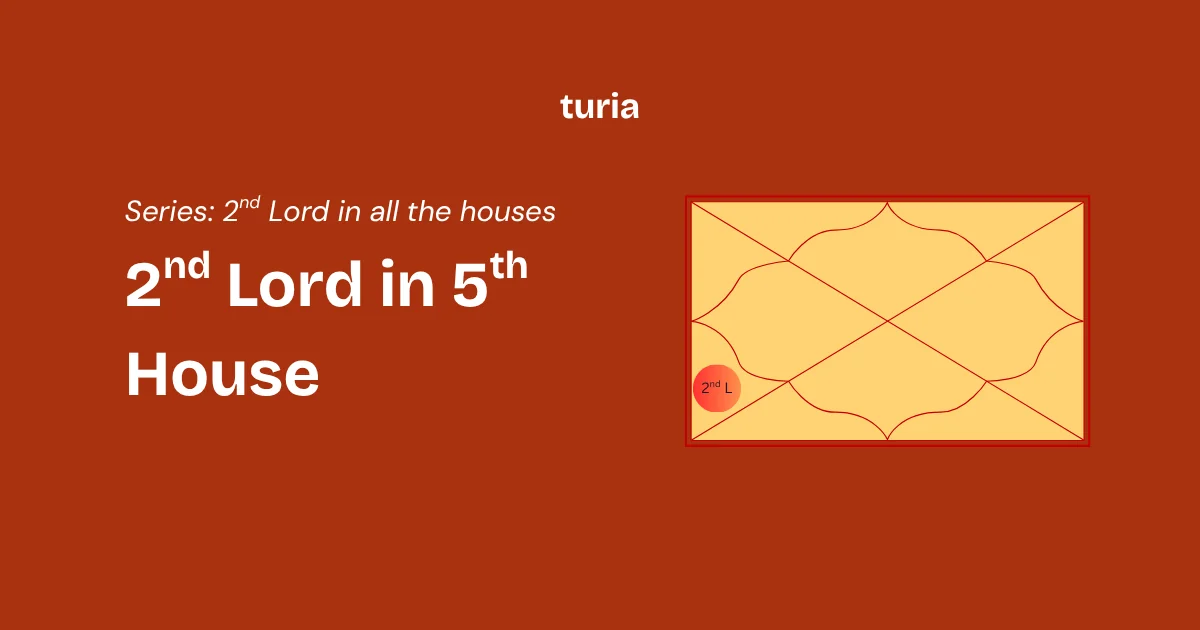
2nd lord in the 5th house means the planet ruling your Dhana Bhava (wealth, speech, family) sits in your Putra Bhava (children, intelligence, speculation, creativity, past-life merit). Classically, this is a genuinely favorable combination — BPHS says the native "will be wealthy," and that the wealth-mindedness often extends to their children too. Income tends to arrive through 5th-house channels: creative work, teaching, intellectual property, speculation, or the stock market, rather than a single fixed salary. The 2nd lord being a natural Maraka sounds alarming, but that significance mostly activates around dasha-timing questions about longevity — not a blanket warning about children. As always, the exact planet, its dignity, and its aspects decide how strongly this plays out.
What "2nd Lord in the 5th House" Actually Means
Your 2nd house is called Dhana Bhava — the house of accumulated wealth, family, speech, and the values you inherit and hold onto. The Dhanesh, or 2nd lord, is the planet that rules the sign on your 2nd house cusp. If you're a Mesh (Aries) ascendant, Shukra (Venus) rules your 2nd house; if Vrishabha (Taurus), it's Budh (Mercury). Wherever that planet physically sits shows where your resources and family identity get channeled.
The 5th house, Putra Bhava, governs children, intelligence, speculation, romance, and Purva Punya — merit carried over from a past life. Classically, the two houses aren't structurally identical in status. BPHS classifies the houses like this:
"Dhan, Putr, Randhr and Labh Bhava are Panapharas (succedents)... Putr and Dharm Bhava are known by the name Kon (or trine)." (BPHS, Ch. 11, Sl. 33-36)
So the 2nd house is a Panaphara (a supportive, secondary house), while the 5th is a Kona (trine) — one of the three most auspicious house types in Parashari astrology. That distinction matters: this isn't a "trine landing in a trine" placement the way Lagna Lord in the 5th house is. It's a Panaphara lord moving into a trine — still a genuinely good shift for wealth, since the lord of your resources is now sitting in one of the chart's most fortunate houses, but a different flavor of "good" than a pure trikona-to-trikona connection.
Quick disambiguation, since it trips people up often: this placement is not the same as the 5th lord sitting in the 2nd house. That's the reverse combination, and BPHS treats it separately — describing a native who will "have many sons and wealth, be a pater familias" (BPHS, Ch. 24, Sl. 50). Similar-sounding, genuinely different chart.
Effects on Wealth and Income
This is the placement's clearest, most direct classical result.
"If Dhan's Lord is in Putr Bhava, the native will be wealthy. Not only the native, but also his sons will be intent on earning wealth." (BPHS, Ch. 24, Sl. 17)
Two things stand out here. First, the wealth reading is unambiguous — no hedging, no conditions attached in this verse. Second, there's a generational thread: the wealth-orientation doesn't stop with the native. It passes down. This is part of why the "family business" and "working alongside your children" themes come up so often in how astrologers describe this combination in practice.
What's different here compared to a 2nd lord sitting quietly in its own house is the source of the money. This isn't usually a straightforward, single-employer salary story. The 5th house adds texture — intellect, creativity, speculation, past-life merit — so the money tends to arrive through one of those channels rather than a flat paycheck.
Speculation, Stock Markets, and Creative Income
The 5th house is the classical house of speculation — anything involving calculated risk for a return: trading, the stock market, gambling in its more disciplined sense, and creative ventures where the payoff isn't guaranteed upfront.
With the 2nd lord — your money significator — physically present here, speculative and creative income genuinely becomes a live possibility, not just a hobby on the side. BPHS's dedicated wealth chapter backs this up independently:
"Dharm's Lord and Putr's Lord are capable of bestowing wealth. Similarly Grahas, yuti with Dharm's Lord and/or Putr's Lord are capable of bestowing wealth. There is no doubt, that these Grahas will give wealth during their Dasha periods." (BPHS, Ch. 41, Sl. 16)
So the 5th house isn't incidentally linked to wealth — it's independently named as a wealth-producing house in classical texts. When your 2nd lord physically sits there, both threads reinforce each other.
A concrete example that shows up often in practice: for a Vrishabha (Taurus) ascendant, Budh (Mercury) is the 2nd lord. Mercury placed in the 5th house here is frequently cited as forming a strong Dhana Yoga — a wealth combination — because Mercury also happens to be a natural significator of trade, analysis, and communication, all of which suit 5th-house speculation and creative income extremely well.
The honest caveat: speculation cuts both ways. A weak or afflicted 2nd lord in the 5th can just as easily mean losses through the same channels — trading, gambling, risky ventures — rather than gains. The direction depends entirely on the planet's dignity, not the placement alone.
Wealth Through Children and Family
Because the 5th house also literally rules children, this placement often shows up as wealth that's connected to them in a practical, not just emotional, sense.
That might mean a family business eventually run in a child's name, a native who builds wealth specifically to secure their children's future, or — in some charts — children who go on to become genuinely successful earners themselves, echoing the "sons will be intent on earning wealth" line from BPHS Ch. 24, Sl. 17 above.
It's worth being specific here rather than vague: this isn't a promise that children will "make you rich." It's a thematic link — money and family become intertwined life areas for this native, in a way they might not be for someone whose 2nd lord sits somewhere unrelated to Putra Bhava.
Is This Placement Risky Because the 2nd Lord Is a Maraka?
Here's the fear that usually brings people to this article, so let's deal with it directly instead of dancing around it.
The 2nd house does hold real Maraka (marriage/longevity-timing) significance in classical astrology:
"Out of the two, Dhan Bhava is a powerful Marak Bhava. The Lords of Dhan and Yuvati Bhava, malefics in Dhan and Yuvati Bhava and malefics, yuti with Dhan's Lord and yuti with Yuvati's Lord are all known, as Marakas. The major and sub-periods of these Grahas will bring death on the native, depending on whether he is a long life, medium life, or short life person." (BPHS, Ch. 44, Sl. 3)
Notice exactly what this verse says — and doesn't say. It's about the 2nd lord's dasha and antardasha periods being sensitive windows for the native's own longevity and health, evaluated alongside the person's overall life-span category. It says nothing about the 2nd lord's placement in the 5th house causing harm to children. Those are two entirely separate classical ideas that get flattened together online because both happen to involve the 2nd lord and the word "Maraka" sounds ominous next to "house of children."
The actual verse describing this specific placement (BPHS Ch. 24, Sl. 17, quoted above) talks about wealth — nothing about loss or death. If you want to genuinely assess Maraka risk, that's a separate, much more technical conversation involving dasha sequencing and the native's overall longevity indicators — not something you conclude from a single house placement in isolation.
Effects on Speech, Learning, and Intelligence
The 2nd house also governs Vak — speech — while the 5th governs intelligence and Vidya connected to deeper, even Vedic, knowledge. Phaladeepika lays out both significations cleanly:
"The second house deals with Vitta (wealth), Vidya (learning)... Speech (Vak) and Kutumba (family)... The fifth house deals with... intelligence, knowledge of the future... Vedic knowledge and other religious scriptures." (Phaladeepika, Ch. 1, Sl. 10)
When the 2nd lord sits in the 5th, this often produces someone whose speech is genuinely persuasive or intellectually sharp — the kind of person who can explain complex ideas simply, or who finds themselves drawn toward mantra, chanting, or study of scripture with more ease than most. In practical terms, this sometimes translates into income linked to teaching, writing, or working with religious or educational institutions and trusts — a natural extension of "wealth through Putra Bhava" applied to knowledge specifically rather than speculation.
Strength Considerations: What Actually Changes the Outcome
As with every placement in Jyotish, the house tells you where; the planet's condition tells you how well.
Exalted or own-sign 2nd lord in the 5th — the strongest version. Expect real, often early-arriving wealth, genuine intellectual sharpness, and a natural instinct for good speculative timing.
Debilitated 2nd lord in the 5th — since the 5th is a trine, this is a real candidate for Neecha Bhanga (cancellation of debilitation), especially if the sign's dispositor is well-placed elsewhere. Even without full cancellation, the underlying trend toward wealth from BPHS Ch. 24, Sl. 17 rarely disappears completely — it just arrives with more friction, delay, or a rockier speculative history first.
Combust 2nd lord — benefits get muted until relevant dasha periods activate more clearly.
Aspected by natural benefics (Jupiter, Venus, unafflicted Mercury) — expect the placement's most generous form: stable creative or speculative income, real happiness through children, sharp learning ability.
Conjunct malefics, especially Mars or Saturn — speculative income becomes genuinely riskier, and the "family business" theme can turn into friction over money within the family rather than shared prosperity. Worth a proper chart reading before assuming either the best or the worst.
The single most important rule here: don't judge this placement from the house alone. Check the sign, the planet's own dignity, its aspects, and the dasha periods that actually activate it.
2nd Lord in the 5th House vs Other Placements
Since this is one part of a series covering the 2nd lord across all 12 houses, it helps to see how the 5th house placement compares.
| Placement | Core theme | How it differs from the 5th house |
|---|---|---|
| 2nd lord in 1st house | Wealth tied directly to self-effort and personal image | Money comes through personal branding and direct action, not creative/speculative channels |
| 2nd lord in 2nd house (own house) | Strong, stable accumulated wealth, but more conventional in source | A Panaphara lord in its own house — solid, but without the trine "lift" the 5th house adds |
| 2nd lord in 5th house | Wealth through speculation, creativity, children, and knowledge | The comparison point for this article |
| 2nd lord in 11th house | Wealth through networks, gains, and multiple income streams | 11th is a house of gains generally; 5th is more specifically about speculative and creative sources |
| 2nd lord in 8th/12th house | Sudden, hidden, or foreign-linked money changes; more volatility | Dusthana houses — a rockier path for wealth compared to the trine ease of the 5th |
It's also worth flagging how this differs from the Lagna Lord in the 5th house, covered elsewhere in this site's house-by-house series: that placement is trikona-to-trikona (1st and 5th are both trines), making it one of the most structurally auspicious combinations possible. The 2nd lord in the 5th is a notch below that in pure structural strength — a Panaphara lord entering a trine — but still lands solidly in the "favorable for wealth" category, especially compared to Dusthana placements like the 6th, 8th, or 12th house.
FAQ
Does 2nd lord in 5th house guarantee wealth?
Not a guarantee, but a strong classical indicator. BPHS states directly that this placement makes the native wealthy, extending even to their children's earning tendencies. The actual scale depends on the planet's dignity, aspects, and the dasha periods that activate it — the placement sets the direction, not the exact outcome.
Can this placement bring money through the stock market or speculation?
Yes, this is one of its more distinctive features. The 5th house governs speculation classically, and with the 2nd lord (your wealth significator) sitting there, trading or speculative ventures become a genuine income channel — provided the planet is reasonably strong. A weak or afflicted 2nd lord here can just as easily mean speculative losses instead.
Is this placement risky for my children because the 2nd lord is a Maraka?
Generally no. The 2nd lord's Maraka significance relates to dasha-timing questions about the native's own longevity — evaluated separately, alongside other longevity indicators — not a warning about the children themselves. The specific classical verse for this placement (BPHS Ch. 24, Sl. 17) describes wealth, not harm.
What's the difference between "2nd lord in 5th house" and "5th lord in 2nd house"?
They're reverse combinations from different starting points and are treated separately in BPHS. 2nd lord in 5th emphasizes wealth arriving through creativity, speculation, and children. 5th lord in 2nd (BPHS Ch. 24, Sl. 50) emphasizes many children and wealth with the native as head of a prosperous family — similar-sounding but structurally distinct.
What if my 2nd lord is debilitated in the 5th house?
Less concerning than it sounds. Since the 5th is a trine, a debilitated 2nd lord here is a genuine candidate for Neecha Bhanga (cancellation of debilitation), especially if that sign's ruling planet is well-placed elsewhere. Even without full cancellation, the underlying wealth trend often persists, just with more delay or a bumpier early phase.
Does this placement help with intelligence or learning?
Yes. Since the 2nd house governs speech and the 5th governs intelligence and Vedic knowledge, this combination often produces people who communicate ideas clearly or who take naturally to study, mantra, or scripture. This sometimes extends into income tied to teaching or knowledge-based institutions.
Is this good for a family business?
Often, yes. The generational wealth thread in BPHS Ch. 24, Sl. 17 — where children are described as also being wealth-oriented — supports family businesses or ventures eventually run in a child's name. It's a thematic tendency though, not an automatic outcome regardless of effort or the planet's condition.
Closing
So when someone asks, "Is my 2nd lord in the 5th house something to worry about because it's a Maraka?" — the honest answer is: not for the reason they're usually worried about.
This placement puts your wealth significator inside one of the chart's three trine houses, and classical texts are direct about the result — genuine wealth, often flowing through creativity, speculation, or knowledge, with a generational thread running through your children as well. The Maraka concern is real, but it belongs to a completely different conversation about dasha timing, not a verdict on this specific placement.
What actually shapes the outcome is the planet involved, its dignity, its aspects, and the periods that activate it. That's worth checking properly, rather than reacting to a scary-sounding word pulled out of context.
Hope this gives you a clearer picture of your own placement.