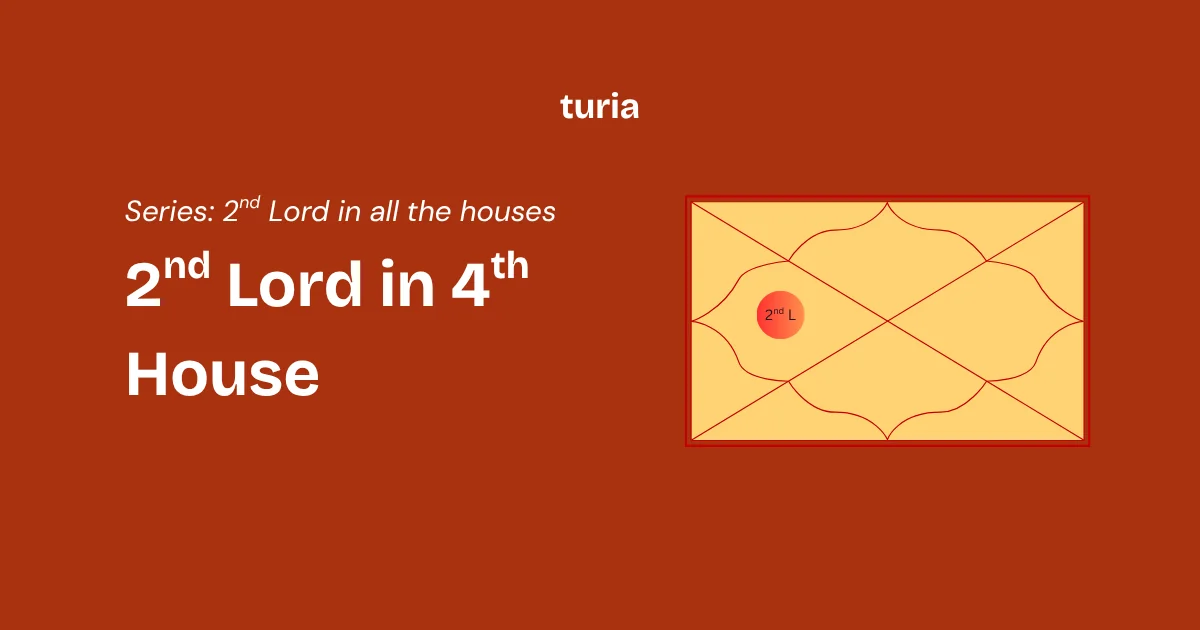
Every time someone finds out their 2nd lord — the ruler of their wealth house — sits in the 4th house, the first question is usually about money. "Does this mean I'll be rich?" Close behind it: "Does this have something to do with my mother, or with property?"
Most generic astrology pages answer this with a checklist — wealth, mother, real estate, done — without showing where any of it actually comes from. And a few pages blur this placement with a completely different one: 4th lord in 2nd house, which is its mirror image, not its twin.
And honestly… the two get confused constantly, because they sound almost identical.
This is the fourth article in the "2nd Lord in 12 Houses" series. Here's what the Brihat Parashara Hora Shastra (BPHS) and the Phaladeepika actually say about this placement — the core classical result, how it plays out through home and mother, why it isn't technically a Dhana Yoga, the exchange condition that upgrades it, and how it compares to the 2nd lord elsewhere in the chart.
Quick answer
When the 2nd lord (ruler of wealth, family, and speech) sits in the 4th house (home, mother, property), BPHS (Ch. 24, Sl. 16) says the native "will acquire all kinds of wealth" — and if the 2nd lord is exalted and joined with Jupiter, "one will be equal to a king." The wealth here routes specifically through home, land, and the mother's side of the family, rather than through career or business alone. It's a genuinely good, classically supported placement — though it isn't a formal Dhana Yoga, and the promise depends heavily on the 2nd lord's dignity and any malefic affliction.
What "2nd Lord in the 4th House" Actually Means
Before the interpretation, the mechanics. Your 2nd house is Dhana Bhava — the house of accumulated wealth, family, speech, and the values you were raised with. The planet ruling your 2nd house sign is your Dhanesh, or 2nd lord.
When that planet sits in your 4th house — Sukha Bhava (house of happiness) or Bandhu Bhava (house of relatives) — your capacity to earn and hold wealth gets planted inside the house that governs home, mother, property, and emotional comfort.
Here's the disambiguation worth getting right early, because it trips up a lot of readers: this is not the same as "4th lord in 2nd house." That's the mirror-image placement — where the ruler of your home and mother sits inside your wealth house instead. BPHS treats them as genuinely different results:
"If Bandhu's Lord is in Dhan Bhava, the native will enjoy pleasures, all kinds of wealth, family life and honour and be adventurous. He will be cunning in disposition." — BPHS, Ch. 24, Sl. 38
Similar-sounding, but distinct. If you're not sure which one applies to you, check which house your 2nd lord — not your 4th lord — is sitting in before reading further.
The Core Classical Result
The direct classical statement on this exact placement comes from BPHS's chapter on the effects of the Bhava lords:
"If Dhan's Lord is in Bandhu Bhava, the native will acquire all kinds of wealth. If Dhan's Lord is exalted and is yuti with Guru, one will be equal to a king." — BPHS, Ch. 24, Sl. 16
Two layers here. The baseline promise is broad and unqualified — "all kinds of wealth," not one specific income stream. The escalation clause is precise: if the 2nd lord is exalted and conjunct Jupiter, the result climbs to royal-level prosperity.
Notice what this sloka doesn't say — it doesn't promise a specific mechanism like a job, a business, or an inheritance. The 4th house simply becomes the channel wealth flows through, and that channel is domestic: home, land, mother, comfort. The next few sections unpack what that looks like in practice.
Wealth Through Home and Property
Because the 4th house is a Kendra (angular house) — one of the four structurally strong positions in the chart — this placement also draws support from a broader classical rule about the 2nd lord's behavior in angles:
"If the Lord of Dhan is in Dhan, or is in an angle, or in trine, he will promote one's wealth (or monetary state). Should he be in Ari/8th/12th, financial conditions will decline." — BPHS, Ch. 13, Sl. 1-2
So the specific 4th-house result (Ch. 24, Sl. 16) isn't an isolated exception — it lines up with the general principle that a 2nd lord placed in any angle tends to strengthen wealth rather than weaken it.
In practice, this usually shows up as wealth tied to tangible, immovable assets rather than liquid income alone: property investment, real estate dealing, ancestral or agricultural land, or income that flows through the home itself — rent, a home-based business, or a family enterprise run out of the ground floor of the house. BPHS separately notes what strengthens Bandhu Bhava toward real estate specifically:
"If Karm's Lord joins Bandhu's Lord in an angle, or in a trine, the native will acquire beautiful mansions." — BPHS, Ch. 15, Sl. 4
That particular sloka describes the 10th lord and 4th lord combining — a different, complementary mechanic — but it shows the consistent classical pattern: strength connected to Bandhu Bhava tends to manifest as real property, not just comfort. Combine that backdrop with the 2nd lord's presence in the same house, and the everyday Indian pattern is familiar — the parents who quietly put together the down payment for their child's first flat, or the family business that never really left the ground floor of the ancestral house.
Mother, Family, and Emotional Wealth
The 2nd house doesn't just track money — the Phaladeepika defines it as covering "Vitta (wealth), Vidya (learning)... Speech (Vak) and Kutumba (family)." When its lord sits in the 4th — Matru Bhava, the house of the mother — family and finances become genuinely intertwined rather than separate life tracks.
Practically, this often looks like:
- Financial support that flows through the mother's side of the family, or eventual maternal property
- A close bond where the native's sense of financial security is tied to a stable, happy home
- Family (not just career) functioning as a real source of the native's accumulated resources — inherited land, jewelry, or a family business passed down
BPHS also links a strong, well-placed 4th house to the mother's own wellbeing:
"If Bandhu Bhava is occupied by a benefic, while its Lord is in his exaltation Rāśi, as the indicator of mother is endowed with strength, the native will have a long-living mother." — BPHS, Ch. 15, Sl. 6
That's a separate classical condition — about the 4th house and its own lord, not the 2nd lord specifically — but it fits naturally alongside this placement's family-and-mother emphasis. The honest caveat: if the 2nd lord here is afflicted by malefics, this same closeness can turn into financial strain connected to the mother or the family home, rather than support.
Not a Classical Dhana Yoga — An Important Clarification
Here's something most pages covering this topic skip, or get wrong: 2nd lord in the 4th house is not a formal Dhana Yoga (wealth-yoga) in the classical sense.
Dhana Yogas are specifically defined combinations where the lords of the 2nd and 11th houses connect with the trine lords (1st, 5th, 9th) or with each other under favorable conditions. The 2nd lord simply sitting in the 4th — a Kendra, not a trine — doesn't meet that technical definition, even though it's a genuinely strong result in its own right, straight from Ch. 24, Sl. 16 above.
This distinction matters if you're comparing charts or reading other material online. Plenty of blog posts label almost any strong-sounding 2nd-lord placement a "Dhana Yoga" loosely. It's worth being precise: this placement is a solid, classically supported wealth indicator — just not technically a Dhana Yoga by name. The Phaladeepika's Dhenu Yoga condition is the closer classical parallel worth knowing:
"If the 2nd house is occupied or aspected by benefic planet and the lord of 2nd house not being combust is posited in an auspicious house in his sign of exaltation or in his own sign, the resulting Yoga is Dhenu Yoga... equal to king of kings." — Phaladeepika
If your 2nd lord happens to be exalted or in its own sign while sitting in the 4th (an auspicious Kendra), you may be meeting this Dhenu Yoga condition on top of the base Ch. 24, Sl. 16 result — which is a meaningfully stronger combination than the placement alone.
The Exchange Yoga — When This Placement Becomes Truly Powerful
As with several placements in this series, there's a version of this combination that classical texts treat as significantly stronger: a mutual exchange, where the 4th lord sits back in the 2nd house while the 2nd lord sits in the 4th.
The Phaladeepika lists this explicitly among its Maha Yogas — the 28 major fortune-conferring combinations:
"Maha Yogas: ...(8) the lord of the 2nd in the 4th and the lord of the 4th in the 2nd..." — Phaladeepika, Maha Yoga section
This mutual placement is called Parivartana Yoga (an exchange yoga), and it's classified as meaningfully stronger than a simple one-directional placement. So if you've read that your 2nd lord is in the 4th and assumed the strongest possible version automatically applies — check whether your 4th lord is actually sitting back in your 2nd house. If yes, you have the full Maha Yoga. If not, you still have the solid, well-attested Ch. 24, Sl. 16 result — just not the amplified exchange version.
Strength Considerations — What Makes or Breaks This Placement
A placement description is only half the story. Classical astrology is explicit that results depend on strength and affliction. Four factors decide how this one actually plays out:
- Dignity of the 2nd lord. Exalted or in its own sign in the 4th gives the fullest classical result — potentially triggering the Dhenu Yoga condition above. Debilitated or in an enemy sign weakens the promise considerably, even in a Kendra.
- Benefic vs. malefic association. A 2nd lord conjunct or aspected by Jupiter, Venus, or a well-placed Mercury strengthens both the wealth and the family-happiness themes. Saturn, Mars, or Rahu in close conjunction can flip the picture — financial strain connected to the home, property disputes, or friction with the mother's side of the family.
- Whether the exchange (Parivartana) is present. As covered above, this is the difference between a solid placement and a classical Maha Yoga.
- Dasha timing. The results activate most visibly during the Mahadasha or Antardasha of the 2nd lord itself, or of the 4th lord — property purchases, family financial milestones, or a deepening bond with the mother often cluster in these periods.
2nd Lord in 4th vs. Other Key Placements in the Series
Since this is part of a 12-house series, here's how the 4th compares to a few other well-known 2nd lord placements:
| Placement | Core Theme | Classical Flavor |
|---|---|---|
| 2nd lord in 1st (own lagna) | Wealth tied directly to personality and self-effort | Native's identity and earning capacity become closely fused |
| 2nd lord in 4th | Wealth through home, property, and mother | BPHS Ch. 24, Sl. 16: "all kinds of wealth," escalating to royal-level prosperity if exalted with Jupiter |
| 2nd lord in 10th | Wealth through career and public standing | Classical Dhana Yoga territory — earnings tied to profession and reputation |
| 2nd lord in 11th | Wealth through networks and multiple income streams | One of the strongest classical Dhana Yoga placements — the 2nd and 11th are natural wealth partners |
The 4th-house version is distinct from the 10th and 11th house placements in one important way: it isn't a formal Dhana Yoga. What it offers instead is wealth with emotional roots — money that's inseparable from home, comfort, and family, rather than pure ambition or networking. If you're comparing your own placement against a sibling or partner whose 2nd lord sits elsewhere, this table is the quick reference — but each placement deserves its own full read in this series.
FAQ
What does 2nd lord in 4th house mean for wealth?
It means wealth channels through home, property, and family rather than career alone. BPHS (Ch. 24, Sl. 16) promises the native "will acquire all kinds of wealth," with an escalated result — "equal to a king" — if the 2nd lord is exalted and conjunct Jupiter. The general angle-strengthening rule (Ch. 13, Sl. 1-2) supports this further, since the 4th is a Kendra.
Is 2nd lord in 4th house good for property and real estate?
Yes, this is one of the most consistent themes. The 4th house governs land and property, and BPHS separately links Bandhu Bhava strength to acquiring "beautiful mansions" (Ch. 15, Sl. 4). Many natives with this placement show a natural pull toward real estate investment, agricultural land, or a family business run from the home itself.
Does this placement affect the relationship with the mother?
Often, yes. Since the 4th house is Matru Bhava, the 2nd lord's presence there ties financial security to the mother's wellbeing and the domestic environment. BPHS (Ch. 15, Sl. 6) links a strong, well-placed 4th house to a long-living mother. If afflicted, the same closeness can express as financial strain tied to the mother or the family home instead.
What's the difference between 2nd lord in 4th house and 4th lord in 2nd house?
They're mirror-image placements with different classical results. This article covers the 2nd lord (wealth ruler) sitting in the 4th house (Ch. 24, Sl. 16 — "all kinds of wealth"). The reverse — 4th lord in 2nd house — is a separate placement (Ch. 24, Sl. 38) describing pleasures, family life, and honour, with a "cunning" disposition noted. Check which lord is actually placed where before assuming either applies to you.
Does 2nd lord in 4th house indicate a family business?
It's a common real-world expression of this placement, though not a specific classical promise. Because wealth is routed through home and domestic themes, natives often show an aptitude for home-based businesses, family enterprises, or property-linked income such as rent or land. This tendency strengthens further if the 2nd lord is well-aspected.
Is 2nd lord in 4th house a Dhana Yoga?
Not technically. Classical Dhana Yogas specifically involve the 2nd and 11th lords connecting with trine lords (1st, 5th, 9th). The 4th is a Kendra, not a trine, so this placement doesn't meet that formal definition — even though it's independently a strong, well-attested wealth placement per BPHS Ch. 24, Sl. 16. The closer classical parallel is the Phaladeepika's Dhenu Yoga, triggered if the 2nd lord is additionally exalted or in its own sign here.
What happens if the 2nd lord is afflicted or debilitated in the 4th house?
Affliction — conjunction with or aspect from Saturn, Mars, or Rahu, or outright debilitation — can flip the domestic-wealth themes into friction: property disputes, financial strain connected to the mother or family home, or difficulty holding onto accumulated wealth despite steady effort. The 4th house's themes don't disappear; they simply express with more resistance.
Bringing It Together
So when someone asks, "Is 2nd lord in the 4th house a good placement for wealth?" — the honest, classical answer is: yes, generally, and specifically wealth with roots — money that grows out of home, land, and family rather than pure career ambition. BPHS is direct about it: "all kinds of wealth," escalating further under the right conditions.
But the strength of the result still depends on the 2nd lord's dignity, whether it's supported by benefics or pulled at by malefics, and whether the rarer exchange with the 4th lord is actually present in the chart. What this placement really describes is a person whose sense of financial security is inseparable from home — where they come from, who raised them, and the domestic foundation their wealth keeps circling back to.