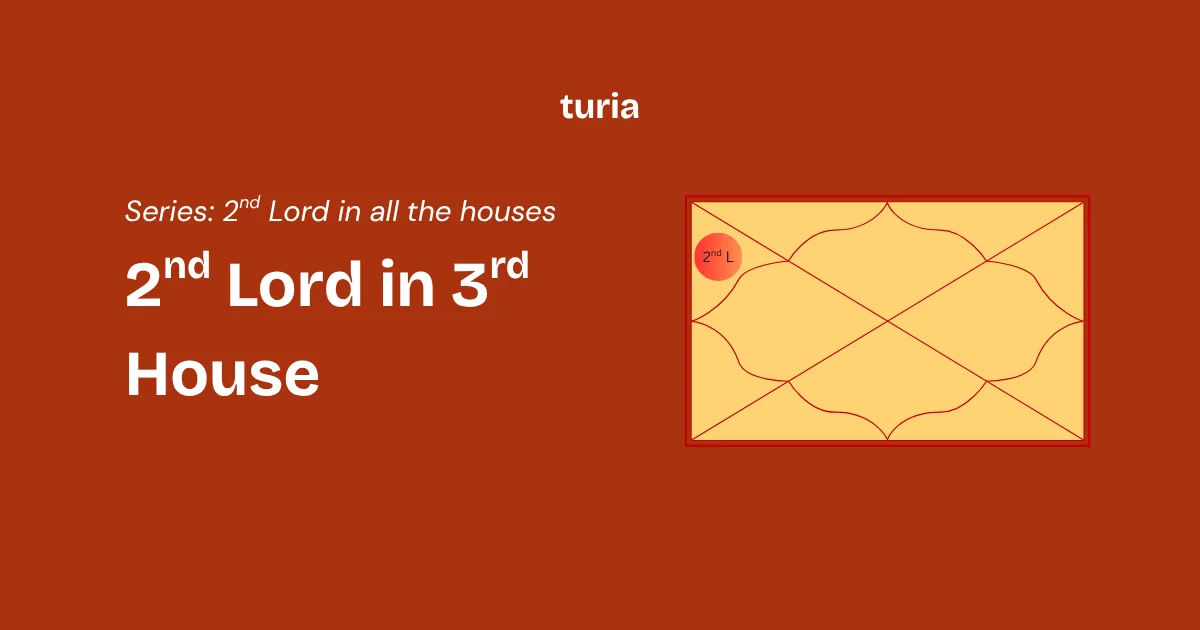
Someone finds out their 2nd lord sits in the 3rd house and usually asks one of two questions: "Will I be wealthy?" or "Why does money feel like it's always one step away?"
Fair questions. Most placement write-ups online answer with a flat list — good for business, good for speech, good with siblings — without explaining the mechanism behind any of it.
And honestly… this is one of the more logical placements in the whole system once you see the pattern. The 2nd house rules wealth, family, and speech. The 3rd house rules courage, self-effort, siblings, and communication. Put the 2nd lord there, and you get a very specific kind of money story — one that's earned, not handed over.
In this guide, we'll cover what the 2nd and 3rd houses actually govern, what the classical texts say about this exact placement, how it shows up in career, siblings, and speech, what strengthens or weakens it, and how it compares to the 2nd lord sitting elsewhere in the series.
Quick answer
When the 2nd lord — ruler of wealth, family, and speech — sits in the 3rd house, Brihat Parashara Hora Shastra (Ch. 24, v. 15) says the native "will be valorous, wise, virtuous... when related to a benefic." The 3rd is an Upachaya (growth) house, so wealth here builds through the native's own courage, communication, and sustained effort rather than arriving early or through inheritance. Expect income tied to speech, writing, sales, or business, financial entanglement with siblings, and results that typically strengthen from the early-to-mid 30s onward.
What the 2nd and 3rd Houses Actually Govern
Before getting into the placement itself, it helps to know what each house is independently about — because this placement is really a conversation between the two.
BPHS (Ch. 13, v. 3) defines the 2nd house directly:
"Wealth, grains (food etc.), family, death, enemies, metals, precious stones etc. are to be understood through Dhan Bhava."
Phaladeepika (Mantreswara, Ch. 1) adds more texture, naming the 2nd house's domain as "Vitta (wealth), Vidya (learning)... the right eye, face... letter or document... Speech (Vak) and Kutumba (family)." That last inclusion — Vak, speech — is the detail most modern write-ups skip, and it's the one that matters most for this placement.
BPHS (Ch. 14, v. 4) then defines the 3rd:
"From Sahaj Bhava know of the following: valour, servants (attending etc.), brothers, sisters etc., initiatory instructions (Upadesh), journey and parent's death."
Dhan Bhava — the 2nd house — is your accumulated resources: money, family, face, and voice.
Sahaja Bhava — the 3rd house — is what you do with your own hands and nerve: courage, siblings, short journeys, and — notably — Upadesh, teaching or instruction.
Put the two together and the placement basically writes itself: the house of money and voice, sitting inside the house of effort and communication. Wealth here isn't separate from action. It's produced by it.
Why the 3rd House Is Different: The Upachaya Effect
This is the detail that reframes the entire placement.
The 3rd house is one of four Upachaya (growth) houses, along with the 6th, 10th, and 11th. BPHS (Ch. 6) classifies them plainly: "Sahaj, Ari, Karm and Labh Bhava are Upachaya Bhavas." Phaladeepika independently confirms the same grouping in its own opening chapter.
Upachaya means increase — houses that don't hand you results at birth. They build them, provided you show up and do the work.
Most houses describe what you're born into. Upachaya houses describe what you'll earn. When your 2nd lord — the planet carrying your money and your voice — sits in one of these houses, the message is direct: your financial story isn't a smooth, early script. It's a growth curve.
This single fact explains almost every other trait attached to this placement — the "wealth comes later" reading, the self-made framing, the emphasis on effort over inheritance.
2nd Lord in the 3rd House — What Classical Texts Say
The direct citation comes from Brihat Parashara Hora Shastra, Chapter 24 ("Effects of the Bhava Lords"), verse 15:
"If Dhan's Lord is in Sahaj Bhava, the native will be valorous, wise, virtuous, lustful and miserly; all these, when related to a benefic. If related to a malefic, the native will be a heterodox."
Two things stand out here.
The good qualities are conditional. Parashara isn't handing out a blank cheque. Valour, wisdom, and virtue are explicitly tied to the 2nd lord being "related to a benefic" — meaning conjunct with, or aspected by, planets like Jupiter, Venus, or a well-placed Mercury. Without that support, the same placement tips toward "heterodox" — unconventional, unorthodox, prone to going against the grain in ways that don't always help.
Miserliness is named directly. It's an odd inclusion next to valour and virtue, but it fits the effort-based theme. A person who builds wealth slowly, through their own hands, often holds onto it more carefully than someone who inherited it. Read generously, this isn't stinginess — it's financial discipline earned the hard way.
There's also a specific classical combination worth knowing about here: if the 2nd lord sits in the 3rd house and the 3rd lord simultaneously sits in the 2nd house, that mutual exchange is named separately — Kahala Yoga (Phaladeepika, Ch. 6). More on that below, since it changes the reading slightly.
Wealth Built Through Effort: What It Actually Looks Like
"Self-made wealth" sounds like a LinkedIn headline. In real charts, it usually looks more specific than that.
The person who starts a small trading business instead of joining the family firm. The one who takes on a side hustle in their late 20s that quietly becomes the main income by their late 30s. The salesperson who out-earns colleagues with better degrees, purely because they can close a deal in conversation that others can't close on paper.
This isn't about a single big break. It's compounding — a series of self-initiated moves that add up over a decade or more, rather than one inheritance or one lucky break.
Where this often shows up concretely: a person with this placement, working a stable job through their 20s, starts a small consulting or reselling side income almost by accident — helping a friend, doing a favour that turns into a paid gig — and that small effort-based stream is the one that eventually outgrows the main salary.
The 3rd house's link to "own strength" also means this native rarely waits for permission. Business ideas, freelance projects, second incomes — the instinct is to build it yourself rather than ask for it.
Siblings and Family Finances
The 3rd house's sibling signification doesn't disappear just because the 2nd lord — a money and family planet — is the one sitting there. If anything, it gets amplified.
BPHS names siblings directly as a 3rd-house indication ("brothers, sisters etc."), and when the wealth-and-family lord lands here, financial matters and sibling relationships tend to intertwine. This shows up a few common ways: business partnerships with a brother or sister, shared family property or resources that involve siblings directly, or — less pleasantly, when the placement is afflicted — money disputes within the family that specifically involve a sibling.
A younger sibling in particular often plays a role. The 3rd house is classically read as more connected to younger co-born than older ones (the 11th house leans toward elder siblings), so it's common for this placement to show a younger brother or sister who either helps open a door professionally, or becomes a financial dependent the native ends up supporting.
None of this is fixed to one outcome. A well-dignified 2nd lord tends to produce warm, mutually beneficial sibling-finance ties. A weak or afflicted one is more likely to show friction or one-sided support.
Communication, Speech, and Career
This is the part of the placement most worth paying attention to, because it's the most actionable.
Phaladeepika names Vak — speech — as a direct 2nd-house signification. Put that lord in the 3rd house, itself the house of communication, writing, and short journeys, and you get a native whose money is disproportionately tied to how well they talk, write, or teach.
In practice, this favours careers in sales, marketing, teaching, coaching, journalism, content creation, public relations, or any business built around explaining something well. It's also common in people who aren't necessarily in a "communication job" on paper, but whose success within their actual role comes from being the one who can pitch the idea, negotiate the deal, or explain the plan clearly enough that others act on it.
BPHS's note that Sahaj Bhava governs Upadesh — instruction — adds a specific sub-theme here too: teaching, mentoring, and training others is often a genuine income channel for this placement, not just a side interest.
Strength Considerations: What Makes This Placement Work Well or Poorly
Not every 2nd lord in the 3rd house behaves the same way. Dignity and aspects change the outcome considerably — which is exactly what BPHS Ch. 24, v. 15 was pointing to with its benefic/malefic condition.
Signs the placement is working well:
- 2nd lord in own sign, exaltation, or a friendly sign while placed in the 3rd
- A benefic — Jupiter, Venus, or a well-placed Mercury — conjunct or aspecting the 2nd lord
- Kahala Yoga present (see below)
- No close affliction from Rahu, Saturn, or Mars in poor dignity
Signs the placement may struggle:
- 2nd lord debilitated or combust while in the 3rd
- Heavy malefic affliction without benefic support — wealth-building turns into constant, draining hustle rather than compounding growth, and speech can turn sharp or careless rather than persuasive
- 3rd house itself weakly placed or afflicted, compounding sibling friction alongside financial strain
Kahala Yoga — the exchange worth knowing about
Phaladeepika (Ch. 6, sloka 8) names a specific yoga formed when the 2nd lord sits in the 3rd house and the 3rd lord sits back in the 2nd — a mutual exchange, or parivartana. This particular exchange is called Kahala Yoga.
Classical texts describe it as giving swings rather than a flat trajectory: "occasionally haughty and sometimes sweet in his speech... occasions when he will be very prosperous and then... driven to poverty." It's not a simple upgrade on the base placement — it's a promise of movement, both up and down, rather than steady linear growth.
If you have this exact exchange in your chart, read the "self-made wealth" theme above with an added note: expect the effort-based gains to arrive in cycles, not a smooth upward line.
Comparing 2nd Lord in the 3rd House to Other Placements
Since this is one entry in a 12-part series on 2nd lord placements, here's how the 3rd compares to two placements readers often ask about alongside it.
| Placement | Core Theme | How Wealth Shows Up |
|---|---|---|
| 2nd Lord in 2nd House (own house) | Direct, personal resources | Wealth is more immediate and stable, tied closely to family and personal values; less dependent on external effort-cycles |
| 2nd Lord in 3rd House | Self-effort, communication, siblings | Wealth builds through courage, speech, and sustained initiative; classically Upachaya — grows with age, conditional on dignity |
| 2nd Lord in 11th House (gains house) | Networks, groups, multiple income streams | Wealth arrives through social and professional circles, collaborations, and "big gain" events rather than individual hands-on effort |
The pattern worth noticing: the 2nd house alone is about having. The 3rd adds doing. The 11th adds connecting. Of the three, the 3rd is the most self-reliant version — the one placement here that offers nothing automatically and asks the native to build the whole thing with their own voice and initiative.
Conclusion
So when someone asks, "is 2nd lord in the 3rd house good for money?" — the honest answer is: usually yes, but on a specific timeline and a specific method.
It doesn't hand you inherited wealth or an easy first act. It hands you courage, a persuasive voice, and the capacity to build income streams no one gave you — and asks you to actually use them. Sibling ties often get pulled into the financial picture, for better or worse. And the real acceleration, for most charts, shows up well into adulthood, not at the starting line.
The person with this placement who's still building their financial base in their late 20s isn't behind. That's the Upachaya pattern doing exactly what it's designed to do.
FAQ
Is 2nd lord in the 3rd house good for wealth?
Generally yes, though it's conditional. BPHS (Ch. 24, v. 15) ties the good outcomes — valour, wisdom, virtue — to the 2nd lord being related to a benefic planet. The 3rd is an Upachaya (growth) house, so wealth typically builds steadily through effort rather than arriving early or easily. It's rarely a placement to worry about, but it does ask for patience.
Does this placement mean self-made money, not inheritance?
Largely, yes. Because the 3rd house rules self-effort and the 2nd lord governs wealth, the financial story this placement tells is built rather than received. Business ventures, sales roles, side incomes, and communication-based work are common paths. Inherited or windfall wealth is less characteristic of this specific placement than earned, effort-based income.
How does it affect relationships with siblings?
Money and family matters often intertwine with sibling relationships here — business partnerships, shared resources, or a younger sibling playing a meaningful role in the native's financial life. When the 2nd lord is well-dignified, this tends to be mutually supportive. When afflicted, it can show up as financial friction or one-sided support within the family.
What careers suit 2nd lord in the 3rd house?
Fields built around communication and self-driven effort: sales, marketing, teaching, coaching, journalism, content creation, writing, and small business or entrepreneurship. The common thread isn't a specific job title — it's income that depends on the native's own voice, initiative, and ability to explain or persuade.
Does it affect speech and voice quality?
Often, yes. Phaladeepika names speech (Vak) as a direct 2nd-house signification, and placing that lord in the communication-ruled 3rd house tends to sharpen persuasive or expressive speech. This can show up as being a strong negotiator, a natural teacher, or simply someone people find easy to listen to.
What if the 2nd lord is afflicted in the 3rd house?
Affliction — debilitation, combustion, or heavy malefic conjunction without benefic support — can turn self-made effort into constant, draining struggle rather than compounding growth, and can make speech sharper or more careless than persuasive. The core themes don't disappear, but they express with more friction.
Does timing matter — why do results often show up later in life?
Yes. As an Upachaya house, the 3rd builds strength over time rather than delivering results at birth. Most sources — classical and modern — describe real acceleration from the early-to-mid 30s onward, often tied to relevant dasha periods or supportive transits. Struggle in the 20s is common for this placement and isn't a sign of a weak chart.
This article is part of a 12-part series on where the 2nd lord (Dhana Bhava's ruling planet) sits across the 12 houses of the kundali. Read the other placements in the series for the full picture of how this single planetary position shapes wealth, family, and self-worth.