Introduction
Someone gets their kundali read, and the astrologer says: "Your 2nd lord is sitting in your 2nd house."
The first reaction is almost always the same. Does that mean I'll be rich? Is my speech going to be good? What does this actually change for me?
Most explanations online flatten this into a one-line verdict — "this is a guaranteed wealth yoga, you're set for life" — without explaining why, or what could still go wrong.
And honestly… the real answer is more useful than either extreme.
2nd lord in the 2nd house is a genuinely strong classical placement. It's called a Swagriha placement — literally "own house" — and it forms one of the more respected wealth combinations in Vedic astrology. But strength isn't the same as a guarantee. In this guide, we'll cover what this placement actually means, the own-house (Swagriha) mechanic behind why it's considered strong, what it does for wealth, speech, and family, what can still weaken it, and how it compares to a couple of other placements in this series — since this is article two of twelve, covering the 2nd lord across all twelve houses.
Quick answer
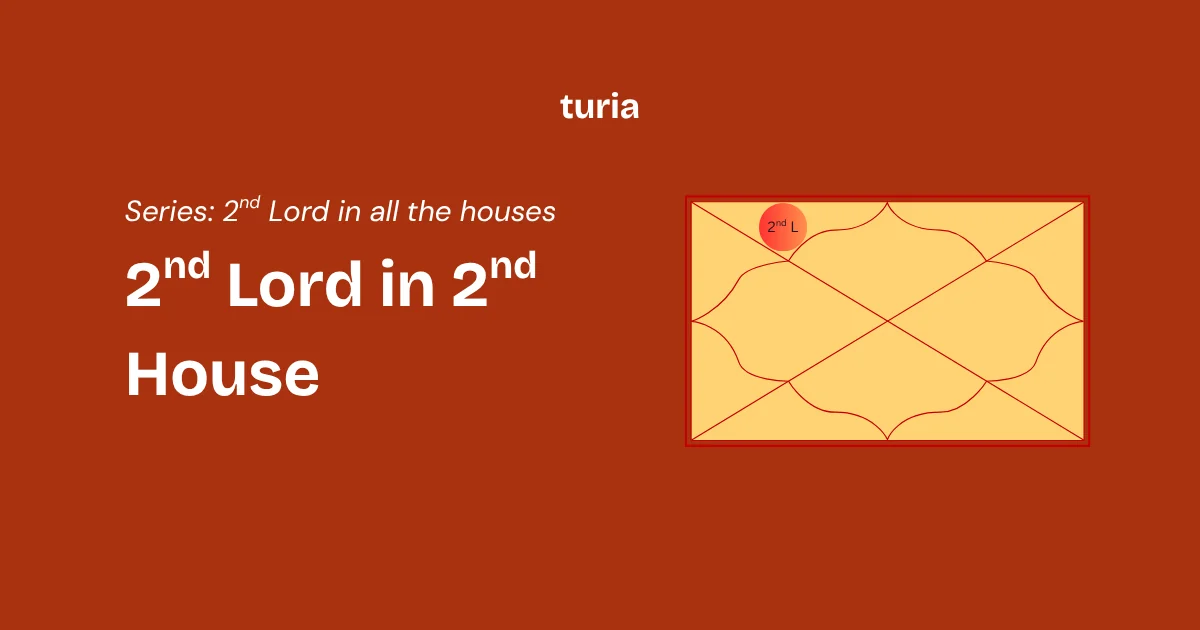
When the 2nd lord (ruler of your Dhana Bhava — the 2nd house of wealth, speech, and family) sits in the 2nd house itself, it's automatically placed in its own sign. Classical texts call this Swagriha (own house). Brihat Parashara Hora Shastra states directly that a Dhan lord placed in Dhan "will promote one's wealth." This is considered one of the sturdier placements for financial stability, persuasive speech, and strong family values — since the planet governing your resources sits exactly where those resources live. But the result still depends on conjunctions, aspects, and any malefic affliction; own-house guarantees sign dignity, not immunity from a difficult chart around it.
What "2nd Lord in 2nd House" Actually Means
Let's clear up the terminology, because this is where most confusion starts.
Your 2nd house is called Dhana Bhava — the house of accumulated wealth, family, speech, food habits, and (classically) the face and right eye. Every sign has a ruling planet. Whichever planet rules the sign sitting on your 2nd house cusp is your 2nd lord, sometimes called Dhanesh.
That planet can sit anywhere in your chart — the 5th house, the 9th, the 11th, wherever it landed at your exact time of birth. When it happens to land back in the 2nd house — its own house of origin — astrologers call this "2nd lord in own house" or Swagriha (sva = own, griha = house).
Here's the mix-up people commonly make: this is not the same as saying "a planet is exalted in the 2nd house." Exaltation is a sign-based dignity — a planet is exalted in one specific sign, regardless of which house that sign happens to be. Swagriha is different: it means the planet has returned to the very sign it rules. A planet can be your 2nd lord, sit in the 2nd house, and still not be exalted — and that's fine, because own-sign placement is its own, separate form of strength.
Think of it like this: the 2nd house is where your resources live — your bank balance, your speech, your family's standing. When the very planet in charge of those resources is sitting in that house instead of being posted somewhere else in the chart, its influence on your wealth and speech is direct. Nothing is routed through another house first.
What Classical Texts Say
This isn't a modern reading — it goes back to Parashara himself.
The Brihat Parashara Hora Shastra (BPHS), in the chapter dedicated to the 2nd house, states it plainly: "If the Lord of Dhan is in Dhan, or is in an angle, or in trine, he will promote one's wealth (or monetary state)." (BPHS, Chapter 13, Sloka 1-2). No ambiguity there — the Dhan (wealth) lord sitting in Dhan is named as a direct wealth-promoting condition.
A few verses later, Parashara adds: "If Dhan's Lord is in own Rāśi, or is exalted, the native will look after his people, will help others and also will become famous." (BPHS, Chapter 13, Sloka 10). Notice he groups "own Rāśi" (own sign) with exaltation — both are treated as strength conditions, which is exactly the logic behind Swagriha.
Parashara returns to this exact placement again in the chapter on bhava lords: "If Dhan's Lord is in Dhan Bhava, the native will be wealthy, proud..." (BPHS, Chapter 24, Sloka 14). The verse continues with a line about multiple marriages and limited progeny — culturally dated phrasing typical of a centuries-old text written for a different social context. The core, transferable signal is the first part: wealth, and a tendency toward pride if the placement isn't kept in check.
Phaladeepika adds the definitional layer, listing what the 2nd house actually governs: "The second house deals with Vitta (wealth), Vidya (learning), Swa, Annapana (riches, food and drinks), Bhukti (eating), the right eye, face (Asya), letter or document (Patrika), Speech (Vak) and Kutumba (family)." This is the textual basis for why this placement touches wealth, speech, and family all at once — they're all governed by the same house.
Wealth and Financial Effects
This is the effect most people come looking for, and it's genuinely the strongest part of this placement.
Because the 2nd lord sits in its own sign, it's structurally dignified by default — there's no risk of it landing in an enemy's sign or debilitation while occupying the 2nd house. This is why the placement is widely counted as a Dhana Yoga (wealth combination) across Indian astrology sources — Swagriha in the very house of wealth reinforces itself.
Phaladeepika's broader principle on own-sign placements applies directly here: "Should a planet occupy his own sign in a birthchart, the native will during the dasa of such a planet acquire power and strength through the beneficence of a wealthy and high dignitary... He will remain in his residence, acquire a new house and lands... and may even get back his lost articles." In plain terms — during the dasha (planetary period) of this 2nd lord, expect steady accumulation, property gains, and even recovery of money or possessions once thought lost.
Real-world translation: someone with this placement tends to be the family member who's careful with money without being stingy about it — the one who builds a fixed deposit steadily every month rather than chasing get-rich-quick bets. Not explosive wealth necessarily, but durable wealth. The kind that survives a bad year.
Speech, Family, and Values
The 2nd house isn't only about money — it's equally the house of Vak (speech) and Kutumba (family).
Speech. A well-placed 2nd lord here tends to give clear, persuasive, often pleasant speech. This shows up practically in careers where communication is the actual product — sales, teaching, writing, public relations, broadcasting. Several modern sources note this placement's wealth often arrives through the native's ability to speak and persuade, not despite it.
Family and values. The 2nd house also governs the values you inherited growing up — your sanskar. People with a strong 2nd lord here often carry a clear sense of what they consider "right" in money matters and family duty. Think of the relative who won't take a loan they can't repay, who insists on contributing to family functions even when no one's counting, who quietly keeps the household's finances organised. That instinct traces back to this kind of placement.
The honest shadow side. BPHS's own line about pride isn't accidental. When this placement is unchecked — no benefic aspect softening it, or a malefic conjunction pushing it — the same self-sufficiency can tip into possessiveness or a materialistic streak. Someone so focused on "my money, my family, my way of doing things" that they struggle to hold loosely. That's not a curse. It's a tendency worth being aware of, the same way any strength has an overused version.
What Decides the Strength
Own-house placement is a strong starting point. It is not, by itself, the whole story.
A few factors decide how cleanly this placement delivers:
- Conjunctions. A benefic (Jupiter, Venus, well-placed Mercury) sitting with the 2nd lord in the 2nd house reinforces the good effects. A malefic conjunction — especially Saturn, Mars, Rahu, or Ketu without redeeming aspects — can introduce delays, disputes over money, or harsher speech.
- Aspects. Benefic drishti (aspect) onto the 2nd house strengthens the wealth and family picture. Aspects from functional malefics for that ascendant can complicate it, even with own-sign dignity intact.
- Which planet is the 2nd lord. The same house placement filters very differently depending on which planet actually rules your 2nd house — a Mercury-ruled 2nd lord in the 2nd house reads differently from a Saturn-ruled or Mars-ruled one, even though both are technically Swagriha.
- The 2nd house sign itself. Since your 2nd lord is here by definition, the sign is always the lord's own sign — but that sign's natural character (a fixed sign vs. a dual sign, for instance) still colours how the wealth tends to behave — steady and slow-building versus more variable.
Here's a simple comparison of how this plays out:
| Factor | Well-supported 2nd Lord in 2nd House | Afflicted 2nd Lord in 2nd House |
|---|---|---|
| Wealth | Steady accumulation, durable savings, property gains | Delays, disputes over money, expenses that eat into savings |
| Speech | Persuasive, pleasant, well-regarded in conversation | Blunt, sharp-tongued, or prone to exaggeration |
| Family | Strong values, protective of family standing | Rigid, controlling, or possessive within the family |
| Overall pattern | Self-reliant prosperity, generosity that doesn't run dry | Materialism, pride, guardedness over money and status |
| Classical basis | BPHS: "will promote one's wealth" (Ch. 13) | BPHS: "wealthy, proud" — pride flagged even in a strong placement (Ch. 24) |
A Classical Example Worth Knowing
Phaladeepika doesn't just state the principle — it points to a worked chart.
In its discussion of powerful combinations, the text notes Abraham Lincoln's chart, where "Venus lord of the 4th and 9th (a yoga karaka) is exalted in the 2nd and is associated with Jupiter lord of the 2nd and the 11th in his own house (2nd). There is no malefic aspect on them." The commentary attributes part of his stature to exactly this — the 2nd lord Jupiter sitting undisturbed in its own house, alongside an exalted yoga karaka, with no malefic interference.
It's a useful reminder: own-house placement earns its reputation partly because it shows up, again and again, in charts that classical commentators considered genuinely strong — not because every own-house placement produces a president, but because the underlying mechanic (a planet resting where it's naturally at home) keeps recurring in charts astrologers point to as examples of durable strength.
How This Compares to 2nd Lord in Other Houses
Since this is the second article in a twelve-part series on the 2nd lord's placement across all houses, here's a quick sense of how this entry differs from two others worth knowing.
| Placement | Underlying mechanic | What it emphasizes | Honest caveat |
|---|---|---|---|
| 2nd lord in 2nd house (this article) | Own house — the lord rests in its own sign | Steady accumulation; wealth and speech reinforce each other | Own-sign dignity is guaranteed, but conjunctions/aspects still decide the outcome |
| 2nd lord in 11th house | Often forms a mutual exchange (parivartana) with the 11th lord | Continuous income flow — money that keeps coming in, not just sitting still | Depends heavily on the 11th lord's own placement and dignity for the exchange to fully activate |
| 2nd lord in 1st house | Wealth becomes tied to identity and self-effort | Self-made income; the native's own personality drives earning capacity | Can tip into image-driven spending if the 1st house itself is weak |
The common thread across the series: house placement tells you where your wealth-lord's energy is directed. The 2nd house keeps that energy at home — self-contained, accumulating, undiluted by any other house's business.
FAQs
What does it mean when the 2nd lord is in the 2nd house?
It means the planet ruling your 2nd house (Dhana Bhava — wealth, speech, family) is also sitting there, in its own sign. This is called Swagriha (own house). Classical texts treat this as a direct wealth-promoting condition, since the ruling planet is undiluted by any other house's influence and automatically holds sign dignity.
Is 2nd lord in 2nd house a good placement?
Generally, yes — it's widely counted as one of the classical Dhana Yogas (wealth combinations), because the lord automatically sits in its own sign here. But "good" isn't automatic in every sense. Conjunctions, aspects, and any malefic affliction still shape whether the potential shows up cleanly as steady wealth or gets complicated by disputes, delays, or a possessive streak.
Does 2nd lord in 2nd house guarantee wealth?
Not a guarantee — a strong foundation. BPHS states this placement "will promote one's wealth," but the same text also flags pride as a possible side effect. The actual level of wealth still depends on the rest of the chart: the dasha sequence, aspects on the 2nd house, and whether malefics are involved.
What is Swagriha (own house placement) in Vedic astrology?
Swagriha means a planet is placed in the sign it rules — literally "own house." It's considered one of the classical dignity states, alongside exaltation and Moolatrikona. A planet in Swagriha is treated as comfortable and strong by default, expressing its natural qualities more fully than in a neutral or enemy sign.
Does 2nd lord in 2nd house affect speech and communication?
Yes, directly — the 2nd house governs Vak (speech). A well-placed 2nd lord here tends to give clear, persuasive, pleasant speech, which often becomes a genuine income source through careers like teaching, sales, writing, or public speaking. An afflicted placement can instead show up as blunt or overly sharp speech.
What if the 2nd lord in the 2nd house is afflicted by malefics?
It doesn't cancel the placement's basic strength, but it complicates the results. Expect more friction around money — delays, disputes, or unexpected expenses — and possibly a harsher edge to speech or a rigid, possessive streak within the family. Check which malefic is involved and whether any benefic aspect offers relief before assuming the worst.
Which planet gives the best results as 2nd lord in the 2nd house?
There's no single "best" — the flavour changes by planet. A Jupiter or Venus 2nd lord here tends to bring generosity alongside the wealth; a Mercury 2nd lord sharpens the speech and business sense; a Saturn or Mars 2nd lord can still give solid results, but often through more disciplined or hard-won effort rather than easy accumulation.
How is this different from 2nd lord in the 11th house?
2nd lord in the 2nd house is about wealth that stays and accumulates — steady, self-contained. 2nd lord in the 11th house usually works through a mutual exchange with the 11th lord, emphasizing continuous income and gains rather than accumulation alone. Both are respected wealth placements, but they describe different rhythms of money — saved versus earned repeatedly.
Closing
So if someone asks you, "Is 2nd lord in 2nd house a good placement?" — the honest answer is: it's a strong, self-reinforcing foundation for wealth, speech, and family life, not a guaranteed outcome regardless of the rest of the chart. Swagriha gives the 2nd lord automatic sign dignity and a direct, undiluted line to your resources. What that actually looks like — steady prosperity and generous speech, or guarded pride over what you've built — depends on the conjunctions and aspects we've walked through above.
This is the second placement in the series. As we move through the 2nd lord in the 11th house, the 1st, the 12th, and the rest, the same underlying question keeps returning in different rooms of the chart: where is your wealth-lord's energy pointed, and what does it find waiting there?
Hope this helps :)