Someone looks up their kundali, sees "2nd lord in the 1st house," and the first thing they usually type into Google is some version of the same question.
"Does this mean I'll be rich?"
Right behind it comes a second, quieter question: "Wait — is this the same as 'lagna lord in the 2nd house'? I've seen that phrase too."
Honestly… it's a fair mix-up. The two phrases look almost identical. But they describe two different planets moving in two different directions — and mixing them up means reading the wrong page for your own chart.
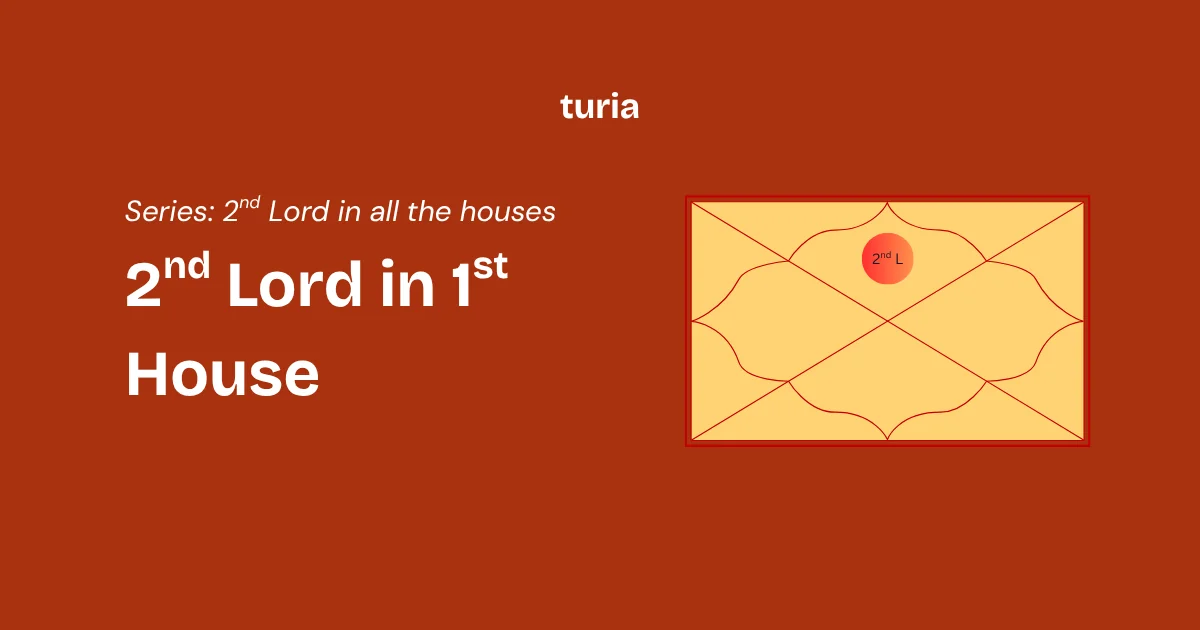
This is the first piece in our series on 2nd lord placements across all 12 houses. The 2nd house is Dhana Bhava — wealth, family, speech, accumulated values, even your face. When its ruling planet sits in the 1st house — your Lagna, the house of self, body, and identity — those themes stop being "things you have" and start becoming "who you are." In this guide: what this placement means, what BPHS and Phaladeepika say about it, how it plays out in wealth, speech, family, marriage and career, why strength changes everything, and how it compares to nearby placements.
Quick answer
When your 2nd lord sits in the 1st house, the significations of wealth, speech, family values, and face get folded directly into your personality. Classical texts describe this as a placement that brings self-earned wealth and a prosperous family — Phaladeepika even names "a handsome face." Your sense of self becomes tied to what you earn, how you speak, and what you value. The exact flavor — generous versus guarded — depends heavily on the 2nd lord's own strength and planetary company.
What "2nd Lord in the 1st House" Actually Means
Let's untangle the mechanics first, because this is exactly where the confusion starts.
Every house in your kundali has a ruling planet, decided by which sign sits on its cusp. The 2nd house — called Dhan Bhava — represents wealth, savings, family, food, speech, and personal values. Its ruling planet is often called the dhanesh (lord of wealth). The 1st house, or Lagna, represents you — your body, your basic nature, how the world reads you within the first few seconds of meeting you.
So when your dhanesh — the planet in charge of your wealth, speech, and family themes — physically sits in your Lagna, it means those themes aren't parked in a separate corner of your life. They're sitting at the control panel of your identity.
Phaladeepika by Mantreswara puts this plainly, and it's the richest classical citation available for this exact placement:
"If the lord of the 2nd house be posited in the Lagna while the 2nd house be occupied by benefics, the native will be equipped with the best of qualities, wealth, with a handsome face and farsighted and will have a prosperous family." — Phaladeepika, Adhyaya XVI, Sloka 5
Notice how specific this is — not just "wealth," but a handsome face (a direct nod to the 2nd house's rulership over the face, expressed here through the 1st house's body), farsightedness, and a prosperous family. The Brihat Parashara Hora Shastra (BPHS) says something similar, with a more candid edge:
"If Dhan's Lord is in Tanu Bhava, the native will be endowed with sons and wealth, be inimical to his family, lustful, hard-hearted and will do others' jobs." — BPHS, Chapter 24, Sloka 13
That middle phrase — "inimical to his family, hard-hearted" — isn't meant to alarm you. Classical texts like BPHS often name the harder edge of a placement alongside its gifts. Modern reading treats this less as literal hostility and more as fierce self-reliance — someone who builds their own security rather than leaning on family, which can occasionally read as detachment.
One quick clarification: this article is about the 2nd lord sitting in the 1st house — a different planet, moving in a different direction, from "lagna lord in the 2nd house" (a separate article in our sibling series). BPHS addresses that mirror placement two slokas earlier: "If the Lagna's Lord is in Dhan, he will be gainful, scholarly, happy... and will have many wives" (Ch.24, Sloka 2). Same two houses, completely different chart configuration. If you're unsure which describes your kundali, check which planet rules your ascendant sign versus which rules your 2nd house sign — they're rarely the same planet.
Effects on Wealth and Self-Made Money
This is what most readers actually came here to check, so let's start with it directly.
When the 2nd lord sits in the 1st house, it forms a classic dhana yoga — a wealth-producing combination — because the planet governing your resources is placed directly in the house of self and effort. In practice, this tends to show up as wealth that's earned rather than inherited: steady, self-directed accumulation built on the native's own skill, intelligence, and initiative rather than a family cushion.
This tracks with how modern Indian astrologers describe the placement — natives who value financial independence, take real pride in not depending on anyone for money, and build wealth methodically over the years rather than through a single windfall. It also lines up with the BPHS line about doing "others' jobs" — a nod to natives comfortable working within someone else's structure (a family business, a client's portfolio, an employer's mandate) while still keeping their own financial identity intact.
One honest caveat: a dhana yoga on paper is a tendency, not a guarantee. The 2nd house's occupants, the aspects reaching it, and the dasha periods that activate the 2nd lord all decide how much of this potential shows up as an actual bank balance.
Effects on Speech, Face, and Self-Worth
The 2nd house isn't only about money — it also rules vaani (speech) and, per Phaladeepika, the face itself. Both get pulled directly into your personality with this placement.
Speech. This is one of the most consistently observed traits across classical and modern sources — words become central to how the native is perceived. Not always loud, but weighty; people remember what this native says. Phaladeepika even breaks it down by planetary company: the 2nd lord with Jupiter gives someone well-versed in scripture and learning; with Mercury, a sharp head for economics; with Venus, charm bordering on indulgence; with Mars, speech that can turn cutting at its worst.
Self-worth. Because the "wealth planet" sits in the "self" house, confidence and self-image get tied to material stability quite literally. When finances are steady, this native tends to feel genuinely secure in who they are. When money feels shaky, it can rattle their sense of identity more than it would for someone else — worth naming honestly, not as a flaw, but as a pattern worth watching.
Face and presence. Phaladeepika's mention of a "handsome face" points to a broader theme — this native often has a naturally magnetic, well put-together presence, the kind that reads as composed even on an ordinary day.
Family Values and How They Shape Identity
The 2nd house also governs kutumb (family) and the values a family hands down — and with this placement, those values become part of how the native carries themselves, rather than staying background noise.
Practically, this often shows up as a native whose personal brand is inseparable from their upbringing: how they talk about money, the causes they care about, even table manners, all trace back to family conditioning folded into their own personality. BPHS's "hard-hearted" language, read less literally, often maps to someone who has processed family expectations into a clear, sometimes rigid, personal value system — they know exactly what they stand for and don't bend it easily.
This can be a genuine strength: a strong personal code and financial discipline learned early. At its more difficult end, it can show up as inflexibility — struggling to see past one's own definition of "the right way to live."
Marriage and Relationships
Marriage-related search patterns around this placement echo a familiar theme: natives with 2nd lord in the 1st house tend to take marriage seriously, often carrying a fairly specific, sometimes traditional picture of what a "good" marriage looks like — stable, honest, financially sound.
Because identity and values are still settling in the twenties, sources consistently note that marrying quite young can be rockier for this placement than marrying once personal values have stabilized. Once that settling happens, relationships tend to deepen considerably, often becoming steadier with time.
Some sources also connect this placement, like its sibling (lagna lord in 2nd house), to more than one significant relationship or attraction over a lifetime. The more useful reading isn't a literal prediction of remarriage — it's a note that this native's magnetism and family-and-value-driven approach to partnership are both genuinely strong themes worth watching, not a fixed verdict.
Career and Life Path
Career-wise, this placement tends to favor work that draws directly on the native's two natural strengths: financial instinct and persuasive speech.
That commonly plays out as work in finance, banking, trading, or wealth management; sales and business development; media, anchoring, teaching, or content creation — any field where speech itself is the product. The BPHS note about "doing others' jobs" adds a less obvious angle: this placement often suits roles where the native manages someone else's money, voice, or interests — a consultant, an agent, a fund manager, a family business successor — while still building an unmistakably personal reputation within that role.
Success, across classical and modern framing, tends to be self-directed and compounding — built through the native's own initiative, more likely to arrive as a steady climb than a single lucky break.
How Strength Changes the Story
Everything above describes this placement's default tendency. But how much of that potential actually shows up depends heavily on the 2nd lord's own strength — its sign, its dignity, its planetary company. This is the part most generic placement pages skip, and it's the part that actually matters when reading a real chart.
Phaladeepika lays out the general principle clearly, and it applies just as much to a bhava lord placed in the Lagna as it does to the Lagna lord itself:
"If at birth, the lord of Lagna be with brilliant rays, the native becomes famous... If, however, the lord of Lagna be placed in a dusthana, be in his sign of debilitation or in the sign of a malefic, the native will be miserable... If the lord of the Lagna be devoid of strength, the native will be constantly overcome by calamities, be unhappy and will lead a sickly life." — Phaladeepika, Adhyaya XVI, Sloka 4
Here's how that dignity principle plays out specifically for a 2nd lord placed in the 1st house:
| Strength condition | What it tends to look like |
|---|---|
| Own sign (swakshetra) | The dhana yoga stabilizes fully — steady, self-earned wealth, articulate speech, and a values system the native is genuinely comfortable living by. |
| Exalted (uchcha) | The strongest version — commanding presence, persuasive and memorable speech, real financial confidence, and the "handsome face" Phaladeepika describes showing up as a naturally magnetic presence. |
| Debilitated (neech) | Self-worth becomes shakier, speech can turn careless or unintentionally harsh, and financial confidence may outpace financial reality — unless a neecha bhanga (debilitation-cancelling combination) is present elsewhere in the chart. |
| Combust (asta) | Too close to the Sun, the native's voice around money and values gets overshadowed — often by a dominant parent or authority figure. Results tend to be delayed rather than destroyed, especially if the same planet also carries a strong underlying dignity. |
| With benefic company (Jupiter, Venus, well-placed Mercury) | Per Phaladeepika's planet-by-planet notes — Jupiter adds scholarliness, Mercury sharpens financial acumen, Venus adds charm — strengthening the ethical, articulate side of the placement. |
| With malefic affliction (Saturn, Rahu, Ketu, or malefics in the 2nd house itself) | Can dull learning, introduce stammering or unreliable speech, or — per BPHS's harsher reading of afflicted 2nd houses — genuinely undercut both wealth and words if left unchecked. |
The principle to internalize, not the table to memorize: the house tells you the theme, the planet's strength tells you the outcome. A weak 2nd lord in the 1st house doesn't erase the wealth-speech-identity theme — it just means that theme becomes the area you have to work at consciously, rather than the area that arrives easily.
How This Compares to Other 2nd Lord Placements
Since this is one placement out of twelve in this series, it's worth zooming out.
When the 2nd lord stays in its own house (the 2nd), BPHS describes wealth that intensifies but stays more contained — "the native will be wealthy, proud... and be bereft of progeny" (Ch.24, Sloka 14). The theme stays inside the wealth house rather than radiating into the whole personality.
When the 2nd lord sits in the 11th house (gains), BPHS calls it one of the strongest classical wealth placements — "the native will have all kinds of wealth, be ever diligent, honourable and famous" (Ch.24, Sloka 23) — a more purely financial dhana yoga than the 1st house version, but less tied to identity.
The 1st house placement covered here sits between those two — genuinely wealth-favorable, but distinctive because it's the version where money, speech, and values stop being things you manage and start being who you are. And to repeat the earlier disambiguation: this is not the same as lagna lord in the 2nd house (our sibling series). That placement moves your identity-planet into the wealth house; this one moves your wealth-planet into the identity house. Related houses, opposite direction, different chart stories.
FAQs
What does it mean when the 2nd lord is in the 1st house?
It means the planet ruling your 2nd house — wealth, speech, family values, and face — is placed in your Lagna, the house of self and identity. Classically, this forms a dhana yoga and, per Phaladeepika, brings wealth, a handsome face, and a prosperous family. In practice, your self-image becomes closely tied to what you earn and how you speak.
Is 2nd lord in 1st house good for wealth?
Generally, yes — both BPHS and Phaladeepika describe it as a wealth-favorable placement and a recognized dhana yoga. It usually points to self-earned money built through personal effort rather than inheritance. The 2nd house's occupants, aspects, and the 2nd lord's own dignity all shape how strongly this potential actually plays out in a specific chart.
Does 2nd lord in 1st house form a dhana yoga?
Yes — this is a classic dhana yoga (wealth-producing combination) in Parashari astrology, since it directly links the wealth house (2nd) with the self house (1st). Its real-world strength still depends on the 2nd lord's sign, dignity, and the dasha periods that activate it during the native's life.
What if the 2nd lord is debilitated in the 1st house?
The core themes — wealth, speech, self-worth — remain, but they become areas of struggle rather than strength. Expect shakier financial confidence or speech that lands more harshly than intended, unless there's a debilitation-cancelling (neecha bhanga) combination elsewhere in the chart. It's a prompt to build these areas deliberately, not a fixed verdict.
What if the 2nd lord is combust in the 1st house?
Combustion tends to overshadow the native's voice around money and values, often due to a dominant parent or authority figure early in life. Results are usually delayed rather than destroyed — and if the same planet also carries strong underlying dignity, like exaltation, good outcomes can still come through over time.
Does 2nd lord in 1st house affect marriage?
Indirectly, yes. Natives with this placement tend to take marriage seriously and hold a fairly clear, sometimes traditional picture of what a stable partnership looks like. Marrying quite young can be rockier since personal values are still settling; relationships generally deepen once that settling happens, usually by the late twenties.
Which career suits a person with 2nd lord in the 1st house?
Careers built around financial instinct and persuasive speech tend to suit this placement well — finance, banking, trading, sales, media, teaching, and content creation. It also often favors roles where the native manages someone else's money or voice — consulting, agency work, wealth management, or a family business — while still building a distinctly personal reputation within that role.
The Bottom Line
So when someone asks, "is 2nd lord in the 1st house good?" — the honest answer is: it's a genuinely wealth-and-identity-favorable placement, but "favorable" isn't automatic. The house sets the theme — your resources, your speech, your values becoming part of who you are. The planet's own strength, its dignity, and its company decide how much of that theme shows up as ease versus effort, and your dasha periods decide when.
If this is your placement, the practical takeaway is straightforward: your chart is nudging you to build your identity consciously around what you earn, say, and value — because for you, those three things were never going to stay separate from who you are. That's not a limitation. It's usually just an early, honest description of how your life actually works.