Introduction
Someone learns their 2nd lord sits in the 12th house, googles it at midnight, and closes the tab feeling slightly sick.
Because the words that show up are blunt. "Loss of wealth." "No savings." "Poverty." The 2nd house is supposed to be the house of money, family, and speech — the house you want to be strong. The 12th house is Vyaya Bhava, the house of losses, expenses, foreign lands, and moksha. Put the two together, and most articles read it as a flat sentence: your money leaks away.
Here's the thing though. The 2nd lord rules your accumulated wealth, family resources, speech, your sense of "what's mine." Where it sits shapes how that wealth behaves — not whether it exists. In the 12th house, wealth doesn't vanish. It moves. Sometimes wastefully. Sometimes toward a life abroad. Sometimes toward something genuinely larger than a bank balance.
This is the twelfth and final placement in our series on where the 2nd lord can sit. In this guide: what this placement actually means, what BPHS says directly, how strength changes the story, and — since this closes the series — a full comparison across all 12 placements.
Quick answer
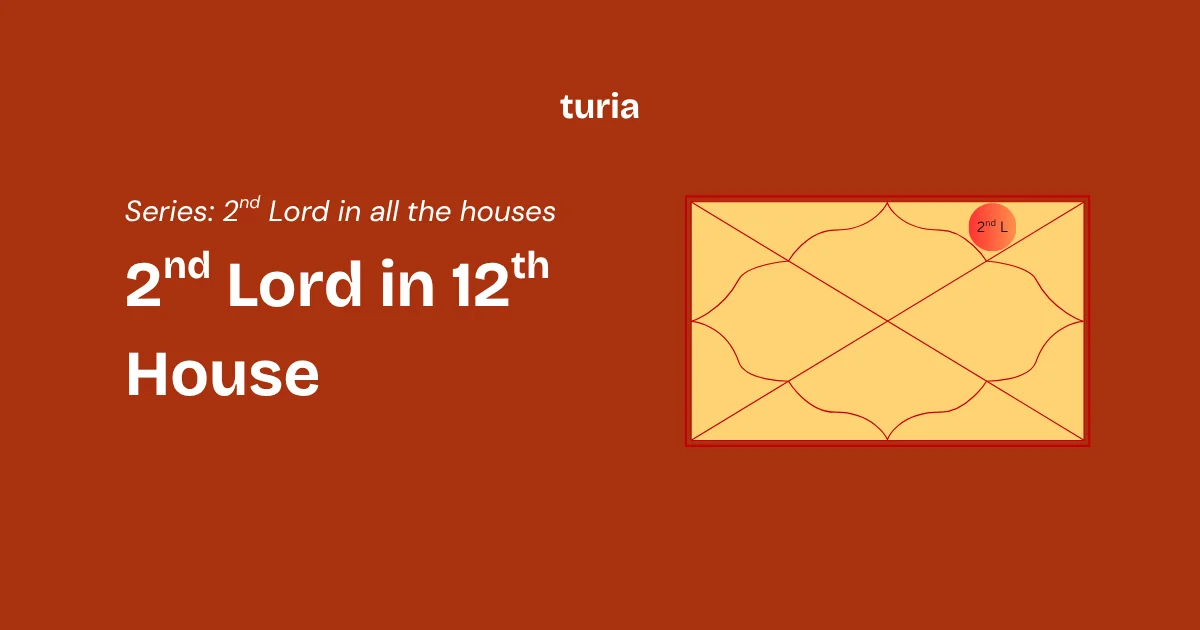
When the 2nd lord — the ruler of wealth, family, and speech — sits in the 12th house (Vyaya Bhava), resources tend to move outward rather than accumulate. BPHS states this directly: "If Dhan's Lord is in Vyaya Bhava, the native will be adventurous, be devoid of wealth and be interested in other's wealth" (BPHS, Ch. 24, Sloka 24). But that outward flow branches three ways depending on strength and aspects — wasteful spending, income and settlement tied to foreign lands, or money and effort channeled into charity, spirituality, or moksha. This placement alone does not create poverty; classical poverty yogas require the 2nd lord and the 11th lord both being weak or afflicted together, not this placement in isolation.
What "2nd Lord in the 12th House" Actually Means
The 2nd lord is simply the ruler of whichever sign falls in your 2nd house from the ascendant. If you're a Leo ascendant, your 2nd house is Virgo, ruled by Mercury — so Mercury is your 2nd lord. Wherever that planet sits, the themes of the 2nd house — wealth, family, speech, food, accumulated values — get filtered through that house's nature.
The 12th house from the lagna is Vyaya Bhava, literally "the house of expenditure." Classical texts group it as a Dusthana (a difficult house, alongside the 6th and 8th) and as a Moksha Trikona house (alongside the 4th and 8th, the triangle tied to spiritual liberation). Structurally, it's the house where things leave — money, energy, attachment, even the soul at the end of a life. So when the 2nd lord, whose entire job is accumulation, ends up here, there's a genuine tension built in.
BPHS addresses this specific combination directly, in the sequence covering the 2nd lord's placement across all twelve houses:
"If Dhan's Lord is in Vyaya Bhava, the native will be adventurous, be devoid of wealth and be interested in other's wealth, while his eldest child will not keep him happy."
— BPHS, Ch. 24, Sloka 24
Read on its own, that sounds final. But this verse sits right after the parallel one for the lagna lord in the 12th house, which BPHS explicitly conditions on the lord being "devoid of benefic Drishti and/or Yuti" (Ch. 24, Sloka 12). Parashara's house-lord verses across this chapter work the same way: they describe the baseline tendency of a placement, which strength, dignity, and aspect then modify — sometimes considerably. Treat this verse as the starting point, not the whole reading.
Quick disambiguation, since search results confuse the two often: this article is about the 2nd lord (ruler of your wealth house) sitting in the 12th house. That's different from the 12th house's own lord moving through the 2nd house — a related but separate placement.
Where the Money Actually Goes
The most literal reading of Vyaya Bhava is expenditure — and when the 2nd lord sits here, the native's own accumulated wealth is wired toward outward flow rather than a growing bank balance.
This doesn't automatically mean poverty. It means resources move — and the direction depends on the rest of the chart. Sometimes that's the classic modern-India experience: a genuinely good salary that never quite turns into savings. EMIs, a sibling's tuition, a parent's medical bills, one expense quietly replacing another. BPHS names this exact pattern in its poverty-combination section:
"One will be penniless, if the Lord of Dhan Bhava is in an evil Bhava, while the Lord of Labh Bhava is also so placed and Dhan Bhava is occupied by a malefic."
— BPHS, Ch. 13, Slokas 6–7
Notice what this verse actually requires — the 2nd lord and the 11th lord (Labh, gains) both weak or afflicted together, not the 2nd lord's 12th-house placement alone. That's the distinction most fear-based content skips. A 2nd lord in the 12th house with a strong 11th lord elsewhere is a very different story from this compound combination.
And BPHS gives the other side too:
"Expenses on Good Accounts. When Guru is in Labh, Śukr is in Dhan and a benefic is placed in Vyaya Bhava, while Dhan's Lord is yuti with a benefic, there will be expenses on religious, or charitable grounds."
— BPHS, Ch. 13, Sloka 9
Picture the relative who quietly pays for a sibling's education, or funds a parent's surgery without mentioning it at family gatherings. That's this placement through a strong 2nd lord — money leaving the house, but leaving it on purpose.
Foreign Wealth, Foreign Settlement
Ask anyone with this placement what they actually want to know, and it's usually: does my money come from — or go to — a life outside India?
The association is genuine. The 12th house has always carried the "foreign lands" signification, and when the wealth-ruling 2nd lord operates from here, there's often a real financial thread running abroad. Think of the software engineer who moves to the US or the Gulf for a job and within a few years is sending a chunk of every paycheque home, or quietly building a property portfolio in India from an overseas salary. India remains the world's largest recipient of remittances — tens of billions of dollars a year moving from NRIs back to families here — and a fair number of those senders carry some version of this exact placement.
BPHS backs this reading through the house's own nature:
"One will wander from country to country, if Vyaya's Lord and Vyaya Bhava are with malefics... One will move in his own country, if Vyaya's Lord and Vyaya Bhava are with benefics."
— BPHS, Ch. 23, Slokas 11–12
So the placement leans toward a foreign financial connection — but whether that becomes permanent settlement, a posting abroad that eventually ends, or simply a foreign source of income while living in India, depends on the rest of the chart. It's a tendency, not a guaranteed visa stamp.
Family, Speech, and What Stays Private
The 2nd house doesn't only rule wealth — it also governs family, food, and vak, speech. When its lord sits in the introspective 12th house, these areas often take on a quieter, more private character too.
Speech can become less about performance and more about what's said behind closed doors — someone who chooses words carefully, or shares the important things with only a few people rather than broadcasting them. Family connections can feel geographically distant (a joint family spread across cities or continents) without being emotionally distant. Domestic habits sometimes lean unconventional too — simpler meals, eating alone by preference, a household that doesn't run on the loud rhythms of a typical joint family.
None of this is a verdict. It's a leaning that shows up more when the 2nd lord is weak or afflicted, and softens considerably when it's strong.
Spirituality, Charity, and the Upside Most Articles Skip
Most competitor content treats spirituality as a footnote here — a consolation prize for the "loss" reading — and moves on. It deserves better: a real, structurally supported outcome of this placement, not an afterthought.
The 12th house sits in the Moksha Trikona, the triangle of houses (4th, 8th, 12th) tied to liberation from the cycle of rebirth. When the wealth-ruling 2nd lord operates through this house, there's often a genuine pull to direct resources — money, time, effort — toward something beyond personal accumulation. BPHS supports this for the house itself:
"If there is a benefic in Vyaya, while its Lord is exalted, or is yuti with, or receives a Drishti from a benefic, one will attain final emancipation."
— BPHS, Ch. 23, Sloka 10
There's a related classical concept worth knowing — Vimala Yoga, described in Mantreswara's Phaladeepika, formed when a dusthana lord (6th, 8th, or 12th) sits in another dusthana. It's technically different from "2nd lord in 12th" — the 2nd house isn't a dusthana — but it makes an adjacent point: classical astrology repeatedly treats 12th-house placements as capable of flipping from drain to discipline.
"The person with his birth in Vimala Yoga will be frugal in his expenses and clever in saving money... will enjoy happiness, will be independent, will follow a respectable profession... and will be well known for his good qualities."
— Phaladeepika, Ch. 6, Verse 69
Picture the person who takes a real pay cut to work at an NGO, a hospice, or a spiritual trust, and ends up more genuinely content than they were in the corporate job that paid double. That's this placement working the way it's meant to — resources moving outward because the person chose to send them there.
Does This Mean Poverty? The Honest Answer
This is the question that brought most readers here, so let's answer it directly instead of hedging.
No — 2nd lord in the 12th house does not, by itself, mean poverty. Classical poverty combinations in BPHS require a compound condition: the 2nd lord and the 11th lord (gains) both placed in difficult houses or afflicted by malefics together — not one placement acting alone. A 2nd lord in the 12th house with decent dignity, a benefic aspect, or a strong 11th lord elsewhere is a fundamentally different reading from the actual poverty yogas BPHS describes.
What this placement reliably does is change the shape of wealth — from steady accumulation to outward flow. Whether that flow becomes waste, foreign income, generosity, or spiritual investment depends almost entirely on the 2nd lord's strength and what it's conjunct or aspected by. That's genuinely different from "you will be poor," and conflating the two is where most fear-based content on this topic goes wrong.
How Strength Changes the Story
If there's one section worth reading twice, it's this one. Strength is what separates the "wasteful, drained, low-savings" reading from the "foreign wealth, disciplined generosity, quietly fulfilled" reading — and both come from the exact same placement.
- Own sign or exalted 2nd lord: Considerably softened — disciplined, purposeful spending (think Vimala Yoga's "frugal and clever in saving") rather than drain. Foreign income becomes more likely than foreign loss.
- Debilitated or combust 2nd lord: The harder version — money that genuinely seems to disappear, difficulty saving despite good income, family resources under real strain. This is the condition worth watching, not the house itself.
- Conjunct or aspected by a natural benefic (Jupiter, Venus, well-placed Mercury): Steers the outward flow toward its generous, spiritual, or foreign-success side — matches BPHS's "expenses on good accounts" (Ch. 13, Sloka 9).
- Conjunct or aspected by malefics (Saturn, Mars, Rahu, Ketu) without benefic support: Leans toward actual financial drain, family disconnection, and guarded rather than merely private speech.
- Co-located with the 12th lord itself: The affliction reading tends to strengthen here, since the money-ruling planet sits directly under the expense-ruling one — worth closer individual reading.
The pattern across all of this: the 12th house sets the terrain — outward flow, foreign connection, spiritual pull. The 2nd lord's strength decides whether the native walks that terrain broke and scattered, or with purpose and real prosperity that simply doesn't look like a fat savings account.
How This Compares to the Other 2nd Lord Placements
Since this closes out the series, here's where the 12th house sits relative to the other eleven — a quick reference if you're comparing placements across a family's charts, or curious how your own compares to a sibling's.
| 2nd Lord In | Core Flavour |
|---|---|
| 1st House | Wealth tied closely to self-effort and personal identity; a self-made financial life |
| 2nd House | Strongest natural placement; wealth accumulates in its own house, often steadily |
| 3rd House | Wealth built through effort, courage, communication, and self-initiated ventures |
| 4th House | Wealth linked to property, land, vehicles, and emotional security at home |
| 5th House | Wealth through intelligence, speculation, children, or creative and intellectual work |
| 6th House | Wealth earned through service, competition, debt cycles, or health-related expense |
| 7th House | Wealth tied to partnership — business partners, spouse's resources, or joint finances |
| 8th House | Wealth arriving through inheritance, insurance, in-laws, or sudden, transformative sources |
| 9th House | Wealth connected to fortune, higher learning, father's resources, or dharmic work |
| 10th House | Wealth built through career, public reputation, and professional standing |
| 11th House | Strongest gains placement — wealth through networks, elder siblings, and long-term aspirations |
| 12th House | Wealth that flows outward — spent, sent abroad, or invested in something larger than accumulation |
Compared to the 2nd house itself (wealth staying close to home, accumulating steadily) or the 11th house (wealth multiplying through gains and networks), the 12th house is the most outward-facing placement in the series. It's less about building a visible pile of assets and more about what the money is for — a family sent abroad for opportunity, a cause funded quietly, or simply a life that measures wealth differently than a bank statement does. That's not a weaker placement. It's a different definition of "having."
FAQs
What does it mean when the 2nd lord is in the 12th house?
It means the planet ruling your wealth, family, and speech operates through Vyaya Bhava, the house of losses, foreign lands, and spiritual liberation. Expect resources to move outward rather than steadily accumulate — as waste, foreign-routed income, or purposeful spending — with the exact shape depending heavily on the lord's strength and aspects.
Does 2nd lord in the 12th house mean I'll be poor?
No, not by itself. BPHS's actual poverty combinations require the 2nd lord and the 11th lord both weak or afflicted together (Ch. 13, Slokas 6–7) — a compound condition, not this single placement. A reasonably strong or well-aspected 2nd lord here often produces foreign income or disciplined generosity rather than genuine poverty.
Does this placement always mean no savings?
Not always. It does often mean savings look different from the conventional pattern — money moves toward EMIs, family obligations, or purposeful causes rather than sitting untouched in an account. BPHS Ch. 13, Sloka 9 specifically describes "expenses on good accounts" when the 2nd lord is well-supported, which is a very different outcome from pure drain.
Can 2nd lord in the 12th house bring foreign wealth or settlement?
Yes, this is a genuine tendency. The 12th house's foreign signification combined with the 2nd lord's wealth rulership often produces income tied to work abroad, remote/international clients, or eventual settlement outside India — though whether that becomes permanent depends on the rest of the chart, particularly the 9th and 12th house strength.
Does this placement cause debt specifically?
Not on its own. Debt in classical astrology is usually read from a combination involving the 2nd, 6th, 10th, and 11th houses together, not the 2nd lord's 12th-house placement alone. This placement signifies outward flow of resources, which is a different (and broader) pattern than debt specifically.
Is 2nd lord in the 12th house good for spirituality and charitable giving?
Often, yes. The 12th house sits in the Moksha Trikona, and BPHS ties a well-supported Vyaya house directly to "final emancipation" (Ch. 23, Sloka 10). Many natives with this placement find real fulfilment in service work, charitable spending, or a career shift toward something less materially driven than what they started with.
How is this different from "12th lord in the 2nd house"?
They're inverse placements with different effects. This article covers the 2nd lord (ruler of your wealth house) sitting in the 12th house. "12th lord in 2nd house" is about the ruler of your expense house sitting in your wealth house — a related but separate topic with its own reading.
Closing Thoughts
So if someone asks you, "Is 2nd lord in the 12th house a bad placement?" — the honest answer is: it depends on strength, aspects, and what else is happening in the chart, exactly like every other placement in this series. But the pattern most charts with this placement share is this — money and resources that don't sit still, a life that's often connected to somewhere beyond home, and a definition of "wealthy" that eventually stops being just about the number in a bank account.
That's not loss. That's just wealth taking a different shape.
This closes our 12-part look at where the 2nd lord can sit — from the steady accumulation of the 2nd house itself to the outward flow of the 12th. Read together, they're less a ranking of "good" and "bad" placements and more a reminder that every house gives the wealth-lord something different to work with.