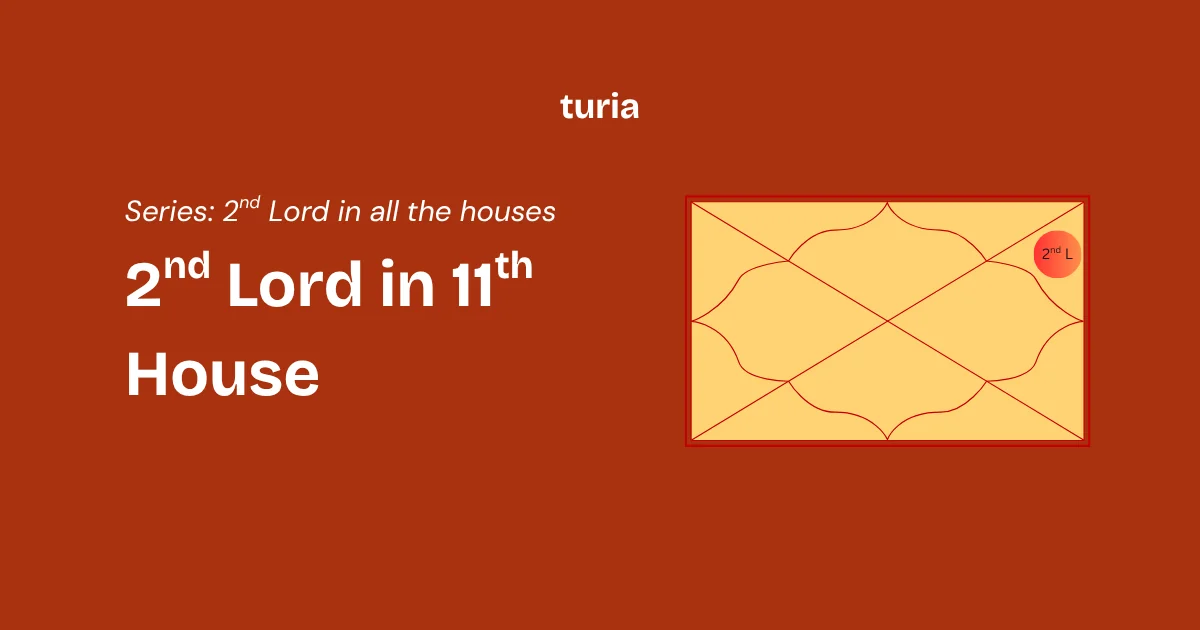
Someone checks their kundali, sees the 2nd lord sitting in the 11th house, and hears the same line every time: "bahut accha hai, paisa aayega" — very good, money will come.
And then… nothing more.
No explanation of why. No mention of timing. No answer to the question that actually matters: if this placement is so good, why isn't everyone who has it a crorepati?
Here's the thing… the 2nd house and the 11th house are the two primary wealth-signifying houses in Parashari astrology — the 2nd for accumulated resources and family wealth, the 11th for gains and income. When the 2nd lord sits in the 11th house, you're linking those two houses directly. Classical texts treat it as one of the more direct wealth combinations a chart can produce.
But "good for wealth" hides a more specific mechanic — and most pages online skip straight past it.
In this guide: what this placement structurally means, why it behaves like compound interest rather than a lottery ticket, what it does for your income, network, and elder siblings, when it becomes a classical dhana yoga, how planetary strength changes the story, and how it compares to other 2nd lord placements in this series.
Quick answer
When your 2nd lord (ruler of wealth, family, and speech) sits in the 11th house, your accumulated resources get channeled through gains, income, and social networks. This is considered one of the stronger wealth placements in Vedic astrology, because the 11th is an Upachaya (growth) house — results build steadily with age and effort rather than arriving all at once. Expect multiple income sources, gains through friends, professional networks, or elder siblings, and wealth that tends to become visible from the late twenties onward. It isn't an automatic guarantee of riches — dignity of the 2nd lord and the overall chart still decide how much of this potential actually gets realized.
What "2nd Lord in the 11th House" Actually Means
Every kundali has a 2nd lord — the planet ruling the sign on the 2nd house, called Dhana Bhava in Sanskrit. Phaladeepika lists what this house governs in detail: "Vitta (wealth), Vidya (learning), Swa, Annapana (riches, food and drinks), Bhukti (eating), the right eye, face (Asya), letter or document (Patrika), Speech (Vak) and Kutumba (family)" (Phaladeepika, Ch. 1, Sloka 10). So the 2nd lord doesn't just carry "money" — it carries your accumulated resources, your family's financial standing, your speech, and your values around what's worth holding onto.
When this planet lands in the 11th house — Labha Bhava, the house of gains — BPHS describes the 11th's domain plainly: "All articles, son's wife, income, prosperity, quadrupeds etc. are to be understood from Labh Bhava" (BPHS, Ch. 11, Sloka 12).
And BPHS is direct about what happens when you combine the two. In its chapter on house lords placed across the twelve bhavas, it states: "If Dhan's Lord is in Labh Bhava, the native will have all kinds of wealth, be ever diligent, honourable and famous" (BPHS, Ch. 22, Sloka 23).
That's the anchor line for this entire article. Four results, named directly: wealth of many kinds, sustained diligence, honour, and fame — not a one-time windfall, but a pattern that keeps producing.
Why the 11th House Is Different — The Upachaya Effect
This is the part most competitor pages skip, and it's the single most useful thing to understand about this specific placement.
Classical astrology sorts the twelve houses into categories. The 1st, 4th, 7th, and 10th are Kendras — the pillars. The 5th and 9th are Trikonas — houses of fortune and grace. And then there's a third, quieter category: the Upachaya houses — the 3rd, 6th, 10th, and 11th. BPHS names them directly: "Sahaj, Ari, Karm and Labh Bhava are Upachaya Bhavas" (BPHS, Sloka 33–36). Phaladeepika confirms the same list independently: "The 3rd, the 6th, the 10th and 11th are Upachaya houses" (Phaladeepika, Ch. 1, Sloka 18).
Upachaya literally means "growth." These houses don't hand out results at birth. They build with age, effort, and time.
This is the mechanic behind the phrase "wealth compounds" for this placement. It isn't a metaphor borrowed from finance for convenience — it's structurally how the 11th house is classically understood to behave. A Kendra placement can announce itself early. An Upachaya placement accumulates quietly, then becomes obvious only in hindsight.
Practically, this means: a person with 2nd lord in the 11th house often doesn't feel unusually wealthy at 22 or 23. What they usually have, without quite noticing it, is a widening set of income sources and a network that keeps growing — small gains that don't look significant individually. None of it looks like "the placement everyone talks about." By the mid-thirties, looking back, it usually does.
Effects on Wealth, Gains, and Multiple Income Streams
The direct classical line already tells most of the story — "all kinds of wealth" isn't a single income source language. It's plural. And that shows up consistently in how this placement plays out.
People with this placement tend to accumulate wealth from more than one channel at a time: a salary plus a side income, a family asset plus personal investments, a primary career plus a smaller venture on the side. The 11th house governs gains broadly, so the 2nd lord sitting there tends to diversify rather than concentrate.
Real example: someone in a steady corporate job through their twenties, nothing dramatic visible from outside. But quietly, they're investing a bit every month, staying close to a strong professional network, picking up freelance work on weekends. By their mid-thirties, the side investments have matured, the network produces a business opportunity, and the "ordinary" job becomes just one of several income streams. That's the Upachaya pattern in a modern Indian career — not a lump sum, a build-up.
Gains Through Network, Friends, and Elder Siblings
The 11th house is also the house of friendships, group affiliations, and social circles — and for a 2nd lord placed here, that network becomes a genuine financial resource, not just a social one.
This maps cleanly onto how wealth actually moves in Indian professional life. An old college WhatsApp group where someone drops a job lead. A CA batchmate who refers a paying client years later. A trusted "sifarish" — recommendation — that gets a file moved up the pile, or a family friend who becomes a business partner because the relationship was maintained, not just made. Classical astrology calls this "gains through connection." Modern Indian professional life calls it networking.
The 11th house also classically governs the elder sibling. Several sources — BPHS's broader Labh Bhava significations and modern commentary alike — note this placement often brings a real financial or supportive role for an elder brother or sister: shared family resources, an elder sibling who helps fund an early venture, or joint financial decisions. A smaller thread than income, but worth knowing, since most competitor content skips it in favour of an all-wealth focus.
Career and Material Life
Careers that suit this placement tend to be ones where gains compound and networks matter directly — sales, business development, consulting, finance, franchise or partnership-based businesses. It also favours entrepreneurship, since wealth-orientation (2nd house) is already wired toward gain-seeking (11th house) — a business that grows through referrals and repeat relationships is a natural fit, not a stretch.
Material life in general widens gradually rather than peaking early. Assets and income streams usually get actively built across the working years instead of arriving all at once — which tends to make the eventual wealth feel more earned and more stable than sudden money usually does.
When This Becomes a Genuine Dhana Yoga
Here's where the "is this a wealth yoga" question actually gets answered properly, instead of the vague yes every other page gives.
The 2nd lord simply sitting in the 11th house is already a favourable wealth signal — the anchor BPHS line above confirms that on its own. But classical texts go further when there's a genuine connection between the two lords, not just one-way placement.
Phaladeepika lists 28 named Maha Yogas — "great yogas" — formed when pairs of house lords exchange signs with each other. One of them is named explicitly: "the lord of the 2nd in the 11th and the lord of the 11th in the 2nd" (Phaladeepika, Ch. 6, Sloka 27–28). That's a Parivartana — a mutual exchange — and it's the upgraded, stronger version of this placement. If your 2nd lord is in the 11th and your 11th lord is sitting in the 2nd house, you have the full Maha Yoga, not just half of it.
There's also a separate, larger formation worth knowing. Phaladeepika describes a Raja Yoga where "one out of the lords of the 11th, the 9th and the 2nd houses occupy a Kendra with reference to the Moon and... Jupiter own the 2nd, the 5th or the 11th house" (Phaladeepika, Ch. 6, Sloka 25) — a configuration classical texts associate with major prosperity. The 2nd and 11th houses show up together repeatedly across these named yogas, which is a strong signal that classical astrology treats their relationship as a genuine, recurring wealth marker — not a one-off internet claim.
How Strength Changes the Story
This is the section that actually decides whether you get the confident, compounding version of this placement, or a version with real friction — and it's the honest answer to "if this is so good, why isn't everyone rich?"
2nd lord exalted or in own sign in the 11th — the cleanest expression. Wealth accumulates with comparatively less struggle, income sources multiply naturally, and the network genuinely works in the native's favour.
2nd lord in a friendly sign, reasonably well-aspected — still strong and largely positive. Growth is real but earned; the Upachaya pattern holds, and effort reliably pays off over time.
Debilitated 2nd lord in the 11th — dilutes the placement meaningfully. Gains may feel inconsistent or delayed relative to the effort. If there's a genuine neecha bhanga (debilitation cancellation), much of the weakness reverses; without it, expect real setbacks before things stabilize.
Combust 2nd lord in the 11th — proximity to the Sun can create ego or recognition issues around money and family — earning well but not getting credit, or friction within the very network meant to help.
Afflicted by malefic conjunction or aspect, without benefic relief — this is where the classical caveat becomes relevant. Phaladeepika names a separate 11th-house yoga, Daridrya Yoga: "Incoming debts constantly will be the way of life for the person with this yoga... He will be deprived of good brotherhood" (Phaladeepika, Ch. 3, Sloka 68). This isn't the typical outcome of a 2nd lord in the 11th — it requires genuine, compounding affliction of the house and its lord — but it's the classical counterweight that keeps this placement from being oversold as an unconditional guarantee.
This is also the honest answer to the Quora question that keeps coming up: lakhs of people share this exact placement — why aren't they all crorepatis? Because a house placement is a signal, not the whole chart. Dignity, dasha timing, divisional charts like the D9, and — yes — actual effort during the Upachaya build-up years all decide how much of the potential gets realized.
How This Compares to Other 2nd Lord Placements
Since this article is one page in a 12-part series on 2nd lord placements, here's how the 11th house's flavour differs from two placements readers commonly compare it against.
| Placement | Core flavour | Pace of results |
|---|---|---|
| 2nd lord in 2nd house (own house) | Direct, self-contained family wealth; values and resources feel settled early | Earlier — results tend to show without needing external gain channels |
| 2nd lord in 3rd house (Upachaya) | Self-made wealth through effort, communication, and initiative — not inheritance | Slow build, driven mainly by personal courage and hustle |
| 2nd lord in 11th house (Upachaya) | Wealth through gains, networks, and multiple income streams — the strongest classical dhana combination | Slow build, but broader and more compounding than 3rd — gains multiply through connections, not just personal effort |
Both 3rd and 11th are Upachaya houses, so both share the "results build with age" pattern. The difference is in the engine: the 3rd house grows wealth through personal courage and communication, largely solo. The 11th house grows wealth through gains and networks — other people, referrals, and connections do real work here, alongside personal effort. That's part of why classical texts single out the 2nd–11th relationship for named yogas, while the 2nd–3rd relationship doesn't get the same treatment.
If you're comparing your own placement to someone else's, remember: dignity still outranks house category. A debilitated 2nd lord in the 11th can underperform a strong 2nd lord sitting quietly in its own house.
FAQs
Is 2nd lord in the 11th house good for wealth?
Yes, generally — it's considered one of the stronger classical wealth placements, since the 2nd (accumulated resources) and 11th (gains) are the two primary wealth-signifying houses. BPHS states directly that this placement brings "all kinds of wealth" along with diligence, honour, and fame. Actual outcomes still depend on the 2nd lord's dignity and the rest of the chart.
Is this placement always a dhana yoga (wealth yoga)?
The placement itself is a favourable wealth signal on its own. It becomes a full classical Maha Yoga specifically when there's a mutual exchange — the 2nd lord in the 11th house and the 11th lord in the 2nd house at the same time. Without the exchange, it's still a strong placement, just not the named, upgraded version.
If this placement is so good, why isn't everyone who has it rich?
Because a single house placement is a signal, not a guarantee. Astrology reads the whole chart — dignity of the 2nd lord, dasha timing, divisional charts like the D9, and overall planetary strength all shape the outcome. Lakhs of people share this exact placement; what separates outcomes is dignity, chart context, and what someone actually does during the Upachaya build-up years.
Does this placement mean gains through friends and social network?
Yes, this is one of its clearer signatures. The 11th house governs friendships, group affiliations, and networks, so a 2nd lord placed here often channels wealth through referrals, professional circles, and long-maintained relationships — closer to how networking actually works in Indian professional life than to sudden luck.
What if the 2nd lord in the 11th house is debilitated or afflicted?
Results become inconsistent or delayed. A debilitated 2nd lord can mean gains that are hard-won and slower than the effort deserves, unless a genuine debilitation cancellation applies. Heavy, compounding affliction without benefic relief can invoke the classical Daridrya Yoga, associated with recurring debt and strained sibling relationships — though this requires real affliction, not just the placement alone.
Does 2nd lord in the 11th house affect marriage?
Not as directly as the 7th house does, but the 2nd house's connection to family and the 11th house's connection to gains often means financial stability and family-related events tend to arrive around similar life phases rather than being unrelated. It's a secondary effect, not the primary marriage indicator in the chart.
Does wealth from this placement arrive early or build gradually?
Gradually, in most cases. Because the 11th is an Upachaya (growth) house, this placement typically doesn't produce dramatic early wealth. Instead, income sources and gains tend to widen steadily through the native's twenties and thirties, often becoming clearly visible only in hindsight by the mid-thirties onward.
The pattern worth remembering
If someone asks whether 2nd lord in the 11th house is a good placement, the honest answer is: yes, structurally — it's one of the more direct wealth combinations classical astrology recognizes, backed by named yogas and a clear anchor line in BPHS. But "good" here means compounding, not instant. This placement doesn't reward a single lucky break. It rewards people who keep showing up, keep their network genuinely maintained, and let small, steady gains accumulate past the point where it usually feels worth tracking.
The dignity of the 2nd lord still decides how smooth that build actually is. But the direction — wealth that widens with age, through gains and connections rather than a single windfall — is written into the placement itself.
Hope this gives you a clearer picture of what this specific piece of your kundali is actually saying.