By Ram Dewani · Jul 14, 2026
Introduction
Ask someone with this placement how their family talks about money, and you'll usually hear some version of the same thing: "We were never poor, but we weren't handed anything either. Whatever we have, someone in the family went out and earned it — usually through a job, a title, a position."
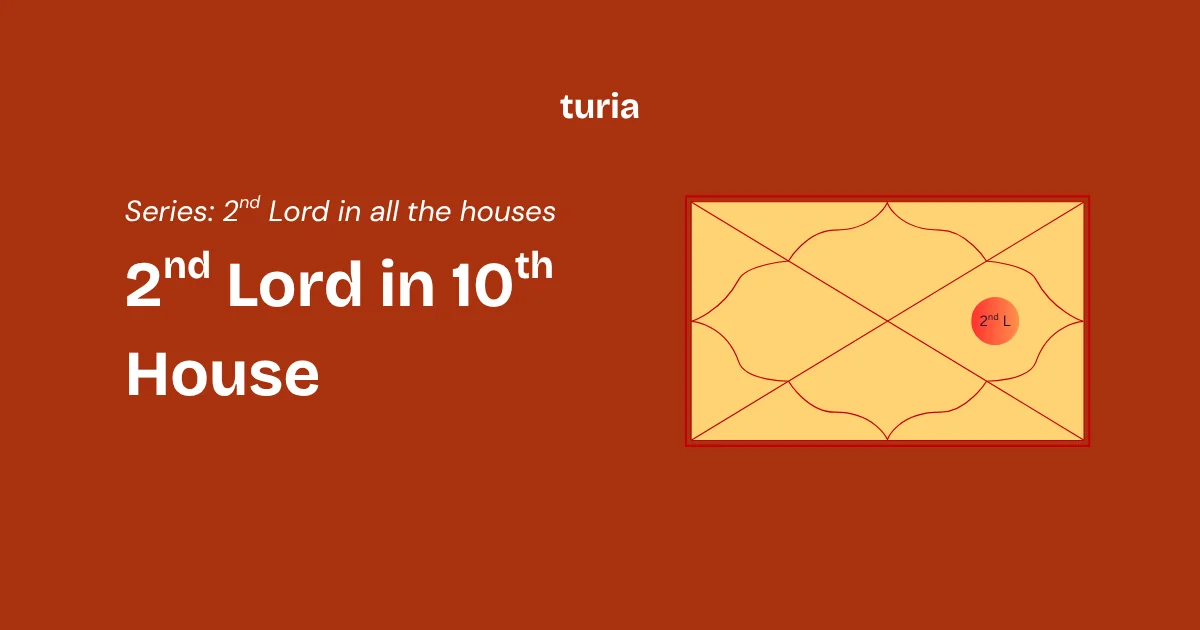
That's not a coincidence. That's the 2nd lord — the planet ruling your Dhan Bhava, the house of wealth, family, speech, and accumulated values — sitting inside the 10th house, or Karma Bhava, the house of career, authority, and public reputation.
And here's the thing about this particular combination. Wealth in Vedic astrology doesn't always come the same way for everyone. Some charts show money arriving through marriage, some through property, some through pure inheritance. This one is different. This one ties your bank balance — and often your family's name — directly to what you do for a living, and how visibly you do it.
Honestly, that's a heavier placement to live under than people expect. It rewards effort, but it also demands it.
This is part of our series on 2nd lord placements across the 12 houses. In this guide, we'll cover what this placement means classically, how it plays out in career and family life, the specific yoga it can form with the 10th lord, and how it compares to a couple of other 2nd lord placements in the series.
Quick answer
2nd lord in the 10th house links wealth and family status directly to career and public reputation — money tends to be self-earned through profession rather than inherited. Both the 2nd and 10th houses belong to the Artha Trikona (the wealth triangle, alongside the 6th), which makes this a structurally strong combination for financial growth through position and authority. Classical texts like the Brihat Parashara Hora Shastra confirm that a 2nd lord placed in a kendra (angle) — which includes the 10th — generally promotes wealth, while Phaladeepika notes that a mutual exchange with the 10th lord specifically forms a Maha Yoga. Career setbacks tend to hit the wallet and the family name at once; career wins do the opposite.
What It Means When the 2nd Lord Sits in the 10th House
The 2nd house governs Dhan — wealth, but also family, speech, food habits, and the values a person carries forward from their upbringing. The 10th house governs Karma — career, authority, public standing, and how the world sees your actions.
Both houses belong to what classical astrology calls the Artha Trikona, the wealth triangle formed by the 2nd, 6th, and 10th houses. The 2nd is the "storage" corner — accumulated wealth and family resources. The 10th is the "action" corner — the career and public effort that generates new wealth. When the 2nd lord physically sits in the 10th, these two corners of the triangle stop working separately and start working as one system.
BPHS is direct about kendra placements for bhava lords in general:
"If the Lord of Dhan is in Dhan, or is in an angle, or in trine, he will promote one's wealth (or monetary state)." — BPHS, Ch. 13, Sloka 1-2
The 10th house is one of the four kendras (angles) — 1st, 4th, 7th, 10th — considered pillars of strength in a kundali. A 2nd lord placed in any kendra is generally treated as favourable, and the 10th specifically channels that strength into career and public life rather than home (4th) or partnership (7th).
BPHS also addresses this exact placement directly, in its chapter on bhava lord effects:
"If Dhan's Lord is in Karm Bhava, the native will be libidinous, honourable and learned; he will have many wives and much wealth, but he will be bereft of filial happiness." — BPHS, Ch. 24, Sloka 22
Strip out the classical phrasing and three things stand out — honour, learning, and wealth are promised, but there's an honest caveat about strain in relationships with children. Classical texts rarely hand out a placement without a trade-off, and this is theirs.
Career and Wealth
This is probably why you landed on this page, so let's get direct.
2nd lord in the 10th house means your career isn't just how you spend your day — it's how your wealth actually gets built. A few patterns show up repeatedly with this placement:
- Earned, not inherited. The consistent thread across classical and modern readings alike is that wealth here comes from the native's own professional effort, not family money or a spouse's income. Even if there's family wealth in the background, the native tends to build their own separately.
- Authority unlocks the payoff. People with this placement who stay in junior, low-visibility roles often feel like the placement "isn't working." The moment they step into a position with real authority — leading a team, running their own practice, holding a title that means something — the financial upside tends to show up.
- Speech-based income is common. Since the 2nd house also rules speech (vani), this placement often shows up in careers where talking is the actual product — teaching, sales, law, consulting, broadcasting, public speaking.
- Government and institutional links. BPHS lists "royalty (authority)" among the core indications of Karma Bhava. In modern terms, this often shows up as income tied to government bodies, large corporations, or well-known institutions rather than purely independent hustle.
- Family business, scaled up. In joint family setups, this is often the sibling who takes the family trade and builds it into something bigger — not because they were forced to, but because status and money genuinely motivate them.
Take a common Indian example: the eldest son in a family that runs a modest textile trading business, who takes over not out of obligation but genuine ambition — and within a decade turns a regional supplier into a recognised brand name in the city. The family's standing rises with his professional standing. That's this placement, working exactly as classical texts describe it.
Family, Reputation, and Speech
Because the 2nd house also governs family lineage and reputation, this placement doesn't just affect the native's personal bank account — it affects how the family is perceived.
BPHS lists "honour, father, living in foreign lands" among Karma Bhava's core indications, alongside authority and profession. When the 2nd lord — the planet in charge of family standing — sits here, the family's name effectively rides on the native's public reputation. A promotion, an award, a visible professional win doesn't just feel good personally; it changes how relatives, neighbours, and the extended family circle talk about the entire household.
The flip side is real too. A public professional setback — a demotion, a failed venture, a scandal at work — tends to be felt as a dent in family honour, not just a personal one. This is one of the placements where career and family reputation genuinely can't be separated.
Speech plays its own role here. Since vani (speech) belongs to the 2nd house, natives with this placement often develop a communication style that's persuasive, precise, or commanding in professional settings — useful in negotiation, teaching, leadership, or any role where being heard clearly matters for advancement.
Marriage and Family Life
This placement rarely creates direct marriage problems on its own, but it does create an imbalance worth watching.
Because career and wealth are so tightly fused with identity here, natives sometimes prioritise professional growth ahead of relationship time — not out of neglect, but because ambition genuinely pulls harder. Spouses of natives with this placement often need to actively carve out family time rather than expect it to happen naturally, especially in the early career-building years.
On the positive side, financial security in the marriage tends to be closely linked to the native's own career trajectory rather than external factors — which, in practice, means a spouse who's supportive of the native's professional ambitions usually sees the household benefit directly. The 7th house and its lord still matter more for the marriage itself; this placement mainly shapes how much of the couple's shared life gets organised around the native's career calendar.
The Maha Yoga Potential
Here's where this placement gets technically interesting.
Classical texts describe a specific combination called Parivartana Yoga — when two planets mutually exchange houses, each sitting in the other's sign. Phaladeepika lists the exchange between the 2nd and 10th lords specifically as one of 28 recognised Maha Yogas (great combinations):
"The lord of the 2nd in the 10th and the lord of the 10th in the 2nd..." — listed among the 28 Maha Yogas, Phaladeepika
And on the general effect of a Maha Yoga:
"Person born with Mahayoga will have the beneficence of the Goddess Sri... He is revered and honoured by the king. He will hold a high position and will be rewarded of authority by the king. He will be blessed with sons and fully enjoy wealth and conveyances." — Phaladeepika, Sloka 34
There's an important nuance here worth being precise about. Simply having the 2nd lord sit in the 10th house is already a strong, wealth-promoting kendra placement on its own, per BPHS. But it only becomes this specific classical Maha Yoga when the exchange is mutual — meaning the 10th lord is also sitting back in the 2nd house. One-directional placement is good. The mutual exchange is genuinely rare and considerably more powerful.
Strength Matters More Than the Placement Itself
Like every placement in this series, the promise on paper depends heavily on how strong the 2nd lord actually is.
When the 2nd lord is strong — exalted, in its own sign, or well-aspected by benefics — this placement tends to deliver close to its textbook promise: self-earned wealth, professional honour, and a family name that rises with the native's career.
When the 2nd lord is weak, debilitated, or afflicted, BPHS's broader principle on Dhan Bhava applies:
"Should he be in Ari/8th/12th, financial conditions will decline. A benefic in Dhan will give wealth, while a malefic instead will destroy wealth." — BPHS, Ch. 13, Sloka 1-2
While this specific line refers to Dhan's Lord placed elsewhere, the underlying classical principle — that a bhava lord's dignity and planetary nature modulate the promised results — applies just as much here. A weak or afflicted 2nd lord in the 10th doesn't erase the placement's potential, but it usually means the wealth comes slower, with more visible struggle, or gets delayed until a supportive dasha or transit activates it.
| Condition | General Effect |
|---|---|
| Exalted or own sign | Strong self-earned wealth, high public respect, smooth authority |
| Well-aspected by benefics (Jupiter, Venus) | Ethical earnings, good family reputation, mentorship-driven growth |
| Combust (too close to the Sun) | Financial anxiety despite real capability, image struggles at work |
| Debilitated, unsupported | Delayed wealth, career instability, family status not matching effort |
| Conjunct or aspected by malefics (Saturn, Mars, Rahu, Ketu) | Slower, harder-earned wealth — but often more durable once achieved |
How This Compares to Other 2nd Lord Placements
Since this is part of a 12-house series, it helps to see this placement next to a couple of others in the same set.
- 2nd lord in the 1st house ties wealth and family values directly to personality and self-image — the native often looks like their family's values (in speech, mannerisms, even appearance). It's a more internal, identity-linked version of the 2nd lord's influence, without the outward career activation the 10th house adds.
- 2nd lord in the 4th house keeps wealth close to home — literally. This version favours property, real estate, ancestral assets, and emotional security tied to domestic roots. The 10th house placement instead pushes that same wealth-drive outward, into public career rather than the home.
- 2nd lord in the 11th house connects wealth to networks, gains, and long-term goals — money through associations, communities, and group ventures. The 10th house version is more individually earned — status and money through personal authority, not group belonging.
Broadly: all three of these placements are considered strong for wealth by classical standards, since the 2nd lord is functioning well in each. But the 10th house version is specifically the public and career-linked expression — it's the one where classical texts most directly connect wealth to visible professional standing rather than family closeness or social networks.
Frequently Asked Questions
Is 2nd lord in the 10th house a good placement?
Yes, generally. It's a kendra placement, which BPHS treats as wealth-promoting for the 2nd lord. It ties financial growth to career and public reputation, meaning the native's own professional effort — rather than inheritance or luck — tends to drive their wealth. Strength of the 2nd lord decides how smoothly that promise plays out.
Does 2nd lord in 10th house always create a Dhana Yoga or Maha Yoga?
Not automatically. The placement on its own is a strong wealth-promoting kendra position. It becomes the specific classical Maha Yoga described in Phaladeepika only when there's a mutual exchange — meaning the 10th lord is also placed back in the 2nd house. Without that reciprocal placement, it's still favourable, just not the full yoga.
What happens if the 2nd lord is weak or debilitated in the 10th house?
Classical texts suggest financial growth becomes slower and more effortful, and family status may not immediately match the native's actual capability. Debilitation isn't a permanent verdict — supportive aspects, a strong dasha period, or neecha bhanga (debilitation cancellation) can still bring the placement's benefits, just later or through more visible struggle.
Does this placement affect marriage and family life?
Indirectly, through imbalance rather than direct harm. Because career and wealth dominate this native's sense of identity, relationship time can get deprioritised, especially early in the career. The 7th house and its lord still govern marriage more directly — this placement mainly shapes how much of shared family life revolves around the native's career calendar.
What professions suit 2nd lord in the 10th house?
Roles involving authority, visibility, and speech tend to suit this placement well — leadership positions, teaching, law, consulting, sales, public-facing government roles, and family business leadership are common. The exact field depends heavily on which planet is the 2nd lord and its sign, so treat this as a tendency, not a rule.
How is 2nd lord in 10th house different from 10th lord in 2nd house?
These are two different placements, not mirror effects of each other. 2nd lord in the 10th house channels wealth-and-family energy into career and public life. 10th lord in the 2nd house channels career-and-authority energy back into family wealth and accumulated assets. Both are favourable, but the direction of influence — and the emphasis — is reversed.
Does this placement bring wealth through government or authority connections?
It can. BPHS lists "royalty (authority)" among the core indications of the 10th house, and having the 2nd lord (wealth) sit there often shows up as income linked to government institutions, large organisations, or people in positions of authority — not exclusively independent business.
Closing
So if someone asks whether 2nd lord in the 10th house is a strong placement — the honest answer is: yes, structurally, it's one of the more favourable combinations in this series. But it's a placement that asks you to earn your way into it. The wealth is real, the family respect is real, but neither arrives passively.
What the classical texts keep returning to is this: strength decides how smoothly the promise plays out, and authority — real, earned authority — is usually the switch that turns this placement on. When it's working, your career and your family's standing move together. When it's weak, both stall together too. Either way, they were never really separate to begin with.
Hope this helps :)