Mars (Mangala/Kuja) is the planet of heat, courage, pursuit, and conflict-and it also speaks to drive/libido and the impulse to initiate. (In contrast, Venus (Shukra) is more about sensuality, pleasure, romance, and how we soften into love.) In relationships, Mars is the part of you that says:
- “This matters.”
- “I want that.”
- “Stop.”
- “Don’t cross that line.”
When Mars is well placed, it creates directness, protection, and healthy boundaries. When Mars is distorted-through fear, shame, power struggles, or unprocessed anger-it becomes reactivity, dominance, scorekeeping, and fights that repeat.
If you’d like your Mars pattern read properly (D1/Lagna, 7th house connections, and key combinations), speak to turia’s expert relationship astrologers here.
This article is astrology-forward (Vedic, D1/Lagna chart) and practical: you’ll see what different Mars placements can look like in real life, then you’ll get tools to reduce conflict without suppressing your fire.
Important: Astrology describes patterns, not fate. And it’s not a substitute for professional help-especially if there’s emotional or physical harm.
Mars in relationship
In Vedic astrology, relationship dynamics aren’t only “the 7th house.” They’re a network. For Mars in relationships, start here:
- Mars placement in the D1 (rāśi) chart
- Sign (rāśi) → how Mars expresses.
- House (bhāva) → where your heat goes.
- Strength (own sign/exaltation/debilitation, combustion, retrograde) → how easy it is to handle the energy.
- 7th house and its lord (partnership, marriage, long-term bonds)
- Mars’ connection to the 7th house
- Mars in the 7th
- Mars aspects the 7th (Mars’ special aspects: 4th, 7th, 8th)
- 7th lord joined/aspected by Mars
- Venus (Shukra) = love style, pleasure, capacity to soften
- Moon (Chandra) = emotional regulation, attachment needs, mood reactivity
- Saturn (Shani) = boundaries, patience, resentment, control
- Rahu = obsession, intensity, looping thoughts, “all-or-nothing” relational drama
If you want one sentence: Mars shows how you fight, how you pursue, how you set limits, and how you reclaim power.
The relationship-side of Mars: what it’s really doing
Mars brings two essential relationship functions:
1) Boundary function (healthy “No”)
A strong Mars can say:
- “That doesn’t work for me.”
- “If this continues, I’m leaving the room.”
- “I’m available to repair, but not to be attacked.”
2) Desire function (healthy “Yes”)
A strong Mars can say:
- “I want you.”
- “Let’s go after this together.”
- “I’m willing to initiate.”
Many couples fight not because Mars is “bad,” but because these two functions get tangled:
- Fear disguises itself as anger (Moon–Mars volatility)
- Insecurity disguises itself as control (Mars–Saturn clench)
- Desire disguises itself as conflict (“We only feel alive when we argue”)
Diagnostic table: what your Mars pattern might look like day-to-day
Use this as a mirror, not a label. Match what repeats.
| Mars signature (D1/Lagna) | Likely relationship pattern | Typical fight trigger | What helps (fast) |
|---|---|---|---|
| Mars tied to 7th house (Mars in 7th / aspects 7th / joins 7th lord) | Partners activate your will; conflict becomes a bonding style | Feeling disrespected, controlled, or “not met halfway” | Clear rules for arguing; structured repair ritual |
| Mars in 1st (Lagna) | Strong identity/independence; direct approach; “I need respect” is central | Feeling dismissed, patronised, or cornered | Tone discipline + clear time-outs; choose respectful language fast |
| Mars in 2nd (speech/family values) | Sharp tongue under stress; conflict around money, family, “how we talk” | Feeling insulted, criticised, or financially unsafe | Slow speech rule; no fighting in kitchens/at meals; money agreements |
| Mars in 4th (home/inner peace) | Domestic friction; irritation about space, chores, relatives, comfort | Feeling intruded upon at home; unequal house load | House rules + load-sharing review; protect decompression time |
| Mars–Moon (conjunction/aspect; Moon receives Mars aspect) | Emotional flooding, hot reactions, quick regrets | Feeling unseen, abandoned, or criticised | Time-outs + body regulation before talking |
| Mars–Venus | High chemistry; love & anger sit close | Rejection, mismatched desire, jealousy | Name desire directly; cultivate softness & praise |
| Mars–Rahu | Intensity, obsession, escalation, dramatic cycles | Ambiguity, mixed signals, perceived betrayal | Slow down; write facts vs stories; externalise the loop |
| Mars–Saturn | Push–pull: anger + restraint; resentment builds | Feeling burdened, unappreciated, or “always responsible” | Boundaries + fair load-sharing; long repair windows |
| Mars in 8th / strong 8th connection | Power struggles, trust tests, sex/anger entanglement | Vulnerability, secrets, money/loyalty issues | Radical honesty + trauma-informed pacing |
| Mars in 12th | Suppressed anger; conflict avoided until explosion | Feeling invaded, overwhelmed, sleep-deprived | Private decompression; earlier micro-boundaries |
| Weak/afflicted Mars (debilitated, heavily afflicted, etc.) | Either aggression without control or chronic people-pleasing then outbursts | Feeling powerless, shamed, or cornered | Build agency: small wins, assertiveness scripts |
Mars and the 7th house: why partnerships bring out your warrior
When Mars touches the 7th house strongly, relationships become a training ground for willpower. The lesson is rarely “avoid conflict.” The lesson is:
- Fight fair.
- Desire cleanly.
- Set boundaries without cruelty.
Mars in the 7th house
Common expressions (varies by sign/lordship/strength):
- You attract partners who are bold, athletic, assertive-or simply hard to ignore.
- Conflict is direct: issues surface quickly instead of simmering.
- Strong sexual polarity is common.
- Shadow: using anger as a tool to get closeness; dominance/submission games you didn’t consciously consent to.
Practice: turn Mars into protector rather than prosecutor.
- Protector asks: “What boundary is needed?”
- Prosecutor asks: “How do I win?”
Mars aspecting the 7th
Mars’ 7th aspect brings “I am in your face” energy into partnership. You may experience:
- quick impatience with compromise
- strong expectations of loyalty
- a high need for respect in tone
Practice: replace mind-reading with direct bids:
- “I want more initiative from you.”
- “When you go silent, I spiral. Can we agree on a check-in time?”
Manglik / Kuja Dosha: what it is, what it isn’t, and how to handle it
In Vedic astrology, Manglik (Kuja) Dosha is a traditional concept where Mars is placed in certain houses from the Lagna (Ascendant) in the D1 chart-classically 1st, 2nd, 4th, 7th, 8th, or 12th. The basic idea is simple: these are sensitive “life-structure” areas (self, family/speech, home, partnership, intimacy, and private life), and Mars brings heat, urgency, and sharp edges.
What Manglik is
- A way of flagging Mars intensity in marriage/partnership themes.
- Not just “anger.” It can show up as strong will, high sexual polarity, independence, quick escalation, or a tendency to take disrespect very personally.
- It often correlates with the relationship needing clean boundaries, clear roles, and mature repair.
Common misconceptions (and why fear doesn’t help)
- “Manglik means your marriage will fail.” No. Astrology indicates patterns and pressure points, not guaranteed outcomes.
- “Manglik = bad person.” No. It’s an energy signature, not a moral judgment.
- “One placement decides everything.” In real chart reading, we always consider D1 context: Mars strength, sign, aspects, benefic support, 7th house/lord condition, and overall emotional regulation factors (Moon/Saturn).
How Manglik can relate to conflict/heat in marriage
When the “Mars heat” is unintegrated, you may see:
- arguments that start small and become about respect/power
- “my way vs your way” dynamics (especially around home, money, family, and intimacy)
- a tendency to initiate strongly, then feel hurt if the partner doesn’t match that pace
- periods of suppression followed by sharp outbursts (particularly when Mars is pressured)
When integrated, the same signature can look like:
- fierce loyalty and protectiveness
- the courage to address issues early (instead of passive resentment)
- strong attraction + decisive partnership-building energy
Practical handling (non-deterministic, real-world)
Think of it as relationship hygiene for Mars:
- Build “fight structure” early: time-outs, tone rules, and a repair ritual (see toolkit below).
- Move Mars through the body: consistent exercise/discipline reduces reactivity dramatically.
- Stop making anger the messenger: translate anger into a specific boundary or request.
- Choose partners and agreements that respect autonomy: many Manglik charts do better with explicit freedom + responsibility.
- Avoid fear-based matching: “Manglik matching” is a tool some families use, but the healthier approach is a full D1 assessment plus practical compatibility and communication skills.
If you’re worried about Manglik, don’t panic-read lists. Get a proper D1 read of Mars + 7th house, and focus on the workable part: boundaries, respect, and repair.
The big combinations: Mars with Venus, Moon, Rahu, Saturn
1) Mars–Venus: love, attraction, and the thin line between passion and conflict
Mars + Venus blends pursuit (Mars) with pleasure/connection (Venus).
Healthy form: chemistry, playfulness, initiative, active romance.
Shadow form:
- desire gets expressed as irritation
- jealousy spikes
- “I love you” becomes “prove you want me”
Practical upgrade:
- Name desire before naming complaints.
- Instead of: “You never initiate.”
- Try: “I want you to initiate tonight. I feel close when you do.”
2) Mars–Moon: reactive fights and emotional flooding
Moon is the nervous system. Mars is the flame.
Healthy form: protective instinct, courage to have emotional conversations.
Shadow form:
- anger arrives faster than language
- tears and rage switch places
- after the fight: shame, exhaustion, “I don’t know what happened”
Practical upgrade:
- Use a physiology-first rule: if either person is above a 7/10, no “content” conversation.
- Try the 90-second pause (timer on): breathe slowly, relax jaw, unclench hands.
- Use the phrase: “I’m flooded; I want to repair; I need 20 minutes.”
3) Mars–Rahu: obsession, escalation, and repeating loops
Rahu amplifies. Mars activates. Together they can create:
- intense attraction + intense suspicion
- “all-in” commitment energy-or breakup threats
- hyper-focus on one issue until everything becomes that issue
Practical upgrade:
- Separate facts vs stories (write it):
- Facts: what was said/done.
- Stories: meanings you assigned.
- Make escalation visible: “We’re in the Rahu loop; let’s slow down.”
- Put in guardrails: no arguing after midnight; no texting during fights.
4) Mars–Saturn: boundaries, resentment, and power struggles
Saturn is structure, time, burden. Mars is action.
Healthy form: disciplined protector energy; reliable follow-through.
Shadow form:
- chronic irritation at incompetence
- feeling you carry the relationship alone
- anger gets stored as contempt
Practical upgrade:
- Do a weekly load-sharing review (15 minutes): “What felt unfair this week? What needs to change?”
- Replace criticism with contracts:
- “If you’re late, text me. If not, I’ll go ahead without waiting.”
- Schedule repair time (Saturn likes structure). Not “we’ll talk later”-pick a day/time.
Practical toolkit: Mars-friendly ways to argue less and respect more
These are intentionally simple-Mars improves through repetition.
1) The Fight Rules Agreement (write it once, revisit monthly)
- No insults, no threats, no bringing up past unrelated mistakes.
- If someone asks for a pause, the other agrees.
- No leaving without naming return time.
Suggested line: “We can be intense without being cruel.”
2) The 3-Part Boundary Script
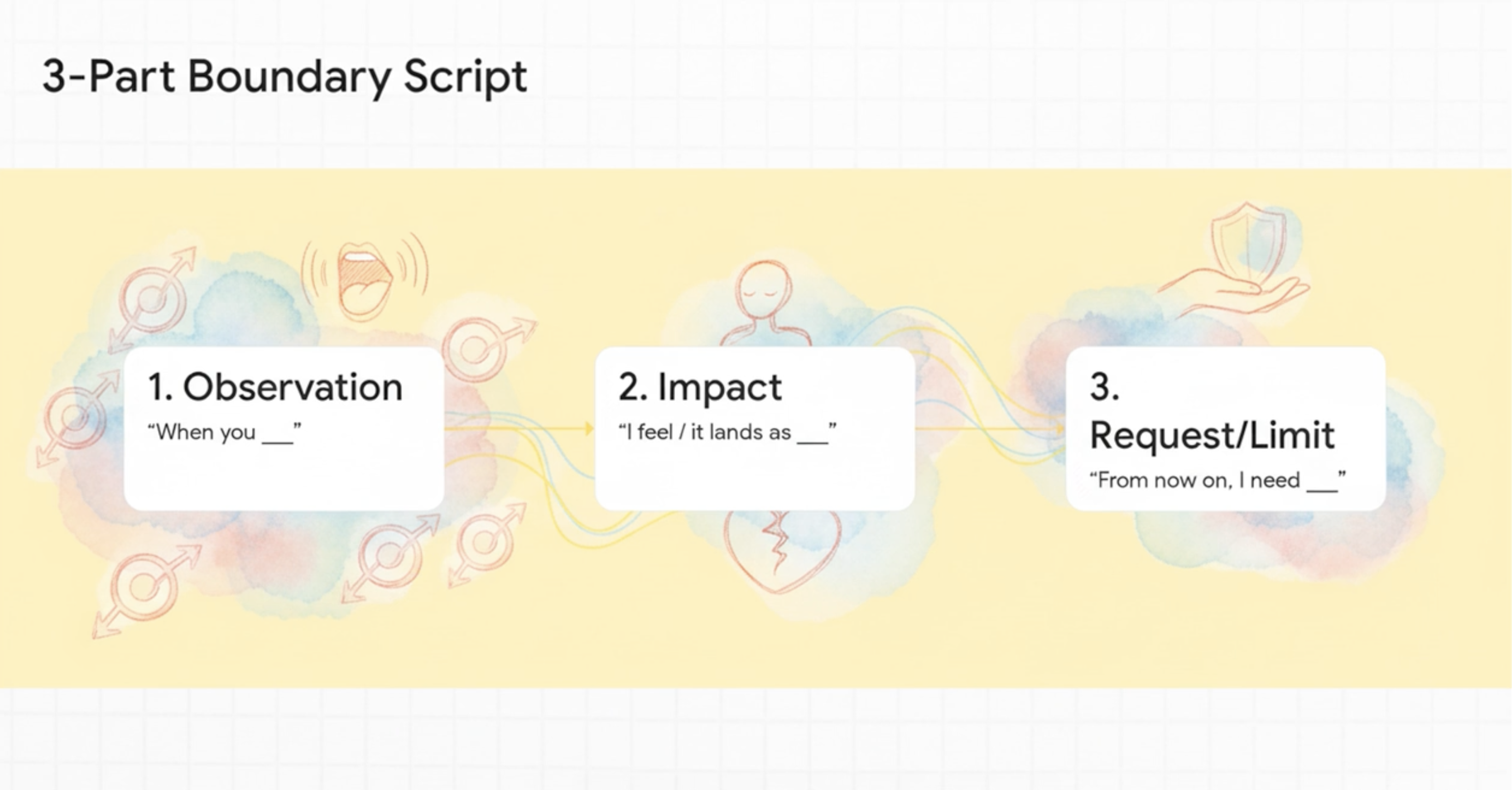
- Observation: “When you ___”
- Impact: “I feel / it lands as ”
- Request/limit: “From now on, I need / If it continues, I will ”
Example: “When you shout, I shut down. I need a normal tone. If it continues, I will leave the room and we’ll talk after 30 minutes.”
3) The Repair Ritual (10 minutes)
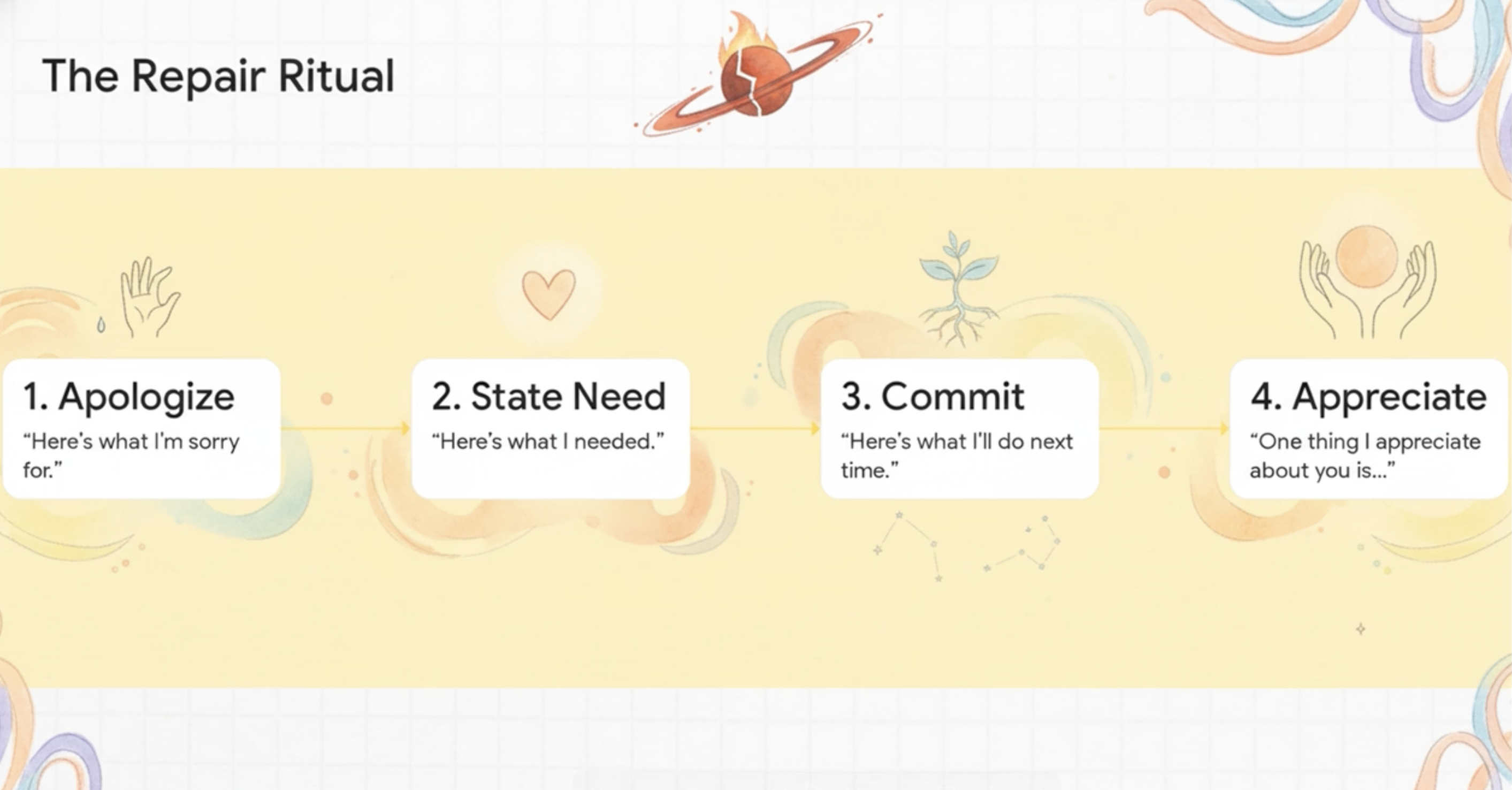
- “Here’s what I’m sorry for.”
- “Here’s what I needed.”
- “Here’s what I’ll do next time.”
- “One thing I appreciate about you is…”
Mars wants closure; Venus wants warmth; Moon wants safety.
4) The Anger-to-Action translation
Anger is energy. Ask: “What action would actually solve this?”
- unclear plans → schedule
- disrespect tone → boundary + consequence
- unmet desire → ask directly
- unfair workload → redistribute
5) The Somatic reset (2–5 minutes)
- slow exhale (longer than inhale)
- relax tongue from roof of mouth
- drop shoulders
- feet on floor, feel weight
Mars gets smarter when the body stops bracing.
Vedic Astrology remedies
If you like traditional remedies, keep them grounded: remedies work best when paired with behavior change.
- Tuesday discipline: one Mars-aligned act weekly (strength training, a hard conversation done kindly, finishing a delayed task).
- Seva (service): help someone who needs protection (donation to shelters, support for people facing violence).
- Mantra (optional): “Om Angarakaya Namah” (consistent, not frantic).
- Gemstones: only with competent guidance; don’t self-prescribe if you’re unsure.
Think of remedies as channeling Mars, not “fixing” Mars.
Talk to an astrologer at turia
If you want personalised clarity on your relationship dynamics, talk to turia’s expert relationship astrologers. A good reading will connect the dots across your D1/Lagna, 7th house, Venus/Moon, and Mars combinations-so you get practical guidance that fits your temperament (not generic advice).
FAQs
1) Is Mars in the 7th house always bad for marriage?
No. It can bring strong attraction and directness. The challenge is managing heat: fair fighting, respectful tone, and not using conflict as a substitute for intimacy.
2) Does Mars always mean anger?
Mars is energy and will. Anger is one expression-often when boundaries are crossed or desire is blocked. Healthy Mars looks like clear action and clean “no’s.”
3) What does Mars–Venus mean in relationships?
Often high chemistry and strong pursuit. It can become reactive if desire is indirect. The remedy is naming wants early and adding tenderness, not just intensity.
4) Why do I overreact and then regret it?
Moon–Mars patterns often show emotional flooding. Build a pause protocol and body-based regulation before you try to solve the topic.
5) What’s the Mars–Rahu “loop” everyone talks about?
It’s escalation through obsession: replaying, assuming, and intensifying until the relationship feels like a battlefield. Interrupt the loop by slowing down, separating facts from stories, and using strict fight guardrails.
6) Can Mars–Saturn indicate resentment?
Yes-especially if responsibility is unequal. Saturn stores anger if it’s not expressed. Regular load-sharing conversations and clear agreements prevent resentment from calcifying.
7) Are “remedies” enough to fix relationship fights?
They help when they channel Mars into discipline and courage. But lasting change comes from communication skills, boundaries, and accountability-ideally practiced consistently.
8) Is Lagna Chart enough to understand Mars in relationships?
For most practical relationship guidance, D1/Lagna + the 7th house/lord + Venus/Moon + key Mars combinations already gives a clear picture of your conflict/desire/boundary style. This article intentionally stays Lagna-only so it remains usable and grounded.